

Author: John Mattiacci | Owner Mattiacci Law
Published May 2, 2026
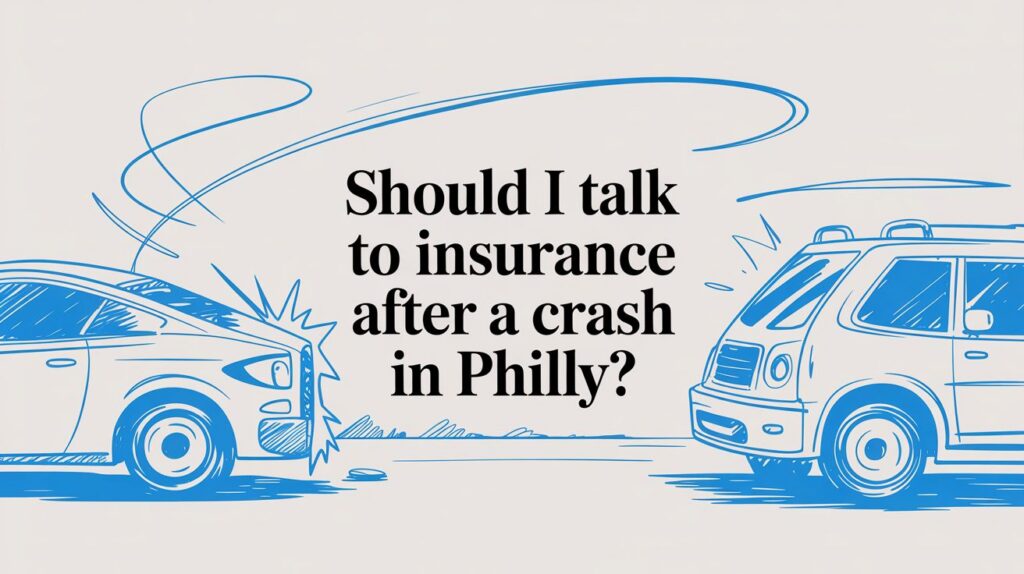
Your phone rings before you've even figured out whether your neck is stiff from the impact or the adrenaline. The caller says they're “just trying to get your side” and “move the claim along.” That sounds harmless. In a Philadelphia crash case, it rarely is.
A lot of people asking Should I Talk to Insurance After a Crash in Philly are in the same spot. The car is damaged. Work may be waiting. Medical questions are starting. Meanwhile, an adjuster wants a statement right now, before you’ve seen all the records, before the police report is in, and before you know whether this is a soreness-for-two-days problem or a months-of-treatment problem.
Your instinct to be careful is the right one.
That First Call After a Philly Car Crash
The usual sequence is fast. Crash. Exchange information. Maybe an ambulance, maybe not. Then the insurance calls start. One from your company. Another from the other driver’s company. The tone is polite, but the pressure is real because what you say early can shape the whole claim.
That matters in Philadelphia because the stakes get expensive fast. Pennsylvania requires only 15/30/5 in liability coverage and at least $5,000 in First Party Benefits. Those limits are often too low for a serious wreck in a city with over 10,000 reported crashes annually, as discussed in this explanation of Philadelphia post-crash insurance issues. If the available coverage is already tight, one bad phone call can make a bad financial situation worse.
Most injured people aren't trying to hide anything. They’re trying to be decent. They answer questions. They say, “I think I’m okay,” because they hope they are. They say, “I didn’t see him,” meaning the other car came out of nowhere. An insurer may hear those same words as: no injury, poor attention, partial fault.
Helpful is not the same as protected
After a crash, people confuse cooperation with overexplaining. Those are different things.
You can report a crash without giving away your claim. You can be polite without agreeing to a recorded statement. You can answer basic questions without discussing fault, pain, speed, visibility, distraction, prior injuries, or whether you “feel fine.”
Practical rule: In the first day or two, give only the information needed to open the claim and preserve coverage. Save the detailed discussion for after you know what happened medically and legally.
If you need a broader checklist for the immediate aftermath, this guide on steps to take after a crash in Philadelphia is a good companion to the insurance advice here.
What this call is really about
That first conversation isn't just administrative. It can affect:
- Medical bills if treatment gets questioned later
- Lost wages if the insurer argues you weren’t really hurt
- Fault allocation if your wording gets used against you
- Settlement value if the insurer locks you into an early version of events
The issue isn’t whether you should ever speak to insurance. The issue is which insurance company, about what, and how much.
Your Insurer vs Theirs The Golden Rule of Post-Crash Calls
Here’s the rule that clears up most confusion.
Talk to your own insurer enough to report the crash. Do not give the other driver’s insurer a detailed statement.
That distinction matters because these are not the same relationship.

Your insurer has a contract with you
Your company provides coverage under your policy. In Pennsylvania’s no-fault framework, your own insurance is the first place for certain benefits like medical coverage and wage-related benefits under the policy. That means you usually do need to notify them promptly and cooperate in a basic, reasonable way.
That does not mean you should volunteer a recorded narrative the moment an adjuster asks.
A safe mindset is this: your insurer needs enough information to open the claim, identify the crash, and process benefits. They do not need your guesses, your pain forecast, your fault analysis, or your attempt to be “fair” to everyone involved.
The other driver’s insurer is protecting its money
The at-fault driver’s insurance company does not represent you. It represents the person or business you may have a claim against. Its job is to reduce what it pays.
That is why the same question can sound casual and still be dangerous:
- “How are you feeling today?”
- “Walk me through what happened.”
- “Did you see the other vehicle before impact?”
- “Would you say you’re mostly okay?”
- “Can we record this just for accuracy?”
Each one invites a soundbite that can be reused later.
If the other side’s adjuster sounds friendly, that doesn’t change the legal posture. They are still gathering information for the defense side of the claim.
The golden rule in plain English
Use this cheat-sheet:
| Insurance company | Your role | Safe approach |
|---|---|---|
| Your own insurer | Policyholder reporting a loss | Report basics and protect your wording |
| Other driver’s insurer | Claimant against their insured | Decline detailed discussion and direct communication through counsel if needed |
What works and what doesn't
What works:
- Confirming the crash happened
- Giving identifying information
- Providing claim-related basics
- Saying medical evaluation is ongoing
- Stopping the call when questions turn detailed
What doesn’t:
- Trying to sound cooperative by filling silence
- Discussing fault before facts are settled
- Describing injuries too early
- Agreeing to a recording because “it’ll be faster”
- Assuming honesty alone protects you
A lot of claim damage happens because people treat both insurers the same. That is the mistake to avoid.
The Dangers of a Recorded Statement
A recorded statement sounds routine. It isn’t. It is one of the most effective tools insurers use to narrow a claim before the full picture is known.

Why insurers want the recording so early
A recording creates a fixed version of your story. Once your voice is on tape, the adjuster has something they can replay, quote, summarize, and compare against later medical records, later testimony, and later treatment.
That is especially risky in the first couple of days after a crash because injuries often become clearer over time. As explained in this discussion of adjuster tactics and recorded statements, if a person says they have “minor neck pain” on day two and later receives a more serious cervical spine diagnosis, the insurer may use that earlier statement to argue the claim should be reduced. The same source notes that this can be even more dangerous when limited tort restrictions are in play.
Innocent phrases that become defense arguments
People rarely damage their claims by lying. They damage them by speaking casually.
A few examples:
- “I’m okay” can become “you denied injury.”
- “I didn’t see them” can become “you weren’t paying attention.”
- “Maybe I could have stopped sooner” can become an admission of fault.
- “My car didn’t look that bad” can become an argument that your body couldn’t be badly hurt.
None of those statements tell the full story. But insurance companies don’t need the full story at that stage. They need usable fragments.
A recorded statement freezes your worst-timed wording. Your medical understanding may improve. The audio won't.
Recorded means permanent
There’s another practical point people miss. Once a call is being recorded, you're not in a normal conversation anymore. You're creating evidence.
If you're unsure how phone recording rules work generally, this overview of call recording consent laws is a useful background read. It helps people understand why they should ask whether a call is being recorded and why that matters before they start talking freely.
What to do when the adjuster asks
You do not need to argue. You do not need to explain your whole philosophy of claims handling. Keep it short.
Try one of these:
- “I’m not comfortable giving a recorded statement at this time.”
- “I’m still receiving medical evaluation, so I won’t discuss injuries yet.”
- “I’ll provide necessary information through the proper channel.”
- “Please put your request in writing.”
That last line is useful because it slows the process down and forces the insurer to be specific.
The trade-off
Some people worry that refusing a recording makes them look difficult. In practice, what hurts claimants far more is talking too much, too soon.
The short-term benefit of sounding cooperative is small. The long-term cost of creating bad evidence can be enormous.
How to Safely Report the Crash to Your Own Insurer
You should usually report the crash to your own insurance company promptly. The key is to report it safely.

In Philadelphia, where over 10,000 crashes occur annually, people often hear from insurers within hours. As noted in this Philadelphia crash and insurance discussion, phrases like “I feel okay” can later be used as a no-injury denial, which is why the safest approach is to report the facts and defer discussion of fault or your physical condition until medical evaluation is underway.
What to have in front of you before you call
Don’t wing it. Put a few items on the table first:
- Your policy information so you can identify the claim correctly
- Crash basics including date, time, and location
- Other driver details if you have them
- Police report number if one was created
- Photos and notes so you don’t rely on memory alone
If you’re upset, ask for the claim number, write it down, and keep your answers tight.
What to say
A basic report can be simple:
Identify yourself and the vehicle.
“I’m reporting a collision involving my vehicle.”State the core facts.
Give the date, approximate time, location, and the other driver’s name if known.Mention police involvement if applicable.
“Police responded, and I’m waiting on the report” or “I have the report number.”Address injuries carefully.
“I’m being medically evaluated, so I’m not in a position to describe injuries yet.”Decline fault discussion.
“I’m not making any statement about fault at this time.”
What not to say
Avoid these common traps:
- Don’t estimate speed unless you know for certain
- Don’t say “I’m fine” because you hope it’s true
- Don’t speculate about what the other driver was doing
- Don’t narrate from memory in a long, emotional stream
- Don’t accept a recorded statement automatically
Use this sentence if you feel pressured: “I’m reporting the loss and I’ll cooperate with necessary claim handling, but I’m not ready to give a detailed statement.”
A short script you can keep on your phone
“Hi, I’m calling to report a crash involving my vehicle. It happened on [date] at [time] in [location]. The other driver was [name if known]. Police [did/did not] respond, and the report information is [if known]. I’m still being medically evaluated, so I’m not discussing injuries in detail right now. I’m also not making any statement about fault.”
That script does the job. It opens the claim without handing over material the insurer can use out of context.
A Script for Handling the Other Driver's Adjuster
When the other driver’s insurance company calls, your goal is not to educate them, persuade them, or win them over. Your goal is to end the conversation without giving them something harmful.

Insurers often push hard in the first 48 hours. According to this guide on Pennsylvania post-accident insurance calls, that early window often comes before a full medical diagnosis, and Pennsylvania law allows you to decline recorded statements to the other driver’s insurer entirely.
The script
Use this, word for word if you want:
“Thank you for calling. I’m not providing a recorded or detailed statement at this time. Please send any requests in writing. If I retain counsel, please direct all future communication to my attorney.”
If they keep pushing, repeat it.
If they ask “why not,” say:
“Because I’m still evaluating the situation and I’m not discussing the facts or injuries right now.”
That’s enough.
Safe vs unsafe responses to any insurer
| Instead Of This (Unsafe) | Say This Instead (Safe) |
|---|---|
| “It was probably partly my fault.” | “I’m not discussing fault.” |
| “I feel okay, just sore.” | “I’m still being medically evaluated.” |
| “I didn’t see your insured.” | “I’m not giving a detailed statement.” |
| “Sure, you can record me.” | “I’m declining a recorded statement.” |
| “Let me explain everything from the beginning.” | “Please send your request in writing.” |
Why this firm response works
Adjusters are trained to keep a person talking. Silence is uncomfortable, and many people fill it by adding details they didn’t need to give. A script solves that problem because it removes improvisation.
It also does something else. It tells the adjuster you understand the difference between a claim and a conversation.
If you want more detail on what happens when an adjuster contacts you, this article on what to do when an insurance adjuster called after an accident in Philly breaks down the next steps.
What if they say they can't process the claim without your statement
Be careful. Sometimes that line is pressure, not law.
The other driver’s insurer may want your statement. That doesn’t mean you owe it to them. Their inability to immediately evaluate your claim on their preferred timeline is not your emergency.
If they want documents, they can request them. If liability is contested, the claim can be investigated through the usual process. Your job is not to make the defense side’s work easier at your expense.
When to Stop Talking and Call Mattiacci Law
Some claims can be handled with very limited direct contact. Others cross into lawyer territory almost immediately. The trick is knowing when that line has been crossed.
Red flags that mean the call should end
Stop handling the conversations yourself if any of these are true:
- You went to the ER or urgent care. Once treatment starts, your words and your records need to match carefully.
- The other driver disputes fault. That means the insurer is already building a liability defense.
- You’re being asked for a recorded statement. That is the moment many people do the most damage.
- The adjuster sounds aggressive or keeps calling. Pressure is usually a sign that the insurer thinks early access to you helps them.
- You have questions about limited tort. That issue can change how damages are analyzed.
- A truck, company vehicle, or commercial policy is involved. Those cases become more technical fast.
- A settlement offer shows up before treatment is clear. Early money often comes with a broad release.
Why lawyer involvement changes the posture
Once counsel takes over, the insurer no longer gets casual access to you. Communication gets filtered. Requests become more formal. The claim gets built around records, evidence, and documented damages instead of off-the-cuff phone comments.
That shift is often what protects the value of the case.
Mattiacci Law is one option for people who want the insurance communication handled for them while the claim is prepared as a serious injury case, not a quick phone-file. If an insurer has already started steering the conversation toward a cheap resolution, this guide on what to do when insurance offered settlement too low in Philly explains the problem.
The simplest decision rule
If you're still asking yourself whether this is “serious enough” for legal help, focus on function.
Are you missing work? Going to appointments? Taking medication? Losing sleep? Getting repeat calls from insurance? Hearing anything about fault, releases, or policy limits?
If yes, stop trying to manage the claim like a customer service issue. It isn’t one.
Philadelphia Car Accident Claim FAQs
Do I have to talk to my own insurance company
Usually, you should report the crash to your own insurer and cooperate in a basic way because your policy requires it. The safer approach is limited cooperation. Report the incident, confirm the essentials, and avoid detailed fault or injury commentary until the facts and medical picture are clearer.
If the questions start sounding more like a cross-examination than a claim setup, slow the process down. Ask what information is needed right now and what can be provided later.
What if the crash seemed minor but I woke up hurting later
That happens all the time. Early adrenaline can mask pain. A crash that looked manageable in a parking lot or intersection can turn into a neck, back, or head injury issue after the body calms down.
The practical move is simple. Get checked, follow the medical advice you’re given, and stop saying things like “I’m fine” or “it was nothing.” Minor vehicle damage does not prove minor human injury.
The right timeline for talking about injuries is after evaluation begins, not during the first rushed phone call.
What if the other driver has no insurance or not enough insurance
UM/UIM coverage becomes important. According to this discussion of uninsured and underinsured claims in Philly, Philadelphia’s uninsured motorist rate is 12.4% as of 2025, or about 1 in 8 crashes, and Pennsylvania law may allow stacking of coverages to increase recovery when serious injuries exceed available limits.
That issue gets missed in a lot of general advice. People assume the only money available is whatever the at-fault driver carried. Sometimes that’s wrong. Your own policy may matter a great deal.
Should I accept a quick settlement if bills are already coming in
Be very careful. A fast offer may solve today’s stress while creating a bigger problem next month. Once you sign a release, you usually can’t go back and ask for more because treatment turned out to be longer, more painful, or more expensive than expected.
The right question isn’t “Do I need money now?” Most injured people do. The right question is “Do I know enough yet to close the case permanently?” Early on, the answer is often no.
What does duty to cooperate actually mean
It means you can’t ignore your own insurer and expect policy benefits to flow normally. It does not mean you have to speculate, guess, exaggerate, minimize, or submit to every form of recorded questioning on demand.
Cooperation should be truthful, limited, and careful. If the claim becomes contested or confusing, have a lawyer define the boundaries before the insurer does it for you.
If you were hurt in a Philadelphia crash and the insurance calls have already started, Mattiacci Law can step in, deal with the adjusters, and help you avoid the mistakes that shrink claims in the first days after a wreck. A free consultation can tell you what to say, what not to say, and whether your case has already reached the point where legal help makes sense.