


Author: John Mattiacci | Owner Mattiacci Law
Published May 6, 2026

You’re probably here because the date of your accident isn’t recent anymore.
Maybe you were hurt in a car crash on I-95, a fall in a store, an incident on a construction site, or an injury involving a city vehicle or public property. At first, your focus was medical care, missed work, and getting through the day. The legal deadline felt far away. Now it doesn’t.
The short answer is that it may not be too late, but that's precisely where complications arise for many. They assume the only question is whether two years have passed. In Philadelphia injury cases, that’s only part of the analysis. Key risks are often hiding somewhere else: a deadline that started earlier than you thought, an exception that may or may not apply, or a case that is still technically timely but already damaged because the evidence has gone cold.
The Two-Year Deadline for Philly Injury Claims
You may still be treating, still talking with the insurance company, and still have time left on the calendar. That does not mean it is safe to wait.
For most injury cases in Philadelphia, Pennsylvania law gives you two years from the date of the injury to file a lawsuit. The rule comes from 42 Pa.C.S. § 5524. If the complaint is filed late, the court will usually dismiss the case, even if the injury is serious and liability seems clear.

Take a simple example. If your crash happened on January 15, 2024, the filing deadline would usually be January 15, 2026. Clients often assume the deadline runs from the last medical appointment, the end of physical therapy, or the day they learned they needed surgery. In most cases, Pennsylvania does not calculate it that way.
What starts the clock
The clock usually starts on the date the injury happened. That is the usual rule for car accidents, slip and falls, pedestrian collisions, motorcycle crashes, construction incidents, and other premises liability claims.
Three mistakes cause problems again and again:
- Insurance negotiations do not pause the deadline. An adjuster can keep asking for records and discussing settlement while your filing window keeps shrinking.
- Medical treatment does not pause the deadline. You can still be in pain, still seeing specialists, and still run out of time to sue.
- Waiting to see whether you recover can cost you the case. Delay affects more than the filing date. Video gets erased, witnesses become harder to find, and property conditions change.
That is why I tell people to treat the two-year period as the outside limit for filing suit, not as time they should use up before getting legal advice. A closer look at Pennsylvania's injury claim deadline can help, but the practical point is simpler. Early action protects evidence.
What this means for you
A case can be timely on paper and still be harder to prove because the evidence has gone stale. In Philadelphia cases, that problem shows up often with store surveillance, intersection footage, business incident reports, and witness memory. Waiting can turn a strong liability case into an argument over missing facts.
The two-year rule also is not the only deadline that matters. If a city vehicle, SEPTA, a public sidewalk issue, or another government-related defendant may be involved, a much shorter notice requirement can come into play. That six-month trap catches people who assume they can wait because the two-year statute has not expired.
If there is any doubt about the accident date, the defendant, or whether a public agency was involved, get the timeline reviewed early. That is how rights get preserved, and how the proof needed to build a real case gets protected.
Exceptions That Can Extend Your Filing Deadline
The two-year rule is the default. It is not the whole story.
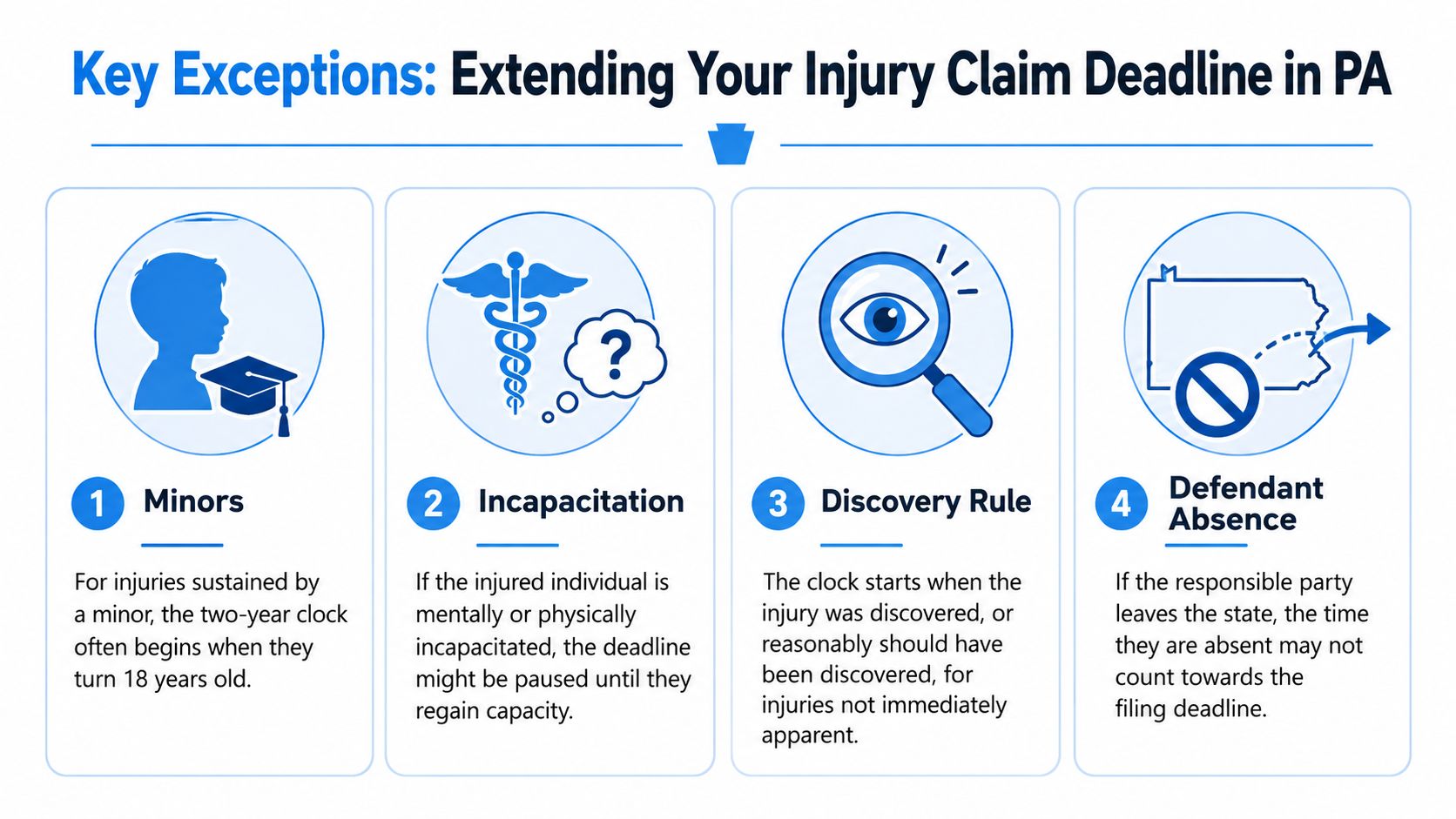
Some cases involve a delayed start or a paused clock. That’s where people hear terms like discovery rule and tolling. Those concepts are real, but they are narrower than commonly believed. They are not blanket excuses for filing late.
The discovery rule
The discovery rule can apply when the injury or its cause was not immediately apparent. As explained in this discussion of Pennsylvania injury deadline exceptions, the clock may start when the person discovered, or reasonably should have discovered, the injury or the negligence behind it.
That often comes up in cases involving latent harm, especially some medical malpractice matters. A useful way to think about it is this: if the problem was hidden, the legal system may not force you to sue before you could reasonably know there was something to sue about.
But there’s a catch. The question is not only when you discovered the issue. Courts also look at when you reasonably should have discovered it. That second part is where many arguments fail.
Tolling for minors
Pennsylvania also pauses the statute for many injured minors. According to Lowenthal & Abrams on Pennsylvania statute of limitations rules, a minor’s claim is generally tolled until age 18, and the injured person can typically file until age 20.
That matters in cases involving children injured in crashes, falls, or other negligence events. Parents should still act early, though. Waiting can create proof problems even if the filing deadline is later.
There is an important wrinkle in medical malpractice matters involving minors. The filing deadline still generally must be met by the minor’s 20th birthday.
Why relying on an exception is dangerous
People often ask whether incapacity, delayed diagnosis, or unusual facts will save a late case. Sometimes they can. Often they don’t.
The safest move is to assume the shortest workable deadline applies until a lawyer confirms otherwise.
A simple comparison helps:
| Situation | Likely timing issue |
|---|---|
| Injury is obvious on the day it happened | Standard filing analysis usually begins that day |
| Harm was hidden and discovered later | Discovery rule may be argued |
| Child was injured before turning 18 | Deadline may be tolled |
| Government body may be involved | Separate notice rules may apply |
The point is not that exceptions are unavailable. It’s that they are fact-specific, limited, and contested. If you’re asking whether Is It Too Late to File an Injury Claim in Philly, and your answer depends on an exception, you should move quickly.
The Six-Month Trap for Claims Against the Government
This is the deadline people miss because they never knew it existed.
If your injury involved a city, county, or state entity, Pennsylvania law usually requires a formal written notice of claim within six months of the injury date. Under 42 Pa.C.S. § 5522 and the notice requirement for government injury claims, missing that shorter deadline can block the claim even if the ordinary two-year lawsuit deadline has not expired.

Cases that trigger this issue
People don’t always realize they’re dealing with a government defendant. The obvious examples are crashes involving city vehicles or incidents on public property, but it can go further than that.
Examples include:
- Transit-related injuries involving a public transportation entity
- Falls on public sidewalks or city-owned buildings
- Construction injuries on government property
- Collisions involving municipal or state agency vehicles
For a closer look at government injury claims and special deadlines in Pennsylvania, it helps to review the issue early, not after insurance communications have already dragged on.
The hidden problem in mixed-defendant cases
Some of the hardest cases involve both a public defendant and a private one.
A construction worker might be injured at a site tied to a public project, but a private contractor may also share responsibility. Someone could fall on public property where maintenance was handled by a third party. A roadway case might involve both a municipal entity and a private company.
That creates two timing tracks at once:
| Defendant type | Key timing concern |
|---|---|
| Government entity | Written notice within six months |
| Private defendant | Standard filing deadline analysis |
Missing the government notice may damage that part of the case even if a private claim still exists. That changes the bargaining position, available defendants, and litigation strategy.
In practice, government cases often fail because the issue wasn’t liability. It was timing and paperwork.
If there is any chance a public body is involved, that question should be sorted out first.
Why Waiting to File Weakens Your Injury Claim
A client can still be inside the legal filing window and already have a harder case to prove.
That usually happens because delay creates defense arguments you do not need to hand over. By the time someone decides to act, the issue is often no longer just the deadline. The problem is whether the evidence still shows what happened, who had notice, and how the injury affected daily life from the start.

In practice, waiting changes the quality of the proof.
A fall case may start with a dangerous condition and end with a dispute about whether that condition existed long enough for anyone to fix it. A crash case may begin with obvious vehicle damage and later turn into an argument over speed, lane position, or whether the injury came from this collision at all. Those are avoidable problems if the right proof is gathered early.
Delay gives the defense room to argue
The longer the gap, the more opportunities the other side has to question the case:
- Witnesses remember less detail. Small facts matter, including timing, lighting, distance, and what was said at the scene.
- Surveillance systems overwrite footage. By the time a request goes out, the video may be gone.
- Property conditions change. Repairs get made, hazards get removed, and equipment gets moved back into service.
- Medical gaps get used against you. If treatment is delayed or poorly documented, insurers often argue the injury was minor or caused by something else.
- Notice becomes harder to prove. In premises cases, delay can make it harder to show the owner knew or should have known about the condition.
Real trade-offs emerge. Some injured people wait because they are focused on treatment, work, or just getting through the week. That is understandable. The legal risk is that the case gets harder to prove while life is still on hold.
A late filing can still be a weak filing
Filing near the end of the two-year period can preserve the right to sue, but it does not fix holes in the record.
If key photos were never taken, if the wrong parties were identified early, or if no one moved to preserve video or incident records, the case may already be narrower than it should have been. That can reduce settlement value and limit the pressure you can put on the defense.
I have seen cases where liability looked strong at first, but delay gave the other side enough uncertainty to fight damages, causation, or even basic facts that should have been straightforward.
What this means for you
If you were hurt in Philadelphia, treat the case as time-sensitive long before the last filing date approaches.
Do these things early:
- Save photos, messages, and incident information while the timeline is still clear.
- Get names of witnesses before people become hard to reach.
- Keep treatment consistent and make sure complaints are documented.
- Find out who may be responsible before a business, contractor, landlord, or agency starts shifting blame.
The filing deadline matters. The proof matters just as much.
How an Experienced Lawyer Can Preserve Your Rights
A lot can go wrong before a lawsuit is ever filed.
By the time someone calls my office, the problem is not always the two-year deadline itself. Sometimes the bigger problem is that video was overwritten, a property owner was misidentified, or a SEPTA, city, or other government-related notice issue was missed while the insurance claim sat in limbo. A lawyer’s job early on is to find those risks fast and stop the case from getting boxed in.
What an attorney does early
Early legal work often includes steps like these:
- Sending preservation demands to put businesses, property owners, or other parties on notice to keep video, incident reports, maintenance records, and other evidence
- Identifying all responsible parties so the claim is not aimed at the wrong defendant while the actual one stays out of the case
- Checking for government involvement before a six-month notice deadline is missed
- Collecting records and reports while they are still available and easier to trace
- Bringing in experts early if the case may turn on reconstruction, medical causation, or site conditions
- Preparing the case for filing on time without waiting until the deadline becomes a scramble
That early work changes the value of a case. It can also determine whether you have a case at all.
I have seen injured people do what seems reasonable. They keep treating, answer the adjuster’s calls, and assume they have time. Meanwhile, the defense gets a head start. Witnesses become harder to find. Records get harder to pin down. If a city agency or other public entity may be involved, delay can create a separate deadline problem that has nothing to do with ordinary insurance negotiations.
Why the first call matters
The first consultation is not just about hearing whether your claim sounds valid. It is about building a plan before avoidable mistakes narrow your options.
For people in Philadelphia, one option is Mattiacci Law, a firm that handles serious injury matters in Pennsylvania and New Jersey, offers free consultations, and works on a no-win, no-fee basis. Whether you speak with that firm or another qualified lawyer, ask direct questions: Who are all the possible defendants? Is any government notice required? What evidence should be preserved this week, not next month?
If you are worried you may have waited too long, get the case reviewed now. Even when time remains on the filing deadline, the proof needed to make the claim work may not.
Frequently Asked Questions About Philly Injury Deadlines
Does talking to the insurance company pause the deadline
No. Insurance discussions and settlement negotiations do not stop the legal clock in Pennsylvania personal injury cases. A lot of people learn this too late.
If an adjuster is still asking for records or saying the claim is under review, that does not mean the filing deadline has been protected. The court deadline and the insurance company’s process are two different things.
What if I’m still getting medical treatment
You can still have a valid case while treatment is ongoing. Waiting until every appointment is finished can be a mistake if it causes delay on the legal side.
Treatment may continue while the case is being investigated and prepared. In many cases, that is exactly what should happen.
Is the deadline different if a child was injured
Sometimes, yes. For minors, Pennsylvania generally tolls the statute until age 18, and the injured person typically has until age 20 to file. Even so, families should not treat that as a reason to wait.
The longer the delay, the harder it can be to preserve witness testimony, records, and scene evidence. A delayed filing window does not preserve proof.
What if I didn’t discover the injury right away
That may raise a discovery-rule issue. In some cases, the clock may begin when the injury or its cause was discovered, or reasonably should have been discovered.
But this is one of the most disputed deadline questions in injury litigation. If your timing depends on a delayed-discovery argument, get legal advice quickly.
What if I was hurt on city property or by a government vehicle
That raises a separate notice issue. Claims against government entities can involve a written notice requirement within six months of the injury date.
This is one of the easiest ways a person can think they are still on time and still lose rights. If there is any possibility a public agency was involved, don’t guess.
What about wrongful death claims
Pennsylvania also applies a two-year statute of limitations to wrongful death claims, but it starts on the date of death, which may differ from the date of the original injury, as explained in this overview of wrongful death claims in Pennsylvania.
That timing distinction matters in fatal injury cases where the person lived for a period after the underlying incident. Families should have both the wrongful death timeline and any related survival claim issues reviewed promptly.
If I think I might be partly at fault, should I still speak with a lawyer
Yes. People often underestimate the value of their case because they assume partial fault ends it. It usually doesn’t make sense to decide that on your own, especially early, when the facts are still developing.
Fault disputes are common in vehicle cases, premises cases, and workplace-related incidents. A lawyer’s job is to analyze what can be proven, not just what the other side is already suggesting.
I’m close to the deadline. Is there still anything a lawyer can do
Sometimes yes, but the answer depends on how close you are and what kind of claim it is.
If you are near the end of the filing window, a lawyer may still be able to evaluate the dates, identify exceptions, prepare a complaint, and take immediate steps to preserve what evidence remains. But this gets harder the longer you wait, especially if a government defendant may be involved or the proof has already deteriorated.
What should I gather before I call
If you have them, gather the accident date, location, photos, names of witnesses, insurance information, medical providers, and any letters or emails related to the incident. If you don’t have everything, call anyway.
People wait because they think they need a complete file before speaking with counsel. They don’t.
If you’re asking whether it’s too late, that’s the right time to get answers. Mattiacci Law offers free consultations for Philadelphia injury matters and can evaluate the filing deadline, identify any government notice issues, and assess what evidence still needs to be preserved.