

Author: John Mattiacci | Owner Mattiacci Law
Published May 8, 2026
The crash happened fast. One second you were inching along I-95, cutting through Center City, or turning through a tight South Philly intersection. The next second you heard tires, metal, glass, and then that awful quiet that follows impact.
Now you're standing on the shoulder or sitting behind the wheel with your heart racing, your phone in your hand, and too many people telling you what to do. In this state, bad decisions often happen. People apologize. They say they're fine when they're not. They forget to take photos. They trust the insurance company to “figure it out later.”
Don't do that.
If you're asking What Should I Do First After a Car Accident in Philly, the answer is simple. Protect safety first, protect evidence second, protect your words at every step. The first hour matters. What you do at the scene can affect your health, your insurance claim, and your ability to recover compensation later.
I'm going to give you the same direct advice I'd give a client who called me from the side of the Schuylkill.
A Philly Car Accident Just Happened What Now
You've just been hit. It's raining. Traffic is stacking up behind you. Someone is honking. The other driver is walking toward your window and already talking too much. You feel shaky, maybe angry, maybe strangely calm. That reaction is normal.

In Philadelphia, crashes get messy quickly. Busy roads, impatient drivers, narrow streets, delivery traffic, and confused witnesses all work against you. If you freeze up for even a few minutes, useful evidence can disappear and the situation can get less safe.
Here's the mindset I want you to adopt immediately.
Your job is not to debate the crash
Your job is not to argue with the other driver. It's not to explain yourself. It's not to decide fault on the side of the road.
Your job is to do three things in order:
- Stop further harm
- Create a record
- Say as little as possible beyond the facts
Practical rule: Treat the crash scene like the beginning of a legal case, because that's exactly what it may become.
A lot of people make the same mistake. They start talking before they start thinking. They say “I'm sorry,” even when they're just being polite. They tell the other driver, “I never even saw you.” They tell the police officer, “I guess I'm okay,” because they want to get home. Those words don't help you. They get used against you.
Stay calm and get methodical
You do not need to solve everything in the next five minutes. You need to be steady. Start with your body. Then your passengers. Then the traffic around you. Then the evidence.
If you follow a clear checklist, you'll be in a much stronger position by the time the tow truck, police officer, or insurance adjuster gets involved.
Your First 10 Minutes The On-Scene Safety Checklist
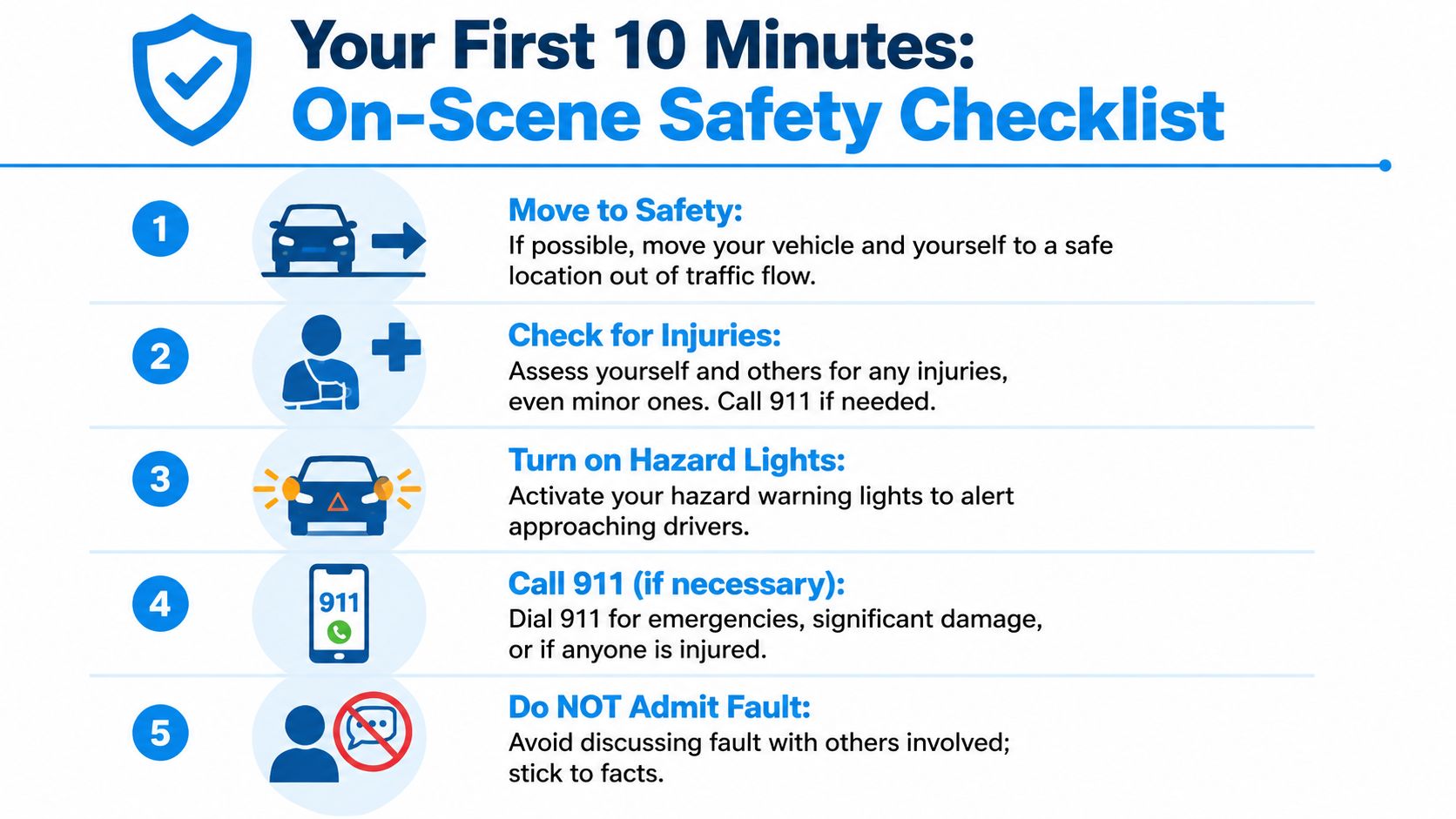
The first ten minutes set the tone for everything that follows. On I-95, the Schuylkill, Roosevelt Boulevard, or a tight South Philly block, a crash scene can turn dangerous fast. Your job is simple. Keep people safe, call for help, and avoid saying anything that hurts your case later.
Step one, secure the scene
Turn on your hazard lights right away.
If the car can be moved safely, pull it out of active traffic and into a shoulder, parking lane, or nearby lot. If moving it would put you at risk, leave it in place and wait for police or EMS. Philadelphia crashes often happen in bad spots: narrow one-way streets, blind intersections, highway ramps, and double-parked corridors where another driver may come through too fast.
If you get out, stand well away from traffic. Stay off the travel lane. Do not stand between vehicles.
Step two, check people before property
Check yourself first. Then your passengers.
Ask direct questions. “Are you hurt?” “Can you move?” “Do you have neck pain, back pain, dizziness, or trouble breathing?” Look for bleeding, confusion, or anyone who seems stunned and slow to respond.
Do not move an injured person unless there is an immediate danger, such as fire or oncoming traffic. A rushed move can make an injury worse.
Step three, call 911 and give a precise location
In Philadelphia, location details matter. “Near Broad Street” is not enough. Give the operator the closest intersection, the direction of travel, the lane if you are on a highway, and any nearby landmark or exit.
Report three things clearly:
- the exact location
- whether anyone may be hurt
- whether traffic is blocked or there is a hazard on the road
If you see leaking fluid, broken glass, or debris, say so. If you are not sure what a leak may indicate after impact, this guide on what brown car fluid leaks mean gives useful context after you are safe and off the roadway. At the scene, treat any fluid leak as a safety problem.
Step four, keep your words tight
Drivers do real damage to their cases. They start filling silence.
Do not apologize. Do not guess. Do not say you are fine if you are not sure. Do not tell the other driver what you “must have done.” On a Philly street corner, with witnesses half-listening and body cams running, loose talk becomes evidence.
Use one clean sentence instead:
“Let's wait for police and stick to the facts.”
That protects you. It also keeps the scene from turning into an argument.
Step five, accept medical help if you have symptoms
Adrenaline hides pain. A person who feels steady at the scene can wake up hours later with neck stiffness, headaches, numbness, rib pain, or a back injury.
If EMS wants to evaluate you, cooperate. If you have pain, dizziness, confusion, tingling, or trouble moving, say it out loud and get checked. Those first records often matter later because evidence used to prove negligence in Pennsylvania includes what was documented at the scene, what you reported, and what happened in the hours right after the crash.
A calm, disciplined first ten minutes can protect both your health and your claim.
Gathering Critical Evidence at the Crash Site
In Philadelphia, crash scenes change fast. Cars get moved. Witnesses head back to work. Rain on I-95, Broad Street traffic, or a crowded Center City intersection can wipe out the details you will need later. Get the evidence while it is still there.
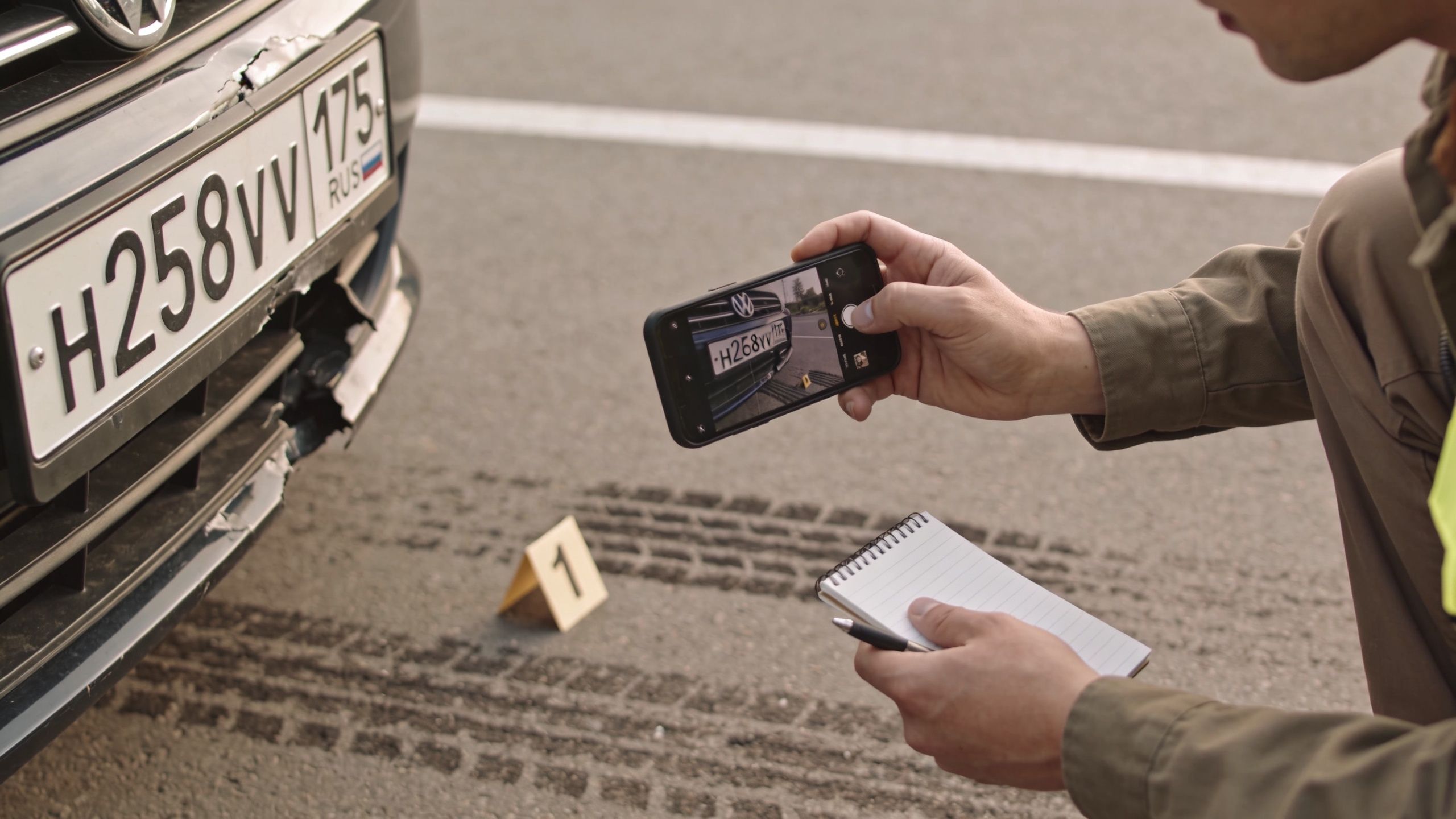
Your phone is your evidence tool. Use it with purpose.
Build a clear photo record
Start wide, then get close. I want you to document the scene the way a trial lawyer would want to show it to an insurance adjuster or a jury.
Take photos of:
- The full scene: where each vehicle ended up, the lanes, intersection corners, and nearby cross streets
- Each vehicle: front, rear, both sides, license plates, and every damaged area
- The roadway: skid marks, debris, broken glass, fluid, potholes, faded lane lines, and shoulder conditions
- Traffic controls: lights, stop signs, turn arrows, merge signs, construction barrels, and parking restrictions
- Visible injuries: cuts, bruising, swelling, airbag burns, and seat belt marks
- Surroundings: weather, lighting, SEPTA buses or stops, storefront cameras, and anything else that explains how this happened
If the crash happened near a business, photograph the storefront. Security footage gets erased all the time. In Philly, that one detail can matter more than drivers realize.
Keep the original files on your phone. Do not edit them, crop them, or add filters.
Exchange information. Nothing more.
Get the other driver's basic information and move on. This is not the place to debate fault, compare memories, or try to be polite by softening what happened.
Photograph or write down:
- Driver's license
- Insurance card
- License plate
- Vehicle registration, if available
- Make, model, and color of the vehicle
If there are passengers in the other car, make a note of that too. Passenger names often show up later, and you do not want surprises.
Get witness information before people disappear
Independent witnesses can make a disputed Philly crash much easier to prove. That is especially true in intersection cases, lane-change crashes, and wrecks where the other driver starts changing their story.
Ask one direct question:
“Did you see what happened? Can I get your name and phone number?”
That is enough. Do not argue with them. Do not suggest what they should say. Just secure the contact information and let them go.
If you want to understand how photos, witness names, and scene details later become proof in a claim, read this explanation of how evidence is used to prove negligence in Pennsylvania.
Two mistakes that cost people later
The first is assuming the police captured everything. They did not. Officers have a job to do, and their report is not a substitute for your own scene documentation.
The second is posting online. Do not post a photo, a joke, or an “I'm okay” update from the shoulder of Roosevelt Boulevard. Insurance companies look for statements and images they can use against you.
| Do this | Not this |
|---|---|
| Take your own photos before the scene changes | Assume the police report will tell the whole story |
| Save witness names and numbers | Let witnesses leave without contact information |
| Keep the crash off social media | Post updates, photos, or comments about fault |
Interacting with Police and Insurance Companies
On a Philadelphia roadside, one bad sentence can do more damage than a dented bumper. I see it all the time. A driver is shaken up on I-95, Roosevelt Boulevard, or Broad Street, tries to be polite, and says too much. Keep it tight. Give facts only.
What to say to the police officer
Your job is to report what you know, not solve the crash at the curb.
Tell the officer:
- Where you were coming from and where you were headed
- Which lane or direction you were traveling
- What you saw before the impact
- What happened at impact and right after
- Whether you feel pain, dizziness, headache, or any other symptoms
Do not guess. Do not fill in blanks. Do not say “I'm sorry,” “I didn't see them,” or “I'm fine” unless you are sure that statement is true.
If you do not know, say, “I'm not sure.” If you did not see the other vehicle until the collision, say exactly that. Nothing more.
Ask for the officer's name and how to get the report. In Philadelphia, that usually means making sure you have the crash report number so you can track down the Philly PD report later. That document matters, but your own words at the scene matter first.
Give facts. Leave opinions out of it.
If your license, insurance, or immigration status is a problem
Panic creates bigger problems.
Do not leave the scene. Do not turn a crash into a hit-and-run case because you are afraid of what comes next. If anyone might be hurt, call for medical help. If the other driver is aggressive or the scene feels unstable, ask for police assistance and keep your distance until officers take control.
You still need to exchange information and handle the scene the right way. Running makes the legal problem worse and makes the injury case harder to defend later.
How to handle the insurance call
Expect a call fast. Your own carrier may want notice right away. The other driver's insurer may sound helpful, casual, even sympathetic. Remember who they work for.
Use this script:
“I'm reporting that a crash occurred. I'm still getting medical evaluation and reviewing the damage. I will not give a recorded statement at this time.”
That is enough.
Do not discuss speed, fault, prior injuries, or how you “feel okay” if adrenaline is still masking pain. Do not let an adjuster rush you into a recorded statement from the tow yard, the ER parking lot, or your kitchen table that night. In serious Philadelphia cases, especially disputed intersection crashes and highway wrecks, early recorded statements are often used to box drivers into incomplete versions of events.
If you want a clearer playbook before speaking with an adjuster, read this guide on how to handle insurance after a car accident in Philly.
Next Steps After Leaving the Accident Scene
Once you leave the scene, the adrenaline starts to wear off. That's when people make a different set of mistakes. They lie down. They wait. They tell themselves they'll deal with it tomorrow.
Don't.

Get checked by a doctor
If you have pain, stiffness, headache, dizziness, numbness, bruising, or just feel “off,” get medical evaluation promptly. The point is not drama. The point is documentation and proper care.
A lot of crash injuries don't announce themselves at the scene. Soft tissue injuries, concussion symptoms, back pain, and shoulder injuries often show up after the chaos settles down. If you wait too long, you make both problems worse. The medical problem can worsen, and the insurance company can argue the injury wasn't tied to the crash.
Preserve the damaged vehicle and everything in it
Don't rush to clean out the car, repair it, or let it disappear into the system without thinking.
Do this first:
- Photograph the vehicle again in daylight if possible
- Keep damaged child seats, phones, glasses, or helmets
- Save towing and storage paperwork
- Keep copies of every receipt and discharge paper
- Do not delete texts, call logs, or photos related to the crash
If the case is serious, vehicle damage patterns can matter. So can electronic data from the vehicle. Once repairs happen or the car gets scrapped, some of that value is gone.
Start a clean paper trail
Create one folder on your phone and one physical folder at home.
Put these in it:
| Keep | Why it matters |
|---|---|
| Crash report information | Identifies the event and responding agency |
| Medical visit records | Connects symptoms to treatment |
| Prescription receipts | Shows out-of-pocket losses |
| Work absence notes | Supports lost income claims |
| Insurance letters and emails | Preserves what was said and when |
Also, stay off social media. Don't post photos of the crash. Don't post that you're “blessed” to be okay. Don't post gym pictures, party pictures, or anything else that gives an insurer a clip to misread.
Write down what you remember
Before memory fades, sit down and write a timeline. Include where you were going, traffic conditions, what you saw before impact, what the other driver said, who arrived, and where you felt pain.
That simple note can be more useful than people realize months later, when details blur and everyone's version suddenly changes.
Why Your First Call Should Be to Mattiacci Law
After a Philadelphia crash, the insurance company gets to work fast. So should you.
The question is not whether a lawyer can file paperwork. The central concern is whether someone is protecting the case before key proof disappears, before a Philly police report error hardens into the record, and before an adjuster gets you talking in a way that hurts you later.
Legal help matters most in the crashes that get messy fast. Serious injuries. Disputed fault. Commercial vehicles. Hit and runs. Conflicting witness stories. Crashes on I-95, Roosevelt Boulevard, or crowded city streets where the scene is chaotic and nobody agrees on what happened.
A good lawyer should take control of the parts of the case that can go wrong early, including:
- Preserving vehicle evidence, video, and witness information
- Checking the police report for mistakes, omissions, or vague wording
- Getting ahead of insurance adjuster contact
- Collecting records that prove injury, treatment, lost wages, and out-of-pocket losses
- Bringing in experts if crash mechanics, road design, or commercial driving rules matter
- Building the case with trial standards in mind from the start
That last point matters. Cases usually settle better when they are prepared as if they may be tried. Insurers read files closely. They can tell the difference between a rushed claim and a case built with proof.
Mattiacci Law is a Philadelphia personal injury firm that handles serious crash cases by investigating early, preserving evidence, and dealing with insurers before small mistakes become expensive ones. That is the job.
If you are unsure whether you should get counsel involved now, this guide on when you should call a lawyer after a crash in Philly lays out the warning signs.
One good call early can prevent weeks of damage control later.