

Author: John Mattiacci | Owner Mattiacci Law
Published May 1, 2026
Your phone rings before you've even had time to deal with the tow truck, the soreness in your neck, or the fact that your car is sitting crumpled on a Philly street. The caller sounds polite. Calm. Maybe even helpful. They say they just want to “get some basic information.”
Slow down.
If an insurance adjuster called after an accident in Philly, that call is not a favor. It's the opening move. And if you handle it casually, you can damage your case before you ever see a doctor, read the police report, or understand how badly you're hurt.
I've seen people make the same mistake over and over. They try to be nice. They try to sound reasonable. They fill silence with guesses, apologies, and “I think I'm okay.” Then the insurance company uses those words to shave down the claim or deny it outright.
You need a script. You need discipline. And if you were hurt, you need a lawyer between you and that adjuster.
That Unexpected Call An Insurance Adjuster's True Goal
You get home from the crash, sit down for the first time, and your phone lights up. The person on the line sounds organized, polite, and ready to help. In Philadelphia, where reported crashes happen every day, insurers push fast to get control of the claim early, as reflected in a PennDOT-based discussion of Philadelphia crash volume.
That early call has one purpose. Lock you into a version of events before you know the full medical picture, before you have the police report, and before anyone explains the Pennsylvania rules that can cut or wipe out your recovery.

Why they want your first version fast
In Philly, adjusters handle volume. Volume changes behavior. They are trained to get a recorded story while you are rattled, sore, distracted, and still trying to piece together what happened on Broad Street, I-95, Roosevelt Boulevard, or a tight South Philly intersection.
That first statement matters because Pennsylvania fault rules punish loose talk. If you hand them an apology, a guess, or a casual comment that you are "okay," they will treat it as evidence, not conversation. Then they will use it to argue you caused the crash, your injuries are minor, or both.
The traps are predictable:
- Apologies that sound like admissions. “I’m sorry, I didn’t see him.”
- Guesses that become facts in the file. “Maybe I was going a little fast.”
- Minimizing statements that hurt your injury claim. “I’m fine. Just shaken up.”
- Loose fault language that feeds a defense. “I probably could’ve stopped sooner.”
This is exactly why injured people need a controlled response. If you want a fuller breakdown of how insurers frame these conversations, read this guide on how to answer insurance claim questions.
Friendly voice, business objective
Do not mistake a calm tone for neutrality.
The adjuster’s job is to protect the insurance company’s money. In Philadelphia’s high-volume accident setting, speed is part of that strategy. They want your words before your doctor connects the neck pain to the crash, before the adrenaline wears off, and before you learn about local claim traps like limited tort.
Here is the right mindset. You are speaking to a company representative who is collecting material to limit what the company pays. Treat every call that way.
A smart claimant stays brief, gives only basic identifying information, and stops talking before the adjuster gets what they really called for. If you start explaining, filling silence, or trying to sound fair, you hand them material they can use against you later.
What to Say (and Not Say) During the First Call
You don't need a speech. You need control.
The first call should be short, polite, and boring. Confirm basic facts. Refuse to speculate. Don't discuss fault. Don't discuss the full extent of your injuries. Don't give a recorded statement just because they ask nicely.
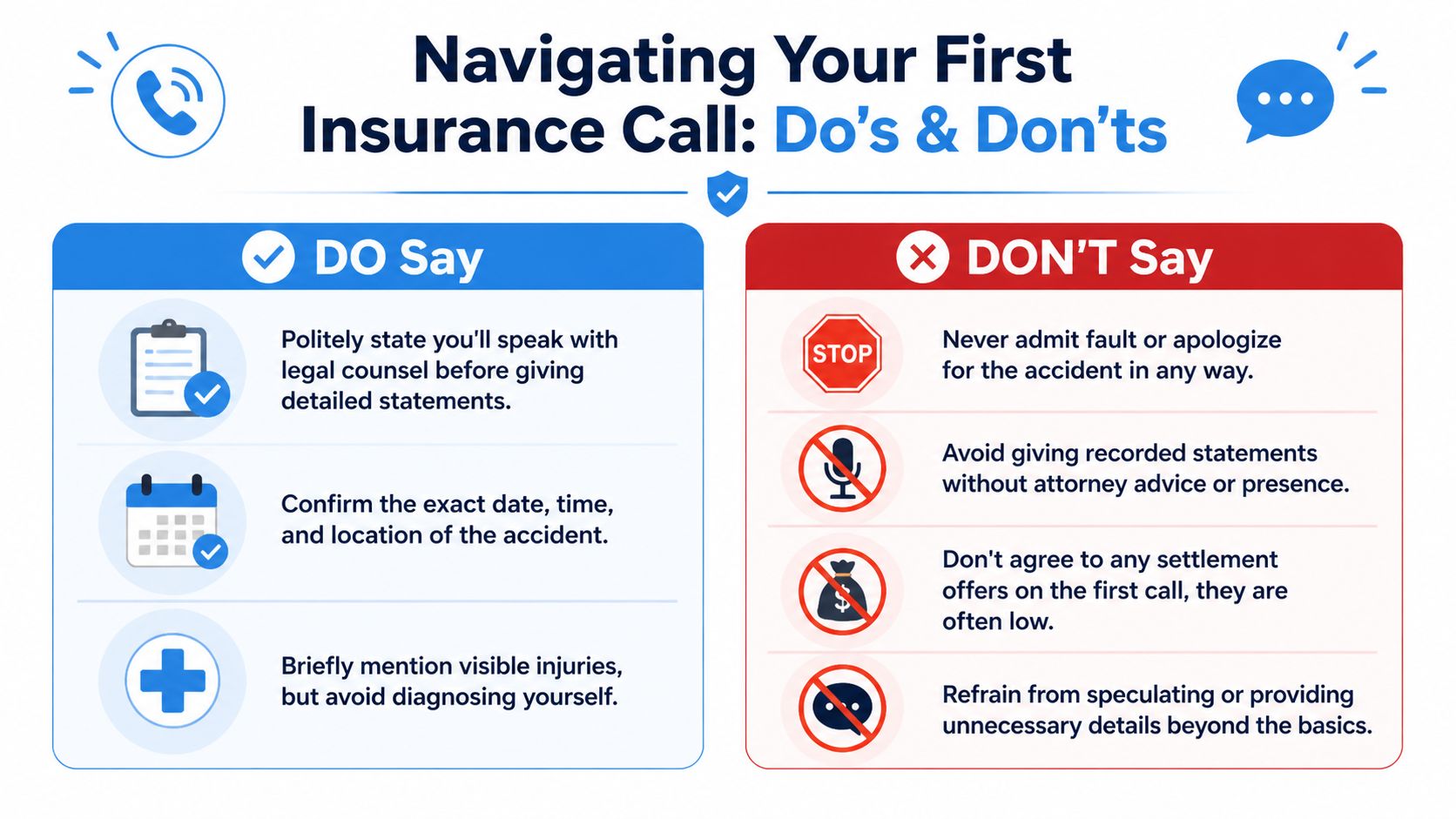
Use this script
If your phone rings and you answer, say this:
“There was a collision on [date] at [location]. The vehicles involved were [basic identifying information]. Police responded. I'm still being medically evaluated. I'm not prepared to discuss details or give a recorded statement. Any further communication should go through counsel.”
That works because it does three things. It opens the claim. It avoids bad facts. It shuts down the fishing expedition.
If you want a deeper breakdown of how to handle claim questions, read how to answer insurance claim questions.
Adjuster Call Cheat Sheet Do's and Don'ts
| Do Say This… | Don't Say This… |
|---|---|
| “The crash happened on [date] at [location].” | “I think I may have caused it.” |
| “Police responded.” | “I didn't see the other car until the last second.” |
| “I'm being evaluated by doctors.” | “I'm okay.” |
| “I'm not giving a recorded statement right now.” | “Sure, record me, I have nothing to hide.” |
| “Please send me the claim number and your contact information.” | “My injuries probably aren't serious.” |
| “I'll have counsel follow up.” | “What kind of settlement can you offer me today?” |
Phrases that hurt people every day
A few lines cause damage again and again:
- “I'm sorry.” That's human. It's also dangerous.
- “I'm okay.” You don't know that yet.
- “It all happened so fast.” True, but useless to you and helpful to them.
- “I don't need a lawyer.” Fine. Keep that thought to yourself.
- “Off the record…” There is no off the record.
Say less than you want to. Then cut it in half.
If they push, repeat yourself
Adjusters are trained to keep you talking. They'll say it's routine. They'll say they can't move the claim forward without more detail. They'll act like you're being difficult.
You are not being difficult. You are protecting yourself.
Use one of these lines and stop there:
- “I'm not discussing fault.”
- “I'm still being evaluated.”
- “I'm not giving a recorded statement.”
- “Please send any requests in writing.”
- “My attorney will handle further communication.”
The mistake isn't being rude. The mistake is talking after you've already given your answer.
Critical Questions to Ask the Insurance Adjuster
Once you've shut down the part of the call where they try to extract information, flip the conversation. Make them give you information.
That changes the dynamic right away. It tells the adjuster you're organized, you're paying attention, and you're not going to wander into a bad statement out of nerves.
Get these details before the call ends
Ask these questions, one by one:
- What is your full name?
- What insurance company do you represent?
- What is your direct phone number and email?
- What is the claim number?
- Who is the insured person under this claim?
- Are you calling for my insurer or the other driver's insurer?
- Do you want a recorded statement?
- What documents are you asking me to provide?
- Are you sending anything for me to sign?
- Will you confirm your request in writing?
Write the answers down. Don't trust your memory. After a crash, people are distracted, medicated, exhausted, or all three.
Why these questions matter
Some of this is basic file management. Some of it is strategic.
If you don't know who the adjuster represents, you can say the wrong thing to the wrong insurance company. If you don't ask whether they're requesting a recorded statement, you may get drawn into one without realizing the conversation has shifted. If you don't pin down what they want in writing, you're left arguing later about what was said on a stressful call.
The person asking questions shouldn't be the only one leaving with useful information.
Questions you should not ask
Don't start with, “How much is my case worth?” That's not an advantage. That's a signal that you're thinking about quick money before the medical picture is clear.
Don't ask, “Can we settle this fast?” That tells them exactly what they're hoping to hear.
And don't ask, “Do I need a lawyer?” An adjuster is not your advisor. The answer they want is the answer that makes their job easier.
How to Preserve Evidence for Your Philly Accident Claim
Phone calls matter. Evidence matters more.
If the adjuster is building a file from day one, you need to do the same. Cases are won and lost on proof. Not on who sounded more sincere on the phone.
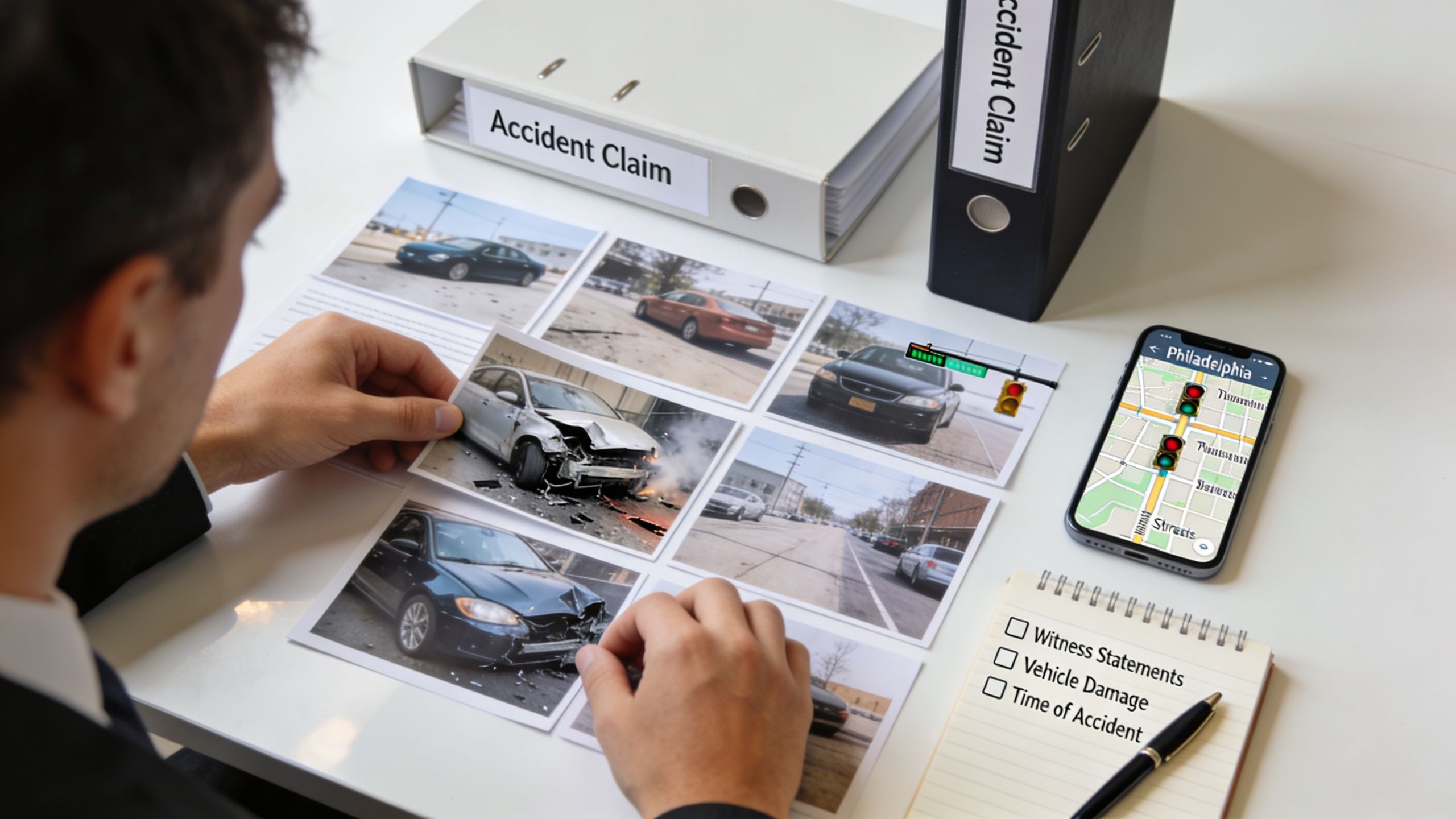
Start with the obvious, then go wider
Taking a photo of the dent and stopping there is a common approach. That's not enough.
You need:
- Wide scene photos: Show lanes, intersections, traffic lights, stop signs, skid marks, debris, weather, and sight lines.
- Vehicle photos: Every side of every vehicle if possible, not just the impact point.
- Body injury photos: Bruising, cuts, swelling, casts, slings, road rash.
- Inside-the-car photos: Airbags, broken glass, seat position, child seats, loose items tossed by impact.
- Paper trail items: Towing receipt, storage bill, repair estimate, rental paperwork, discharge instructions.
If you want a stronger understanding of how proof works in a Pennsylvania injury case, review how evidence is used to prove negligence in Pennsylvania.
Build a damages file
Injured individuals often grow complacent, a situation that benefits insurance companies.
Keep one folder, digital or paper, with:
- Medical records: ER papers, urgent care notes, specialist visits, imaging instructions, prescriptions.
- Bills and receipts: Copays, medication, braces, parking, rides to treatment.
- Work loss documents: Missed days, reduced hours, employer notes, pay records.
- Repair and property documents: Estimates, photos, total loss paperwork, personal items damaged in the crash.
Don't rely on the hospital portal to keep your case organized for you. Download records. Save PDFs. Back up photos.
Keep a daily journal
Not a dramatic one. A useful one.
Write down what hurts, where it hurts, what treatment you had, what you couldn't do that day, how you slept, and what you missed. If you couldn't pick up your kid, lift at work, sit through a shift, or turn your head while driving, write it down.
That journal matters because adjusters love to say soft tissue complaints are vague, delayed, or exaggerated. A steady timeline undercuts that.
Keep it plain: “Neck pain when turning left. Missed work. Physical therapy in afternoon. Couldn't sleep through night.” That's stronger than theatrics.
What to avoid
Don't repair over evidence too fast if major damage or disputed fault is involved. Don't throw away damaged personal items. Don't post crash photos or injury updates on social media. And don't leave gaps in treatment unless you have no choice, because insurers seize on inconsistency.
A clean, documented file gives your lawyer something to use. A messy one gives the adjuster room to argue.
Understanding Philly-Specific Traps Like Limited Tort
You can have a clean rear-end crash in Philadelphia, clear vehicle damage, a trip to urgent care, and still watch the insurer argue your case is worth far less than it should be. That happens every day here because adjusters are not just evaluating the wreck. They are sizing up Pennsylvania insurance rules they can use against you.
The biggest trap is limited tort.

Why limited tort changes the whole conversation
Limited tort can restrict your right to recover pain and suffering unless your injury qualifies under Pennsylvania law. Adjusters in high-volume Philly claims know that. They listen for casual phrases they can later frame as proof that you were only sore, quickly recovered, or never had a serious injury in the first place.
That is why the first phone call matters so much.
If you need the rule explained in plain English, read what limited tort insurance means in Pennsylvania. Then treat every conversation with the insurer like it is being built into a defense file, because it is.
How adjusters use your own words against you
Here is the common Philly pattern. You get hit on Roosevelt Boulevard, I-95, Broad Street, or an overcrowded neighborhood block. You are shaken up, you have not had imaging yet, and the stiffness has not fully set in. The adjuster calls fast and asks how you are feeling.
You say, “I’m okay, just sore.”
Now they have language they can use later, even if your symptoms worsen, your doctor orders therapy, or a concussion diagnosis comes days after the crash. They will compare your first off-the-cuff statement to your later treatment and argue exaggeration. Limited tort gives them extra incentive to make that argument early.
Use this instead: “I’m still being evaluated, and I’m not ready to discuss the extent of my injuries.”
That answer is accurate. It gives them nothing to twist.
If you have limited tort, the first call is a screening tool for your pain and suffering claim.
The second local trap is fault shifting
Philadelphia claims move fast, and adjusters know city crashes often involve packed intersections, buses, double-parked cars, delivery traffic, pedestrians, and conflicting witness accounts. They use that chaos to push blame onto you.
So they ask questions that sound routine but are built for one purpose. They want facts they can turn into percentages. Speed. Lane position. Whether you looked twice. Whether you could have braked sooner. Whether you were distracted by traffic, your phone, a passenger, or the weather.
Do not guess. Do not estimate. Do not help them reconstruct the crash from memory while you are injured and rattled.
Say this instead: “I’m not giving estimates or speculation. The investigation should rely on the vehicles, scene evidence, and reports.”
That is the right move in any case. It is even more important in Philadelphia, where insurers handle a high volume of claims and look for quick ways to downgrade one file and move on to the next.
Injured people often neglect this step, and insurance companies benefit from it. They assume a straightforward crash means a straightforward claim. Pennsylvania law does not work that way, and adjusters know it better than you do.
When to Stop Talking and Call Mattiacci Law
The call seems harmless. A few polite questions. A request to “clear up the facts.” Maybe a fast payment if you cooperate. In Philadelphia, that is often the moment injured people do the most damage to their own case.
Stop handling it yourself once the adjuster starts building a record instead of gathering basics. In a high-volume Philly claim, they are not calling to help you sort things out. They are trying to lock in statements, test your injuries, and find shortcuts around your claim before the medical picture is clear. If limited tort may be in play, the risk goes up fast.
Signs you need a lawyer now
Call a lawyer if any of this is happening:
- The other driver's insurer keeps calling or pressuring you to talk
- Your treatment is ongoing, or doctors are still figuring out what's wrong
- The adjuster is pushing fault back onto you
- You have limited tort questions and no clear answer
- They want a recorded statement, broad medical authorization, or signed forms
- They put money on the table before you know how long recovery will take
At that point, professional help is the only safe path.
One option is Mattiacci Law, a Philadelphia-based injury firm that handles insurer communication, investigates Pennsylvania and New Jersey crash claims, and prepares cases for litigation when needed. That changes the dynamic. The adjuster no longer gets to use your stress, uncertainty, or off-the-cuff answers as the easiest way to cut the file down.
The smartest move
Use one sentence and end the call: “I am getting legal advice before I discuss the claim any further.”
Then stop talking.
You do not beat an insurance adjuster by sounding sincere, reasonable, or cooperative enough on the phone. You protect your case by shutting down the fishing expedition, keeping your medical care on track, and putting a lawyer between you and the insurer before they box you in.
If you already talked, do not panic. But do not give them a second clean shot at you.
Frequently Asked Questions
Do I have to talk to the other driver's insurance adjuster?
No. You are not required to give the other driver's adjuster a narrative, your opinions about fault, or a play-by-play of your injuries.
Keep it tight. Confirm your name, contact information, and the date of the crash if needed. Then use this line: “I am not giving a statement. Please direct future communication to my lawyer.”
In Philadelphia, adjusters handle a high volume of claims and move fast. Speed helps them, not you.
Should I give a recorded statement?
No, not before you get legal advice.
Recorded statements are built to pin you down early, before you know the full medical picture and before you understand Pennsylvania rules like limited tort. One careless phrase can get used for months. If they ask, say: “I’m not prepared to give a recorded statement.”
Then end the call.
What if they offer me money right away?
Treat a quick offer as a warning sign.
Early offers usually show up before your treatment is settled and before anyone knows whether your injuries will qualify outside limited tort. Once you sign a release, the case is over. It does not matter if your pain gets worse next week or your doctor later finds a more serious injury.
Do not let an adjuster buy certainty from you while you are still living with uncertainty.
What if the adjuster is from New Jersey?
Slow the conversation down.
Crashes around Philly often involve Pennsylvania drivers, New Jersey vehicles, and insurance policies written under different rules. That creates confusion adjusters use to their advantage. They may talk about PIP, verbal thresholds, or which state's law should apply, hoping you will start explaining things you should never explain on the phone.
Do not debate state law with an adjuster. Say: “I’m not discussing coverage or legal issues on this call. Send your questions in writing or speak with my lawyer.”
Complications can arise in claims between the two states. That is exactly why you should not wing it.
What if I already told them I was okay?
That happens all the time. People say it at the scene, in the ER, or on the first insurance call because they are shaken up and trying to get through the day.
Do not try to talk your way out of it with a second long statement. Get medical care. Follow the doctor's instructions. Make sure your symptoms are documented. Then get a lawyer involved before the adjuster turns one polite sentence into the theme of your whole case.
Do I need a lawyer if the claim seems simple?
Yes, if the adjuster is asking for a recorded statement, pushing papers in front of you, questioning your injuries, or raising fault.
And in Philly, “simple” claims stop being simple fast. Limited tort issues, prior injuries, delayed symptoms, SEPTA crashes, out-of-state drivers, and camera footage that disappears can change the value of a case in a hurry. Professional help is the only safe path once the insurer starts probing for those issues.
If an insurance adjuster called after an accident in Philly, treat that call as the start of the defense case against your claim. Mattiacci Law can review what has happened, take over communication with the insurer, and help protect your right to recover while you focus on treatment.