


Author: John Mattiacci | Owner Mattiacci Law
Published August 3, 2026

You do not automatically get a ticket for a car accident. In 2022, police stopped 6,719,300 people after a traffic accident, and citations after a crash depend on the responding officer's judgment about a specific traffic-law violation, not the crash alone.
You're probably sitting there wondering whether the officer is going to hand you a ticket, whether one is already on the way, and whether the lack of a citation means you're safe. It doesn't work that way, and that's why the first hours after a crash matter so much.
What Happens When Police Respond to a Car Accident
The scene usually starts the same way. Flashing lights. Traffic backing up. One driver trying to explain, another driver insisting the other person caused everything, and an officer asking questions while everyone's nerves are already shot.
The important part is simple. A citation is not automatic after a collision. It's usually issued at the responding officer's discretion and tied to a specific alleged violation, not to the bare fact that two cars hit each other. That's why two drivers in the same crash can leave with very different outcomes, one with a ticket, one without one.
What officers are actually looking for
Officers are trying to decide whether they can connect the crash to a traffic violation they can support. That might mean speed, lane movement, right-of-way, signaling, equipment, or another rule that clearly mattered at impact. If the officer can't sort out conflicting stories, didn't see the crash, or doesn't believe one driver clearly violated a traffic law, no ticket may be issued.
That's why the paperwork matters, but it doesn't control everything. A ticket is one officer's enforcement decision, not a final ruling on blame. If you want a practical example of how to behave in those first moments, the first steps after a Florida car accident resource from Ticket Shield, PLLC gives a useful scene-level checklist, even though the legal rules still depend on your state.
Practical rule: stay calm, answer questions without volunteering guesses, and make sure your version is recorded accurately.
If you're in Pennsylvania or New Jersey, don't assume the officer's first impression is the end of the story. For a deeper look at police procedure after a crash, see what police do after a car accident. The citation question is only one part of the larger fault analysis.
Common Traffic Violations That Lead to Post-Accident Tickets
A crash scene often turns into a violation scene. Officers aren't just asking, “Who hit whom?” They're asking, “What rule was broken that caused this?” That's why tickets after accidents often track the same offenses that show up again and again in traffic enforcement.
National citation data summarized by MarketWatch shows that speeding accounts for 24.6% of citations, document violations for 20.7%, and careless driving for 11.8% (MarketWatch traffic ticket statistics). That doesn't mean every crash leads to those charges, but it does show what police spend a lot of time enforcing around collision scenes.
The violations that usually matter most
| Citation Type | Share of All Citations | Typical Accident Scenario |
|---|---|---|
| Speeding | 24.6% | A driver rear-ends another car after moving too fast for traffic or road conditions |
| Document violations | 20.7% | A stop exposes expired registration, missing proof of insurance, or related paperwork issues |
| Careless driving | 11.8% | A driver looks away, misjudges a turn, or makes an unsafe maneuver that causes impact |
Those numbers matter because accident scenes often uncover more than one problem. A driver may be cited for speeding even if the crash also involved poor lane discipline or an unsafe merge. Another driver may walk away with a citation for a paperwork issue while the actual fault question gets sorted out later.
Why the officer picks one violation over another
Police usually focus on the clearest, easiest-to-support violation. If the scene shows obvious speed, the officer may write that ticket instead of debating every contributing factor. If the car's equipment clearly failed, or the plates and documents are part of the stop, that can produce a separate ticket even though the collision itself caused the stop.
A broken tail light can also become part of the story after a crash, especially if it affected visibility or signaling. If you're dealing with vehicle damage and want to understand that kind of issue from the repair side, repair your tail light at home is a practical read, though it doesn't replace legal advice about fault.
For Pennsylvania drivers, the negligence analysis often turns on whether the underlying violation supports civil fault too. That's why traffic law violations and negligence per se in PA is worth reading if a citation gets tied to your crash.
Why No Ticket Does Not Mean No Fault
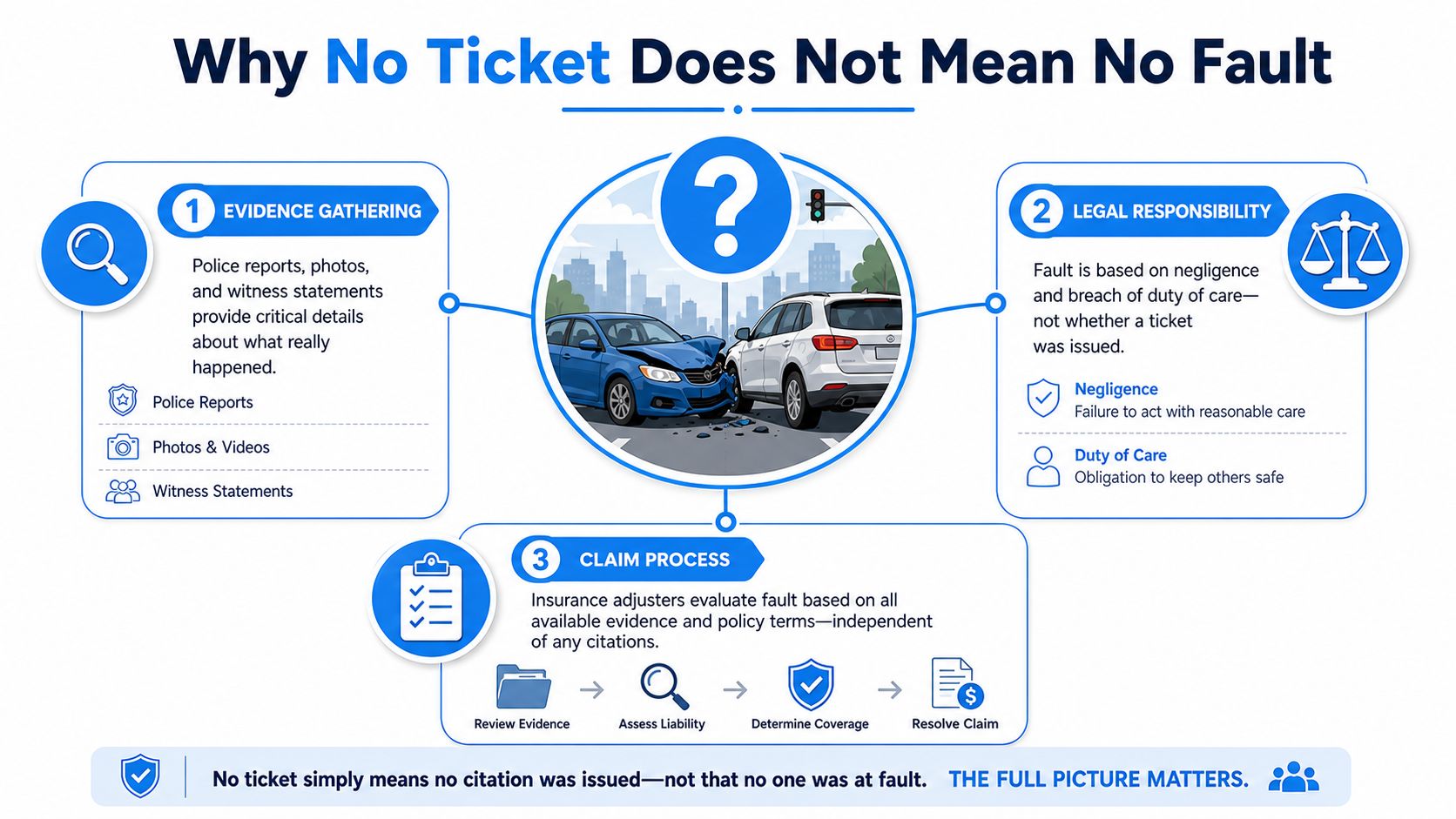
A lot of injured people make the same mistake. No ticket came at the scene, so they assume the other driver can't be at fault. That's not how civil claims work, and it's one of the fastest ways to undercut a valid injury case.
A citation is just one piece of evidence. It records the officer's view of what happened, but it doesn't decide insurance liability by itself or prove civil fault in court. Officers may issue no ticket when they didn't witness the crash, couldn't resolve conflicting accounts, or didn't believe a clear traffic-law violation was established.
What actually proves fault
Civil fault gets built from evidence, not from the presence or absence of a ticket. Photos, witness statements, crash diagrams, repair estimates, medical records, and video footage can all matter more than the citation itself. That's especially true when the officer arrived after the impact and had to reconstruct the event from the people who were already upset, injured, or disagreeing with each other.
The insurance adjuster is not waiting for a traffic ticket to decide whether to push back on your claim.
That's the point most drivers miss. Adjusters evaluate the file independently, and they're looking for gaps, inconsistencies, and anything that lets them shift blame. A ticket may help your argument, but no ticket does not erase the rest of the evidence.
Why this matters in PA and NJ
In Pennsylvania and New Jersey, claim outcomes depend on the quality of the proof, not on whether a patrol officer wrote a citation that day. If the other driver ran a stop, drifted across lanes, or hit you while turning left, those facts can still support a claim even if the police report stays silent on fault. The best cases are the ones where the evidence is preserved early and organized clearly.
The legal takeaway is blunt. Don't treat no ticket as a clean bill of health, and don't treat a ticket as automatic victory. Both are evidence, neither is the whole case.
The Hidden Risk of Delayed Citations After a Crash
The most overlooked danger is timing. A lot of guides talk about what happens at the scene, but they skip the possibility that a ticket shows up days or weeks later after someone reviews the file again.
That delay happens for a reason. Police or investigators may go back through dashcam footage, surveillance video, witness statements, or the crash report before deciding whether to issue a citation. A delayed ticket can change insurance strategy, courtroom posture, and the way you protect your own record after the crash.

Why the delay happens
If the officer at the scene couldn't sort out fault, the agency may keep looking. That review can come from body-camera footage, vehicle damage photos, follow-up witness statements, or other details that weren't clear in the first ten minutes after the crash. The citation may still be issued later if the file supports a specific violation.
That means your job doesn't end when the tow truck leaves. If you leave the scene thinking the matter is over because nobody handed you a ticket, you may be wrong. The safest assumption is that the record is still being built.
What to do right away
Take the scene seriously from the start. Preserve photos, save any video, and write down the names of witnesses before people disappear. If you're confused about post-crash responsibilities, steps after car accident from Total Loss Northwest is a useful general guide to the practical side of the aftermath.
Bottom line: a delayed citation can arrive after the evidence gets reviewed, so the first version of the story is not always the final one.
For drivers in Pennsylvania and New Jersey, that matters because a late ticket can affect how you talk to insurers, how you document injuries, and whether you challenge the citation before it gains momentum. Act as if the file will be reviewed again, because sometimes it will be.
How Tickets Affect Your Insurance and Driving Record in PA and NJ
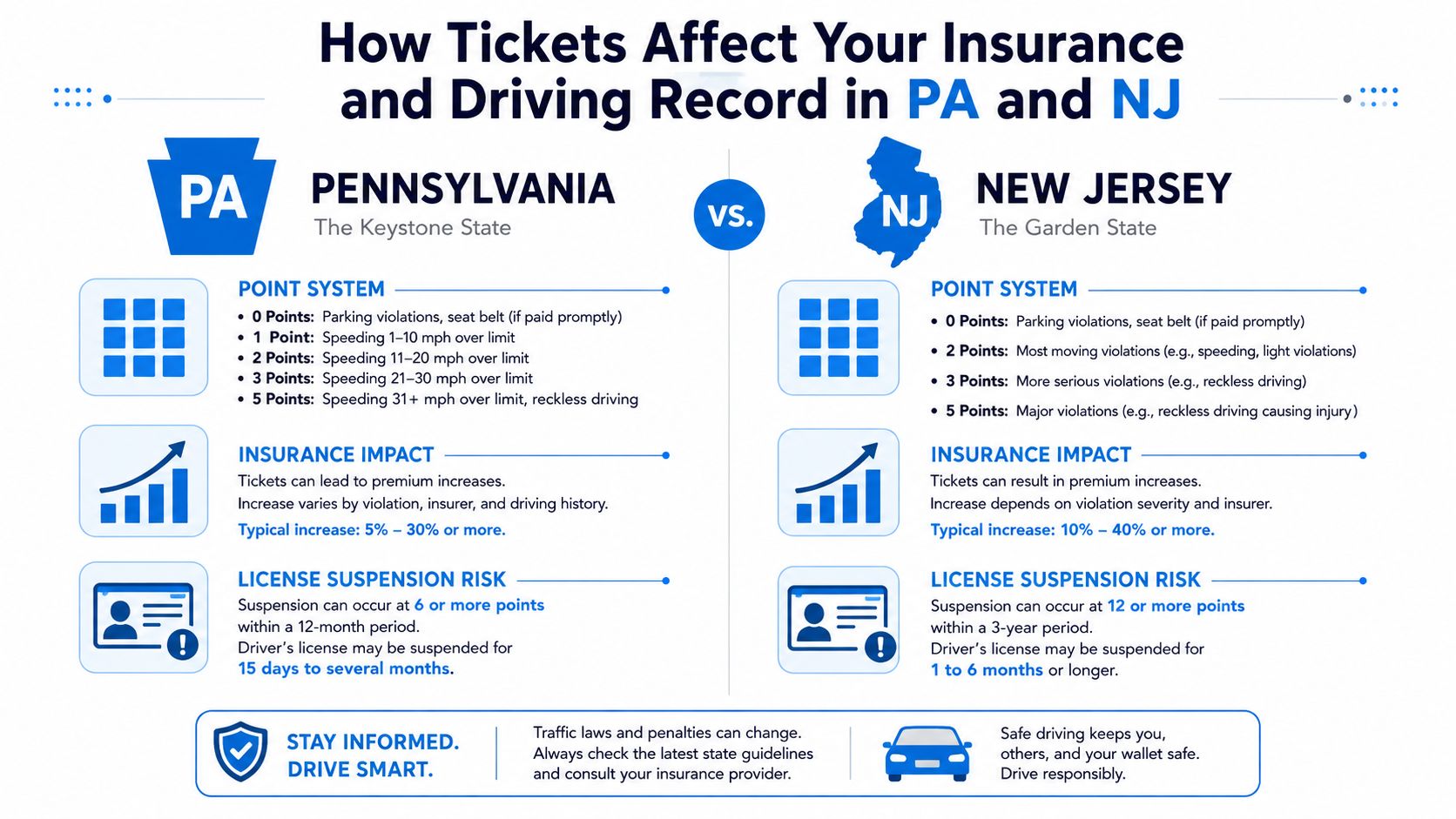
A ticket after an accident doesn't just sit on paper. It can affect your driving record, your insurance posture, and your options for contesting the charge. Paying it usually means accepting the violation, which is a much bigger deal than many drivers realize.
The cleanest way to think about it is this. A ticket is a legal problem and an insurance problem at the same time, but it's not the same thing as fault in the civil sense. That distinction matters more in Pennsylvania and New Jersey than many might expect.
Paying versus fighting
If you pay a ticket, you're usually accepting the charge. That can make the citation harder to undo later, and it can give an insurer another reason to argue that you admitted to the conduct. Contesting the ticket keeps the issue alive and may preserve room to challenge how the officer interpreted the scene.
That doesn't mean every ticket should be fought. It means you should not pay first and think later. Once you accept the violation, you may have made the civil and insurance side of your case harder for no good reason.
Reporting duties are separate
Crash reporting is a different obligation from traffic citations. New York requires a DMV crash report within 10 days when a crash involves a fatality, personal injury, or $1,000+ in property damage, and Louisiana requires immediate notice to police for crashes causing injury, death, or more than $500 in property damage (New York DMV crash reporting rules). The point is simple, missing a reporting duty can trigger consequences even if nobody writes a ticket at the scene.
What PA and NJ drivers should remember
Don't assume the police report, the citation, and the insurance claim are the same issue. They aren't. One can move forward while the others are still being decided.
If you're sorting out a crash claim, what to do after a car accident gives a useful overview of the immediate response, but the key rule is this, keep the civil claim and the citation defense separate in your mind. Treat both seriously, because insurers certainly will.
Steps to Protect Your Rights Immediately After an Accident
After a crash, your job is evidence preservation. Not panic, not explaining yourself to the other driver's insurer, and not assuming the police report will save you.
Start with the scene. Take photos of the vehicles, the road, the lane position, skid marks, traffic signals, and any visible injuries. Get witness names and phone numbers before everyone leaves, because witness memory gets weaker fast and people vanish once traffic starts moving again.
The moves that matter most
- Document everything: Photograph damage, the intersection, weather, and anything that helps show how the collision happened.
- Get medical care early: Even a minor ache can turn into a bigger problem, and the medical record connects the injury to the crash.
- Don't give a recorded statement too fast: The other driver's insurer is looking for admissions, confusion, or inconsistent details.
- Ask for the police report: Review it for errors, because mistakes can affect both the ticket and the claim.
- Keep your own notes: Write down what happened while your memory is still sharp.
If you want a broader practical guide for the post-crash process, steps after car accident from Total Loss Northwest is a solid starting point, especially for the logistics that people forget when they're shaken up. It won't replace legal guidance, but it helps you stay organized.
Do not rely on a phone call from the insurance company to “just get your side of the story.” That call is part of their file, not yours.
The point of these steps is simple. You're building proof before someone else controls the narrative. The earlier you lock down the details, the harder it becomes for an insurer or defense lawyer to rewrite the crash.
When to Hire a Personal Injury Attorney After a Crash
You don't need a lawyer for every fender-bender. You do need one when the stakes are real, the fault is disputed, the other driver's insurer is pushing back, or a delayed citation could complicate the case. Once injuries, unpaid bills, or bad liability arguments enter the picture, trying to manage it alone usually costs more than it saves.
A personal injury attorney can investigate the crash independently of the police report, line up witnesses, review video, and press the insurer on fault and damages. That matters because the officer's ticket, or lack of one, is only one part of the file. The claim gets built from evidence, and a lawyer's job is to keep that evidence from disappearing or being minimized.
When hiring counsel makes the most sense
- Serious injuries: Medical treatment, missed work, and long-term symptoms deserve a real claim review.
- Disputed fault: If the other driver blames you, the case needs independent investigation.
- Delayed citation risk: If a ticket may arrive later, you want someone watching the file.
- Commercial vehicle involvement: Larger insurers and corporate claims teams move differently.
- Insurance pressure: A quick settlement offer is usually a sign the company wants a cheap release.
Mattiacci Law handles car accident claims in Philadelphia and across Pennsylvania and New Jersey, including cases where the police report, incident report, or citation issue is part of the evidence file. That kind of representation matters when you need someone who knows how to use the paperwork without overvaluing it.
The contingency fee model also makes this easier than people think. You don't pay upfront to get the case reviewed, and you shouldn't wait until the insurer has already shaped the narrative. If you're hurt, confused about a citation, or unsure whether the other driver's conduct is being understated, get counsel involved early.
If you're dealing with a crash in Pennsylvania or New Jersey, talk to Mattiacci Law before you assume the ticket question tells you everything. The firm can review the crash record, the citation issue, and the insurance angle so you know what affects your claim.