


Author: John Mattiacci | Owner Mattiacci Law
Published March 20, 2026

The moments right after a car crash are a blur of confusion and adrenaline. If you're wondering what to do after a car accident, your mind is probably racing. But the steps you take next are absolutely critical. Just remember to focus on three things: safety, reporting, and evidence.
Getting to a safe spot, calling 911, and documenting what happened will protect your well-being and your legal rights down the road.
Your Immediate Actions at the Accident Scene

The first fifteen minutes after a collision can feel like chaos. It’s easy to get overwhelmed, but your actions in this small window of time lay the foundation for everything that follows. Here’s your playbook for getting through the immediate aftermath with a clear head.
First things first: safety. If your car is still drivable, get it out of traffic and onto the shoulder or into a nearby parking lot. Immediately flip on your hazard lights. This simple action warns other drivers and can prevent a second, more dangerous collision.
Once you’re out of harm’s way, take a deep breath and check yourself and any passengers for injuries. Even if you feel okay, adrenaline is a powerful painkiller. Don’t ever assume you or anyone else is unhurt; that’s for a doctor to decide later.
Why You Must Call 911
Even if the crash seems like a minor fender-bender, calling 911 is non-negotiable. In states like Pennsylvania and New Jersey, the police report created by the responding officer is the single most important official record of the accident. It’s the cornerstone of any insurance claim.
Without that report, the other driver could easily change their story later. Their insurance company will jump at the chance to dispute liability. The officer will officially document:
- The date, time, and location of the crash
- Statements from all drivers and any witnesses
- A diagram of the accident scene and where the vehicles ended up
- Their initial assessment of who might be at fault or what caused the crash
In a state like Pennsylvania, which saw over 120,000 crashes in 2024 alone, a police report is often the deciding factor in whether an insurer accepts or denies a claim. You can learn more about national crash data trends from the NHTSA.
A police report provides an unbiased, third-party account of the accident. From my experience, claims without one are far more likely to be unfairly denied or significantly undervalued by insurers.
Interacting with the Other Driver
Keep your conversation with the other driver brief, calm, and strictly factual. There's specific information you need to exchange, but there are also things you should never say.
The most common mistake I see people make is apologizing. Saying "I'm so sorry" is a natural human reaction, but an insurance adjuster can—and will—twist that into a full admission of fault, even if you did nothing wrong.
Stick to the script. Exchange only this information:
- Full Name and Contact Information
- Insurance Company and Policy Number
- Driver's License Number
- Vehicle License Plate Number
Politely refuse to discuss how the accident happened. Just say you’d rather wait for the police to arrive and sort out the details.
Immediate Post-Accident Safety Checklist
In those first disorienting moments, it helps to have a quick mental checklist. Here are the absolute must-do actions to take within the first 15 minutes of a crash.
| Action Step | Why It's Critical | Pro Tip for PA/NJ |
|---|---|---|
| Move to Safety | Prevents secondary accidents and protects you from oncoming traffic. | Find the nearest safe spot, like a shoulder or side street, even if it slightly alters the final vehicle positions. Your safety is #1. |
| Call 911 | Creates an official police report, the foundational document for your claim. | Tell the dispatcher if there are any injuries, no matter how minor they seem. This ensures EMS is dispatched. |
| Check for Injuries | Adrenaline can mask serious injuries. A quick self-assessment is the first step. | Tell the responding officer about any pain you feel, even if it's just stiffness or soreness. Get it on the record. |
| Exchange Information | Legally required and necessary for filing an insurance claim. | Use your phone to take a picture of their driver’s license and insurance card. It’s faster and avoids writing errors. |
| Avoid Admitting Fault | Apologizing or accepting blame can be used against you by insurers. | Stick to facts only. "Are you okay?" is fine. "I'm so sorry, I didn't see you" is not. |
This initial phase is all about control—controlling the scene, controlling the information you share, and controlling your emotions. By following these steps, you protect your physical health and preserve the integrity of your potential legal claim from the very start.
Gathering Evidence to Build a Strong Claim

After you've checked for injuries and called 911, your next job is to start gathering evidence. The few minutes after a crash are critical. Your phone is your best tool for locking down what happened before stories change and memories get fuzzy.
Think of it this way: you’re creating a permanent record. The photos you take and the information you collect are the foundation of your insurance claim. Without them, you're left with a "he-said, she-said" battle that's tough to win.
Start by taking wide shots of the whole scene, showing where all the cars ended up. Then, get closer. Take pictures of the damage on every vehicle from multiple angles—not just your own car.
Capture the Crash Scene and a Story
The damage to the cars is only part of the story. The surrounding area tells an adjuster or a jury how the crash happened. Answering the question of what to do after a car accident means documenting everything that could explain who was at fault.
Make sure your photos capture details like:
- Skid marks on the road
- Broken glass and other debris
- Traffic signs and signals in the area
- Weather or road conditions (like sun glare, rain, or potholes)
- Street signs or landmarks to pinpoint the location
These details can be game-changers. For instance, a picture of a stop sign hidden by a tree branch could completely change who is held responsible for the crash. You can learn more about how evidence is used to prove negligence in Pennsylvania and see why this is so important.
The moments after a crash are fleeting. Once the vehicles are towed and the debris is cleared, the scene is gone forever. The photos you take are the only permanent record of what happened.
Talk to Witnesses Before They Disappear
A photo is worth a thousand words, but an independent witness can be priceless. A neutral third party with nothing to gain can cut right through a "he-said, she-said" standoff when the other driver starts changing their story.
If people stop to see what happened, politely ask for their name and phone number. Most people are willing to help, but they won't wait around for the police to finish their report. Get their contact info immediately so their side of the story isn't lost for good.
Get the Other Driver's Information (the Smart Way)
You've already exchanged names and basic insurance details, but don't stop there. Use your phone’s camera to make sure you get it right. It’s faster and eliminates mistakes.
Snap pictures of:
- The other driver's license plate
- Their driver's license
- Their insurance card
- The Vehicle Identification Number (VIN) on their dashboard or door jamb
Once things have calmed down, take a minute to record a voice memo or jot down your own version of what happened. Do it while it's fresh in your mind. Note where you were going, what you saw, and what you heard right before the impact. These details get blurry fast, and having your own immediate record is invaluable.
Prioritizing Your Health After the Crash
In the moments after a crash, your body is pumping with adrenaline. It's a powerful rush that can completely mask pain, tricking you into thinking you’re “fine” even when you’re not. It’s an illusion I’ve seen countless times, and it leads people to make one of the biggest mistakes: skipping a medical evaluation.
But waiting to see a doctor is a gamble. Injuries like whiplash, concussions, or even small internal tears often don't show up for hours or days. That initial feeling of relief can quickly turn into serious pain, stiffness, and a host of other problems down the road.
This timeline gives you a clear picture of the health-related steps you need to take right away, especially within the first 72 hours.
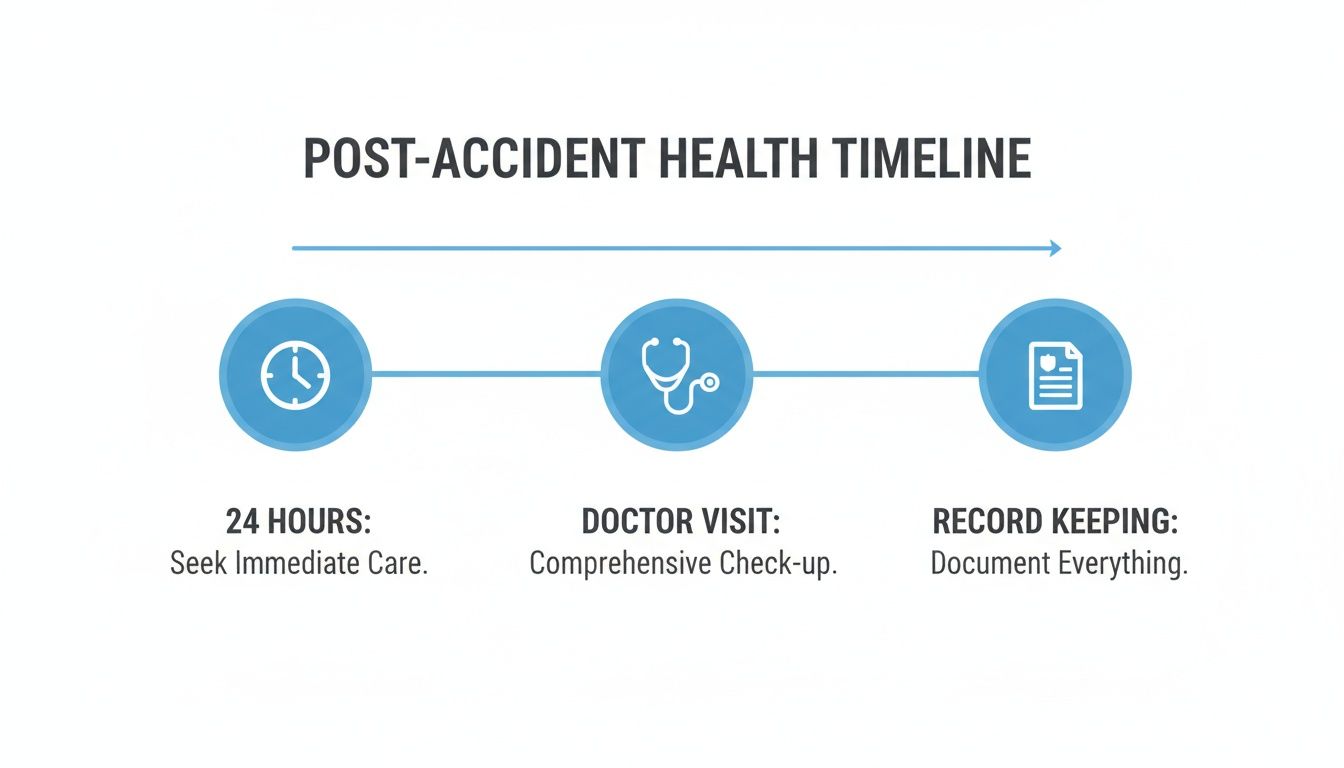
The takeaway here is simple. Acting fast creates a clear, undeniable link between the accident and your injuries. That link is everything for both your physical recovery and your legal claim.
The Critical 72-Hour Window
Getting a medical evaluation within 24 to 72 hours is non-negotiable. This visit isn't just about getting checked out; it creates an official medical record documenting every injury you have. This piece of paper becomes powerful proof that connects your physical condition directly back to the crash.
Why does this matter so much? Because insurance companies live and die by timelines. Any significant gap between the accident and your first doctor's visit gives them an opening to argue your injuries either aren't that serious or, worse, were caused by something else entirely.
From years of experience, I can tell you exactly what the adjuster will say:
"If you were really hurt, you would have gone to the doctor right away." They use this line to justify lowball offers that are just a fraction of what your claim is actually worth. Don’t hand them that argument on a silver platter.
When you see a doctor, be painfully specific about everything you feel, no matter how small it seems. Don't just say, "My neck hurts."
Explain the details:
- Where exactly is the pain?
- What kind of pain is it—sharp, dull, throbbing, or shooting?
- When did you first notice it, and what makes it worse?
- Are there other symptoms? Dizziness, blurred vision, or a new headache after car accident can all be signs of a more serious issue like a concussion that needs immediate attention.
Following Your Doctor’s Orders
Your job isn’t over after that first appointment. Following your doctor’s treatment plan to the letter is just as critical. If they recommend physical therapy, specialist visits, or certain medications, you have to do it.
Every time you skip an appointment or stop treatment early, you're sending a message to the insurance company. That message is: "I'm all better," or "My injuries weren't that bad to begin with."
To protect your health and your claim, you need to:
- Go to every single appointment. This includes all physical therapy sessions, follow-ups, and specialist consultations. No exceptions.
- Fill your prescriptions. Pick up your medications and, more importantly, take them exactly as prescribed.
- Keep everything. Start a folder for all your medical bills, reports, receipts, and even track the miles you drive to and from appointments.
- Speak up. If a treatment isn't helping or your symptoms are getting worse, tell your doctor right away.
When you consistently follow medical advice, you create a documented history of diligent care. This dismantles the insurance adjuster’s favorite arguments and helps us build a much stronger case for the full and fair compensation you deserve.
Handling Insurance Calls and Critical Deadlines
After a crash, your phone is going to ring. Sooner or later, an insurance adjuster will be on the other end. It might be your own company, but the really tricky call will come from the other driver’s insurer. Trust me, this conversation is a minefield, and what you say can make or break your claim.
First things first: you do need to report the accident to your own insurance company. It’s part of your policy. When you call them, just stick to the basic, undisputed facts—who, what, where, and when. You’re just giving them a heads-up that an accident happened. That's it.
The call you need to be wary of is from the other driver's adjuster. Their job isn’t to help you. It’s to save their company money by paying you as little as possible.
What to Avoid Saying to an Adjuster
The adjuster will probably sound friendly, maybe even concerned. They're trained to be. But they are also trained to get you to say things that can be used against you later. A common tactic is asking for a recorded statement. You are under no obligation to give one, and you should always politely say no.
Every word matters. Here’s how innocent comments can be twisted:
- They ask, "How are you?" You say, "I'm okay." They’ll write down that you admitted you weren't injured.
- You guess about how the crash happened. They'll use any tiny inconsistency to attack your credibility later.
- You try to describe your injuries before you've even seen a doctor. You might downplay something that turns out to be a serious, long-term problem.
Never give a recorded statement to the at-fault driver’s insurance company without first consulting an attorney. Their questions are designed to get you to say something that undermines your claim, and once it's on record, it's very difficult to take back.
It’s perfectly fine to say, "I'm not ready to discuss the details of the accident right now." Keep it brief, stick to the facts you know for sure, and end the call.
Pennsylvania vs. New Jersey Critical Timelines
Beyond the insurance calls, you’re also up against the clock. Both Pennsylvania and New Jersey have strict legal deadlines, called the statute of limitations, for filing a personal injury lawsuit. If you miss this window, you lose your right to sue forever, no matter how clear it is that the other driver was at fault.
Generally, you have two years from the date of the accident in both states. Two years might sound like a long time, but it flies by. Building a strong case means gathering evidence, finishing medical treatment, and getting expert opinions. Waiting until the last minute is a recipe for disaster. If you want a deeper look at these deadlines, you can learn more about how long after an auto accident you can sue.
The rules in PA and NJ have some key differences that can seriously affect your claim. Here's a quick breakdown.
Pennsylvania vs. New Jersey Car Accident Claim Timelines and Rules
Navigating a car accident claim isn't just about deadlines. The insurance rules in Pennsylvania and New Jersey are different, and the choices you made on your own policy can have a huge impact on your ability to recover money. This table highlights some of the most critical differences.
| Legal Aspect | Pennsylvania Rule | New Jersey Rule |
|---|---|---|
| Personal Injury Lawsuit Deadline | 2 years from the date of the accident. | 2 years from the date of the accident. |
| Property Damage Lawsuit Deadline | 2 years from the date of the accident. | 6 years from the date of the accident. |
| Insurance System | "Choice No-Fault" system. Drivers choose between Full Tort (unrestricted right to sue) and Limited Tort (restricted right to sue for pain and suffering). | "Choice No-Fault" system. Drivers choose a "verbal threshold" or Limitation on Lawsuit option, which restricts the right to sue for non-economic damages unless the injury is permanent. |
| First-Party Medical Benefits (PIP) | Minimum $5,000 in medical benefits coverage is required. | Drivers choose their PIP coverage level, with the standard being $15,000, but options can go up to $250,000 or be waived in certain circumstances. |
As you can see, things get complicated fast. Your "tort option" in Pennsylvania or your "verbal threshold" choice in New Jersey can determine whether you can even make a claim for your pain and suffering. Trying to figure this out while recovering from an injury and dealing with adjusters is exactly why getting a lawyer involved early is so crucial. It levels the playing field and makes sure your rights are protected from day one.
Knowing When You Need a Personal Injury Attorney

Thinking about hiring a lawyer can feel like a huge, intimidating step. A lot of people second-guess themselves, wondering if their crash was "serious enough" to make that call. That hesitation is exactly what insurance companies hope for.
The truth is, knowing when to bring in professional legal help is one of the most important parts of knowing what to do after a car accident. It isn’t about being aggressive; it’s about making sure you have a pro in your corner to protect your rights from day one.
Clear Signs You Should Call an Attorney
Certain situations are immediate red flags. If any of these sound familiar, it's time to get a professional opinion on your case.
Any Time There Are Injuries
If you or anyone in your car was hurt—even if it just seems like whiplash, soreness, or a minor concussion—you should talk to an attorney. Insurance companies are masters at downplaying injuries to keep their payouts low. A lawyer makes sure your current and future medical needs are properly valued.
The Other Driver Blames You
Arguments over who caused the crash are incredibly common. If the other driver is denying they were at fault or, worse, trying to point the finger at you, you need an advocate. An attorney can launch an investigation to get the facts straight and shut down any false claims.
The Insurance Company Gives You the Runaround
Is the adjuster dodging your calls, stalling your claim, or pushing you to give a recorded statement? These are classic tactics used to frustrate you into either giving up or accepting a lowball offer. An attorney steps in and takes over all communications, forcing the insurer to deal with a professional who knows all their games.
The Settlement Offer Seems Low
Insurers love to make quick, low offers. They hope you'll grab the cash and disappear before you realize the true cost of your accident. That first offer is almost never what your claim is actually worth.
The first offer from an insurance company isn't a fair assessment of your losses; it's a business calculation. It’s the starting point for a negotiation, and if you accept it without a legal review, you can't undo that mistake.
What Happens During a Free Consultation
"Free consultation" can sound like a cheesy sales pitch, but it's really a no-risk way to get essential information. It’s just a straightforward conversation where you can tell your story and get an honest, professional opinion about your case.
An experienced personal injury lawyer will listen to what happened and break down your legal options in plain English. There’s no pressure and zero obligation. The whole point is to give you the knowledge you need to make a smart decision.
During this talk, the attorney will:
- Go over the details of your accident.
- Discuss the type of injuries you’re dealing with.
- Explain your rights under Pennsylvania or New Jersey law.
- Outline a possible strategy for getting you compensation.
This one meeting can lift a massive weight off your shoulders. You get to see if the attorney is a good fit, and they can tell you if you have a solid claim. Finding the right advocate is crucial, and it helps to understand how to choose a personal injury lawyer who will genuinely fight for you.
The Power of a Dedicated Legal Team
When you hire a firm like Mattiacci Law, you’re not just getting one lawyer. You’re getting an entire team that manages every single part of your claim. We immediately take over all the calls and emails with the insurance companies, putting a stop to the frustrating runaround.
Our team kicks off a deep investigation, often bringing in accident reconstruction experts to prove exactly how the crash happened. We gather and dissect every piece of evidence—police reports, medical records, witness statements, expert opinions—to build a powerful case designed to get you full and fair compensation.
We prepare every single case as if it's going to trial. That intense preparation gives us a huge advantage in negotiations because it shows the insurance company we're ready for a courtroom fight. This approach puts you in the strongest possible position to recover the money you need for your medical bills, lost income, and your pain and suffering.
Common Questions After a Car Accident
After a crash, your head is probably spinning with questions. The shock wears off, and the uncertainty of what comes next can feel almost as stressful as the accident itself.
We hear the same concerns from clients every day. Below, we're giving you straight answers to the questions you're likely asking yourself right now, so you can make smart choices to protect yourself.
Should I Accept the Insurance Company's First Settlement Offer?
The short answer is almost always no. That first offer from the at-fault driver’s insurance company isn't a good-faith attempt to make you whole. It's a business tactic designed to close your claim fast and for as little money as possible.
Insurance adjusters are trained to minimize what they pay out. They know you're probably worried about medical bills piling up and getting your car fixed, and they use that financial pressure to push you into taking a lowball offer.
When you accept a settlement, you sign a release that permanently closes your claim. If your injuries turn out to be worse than you thought, you can't go back and ask for more money. It's over.
Before you even think about taking an offer, you need to know what your claim is actually worth—including future medical care and the long-term impact on your life. Having an experienced personal injury attorney look at any offer is the only way to be sure you aren't leaving a huge amount of money on the table.
What if the Other Driver Was Uninsured or Fled the Scene?
Getting hit by a driver who takes off or doesn't have insurance feels like a dead end, but you still have options. This is exactly why your own auto policy includes Uninsured/Underinsured Motorist (UM/UIM) coverage.
This coverage is a critical safety net that lets you file a claim with your own insurance company to cover your medical bills, lost wages, and other damages. Both Pennsylvania and New Jersey law make this coverage available, and it's essential for situations just like this.
But don't assume your own insurance company will make it easy. They can still try to limit their payout, making these claims surprisingly tough to navigate. An attorney's help is invaluable for a UM/UIM claim to ensure you get the full benefits you've been paying for.
How Is Pain and Suffering Calculated in a Claim?
There’s no simple calculator for “pain and suffering.” This is what we call non-economic damage, and it’s meant to compensate you for the human cost of the accident—the physical pain, the emotional trauma, and the way the injury has impacted your ability to enjoy your life.
Several things go into figuring out a fair number:
- The severity and permanence of your injuries: A broken arm that heals completely is valued differently than a permanent spinal cord injury.
- The total cost of your medical treatment: Higher medical bills often point to a more serious injury.
- How long and difficult your recovery is: Months of painful physical therapy will absolutely increase the value of your claim.
- The overall impact on your daily life: Can you no longer play with your kids, work in your garden, or enjoy the hobbies that once brought you joy?
An experienced attorney knows how to build a powerful story. We use your medical records, testimony from you and your family, and expert reports to show the insurance company exactly how this accident has turned your life upside down. This allows us to argue for a fair and just amount that truly reflects everything you’ve been through.
Navigating what comes after a car accident is tough, but you don’t have to do it alone. The legal team at Mattiacci Law is here to answer your questions, deal with the insurance companies, and fight for the full compensation you deserve. Contact us today for a free, no-obligation consultation to understand your rights and options. Visit us at https://jminjurylawyer.com to get started.