

Author: John Mattiacci | Owner Mattiacci Law
Published April 25, 2026

Just had a crash in Philly? Your heart is pounding. Traffic is still moving. Someone is saying they’re fine. Someone else is already talking about insurance. You’re trying to figure out whether to move the car, call the police, or just get out of the road.
This is the moment when people make preventable mistakes.
What you do in the first minutes and first day after a collision can affect your medical recovery, your insurance claim, and your injury case. In Philadelphia, that matters. The city records over 10,000 crashes each year within city limits, and Pennsylvania reported 110,765 vehicle crashes resulting in 1,127 fatalities and nearly 67,000 injuries, according to PennDOT-related crash data discussed here. If you’re hit on I-95, the Schuylkill Expressway, Roosevelt Boulevard, or even a crowded city street in Center City, a bad scene can get worse fast.
This isn’t a generic safety list. This is a trial lawyer’s checklist for protecting your rights and preserving claim value after a Philadelphia crash. Every step has a legal reason behind it. The police report matters. Photos matter. Same-day treatment matters. What you say to the other driver and the insurance adjuster matters.
Keep this simple. Handle the scene. Get checked out. Preserve evidence. Don’t give the insurance company ammunition.
Start here.
1. Ensure Immediate Safety and Call Emergency Services
You get hit on Roosevelt Boulevard or the Schuylkill, adrenaline kicks in, and the first bad decision usually comes fast. Someone says, “We can just exchange numbers.” Ignore that. Your first job is to protect lives and protect the record.
If the vehicles can be moved without making injuries worse, get them out of active traffic, turn on your hazard lights, and get to the shoulder, sidewalk, or another safer area. Secondary crashes are common on high-speed Philadelphia roads, and getting struck a second time can turn a manageable claim into a catastrophic one.
Then call 911.
In Pennsylvania, a crash involving injury, death, or a vehicle that cannot be driven needs to be reported. In practice, if there is any injury complaint, any real damage, or any doubt, make the call. That call matters for two reasons. It brings police and EMS to the scene, and it creates the first neutral record of what happened. Insurance companies look for gaps. A missing police response gives them one.
What to do before the story starts changing
Stay at the scene unless EMS takes you out. Do not let the other driver talk you into handling it privately. That move helps the defense, not you.
When Philadelphia police or another responding agency arrives, get the officer’s name, badge number, and the incident or report number if they have it. In a real injury case, the police report often shapes the first round of insurance decisions before anyone has your medical records or witness statements.
Keep your statements short and factual. Tell the officer what you saw, what direction you were traveling, where the impact occurred, and whether you feel pain. Do not guess about speed. Do not say “I’m fine” just because you want to get home. Do not argue fault on the roadside.
Use this checklist:
- Move to safety if you can: Get out of a live lane only if moving the vehicle will not put anyone at greater risk.
- Call 911 right away: Do that before calling family, your employer, or your insurer.
- Ask for medical help if anything feels off: Dizziness, headache, neck pain, numbness, and confusion belong in the record.
- Identify the responders: Write down police, fire, and EMS details while they are still there.
- Watch your words: Stick to facts. Stress makes people guess, and guessed facts get used against them later.
If you want a plain-English backup list after the immediate danger passes, this guide on what to do after a car accident covers the first decisions clearly.
2. Document the Accident Scene Thoroughly
Crash scenes change fast. Cars get towed. Debris gets cleared. Rain washes away marks. A city bus blocks the camera angle. A store owner turns off exterior lights. If you’re physically able, start documenting right away.
Your phone is your evidence tool. Use it.

Take wide shots first. Show the whole scene, lane positions, intersections, traffic lights, stop signs, crosswalks, street names, and nearby businesses. Then move in closer and photograph each vehicle from multiple angles, the damage, broken glass, debris, skid marks, gouge marks, and any visible injuries.
What your photos need to prove
Good scene photos help establish impact direction, lane position, sight lines, and road conditions. In a disputed red-light crash in Center City, a photo that includes the signal head, street sign, and resting position of the vehicles can be far more useful than ten close-ups of a dented bumper.
Get these images if you can:
- Vehicle positions: Photograph the cars before they’re moved, if traffic conditions allow.
- Street identifiers: Capture street signs, landmarks, SEPTA stops, storefronts, or building numbers.
- Road condition evidence: Include puddles, potholes, ice, construction plates, faded lane markings, or poor lighting.
- Visibility issues: Show weather, glare, darkness, parked cars, or obstructions near the intersection.
Email the images to yourself or upload them to cloud storage before the day ends. Phones get lost, broken, replaced, or wiped.
The insurance company will study the scene later from a desk. Your photos let you show them what it actually looked like.
If there’s a nearby business with exterior cameras, make a note of it. Don’t assume the footage will still be there later. Evidence preservation gets harder with every passing day.
3. Collect Witness Information and Statements
Independent witnesses can break a deadlock. When both drivers tell different stories, the neutral bystander often matters more than either one of them.
Don’t wait for police to gather every name. Officers may speak to some witnesses, but not all of them, and people leave quickly. If someone saw the crash, approach calmly and ask for their full name, phone number, and email address.
Ask simple questions, not leading ones
Don’t feed the witness an answer. Ask, “What did you see?” Then listen. If they mention the light was red, one car was speeding, or a driver was looking down before impact, write that down as closely to their words as you can.
A solid witness in Philadelphia isn’t always another driver. It might be:
- A bus passenger: Someone looking out the window at the intersection.
- A delivery driver: Someone stopped nearby with a clear view of lane movement.
- A store employee: Someone standing in a doorway or at a register facing the street.
- A crossing pedestrian: Someone who saw the signal phase change.
Ask where they were standing or sitting when they saw the crash. That tells your lawyer whether they had a clean line of sight. Also ask whether they took photos or video. Many people do, and they don’t volunteer that information unless asked.
If the crash happened near a business, note the name and address immediately. In Pennsylvania injury cases, early evidence collection matters. One reason is timing. Evidence preservation becomes especially important within 24 to 48 hours, and surveillance footage is often overwritten within 30 to 60 days, according to this discussion of early evidence preservation in Pennsylvania claims.
That same urgency applies after a vehicle crash. Get the witness. Identify the camera. Preserve the scene before it disappears.
4. Exchange Information with Other Parties
You need the right information from every involved driver. Not half of it. Not a phone number scribbled on a receipt. Everything.
Get the driver’s full name, address, phone number, driver’s license number, license plate number, vehicle make and model, insurance company, and policy information. If it’s a work vehicle, get the employer name too. If it’s a rideshare or delivery vehicle, note that clearly.
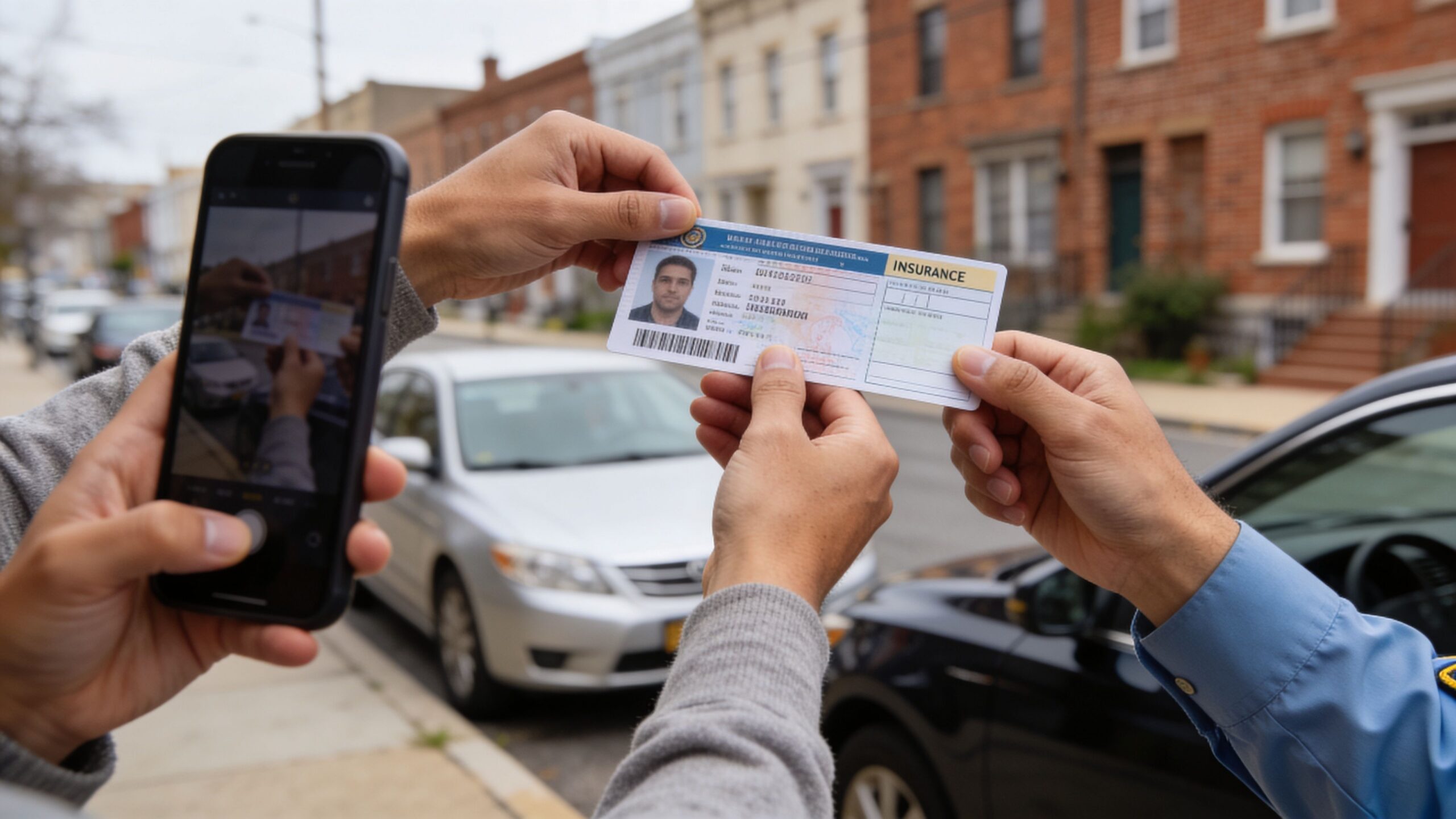
Take photos of the insurance card, registration, driver’s license, and the plate. People transpose digits. They give old addresses. They hand over expired cards. A photo cuts down on avoidable mistakes.
Keep the conversation controlled
This is not the time to debate fault. Don’t accuse. Don’t apologize. Don’t say, “I never even saw you.” Don’t say, “I’m probably okay.” Every one of those statements can be reused later.
Use this script if you need one:
- Confirm identity: “I need your license and insurance information.”
- Stay factual: “Police are on the way.”
- Avoid fault talk: “We can let the investigation sort that out.”
- End the conversation: “I’m going to document the scene and wait for the officer.”
If the other driver seems impaired, agitated, or tries to leave, tell police immediately. If it becomes a hit-and-run, immediate reporting matters because police may be able to use witnesses, scene evidence, and nearby surveillance to identify the driver. Under Pennsylvania law, drivers involved in a crash are required to stop and remain at the scene in the situations described earlier.
One more thing. If the vehicle belongs to a city agency or involves a SEPTA bus, don’t treat it like an ordinary private-car case. Claims involving government entities can involve a six-month notice requirement, as explained in this discussion of claims involving government entities in Philadelphia. Miss that deadline and you can lose rights fast.
5. Seek Medical Evaluation and Document All Injuries
Go get checked out the same day. Don’t wait to “see how you feel tomorrow.” That decision hurts people medically and legally.
After a crash, adrenaline can mask pain. Concussions, soft tissue injuries, internal bleeding, and other trauma may not show up right away. Delayed symptom onset can happen within 24 to 72 hours, and delayed treatment for traumatic brain injuries leads to worse outcomes, as discussed in this Philadelphia accident treatment article.

Why same-day care matters to your case
Insurance adjusters look for gaps. If you wait days to seek treatment, they often argue one of two things: you weren’t really hurt, or something else caused the injury. Prompt treatment creates a clean timeline between the crash and the symptoms.
Tell the doctor everything. Headache. Neck stiffness. Ringing in your ears. Dizziness. Numbness. Chest pain from the seat belt. Trouble concentrating. Trouble sleeping. If you leave it out, don’t expect the record to include it.
Go to the ER, urgent care, or your doctor right away. “I felt okay at first” is one of the most common phrases insurers use against injured people.
Follow-up care matters too. Go to the appointments you’re told to attend. Fill prescriptions. Start therapy if it’s recommended. Keep discharge papers, imaging results, work notes, and bills. If mobility becomes an issue at home, practical equipment and support can matter during recovery, including guidance on safe patient transfer techniques.
Mattiacci Law also explains the timing issue well in this guide on how soon you should see a doctor after an accident.
6. Report the Accident to Your Insurance Company
A Philadelphia crash can turn into an insurance trap fast. You call to open the claim, the adjuster sounds friendly, and ten minutes later you have handed over facts they will use to cut the value of your case.
Report the crash to your own insurer promptly. Do it the same day if you can. Pennsylvania policies usually require timely notice, and you do not want your own carrier arguing late reporting while you are still trying to get treatment and sort out the police paperwork.
Keep the first report tight. Give the date, time, location, the vehicles involved, and the police report number if you have it. Tell them where the car is, whether it can be driven, and whether you got medical care. Then stop. You are opening a claim, not giving testimony.
What to say, and what to avoid
Use simple, factual language. If you do not know an answer, say that. If you have not been fully checked out yet, say you are still being evaluated.
Avoid four mistakes that hurt claims every day:
- Do not guess about details: Speed, distance, light timing, lane position, and impact angle get people in trouble when they guess.
- Do not downplay your injuries: "I'm okay" can show up in the claim notes long before your neck, back, or concussion symptoms fully set in.
- Do not admit fault: Pennsylvania uses comparative negligence. What you say on day one can affect how much you can recover later.
- Do not agree to a recorded statement without thinking it through: The other side wants to lock you into answers before the medical picture is clear.
If police did not respond, do not assume the reporting issue disappears. Pennsylvania law can require a report to PennDOT when a crash involves injury, death, or damage serious enough that a vehicle has to be towed. Handle that promptly. Deadlines matter, and sloppy reporting gives insurers another angle to use against you.
Keep a claim log from the start. Write down the date and time of every call, who you spoke with, their direct number, the claim number, and what was discussed. Save emails, letters, texts, app messages, and voicemail screenshots. That paper trail helps your lawyer pin down what the insurer knew, when they knew it, and whether they started playing games early.
If the other driver's insurer calls, be careful. You do not owe them a full interview on their schedule. Give basic identifying information if needed, then slow the process down and get advice about whether you should get a lawyer after an accident in Philly. That one call can shape fault arguments, injury disputes, and settlement value.
7. Consult with a Personal Injury Attorney Immediately
Talk to a lawyer early. Not after weeks of voicemail with adjusters. Not after you’ve signed medical authorizations you don’t understand. Not after a quick settlement offer lands in your inbox.
A good Philadelphia injury lawyer does more than file paperwork. The lawyer preserves evidence, secures footage, gets witness statements on record, reviews medical issues, handles insurer communications, and identifies deadline problems before they wreck the case.
Early legal help matters more than people think
Pennsylvania’s statute of limitations for personal injury claims is two years from the date of the crash, but waiting is still a mistake. Evidence can disappear long before that. Witness memory fades quickly. Video gets overwritten. Property damage gets repaired. Cars get sold.
That timing issue gets even more serious if the crash involved a government vehicle, a dangerous roadway condition, or a SEPTA bus. Those cases can raise special notice requirements and procedural traps.
Bring these items to the first consultation if you have them:
- Crash documents: Exchange sheet, report number, photos, and any incident paperwork.
- Medical records: Discharge papers, urgent care records, prescriptions, and appointment lists.
- Insurance details: Your policy, claim number, and any letters or emails from insurers.
- Witness information: Names, numbers, and notes about what each witness saw.
A lawyer can’t change the facts of the crash. A lawyer can stop the insurance company from controlling the facts that survive.
If you’re weighing whether it’s worth hiring counsel, review Mattiacci Law’s guide on whether you should get a lawyer after an accident in Philly. If your injuries are serious, liability is disputed, or a commercial or government vehicle is involved, get legal help immediately.
8. Maintain Detailed Records of All Damages and Losses
Your claim is only as strong as the proof behind it. People remember the crash, but they forget the receipts, mileage, prescriptions, missed work, and daily disruption. That’s where value gets lost.
Start a file the day of the accident. Use a folder, cloud drive, notes app, spreadsheet, or all of the above. Keep every document tied to the crash in one place.
Build the paper trail insurers can’t dismiss
You’re not just tracking bills. You’re documenting how the crash changed your life.
Keep records for:
- Medical costs: Bills, copays, imaging, therapy, prescriptions, braces, and equipment.
- Wage loss: Pay stubs, employer letters, missed shifts, PTO use, and reduced hours.
- Vehicle loss: Repair estimates, total-loss paperwork, rental car charges, towing, and storage.
- Out-of-pocket expenses: Parking at appointments, transportation, childcare, and household help.
- Daily impact: Pain levels, sleep problems, missed events, and limits on work or normal activities.
A short daily journal helps more than people expect. Write down what hurts, what you couldn’t do, whether you missed work, whether you needed help getting around, and how the injury affected your concentration, mood, or sleep. Keep it plain and honest. Juries and adjusters respond better to consistent detail than dramatic language.
If there’s any chance your injuries are more serious than they first seemed, this record becomes even more important. Hidden injuries can become contested injuries very quickly. One issue that often gets overlooked is the need to establish a clear early timeline for symptoms that don’t fully appear at the scene, especially head injuries, as discussed in this article on post-crash steps and delayed injuries in Philadelphia.
Philadelphia Post-Crash: 8-Step Comparison
| Action | Implementation complexity | Resource requirements | Expected outcomes | Ideal use cases | Key advantages |
|---|---|---|---|---|---|
| Ensure Immediate Safety and Call Emergency Services | Low, urgent, procedural | 911/emergency responders, basic safety actions | Police report, medical aid, scene secured, official timeline | Injuries, major damage, traffic hazards, hit-and-run | Life-saving care, official documentation, police witnesses |
| Document the Accident Scene Thoroughly | Medium, requires technique and speed | Smartphone/camera, time, image backup | Time-stamped visual evidence supporting reconstruction | Liability disputes, complex damage, transient evidence | Objective proof, preserves scene before changes |
| Collect Witness Information and Statements | Medium, interpersonal effort | Pen/phone, time, witness cooperation | Independent accounts, contact details for testimony | Conflicting accounts, busy intersections, pedestrian incidents | Credible third-party corroboration of events |
| Exchange Information with Other Parties | Low, routine but important | IDs, insurance cards, smartphone photos | Enables claims, identifies involved parties | All accidents (legally required in PA) | Prevents ID disputes, necessary for insurance filing |
| Seek Medical Evaluation and Document All Injuries | Low to Medium, immediate action with ongoing follow-up | Medical providers, diagnostics, medical records | Medical causation, diagnosis, treatment records | Any injury, delayed symptoms, severe trauma | Establishes injury link to crash, supports damages |
| Report the Accident to Your Insurance Company | Low, but strategically sensitive | Policy details, police report number, documentation | Claim initiation, coverage activation, recorded notice | Filing medical/vehicle claims, policy compliance | Preserves coverage, prevents denial for late notice |
| Consult with a Personal Injury Attorney Immediately | Medium, legal coordination | Attorney (contingency fees), case documents, expert coordination | Case evaluation, negotiated settlements, litigation readiness | Serious injuries, complex or disputed liability, low offers | Maximizes compensation, handles insurers, preserves evidence |
| Maintain Detailed Records of All Damages and Losses | Medium to High, ongoing documentation | Receipts, medical bills, wage statements, spreadsheets | Accurate damage calculations, stronger negotiation position | Long-term injuries, lost wages, extensive property damage | Comprehensive proof of economic and non-economic losses |
Don't Navigate This Alone. Take the Final Step
A crash in Philadelphia turns into a legal case faster than many expect. One minute you’re dealing with pain, towing, and a wrecked car. The next, you’re fielding calls from adjusters, trying to schedule treatment, and hearing subtle suggestions that your injuries aren’t that serious or that the facts are somehow unclear.
That’s why these steps matter.
Calling 911 creates a record. Photos preserve a scene that won’t stay the same. Witness names protect you when stories change. Proper information exchange keeps the claim from stalling on basic identification issues. Same-day medical care helps protect your health and draws a clean line between the crash and your injuries. Careful insurance reporting prevents loose statements from being turned against you. Early legal help protects evidence and deadlines. Good recordkeeping supports the full scope of your losses, not just the bills that arrived first.
Philadelphia is a high-crash environment, and serious collisions happen on expressways, neighborhood streets, commercial corridors, and transit routes. Some cases involve private drivers. Others involve trucks, buses, rideshare vehicles, work vehicles, or even government entities. The more complicated the facts, the more dangerous it is to handle everything casually.
You also don’t need to wait until you “know how bad it is” to speak with a lawyer. That’s another common mistake. In many cases, the most important legal work happens early, while evidence can still be preserved and before the insurance company has boxed you into a damaging version of events.
If you’ve been hurt, focus on getting proper treatment and protecting your recovery. Let a trial-ready legal team deal with the investigation, the insurer pressure, the paperwork, and the strategy behind the claim. That’s how strong cases are built.
Mattiacci Law handles serious injury claims in Philadelphia and prepares cases as if they’re going to trial. That approach matters. Insurance companies evaluate cases differently when they know the lawyer on the other side is prepared to prove the case, not just process it.
If you’re unsure what to do next, get answers now. A free consultation can clarify your options, identify immediate risks, and help you avoid mistakes that can weaken an otherwise valid case. You don’t have to figure this out alone, and you shouldn’t.
If you were injured in a Philadelphia crash, contact Mattiacci Law for a free consultation. The firm can review what happened, explain your rights under Pennsylvania law, preserve key evidence, handle the insurance companies, and pursue the full compensation your case deserves.