


Author: John Mattiacci | Owner Mattiacci Law
Published April 12, 2026
You’re probably reading this with your heart still pounding.
Maybe the crash happened this morning on I-95, Broad Street, Roosevelt Boulevard, or a neighborhood block where traffic never seems to make sense. Maybe your car is in the shop, your neck hurts, your phone keeps buzzing with insurance calls, and everyone is telling you something different. One person says, “It’s straightforward.” Another says, “Just let insurance handle it.”
My advice is simpler than that. If you were hurt in a Philadelphia accident, don’t assume this will sort itself out. Serious injury claims in this city go bad fast when the injured person waits too long, talks too much to the wrong people, or trusts the insurance company to be fair.
Should I Get a Lawyer After an Accident in Philly? If you have real injuries, disputed fault, a commercial vehicle involved, or insurance problems, yes. You should. Not later. Now.
The Moments After a Crash in Philadelphia
The first few minutes after a collision are messy. You hear tires, glass, horns, somebody yelling that they already called 911. You check your hands, your legs, your head. You try to figure out whether the pain is adrenaline or something worse.
Then the practical problems hit. Is the car drivable? Did anyone see what happened? What do you tell the officer? Should you answer the other driver’s insurance company if they call before you even get home?
That confusion is normal. It’s also when people make mistakes that follow them for months.

Philly crashes are constant, not rare
Philadelphia roads are not forgiving. According to PennDOT crash statistics summarized here, Philadelphia County had 10,417 crashes in a single recent year, which works out to more than one crash every hour, and 63% resulted in injury or death.
That matters for one reason. Insurance companies handling Philadelphia claims are not seeing your case as a unique emergency. To them, it’s another file in a city with a heavy volume of serious wrecks. They have systems for that. Scripts for that. Delay tactics for that.
You need a system too.
The first day matters more than many realize
A lot of injured people think they can wait a week before deciding what to do. That’s often a mistake.
Evidence starts disappearing right away. Vehicles get repaired. Surveillance footage gets recorded over. Witnesses stop answering their phones. Pain that felt minor at the scene turns into a real diagnosis after the adrenaline wears off.
Practical rule: If you were hurt, act like every hour after the crash matters, because it does.
If you need a straightforward checklist before anything else, this guide on what to do after a car accident is a good place to start.
What I’d want you to understand right now
Three things.
- Your case started at the crash scene. Not when the insurance adjuster called.
- Your words will be used against your claim. Even polite, casual comments can be twisted into admissions.
- The “simple” cases are often the ones that become expensive fights. Especially when pain gets worse, treatment continues, or fault gets disputed.
If you’re asking whether you should get a lawyer after an accident in Philly, you’re already at the stage where legal advice probably helps. People with minor, no-injury bumps usually aren’t searching for this question. Injured people are.
Protecting Your Rights Immediately After an Accident
You don’t need to know personal injury law at the crash scene. You do need to avoid the common mistakes that wreck good claims.
What to do at the scene
Start with your health. Get medical help if you need it. If paramedics recommend evaluation, listen.
Then do the work that preserves the facts.
- Call police and get a report started. You need a documented record that the crash happened.
- Take photos wider than you think you need. Photograph the vehicles, the lane positions, skid marks, debris, street signs, weather, traffic signals, and any visible injuries.
- Get witness names and contact information. Independent witnesses can matter more than either driver’s version.
- Exchange driver and insurance information. Keep it factual and brief.
- Do not argue about fault. Don’t apologize. Don’t speculate. Don’t say, “I’m fine,” if you don’t know whether you are.
A short sentence is enough: “I want to cooperate, but I’m not discussing fault at the scene.”
What to do in the next few hours
A lot of legitimate injuries don’t show themselves immediately. Concussions, back injuries, and soft-tissue injuries often become obvious later.
Get checked even if you walked away from the crash. “I felt okay at first” is common. It’s also how people delay the diagnosis that proves their claim.
After that, keep your file organized.
- Save every medical paper. Discharge paperwork, prescriptions, referrals, imaging orders.
- Create a photo folder on your phone. Add bruising, swelling, casts, medications, and vehicle damage.
- Write down what hurts. Daily notes about sleep, headaches, missed work, and physical limits become useful later.
- Report the crash to your insurer. Give the basics. Don’t give a recorded statement to the other side without legal advice.
What not to do
These mistakes come up constantly.
- Don’t post about the crash on social media. Innocent photos and comments get misread.
- Don’t skip treatment. Gaps in care give insurers ammunition.
- Don’t sign broad releases early. You may hand over far more than necessary.
- Don’t let language problems create confusion. If English isn’t your first language, or important records need translation, use expert linguistic services for legal documents so your medical history, statements, and paperwork are accurate.
The goal in the first days
You’re doing two things at once. You’re protecting your health, and you’re preserving proof.
That’s it. Keep it simple. Get treatment. Document everything. Say little. Save records. If your injuries are more than minor soreness, get legal advice before the insurance company defines your case for you.
Red Flags That Signal You Need a Lawyer Now
Some accidents are property-damage problems. Many can tell the difference.
If your situation includes any of the red flags below, stop wondering and talk to a lawyer.
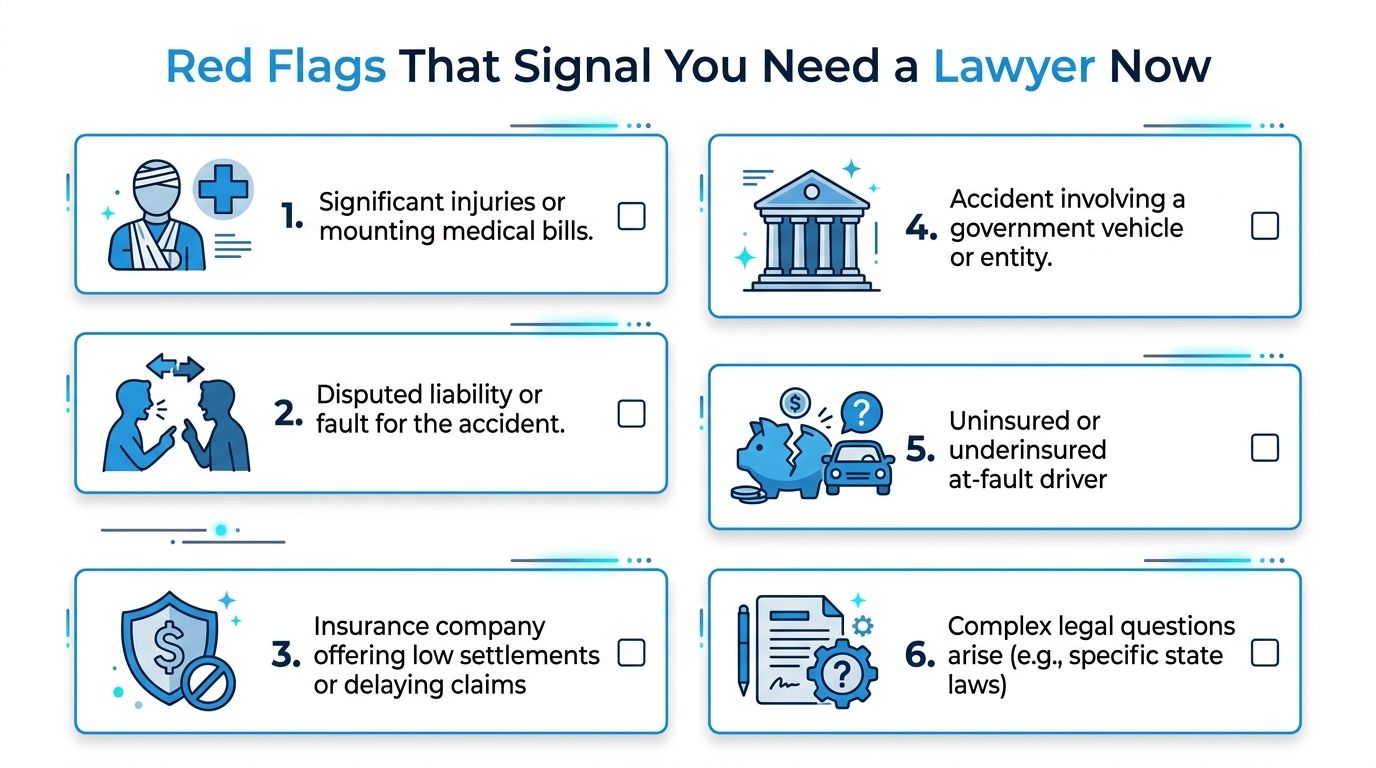
Injury that goes beyond a quick checkup
If you needed an ER visit, follow-up care, imaging, physical therapy, a specialist, or surgery consults, you are not in a small claim anymore.
That’s especially true when the injury affects work, sleep, driving, lifting, or childcare. Once the case starts touching your daily function, insurance companies start looking for ways to minimize it.
Fault is being disputed
If the other driver says you caused it, or the adjuster starts asking loaded questions, your case has already moved into contested territory.
That includes rear-end crashes with odd lane-change issues, intersection wrecks, left-turn cases, pedestrian claims, rideshare claims, and anything involving multiple vehicles.
If liability is disputed, the legal fight starts before anyone talks settlement.
The insurance company is moving too fast or too slow
Fast is suspicious. Slow is suspicious too.
A quick offer often means the insurer thinks you don’t know what your case may become. A long silence often means they’re waiting for you to get frustrated, miss steps, or accept less.
The at-fault driver may not have enough coverage
This is a big Philadelphia problem. According to this discussion of Philadelphia uninsured and underinsured driver issues, minimum liability coverage can be just $15,000, and cases where recovery problems involve uninsured or underinsured drivers affect 30-40% of claims nationwide.
If your medical bills are already serious, low coverage can cripple a claim unless someone checks for every available source of recovery, including your own UM/UIM coverage. If you’re dealing with an insurer refusing to pay, this explanation of what happens if the at-fault driver's insurance won't pay in Pennsylvania can help you understand the pressure points.
A government or commercial vehicle is involved
SEPTA buses, city vehicles, work trucks, delivery vehicles, and contractor vehicles create complications ordinary drivers don’t expect.
Those cases can involve layered insurance, company investigators, special notice issues, electronic records, and fights over who was responsible.
Do You Need a Lawyer? A Quick Checklist
| Situation | Do You Need a Lawyer? |
|---|---|
| You only have vehicle damage and no injury symptoms | Probably not immediately, but monitor your condition |
| You have ongoing pain, treatment, or missed work | Yes |
| The other driver blames you | Yes |
| The insurer made a fast low offer | Yes |
| The driver may be uninsured or underinsured | Yes |
| A truck, bus, work vehicle, or government vehicle was involved | Yes |
| You’re unsure what your own policy covers | Yes |
My direct answer
You don’t hire a lawyer because the case feels dramatic. You hire one because the claim has risk.
And once serious injury, fault disputes, low coverage, or complex insurance enters the picture, the risk is real.
The Dangers of Handling a Serious Philly Claim Alone
A serious claim is not a paperwork exercise. It’s a controlled fight over fault, medical proof, and money.
People get into trouble when they think the adjuster is just gathering information. The adjuster is evaluating exposure. That’s a different goal.

Comparative negligence can kill a claim
Pennsylvania follows comparative negligence under 42 Pa.C.S. § 7102. As explained in this summary of Pennsylvania at-fault accident law, your recovery is reduced by your share of fault, and you recover nothing if you are found 51% or more at fault.
That rule sounds simple until you see how it plays out in real cases.
A driver says you were speeding. Another says you turned late. The report is incomplete. The insurer pushes your fault percentage upward. Suddenly the whole case is about blame, not injury.
The same source states that attorney involvement boosts net payouts by an average of 3.4 times because lawyers push back against those fault arguments with evidence instead of guesswork.
Limited tort catches people off guard
A lot of drivers don’t even know what tort option they chose on their own policy. Then they learn about it after they’re hurt.
If you selected limited tort, your ability to recover for pain and suffering may be restricted. That becomes a serious problem when the insurer already wants to minimize the claim. A lawyer reviews the policy, the available exceptions, and the actual injury facts before the defense defines the issue for you.
Insurance adjusters are trained for this
You are not dealing with a neutral person trying to “help process” your claim.
You are dealing with someone whose job is to:
- Narrow your injury story
- Lock you into an early version of events
- Use gaps in treatment against you
- Argue your pain is unrelated or overstated
- Push settlement before the full picture is known
The biggest self-representation mistake is talking before you understand the legal consequences of what you’re saying.
Why handling it yourself usually backfires
People think they’re saving fees by doing it alone. In serious cases, they usually save nothing.
They miss categories of damages. They don’t know what records matter most. They accept fault allocations they should fight. They treat the police report like the final word when it often isn’t. They settle before future treatment becomes clear.
If your case is serious enough that the insurance company has meaningful money at risk, it’s serious enough for them to use every available defense. You should expect that and prepare accordingly.
What a Trial-Focused Attorney Will Do for You
A good lawyer doesn’t just send demand letters. A trial-focused lawyer builds the case as if a jury may have to decide it.
That approach changes everything, starting with evidence.

Preserving the evidence that disappears first
One of the most important examples is the vehicle’s event data recorder, often called the EDR or black box.
According to this explanation of Philadelphia accident evidence and EDR data, the EDR records key pre-crash information like speed and braking, and that evidence is often lost within 30 days. The same source notes that police reports alone err in fault assignment 25-35% of the time, while EDR-supported cases can produce significantly stronger settlements.
That’s why a serious lawyer moves quickly with preservation letters, vehicle inspections, and demands that relevant evidence not be destroyed.
Building proof, not just collecting papers
A proper case build usually includes:
- Securing videos early from nearby businesses, traffic cameras, dashcams, or transit sources
- Interviewing witnesses while memories are fresh
- Organizing medical records into a coherent timeline
- Working with reconstruction experts when liability is disputed
- Using treating doctors and specialists to explain the injury impact clearly. Preparation separates trial lawyers from settlement mills.
Taking the pressure off you
A lawyer should also shut down the chaos.
That means handling calls, controlling insurer communication, preparing you for necessary statements, gathering records, and keeping the claim moving while you focus on treatment.
If you want a rough starting point for what damages categories may exist, a Personal Injury Settlement Calculator can help you think through medical expenses, lost income, and other claim components. It’s not a valuation of your case, but it can help you understand what questions to ask.
Why trial readiness matters in settlement talks
Insurance companies pay attention to who is on the other side.
If they think the lawyer won’t file suit, won’t hire experts, won’t push discovery, and won’t try the case, that affects the offer. If they believe the case is prepared for litigation, the conversation changes.
Mattiacci Law handles serious injury claims in Philadelphia and New Jersey with that trial-preparation model. That means investigating early, working with medical and accident experts, and preparing the case for litigation if the offer doesn’t reflect the harm done.
A lawyer’s value is not just in negotiation. It’s in forcing the other side to take your case seriously.
How to Choose the Right Philadelphia Accident Lawyer
Not every injury firm is built the same. Some are case processors. Some are litigators. You need to know which one you’re talking to.
If your injuries are real, choose carefully.
Ask how they handle serious cases
The value gap between a minor claim and a serious one can be enormous. According to this discussion of average personal injury settlement ranges in Pennsylvania, many minor injury claims settle in the $10,000-$25,000 range, while severe cases involving surgery or permanent disability can exceed $300,000 or even $1 million.
That’s why valuation matters. A lawyer who doesn’t understand future medical care, lost earning capacity, and pain and suffering can undervalue your case before it ever gets off the ground.
The questions I’d ask in a consultation
Use the consultation to test the lawyer, not just tell your story.
- Will you personally handle my case, or will I be passed around?
- How often do you file suit when the offer is unfair?
- Have you handled claims involving my kind of injury or vehicle?
- Who gathers the evidence early?
- How do you approach disputed liability?
- What does your fee arrangement look like, and what costs should I expect?
A good answer is clear and direct. A bad answer sounds scripted.
Trial firm versus settlement mill
Here’s the practical difference.
| Type of firm | What you’ll usually see |
|---|---|
| Trial-focused firm | Early investigation, careful evidence preservation, serious negotiation backed by litigation readiness |
| High-volume settlement mill | Fast intake, heavy staff turnover, pressure to settle before the case is fully developed |
You don’t need flashy slogans. You need competence, access, and strategy.
Look for fit, not just advertising
The right lawyer should explain things in plain English, answer hard questions directly, and make you feel informed rather than handled.
That includes whether they take calls, whether they know the local courts, and whether they can explain why your case is worth more than the insurer’s first number.
If you want a deeper framework for screening firms, this guide on how to choose a personal injury lawyer is useful.
One more point about cost
Most reputable personal injury lawyers handle these cases on a contingency fee. That means you don’t pay upfront attorney fees, and the fee comes from the recovery if the case succeeds.
That structure matters because it lets injured people hire serious representation without writing a check in the middle of a medical and financial crisis.
Frequently Asked Questions About Philly Accident Claims
Can I afford to hire a lawyer?
Usually, yes. Most accident lawyers handle injury claims on a contingency fee basis. No upfront fee. The lawyer gets paid from the recovery if there is one.
Ask for the fee agreement in writing and read it carefully.
The other driver’s insurance company keeps calling. Should I talk to them?
Be careful. You can report basic facts like the date and location of the crash to your own insurer, but don’t give the other side a recorded statement without legal advice.
They are not calling to help you value your case. They are gathering material they may later use to limit or deny it.
“I’m not prepared to give a statement today” is a complete answer.
What if the police report says I was at fault?
That hurts, but it is not the final word.
Police reports matter. They do not decide civil liability by themselves. Officers often arrive after the impact and may not have every witness, every video angle, or every piece of physical evidence. A lawyer can challenge the story with better proof.
How long do I have to file a claim in Pennsylvania or New Jersey?
Deadlines matter a lot, and they can change depending on the type of defendant and where the crash happened. Claims involving public entities can have shorter notice requirements than ordinary car wrecks.
Don’t guess on timing. Don’t rely on what a friend says. Get legal advice early enough that evidence and deadlines are protected.
Do I still need a lawyer if I think I was partly at fault?
Yes. Especially then.
Partial fault cases are where legal representation often matters most, because the fight becomes about how much blame gets pinned on you and whether that wipes out your recovery.
What if I already started a claim on my own?
That’s common. You can still talk to a lawyer.
Bring the letters, emails, claim number, photos, medical records, and anything you signed. A lawyer can tell you quickly whether the claim can still be redirected before more damage is done.
When is it okay to handle it myself?
If it is a minor property-damage matter with no injury, no treatment, no lost time, and no dispute, you may not need a lawyer.
But once there is meaningful pain, ongoing treatment, lost income, fault arguments, low insurance limits, or pressure from adjusters, you are in lawyer territory.
If you were hurt and you need a direct answer about what your case is worth, who may be at fault, or what to do before talking to insurance again, contact Mattiacci Law for a free consultation. The firm handles serious injury cases in Philadelphia and New Jersey, works on a no-win, no-fee basis, and can review the facts before you make a mistake that costs you your claim.