


Author: John Mattiacci | Owner Mattiacci Law
Published May 11, 2026

A lot of Philadelphia drivers have the same story. The crash didn't look terrible. You got rear-ended at a light, clipped in traffic on I-76, or bumped in an intersection downtown. You exchanged insurance information, looked over the car, and told yourself you were lucky because you could still stand, walk, and talk.
Then the next morning your neck won't turn. By the second day, the headache starts. A few days later, your lower back tightens, your shoulder burns, or you can't focus the way you normally do.
That experience is common, and it creates a serious problem. The medical problem is obvious. The legal problem is less obvious, but in many cases it becomes just as important. Insurance companies love delayed symptoms because they give adjusters room to argue that the crash “couldn't have been that bad” or that the injury came from something else.
Delayed Injury After Car Accident in Philadelphia cases often turn on one issue above all others. Causation. Not whether you hurt now, but whether you can prove the collision caused what you're feeling today.
That "Minor" Accident Might Be a Major Problem
A so-called minor crash often becomes major after the scene is over.
A driver gets tapped from behind on Kelly Drive. Airbags don't deploy. The cars are still drivable. Nobody wants to spend the afternoon waiting around, so both drivers exchange information and move on. At the scene, the injured driver says the same thing many people say: “I'm okay.”
That statement feels harmless in the moment. It often isn't. Hours later, the stiffness starts. By the next day, it hurts to sit, turn the head, or lift a bag. A week later, the person is missing work, sleeping poorly, and wondering why the pain is getting worse instead of better.
That's one reason people get trapped after a crash with no immediate medical record or police involvement. If that sounds familiar, this guide on a minor accident without a police report in Philly explains the evidence problems that can follow.
The part that confuses people
Delayed pain makes people second-guess themselves. Friends may say it's just soreness. Adjusters may sound polite while building a denial around the fact that you walked away from the scene. Even some victims start wondering whether they're overreacting.
They usually aren't.
The body doesn't always report damage immediately. A crash can strain the neck, back, brain, and soft tissue before pain fully develops. That delay is medically real, and in legal claims it's one of the first things an insurance company tries to exploit.
You can feel functional at the scene and still have a legitimate injury that shows up later.
What usually goes wrong
The biggest mistakes happen early:
- People wait too long: They hope symptoms will fade, and the treatment gap gets longer.
- They minimize the crash: They tell insurance they're “fine” before they know whether that's true.
- They fail to document changes: No notes, no photos, no timeline, no follow-up.
If you're reading this with neck pain, headaches, back stiffness, dizziness, or numbness after a Philadelphia crash, the confusion you're feeling is normal. The mistake is thinking delayed symptoms mean a weak case. They don't. They mean the case has to be built correctly.
Why Pain Hides The Biological Truth of Delayed Injuries
The reason delayed injuries confuse so many people is simple. Pain doesn't always arrive at the same time as damage.
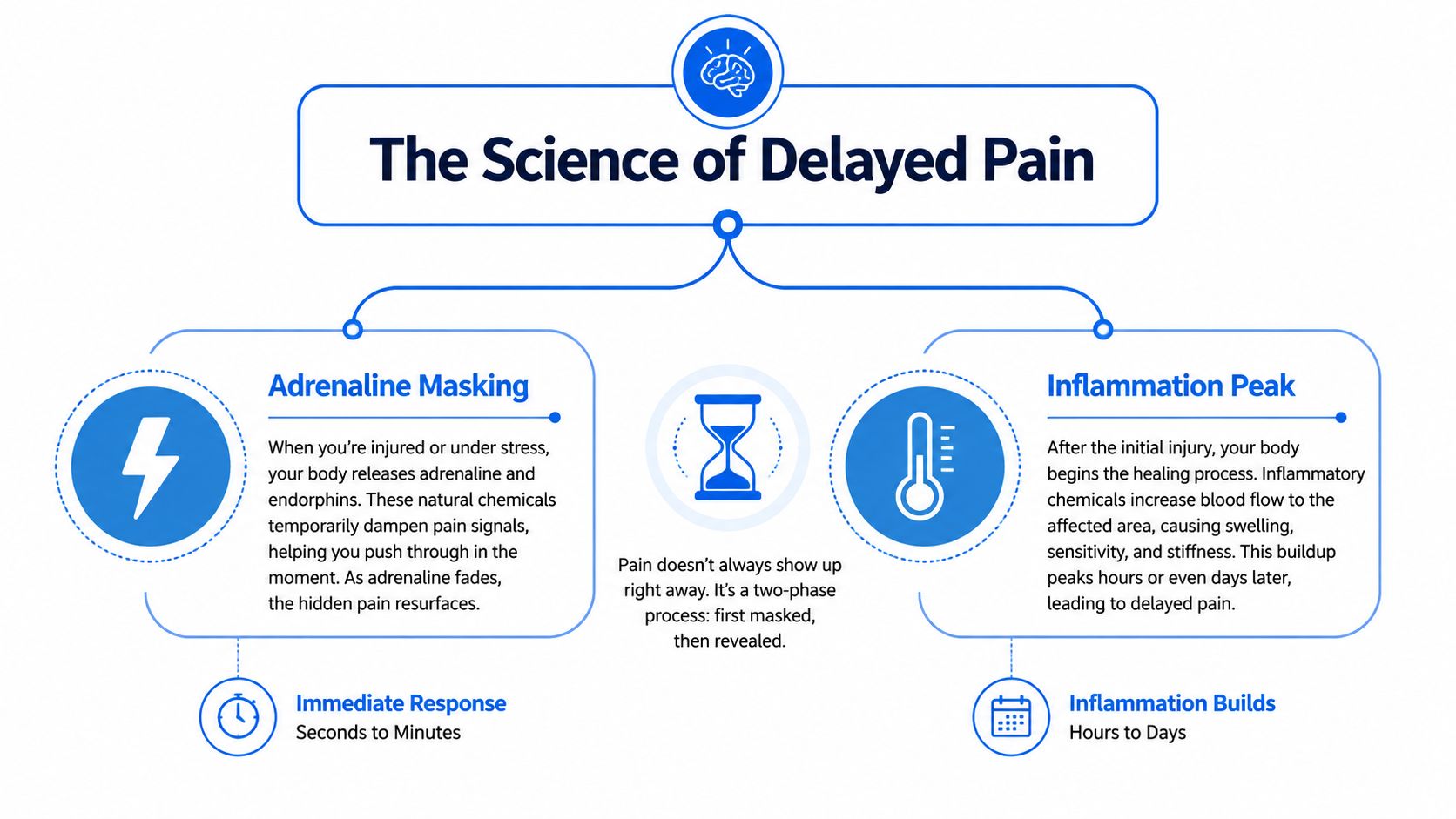
During a crash, your body shifts into survival mode. According to this discussion of delayed injury symptoms after a car accident, the mechanism behind delayed symptoms includes adrenaline-mediated pain masking and a biphasic inflammatory response. During trauma, catecholamine release suppresses pain perception, and soft tissue injuries such as whiplash can remain asymptomatic for 24 to 48 hours while swelling and inflammation build.
Adrenaline first, pain later
The damage begins first, much like a fire alarm that does not sound the very moment a wire starts burning. The warning comes after.
Right after impact, your system pumps out stress chemicals that can blunt pain and keep you moving. That's why people sometimes get out of the car, make phone calls, and feel “mostly okay,” only to wake up the next day in real pain. The body was busy getting through the event. It wasn't giving you a full report.
Inflammation is often what you actually feel
Whiplash is a good example. Tiny tears can occur in muscles, tendons, and ligaments at the moment of impact. But the swelling that makes those injuries painful takes time to develop. As fluid builds and tissues become irritated, stiffness, reduced range of motion, and pain start to show up.
The same delayed pattern can happen with concussive symptoms. A person may not notice much at the scene, then later develop headaches, dizziness, confusion, memory trouble, or unusual fatigue.
Practical rule: If symptoms appear after a crash, treat the timing as part of the injury, not proof that nothing happened.
What helps and what doesn't
Some people also explore symptom-management tools while they follow medical advice. For readers trying to understand one supportive therapy used in some recovery settings, MedEq Fitness has a clear guide to hyperbaric therapy. It isn't a substitute for diagnosis, imaging, or physician-directed treatment, but it helps explain why people look beyond basic rest when symptoms linger.
What doesn't help is waiting around without creating a record. If you haven't been checked yet, this page on how soon you should see a doctor after an accident addresses why that first visit matters even when symptoms seem mild.
Here is the legal reality behind the biology:
| What happens in your body | What the insurer argues |
|---|---|
| Adrenaline masks pain at first | “You said you felt fine.” |
| Swelling builds over time | “The delay means it came from somewhere else.” |
| Symptoms worsen over days | “If it were serious, you'd have gone sooner.” |
That mismatch is exactly why delayed injury claims need to be handled carefully from the start.
Common Delayed Injuries We See in Philadelphia Accident Victims
Philadelphia crashes happen constantly, and delayed injuries are part of that picture. According to Philadelphia car accident statistics, the city has over 10,000 reported crashes annually. In 2022, Philadelphia had 8,714 crashes causing 134 deaths and 5,549 injuries, which works out to nearly 28 crashes every day. In a city with that level of collision volume, it's not surprising that injuries like whiplash, concussions, and soft tissue damage often show up hours or days later.

Neck and soft tissue injuries
Rear-end collisions are classic setups for delayed neck pain. The head snaps forward and backward, and the injured person may not feel the full effect until the next day.
Watch for:
- Stiffness: Trouble turning your head while driving or looking over your shoulder
- Radiating pain: Discomfort that spreads into the shoulder blades or upper back
- Muscle spasm: Tight, guarded movement that gets worse after sleep or long sitting
These injuries often look “invisible” on the outside, which is exactly why adjusters try to downplay them.
Concussions and brain-related symptoms
A concussion doesn't always announce itself dramatically. People expect loss of consciousness. Many never have it.
Instead, symptoms may come on gradually:
- Headaches: Persistent or worsening after the collision
- Brain fog: Trouble concentrating, processing information, or remembering details
- Dizziness or light sensitivity: Often dismissed at first, then harder to ignore
- Mood changes: Irritability, fatigue, sleep disruption
When those symptoms appear after a crash, they deserve prompt evaluation, not self-diagnosis.
If your thinking feels off after a collision, trust that change and get it documented.
Back injuries, disc problems, and hidden internal harm
Lower back pain may start as soreness and then become sharp, burning, or nerve-like. Some people develop numbness, tingling, or pain into an arm or leg, which can point to a disc issue or nerve irritation rather than a simple strain.
There's also a category of delayed injury that requires immediate caution. Internal injuries may not be obvious right away. New abdominal pain, severe weakness, faintness, chest pain, or rapidly worsening symptoms need urgent medical attention.
For people dealing with lingering back symptoms during treatment, conservative pain-management tools sometimes become part of the discussion. This overview of using TENS to manage back pain is a useful plain-English explanation of one option patients often ask about. It's not a diagnosis, and it doesn't replace a physician's workup, but it helps people understand a common supportive approach.
A quick symptom guide
| Symptom showing up later | Possible concern |
|---|---|
| Neck stiffness and shoulder pain | Whiplash or soft tissue injury |
| Headache, confusion, dizziness | Concussion or other brain injury |
| Low back pain with numbness | Disc injury or nerve irritation |
| Abdominal pain or faintness | Possible internal injury |
If your body feels different after a crash, that change matters even if the vehicle damage looked modest.
Four Steps to Protect Your Health and Legal Rights
Delayed injury cases are won or lost in ordinary moments. The urgent care visit you almost skipped. The photo you almost deleted. The recorded statement you almost gave because the adjuster sounded friendly.
Here's the action plan that protects both your recovery and your claim.

Get evaluated even if you think you can wait
That first medical visit creates a baseline. It tells a doctor when the crash happened, what parts of your body were affected, and whether symptoms are developing in a pattern that fits the collision.
If you wait, the insurance company gets an easy argument. They'll say the injury must have come from work, the gym, a prior condition, or daily life.
Build a record before details disappear
Do this while the facts are still fresh:
- Photograph the vehicles: Get all angles, interior shots, deployed airbags if any, and close-ups of impact areas
- Save scene evidence: Intersection layout, lane markings, debris, weather, and road surface
- Keep names and numbers: Witnesses vanish fast in city crashes
- Preserve paperwork: Police information, tow records, repair estimates, discharge papers
Small details often become big proof later.
Keep a symptom journal that sounds like a human being
Don't write like you're preparing a legal memo. Write what happens.
Useful entries include:
- When the symptom began
- What movement makes it worse
- Whether you missed work or had to leave early
- What sleep looked like that night
- Whether you felt dizzy, nauseated, foggy, or unusually emotional
A credible journal is specific and boring. That's exactly why it helps.
Write down what your body did today, not what you think a case needs to say.
Don't give the other insurer a recorded statement
Many valid claims get damaged at this stage.
The adjuster may sound casual. They may say they “just need your side.” What they're often doing is locking you into early wording before the medical picture is clear. If you say “I'm okay,” “it was just a little sore,” or “I didn't hit my head,” those phrases can reappear later in a denial letter or deposition.
A short decision table helps:
| Situation | Best move |
|---|---|
| You start hurting the next day | Get seen and report the new symptoms accurately |
| The adjuster asks for a recording | Decline until you understand your injuries |
| Symptoms change over time | Update your doctor, not just your family |
| You miss treatment | Reschedule quickly and explain the gap |
None of this is overkill. It's basic protection in a claim where timing will be challenged.
The Pennsylvania Legal Clock Is Ticking
Delayed symptoms create a dangerous illusion. People think the legal timeline starts when the pain becomes obvious. In Pennsylvania, that usually isn't how it works.
According to this explanation of comparative negligence in Pennsylvania injury claims, Pennsylvania has a two-year statute of limitations for personal injury claims, starting from the accident date. That same source also explains that when there's a delay between the accident and the first medical evaluation, insurers use that gap to argue the injury is unrelated and to push down settlement value.
The date that matters most
The crash date is the anchor. Not the day your neck locked up. Not the day the MRI got ordered. Not the day a neurologist finally connected your headaches to the collision.
That's why delayed injury claims can become legal emergencies without people realizing it. A person spends weeks trying to tough it out, months treating conservatively, and only later learns the case already has timing problems.
For a closer look at that issue, this article on the discovery rule and delayed injury claims in Pennsylvania explains why waiting for symptoms to “declare themselves” can be risky.
Limited tort can narrow your options
A second problem comes from your own insurance election. Many Pennsylvania drivers carry limited tort without fully understanding what it can restrict. In plain terms, limited tort can limit recovery for pain and suffering unless the injury clears the legal threshold for seriousness or another exception applies.
That doesn't mean a delayed injury claim is worthless. It means the claim needs sharper proof. The medical record has to be consistent. The diagnosis has to be documented. Functional limitations matter.
Why delay helps the insurer
Insurers know exactly how to frame treatment gaps. They argue:
- No immediate treatment means no immediate injury
- Delayed complaints mean another cause is more likely
- Inconsistent follow-up weakens credibility
- Early “I'm fine” statements carry more weight than later corrections
That framing isn't medically fair, but it's common.
Time doesn't just pass in a delayed injury case. It changes how the evidence looks.
If your symptoms surfaced after the crash, the answer isn't panic. It's speed, documentation, and a clear plan before the file hardens around the insurer's version of events.
How We Prove Causation When Symptoms Are Delayed
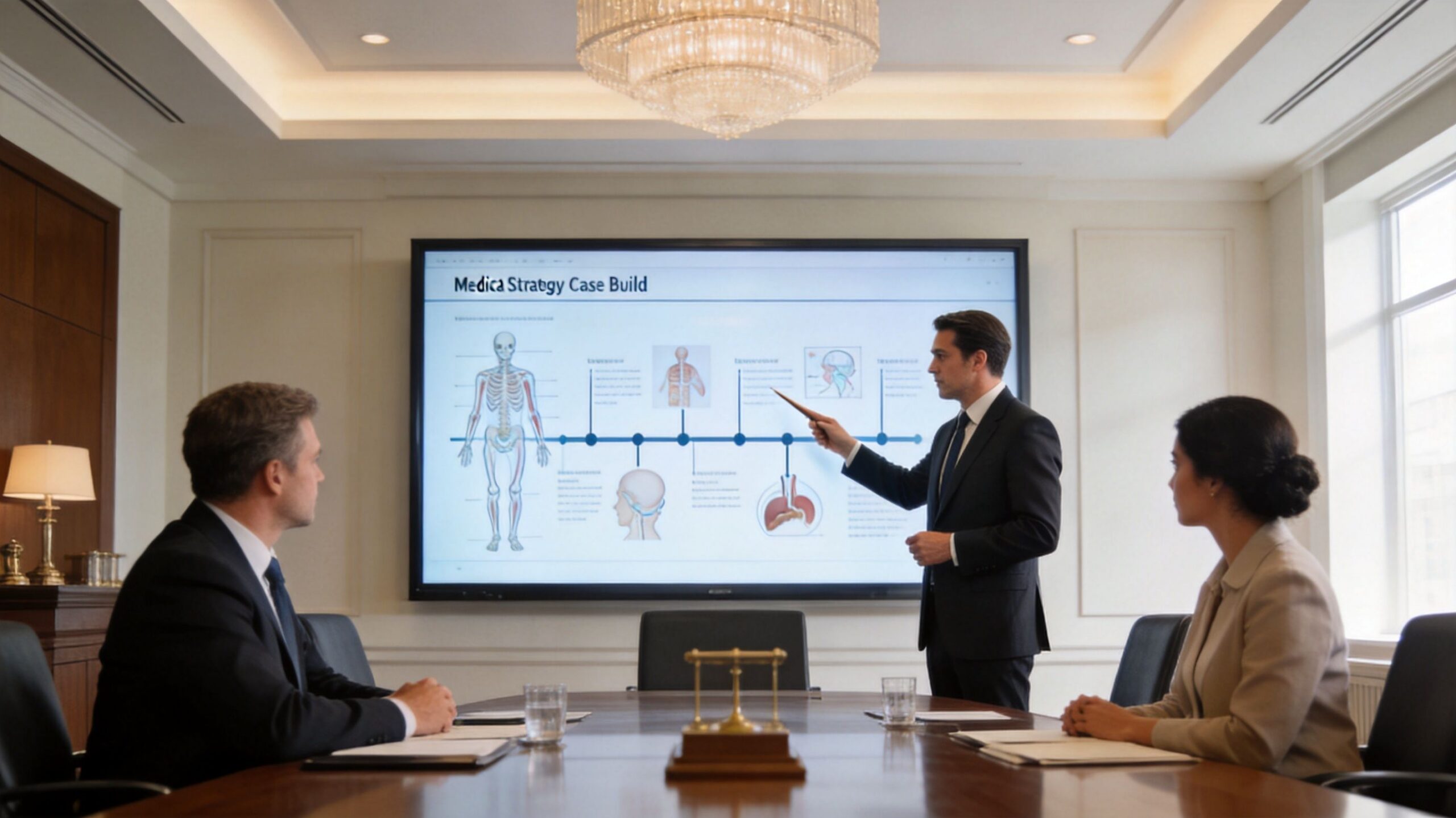
Insurance companies treat delayed symptoms as an opening. A strong case closes that opening by connecting the science of injury to the physics of the crash.
According to Philadelphia car accident statistics and legal analysis, Philadelphia County has consistently led Pennsylvania in crash severity. In 2021, 63% of the city's 10,417 crashes resulted in injury or death. In that environment, proving delayed injuries requires aggressive investigation and expert testimony to connect crash forces to the medical outcome.
The insurer's favorite argument
The defense theme is familiar: if you were hurt, you would have felt it immediately. If the crash caused the injury, you would have gone straight to the hospital. If the car damage looks modest, your complaints must be exaggerated.
That argument sounds clean. Real injury cases usually aren't.
What actually proves the case
Causation gets built by stacking facts that reinforce each other. Not one dramatic document. A chain.
That chain often includes:
- Vehicle damage evidence: Photos showing where the impact landed and how force moved through the car
- Police and scene records: Position of the vehicles, statements from witnesses, and crash dynamics
- Medical chronology: When symptoms started, how they progressed, and what providers found
- Expert interpretation: Doctors explaining why the delayed symptom pattern fits the injury mechanism
- Functional proof: Missed work, restricted movement, sleep disruption, and changes in daily life
A good case file lets each piece support the others.
Why accident reconstruction matters
Jurors and adjusters don't feel the crash the way your body did. They see photos. They hear words like “low speed” and “minor impact.” Reconstruction work helps translate impact into mechanics.
For example, direction matters. So does body position, seat placement, whether the head was turned, whether there was secondary impact inside the vehicle, and whether the force was rear, side, or angled. Those details can line up directly with a neck injury, disc injury, or concussion pattern.
Why medicine alone isn't enough
A doctor can diagnose whiplash, a concussion, or a disc issue. But in a delayed injury case, diagnosis alone doesn't finish the job. The defense may still say the condition existed earlier or came from something unrelated.
That's where coordinated proof matters. The crash evidence shows what happened. The medical evidence shows what changed. The expert testimony explains why the timing makes sense.
The strongest delayed injury cases don't ask people to guess. They show how the crash, the body, and the timeline fit together.
That's the difference between merely reporting pain and proving causation.
Frequently Asked Questions About Delayed Injury Claims
Delayed injury claims create a lot of anxiety because the facts rarely unfold in a neat order. People say they're fine, then symptoms appear. They wait, then worry they waited too long. They hear “discovery rule” and assume it automatically saves the case.
For traumatic brain injuries, that assumption can be dangerous. According to this article on delayed symptoms after a car crash, the discovery rule rarely extends Pennsylvania's two-year filing deadline in delayed TBI cases, because the clock usually starts on the crash date, not symptom onset. The same source states there has been a 22% increase in TBI claims in Philadelphia, and insurers deny 40% of those claims, which is why advanced diagnostics such as biomarker blood tests can matter when standard exams miss subtle injuries that appear 24 to 48 hours later.
Client-First FAQ on Delayed Injury Claims
| Question | Answer |
|---|---|
| What if I told the police or the adjuster I was “fine” at the scene? | That's common. It doesn't automatically destroy your claim. What matters next is whether you sought medical care once symptoms appeared and whether your records consistently document the change. |
| How long is too long to wait before seeing a doctor? | Sooner is better. Every delay gives the insurer more room to argue about causation. If you're already past that point, don't compound the problem by waiting longer. |
| Can I still have a case with limited tort? | Possibly, yes. Limited tort can restrict pain-and-suffering recovery, but it doesn't end every claim. The seriousness of the injury and the facts of the policy matter. |
| What if my headaches or confusion started days later? | That can happen with a concussion or other brain injury. Delayed neurological symptoms should be evaluated promptly and documented carefully. |
| Will the discovery rule save me if my injury was diagnosed late? | Usually not in a standard car crash case. Pennsylvania courts generally treat the collision date as the starting point because the traumatic event was known from day one. |
| Do I need special testing for a delayed brain injury claim? | Sometimes. Standard exams can miss subtle TBIs. When symptoms suggest a brain injury but routine evaluation doesn't tell the full story, more advanced diagnostics may become important. |
Two practical answers people need to hear
First, don’t assume a delayed claim is weak just because the timeline is messy. Messy is normal in these cases.
Second, don’t assume the insurance company will “understand” once you explain it. They may understand perfectly and still deny it. That’s why documentation matters more than reassurance.
If you’re dealing with delayed symptoms after a crash, the right response is to act like the timeline matters, because it does.
If you’re dealing with a Delayed Injury After Car Accident in Philadelphia and the insurance company is already using that delay against you, Mattiacci Law can help you understand your options, protect the medical record, and build proof that ties the crash to the injuries that showed up later. The firm handles serious Pennsylvania and New Jersey injury cases with a trial-ready approach, clear communication, and free consultations.