


Author: John Mattiacci | Owner Mattiacci Law
Published April 21, 2026

TL;DR: In Pennsylvania, you generally have 2 years to file a personal injury claim, and if you miss that deadline, you can lose your right to compensation entirely under 42 Pa.C.S. § 5524(2). Long before that, the value of your case can drop because evidence disappears, witnesses forget details, and insurers gain an advantage.
You may be reading this a few weeks after a crash, a fall, or another injury in Philadelphia. Maybe you thought the pain would pass. Maybe you're still treating and didn't want to "make it a legal thing" yet. Maybe the insurance company sounded cooperative, so you assumed there was time.
That hesitation is common. It's also dangerous.
Waiting doesn't just create one problem at the end of the road. It creates a series of smaller losses that add up. First, the scene changes. Then footage disappears. Then witness memory softens. Then the adjuster starts asking why treatment didn't happen sooner, or why no one preserved the proof when it mattered.
A personal injury claim doesn't usually collapse all at once. It erodes. Imagine a photograph left on a windowsill. It doesn't vanish overnight, but week by week, the image gets lighter, blurrier, and harder to trust.
What Happens If I Wait to File a Claim in Philly
A lot of injured people don't delay because they're irresponsible. They delay because life gets loud. You're trying to get to appointments, keep working if you can, help your family, deal with pain, and answer calls from insurance. Legal deadlines don't feel urgent until suddenly they are.

In Philadelphia, that delay has two separate effects. One is legal. At some point, the filing deadline runs out and the claim can be barred. The other is practical. Your case may still be technically alive, but weaker than it should've been because the proof that gave it force is gone.
Waiting feels passive, but it changes the case
A delayed claim often starts with a simple thought: "I'll deal with this once I know how bad it is." The problem is that the other side doesn't treat delay as neutral. Property owners fix hazards. Businesses save over old footage. Witnesses move, stop answering, or remember only fragments. Medical gaps create questions that didn't need to exist.
That means time can hurt a strong case in stages:
- The first loss is evidence: photos, video, incident reports, and physical conditions are easiest to capture right away.
- The second loss is clarity: the longer the gap, the easier it is for the defense to argue about what happened and why you were hurt.
- The final loss is legal: once the deadline expires, the court can close the door entirely.
Practical rule: If you're asking whether you've "waited too long," the safest assumption is that every additional week makes the case harder to prove.
People often think filing is only about paperwork. It isn't. Early action gives your lawyer a chance to secure records, preserve video, identify witnesses, and shape the claim before the defense shapes it for you.
Pennsylvania's Unforgiving Two-Year Deadline
Pennsylvania gives most injury victims a strict 2-year window to file a personal injury claim under 42 Pa.C.S. § 5524(2). If that deadline passes, the court can dismiss the case even if liability is clear and your injuries are serious. Local docket data showed that over 15% of late-filed personal injury cases in Pennsylvania were summarily dismissed on statute grounds in 2023 without any review of the merits, as discussed in this analysis of Pennsylvania slip and fall filing deadlines.
Think of the statute of limitations as a courthouse clock that starts running on the date of injury. Not when you feel ready. Not when the insurance company stops stalling. Not when treatment ends. In most ordinary injury cases, the clock starts when the accident happened.
The deadline table most people need to see
| Type of Claim | Filing Deadline |
|---|---|
| Most Pennsylvania personal injury claims | 2 years from the date of injury |
| Claims involving government property or entities | 6 months for notice of intent to sue |
If you want a fuller breakdown of the rule itself, Mattiacci Law has a plain-language guide on the Pennsylvania personal injury statute of limitations.
What the court does after the deadline passes
People sometimes assume that if the evidence is strong enough, a late filing can be excused. Usually, it can't.
The defense doesn't need to prove you weren't injured. It only needs to point to the expired deadline and ask the court to enforce it. If the statute applies and the filing came too late, the judge can dismiss the case without reaching the substance of what happened.
That feels unfair to many clients, especially when the underlying negligence seems obvious. But statutes of limitation are designed to cut off claims after a defined period. Once the filing window closes, the legal right itself may be gone.
Missing the deadline doesn't just weaken your leverage. It can erase the claim.
Why exceptions usually don't rescue ordinary accident cases
There are narrow exceptions, but people rely on them far too casually.
One is the discovery rule. That can matter when the harm wasn't immediately discoverable. Another is fraudulent concealment, which applies when a defendant actively hid wrongdoing. In a typical car crash, fall, or obvious injury event, those arguments are hard to use because the injured person usually knows right away that something happened and that someone may be at fault.
That is why "I'll sort it out later" is such a risky strategy. The law doesn't usually pause the clock just because treatment took time, life was chaotic, or the insurer kept talking.
What works and what doesn't
What works is treating the deadline as the outside limit, not the planning target.
What doesn't work is waiting until you're close to the end of the two years and then trying to rebuild a case from fragments. By that point, even if filing is still technically possible, the legal task is often much harder than it needed to be.
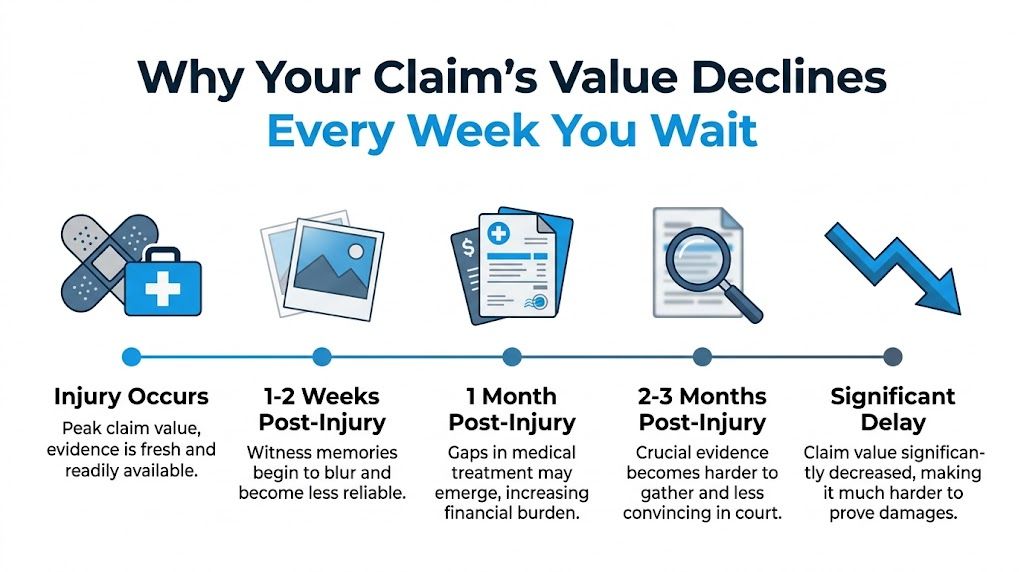
Why Your Claim's Value Declines Every Week You Wait
The filing deadline is the cliff. Evidence loss is the slope leading to it.
Most injured people understand the cliff. They don't always see the slope. A claim can still exist on paper while losing force in practice. That's the part that surprises people. They think, "I'm still within the deadline, so I should be fine." Legally, maybe. Strategically, not necessarily.
Waiting to file can weaken a case because 80 to 90% of slip and fall claims rely on time-sensitive proof, and delay can reduce settlement values by 20 to 30% on average. The same source notes that insurers may overwrite surveillance footage in as little as 7 to 30 days and that witness recall deteriorates over time, as summarized in this discussion of why delay harms slip and fall claims in Pennsylvania.
Evidence melts first
A claim is a lot like an ice cube on a hot sidewalk. You can still see it for a while, but it's shrinking the entire time.
Here is what usually disappears early:
- Video footage: many businesses don't keep it long.
- Scene conditions: wet floors dry, debris gets removed, broken steps get repaired.
- Witness confidence: people remember the broad outline longer than the small details, and small details often decide liability.
- Documents: incident reports, maintenance records, and internal communications are easier to locate when someone demands preservation early.
Less proof means less leverage
When the evidence is fresh, the demand is concrete. There are photographs, names, records, timestamps, and a clear narrative. When the evidence has faded, the same claim may sound less certain, even if the injury is real.
That shift affects value because settlement isn't based only on injury. It is also based on how convincingly you can prove fault and damages. If the defense can say the hazard wasn't there, the crash wasn't severe, the witness isn't sure, or the treatment gap suggests some other cause, they gain room to discount the case.
A delayed claim often becomes an argument about missing proof instead of an argument about the defendant's conduct.
The harsh part is that this decline starts early. Not at the lawsuit deadline. Not when the insurer denies the claim. Early.
How Insurance Companies Use Delays Against You
Insurance companies evaluate claims through a skeptical lens. Delay fits neatly into their playbook because it gives them multiple arguments at once. They can question severity, causation, and credibility without ever saying you're lying.

Insurers such as Progressive and State Farm typically delete surveillance footage after 30 to 90 days, and a 2024 Nolo study of 5,000 personal injury cases found that timely filings yielded 25 to 40% higher settlements because lawyers could secure evidence before it degraded. That summary appears in this overview of how long you have to file a personal injury claim in Pennsylvania.
The adjuster's reading of your delay
An adjuster may look at a gap in action and ask questions like these:
- "If the injury was serious, why didn't treatment happen sooner?"
- "If liability was clear, why wasn't evidence preserved right away?"
- "If the claimant waited months, what happened in the meantime that could explain the symptoms?"
Those aren't neutral questions. They're valuation tools. Every one of them pushes the number down.
This is one reason negotiation in injury cases is less about rhetoric and more about timing, documentation, and bargaining power. If you want a non-legal comparison, the same principles show up in business deals where preparation changes bargaining power. This overview of powerful contract negotiation strategies is useful because it highlights a universal rule: the side with better information and better timing negotiates from strength.
Delay creates alternate explanations
The defense doesn't have to prove a better story. It only needs enough uncertainty to justify a lower offer.
A treatment gap lets the insurer argue your pain came from something else. A delay in reporting can let it say the condition wasn't urgent. Missing photographs let it dispute the scene. Lost video lets it deny the mechanism of injury. By the time you realize those arguments are coming, the material that would answer them may already be gone.
For people dealing with insurance stalling, this page on whether insurance delay affects the statute of limitations in Pennsylvania addresses a misconception that gets many claimants in trouble. Ongoing discussions with an insurer don't stop the legal clock.
What forces insurers to take a claim seriously
Prompt action changes the tone of the case. It tells the insurer that someone is preserving proof, tracking records, and preparing the matter in an organized way.
That doesn't guarantee a fair offer. It does remove easy excuses.
A lawyer can send preservation demands, gather records, lock down witness statements, and prevent the claim from being defined by delay. Mattiacci Law is one Philadelphia option for that kind of early case development in serious injury matters. The important point is not the name of the firm. It's the timing of the work.
The Six-Month Trap When Suing a Government Entity
Many people assume the two-year rule applies to every injury case in Philadelphia. That's one of the most expensive assumptions you can make.
If the claim involves a government entity, the timing can change fast. For accidents on city property, such as a sidewalk, public building, or other government-controlled location, Pennsylvania law requires a formal notice of intent to sue within 6 months of the injury. Pennsylvania court data also shows that government entities successfully dismiss about 70% of claims when that notice is late, according to this explanation of Pennsylvania slip and fall deadlines involving public property.

Cases where this trap appears
This issue comes up more often than people expect. Examples include:
- Sidewalk and street defects: a fall tied to a broken or dangerous public walkway.
- Public buildings: injuries inside city-owned facilities.
- Transit and municipal settings: incidents involving property operated by public bodies.
People often don't realize the property is public until well after the accident. By then, precious time may already be gone.
Why this deadline catches people off guard
Government claims involve special procedures. The law doesn't wait for you to figure out ownership, sort out medical treatment, or decide whether you want to pursue the case. If notice was required and wasn't given in time, the claim can be barred regardless of how serious the injury was.
If there's any chance the accident happened on city or other government property, treat it as urgent from day one.
For a practical overview of these shorter rules, this resource on government injury claims and special deadlines in Pennsylvania is a useful starting point.
The lesson is simple. Don't assume every claim follows the standard timetable. Public entity cases can fail much earlier than people think.
Protecting Your Rights Your First Steps After an Injury
Once you understand what delay does to a case, the next question is straightforward. What should you do now?
Start with the basics and do them in order. Not because every case becomes a lawsuit, but because early discipline protects your options.
Get medical care and follow through
Your health comes first. It also creates the record that connects the injury to the event.
If you've already seen a doctor, keep going as directed. If you haven't, don't wait for symptoms to become unbearable. Gaps in care can complicate both recovery and the proof of damages.
Preserve what you can before it disappears
Don't assume someone else saved it.
Take photographs of injuries, vehicles, property conditions, footwear, debris, weather conditions, or anything else that helps explain what happened. Keep names, phone numbers, and screenshots. Save discharge papers, visit summaries, prescriptions, and work notes.
A simple personal timeline helps more than people realize. Write down the date of the accident, where it happened, when pain started, who you spoke with, and what changed afterward.
Be careful with insurance conversations
You don't have to handle every call the moment it comes in.
Before giving a recorded statement or signing any release, slow down and understand what the insurer is asking for. Early statements often lock people into incomplete descriptions before they know the full extent of their injuries. Broad medical authorizations can also give the defense access to records that have little to do with the claim.
Don't mistake activity for progress
Many injured people think the case is "moving" because the insurance company keeps calling, asking for documents, or saying it's under review. That can create a false sense of security.
Real progress means the claim is being documented, evidence is being preserved, deadlines are being tracked, and decisions are being made with the filing clock in mind. Friendly communication from an adjuster isn't a substitute for that work.
A practical checklist you can use today
- Seek treatment: get evaluated and follow the treatment plan you receive.
- Photograph everything: injuries, the scene, property damage, and anything likely to change.
- Save records: bills, discharge instructions, prescriptions, wage-loss information, and messages.
- Limit statements: don't guess, speculate, or minimize your symptoms in recorded calls.
- Identify ownership: if the incident may involve public property, find that out immediately.
- Talk to a lawyer early: not because every case needs a lawsuit today, but because delay changes what can still be proved.
The best time to protect a claim is before the other side decides what evidence survives.
If you're hurt and unsure whether you've waited too long, the right move is to get a clear legal assessment now, while options may still exist.
If you need guidance on deadlines, evidence preservation, or whether a delay has already affected your case, Mattiacci Law offers free consultations for injury victims in Philadelphia and across Pennsylvania. A prompt review can help determine what deadlines apply, what proof can still be secured, and what steps make sense before more strength is eroded.