


Author: John Mattiacci | Owner Mattiacci Law
Published April 16, 2026

You’re probably reading this after a hard, chaotic day. A crash on I-95, Roosevelt Boulevard, Kelly Drive, Broad Street, or a neighborhood intersection. Maybe the airbags went off. Maybe your head snapped back and forth. Maybe you walked away thinking you were lucky, and now a headache is building, your vision feels off, or you can’t focus on a simple text message.
That’s exactly when people make the mistake that hurts them twice. First medically, then legally. They tell themselves it’s “just stress,” they go to sleep, they skip follow-up care, and they fail to create a record of what their brain and body are doing after the collision.
I’ve seen that play out too many times in Philadelphia injury cases. Insurance companies love gaps in treatment and vague symptom descriptions. They treat silence in the medical record like proof nothing serious happened. It isn’t proof. It’s just missing documentation.
Your Guide to Head Injuries After a Philadelphia Crash
Right after a crash, your body floods with adrenaline. That can hide serious symptoms for hours or days. You may feel shaky, angry, embarrassed, or eager to get home. Then the headache hits. Or your spouse notices you’re repeating yourself. Or you wake up the next morning and the room tilts when you stand.
That pattern is common in Head Injury Symptoms After Crash in Philadelphia cases. It’s why you need to think like both a patient and a future claimant from the start. Get checked. Track changes. Protect the timeline.

If doctors later diagnose a concussion, contusion, hemorrhage, or another traumatic brain injury, your early records matter. They help connect the crash to the symptoms. They also help rebut the predictable insurance argument that your problems came from something else. If you want a legal overview of these cases, this Philadelphia brain injury lawyer page gives a useful starting point.
What you need to do now
- Take every head symptom seriously: Headache, dizziness, confusion, nausea, blurred vision, ringing in the ears, and memory problems can all matter.
- Write symptoms down the same day: Don’t rely on memory. Brain injuries often make memory less reliable.
- Get evaluated quickly: A same-day medical record is far stronger than a delayed “I started feeling bad later” explanation.
- Tell doctors exactly what happened: Describe the impact, where your head went, whether you blacked out, and what changed afterward.
Practical rule: If a symptom seems small but it’s new after the crash, document it.
The First 24 Hours What to Watch For Immediately
The first day matters. A lot. In Pennsylvania, about 138,000 people suffer traumatic brain injuries each year, and roughly one in seven, or about 19,714 cases annually, are caused by traffic accidents, according to Wapner Newman’s discussion of brain injuries from car accidents. Don’t brush off what your body is telling you.
Symptoms that should get your attention right away
- Loss of consciousness: Even if it lasted only seconds, that matters. Tell the doctor and make sure it goes in the chart.
- Feeling dazed or confused: If you couldn’t think clearly, forgot basic details, or felt mentally “foggy,” that’s not normal post-crash stress.
- Persistent headache: A headache that starts after impact or keeps getting worse needs medical attention and written documentation.
- Nausea or vomiting: People often dismiss this as nerves. After a crash, it can be a head injury sign.
- Dizziness or balance trouble: If walking feels off, if you need to steady yourself, or if turning your head makes things worse, note it.
- Blurred vision or light sensitivity: Vision changes are common after a brain injury and often show up early.
- Ringing in the ears: Tinnitus after a collision belongs in the record.
- Slurred speech: If words sound wrong coming out, get help immediately.
What these symptoms can feel like
A concussion doesn’t always look dramatic. Sometimes it feels like you’re slow, detached, or oddly tired. A contusion, which is bruising on brain tissue, can bring localized pain and concentration trouble. Some injuries involve bleeding or swelling that becomes more obvious over time, not less.
That’s why “I didn’t hit my head that hard” isn’t a useful standard. The force of the crash can jolt the brain inside the skull even without a visible cut or lump.
If you’re wondering whether you should get checked, the answer after a crash with head symptoms is usually yes.
One smart move people skip
Use the same discipline you’d use after any serious wreck. The checklist on what to do immediately after a car accident in Pennsylvania is worth following, especially the parts about prompt care and preserving evidence.
The Hidden Danger Delayed Head Injury Symptoms
A lot of crash victims feel “mostly okay” at the scene. Then the serious issues manifest later. That false calm is one of the biggest traps in head injury cases.
Your brain after trauma can be like a house after a hard storm. From the sidewalk, the roof may look intact. Inside, water is moving behind the walls. Wiring is affected. Damage shows up room by room. Brain injury symptoms can unfold the same way.
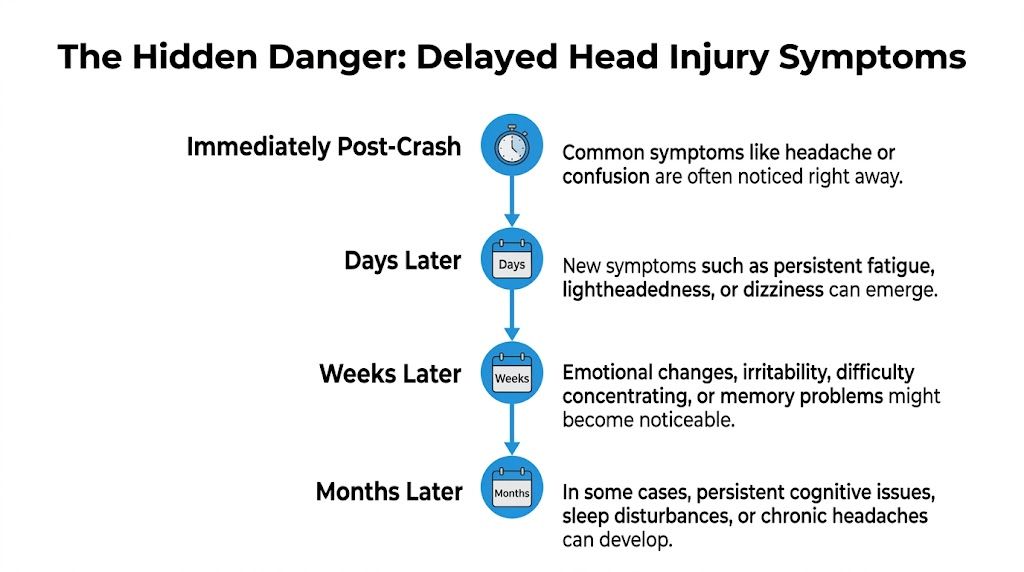
Symptoms that may show up later
The delayed symptoms are often the ones insurers try to minimize because they don’t look dramatic on day one.
- Memory problems: You forget appointments, repeat questions, lose track of conversations, or can’t recall part of the crash.
- Brain fog: You know something is wrong, but it’s hard to describe. Thinking feels slower. Multitasking gets harder.
- Trouble concentrating: Reading emails, driving, following meetings, or helping your kids with homework suddenly feels exhausting.
- Mood changes: Irritability, anxiety, depression, or emotional swings may appear without warning.
- Sleep disruption: You may sleep too much, struggle to fall asleep, or wake up constantly.
- Fatigue: A simple errand can wipe you out.
- Sensitivity to light or sound: Screens, headlights, office lighting, and city noise become hard to tolerate.
CDC-related information cited in this discussion of traumatic brain injury symptoms after a car wreck notes that post-concussion symptoms such as mood swings or sleep disturbances can emerge 1 to 2 weeks after injury, and people often mistake them for ordinary stress.
Why delayed symptoms matter legally
If your symptoms evolve after the crash, don’t wait until they become unbearable. Report them to a doctor as they develop. Then keep reporting them. A clean day-one ER note doesn’t end the story. It starts it.
One of the best ways to stay organized is to use a symptom checklist similar to a Review of Systems, which helps patients track changes across areas like sleep, memory, dizziness, mood, and vision. That kind of disciplined tracking can help you communicate better with doctors and create a stronger record.
A delayed symptom is still a real symptom. The key is reporting it when it appears, not months later when the insurance adjuster says it’s too late to trust.
Don’t let a delay become a gap
When injuries show up after the wreck, people panic because they think they’ve lost their case. Not necessarily. But they do need to act fast. If that’s your situation, this page on injuries that showed up later after someone hit your car addresses the issue directly.
Red Flags When to Go to the ER Immediately
Some symptoms are not “watch and wait” symptoms. They are ER symptoms. If you or your loved one has any of the signs below after a crash, go now or call 911.
According to Cordisco & Saile’s Philadelphia car accident statistics discussion, moderate to severe TBIs can involve prolonged unconsciousness, repeated vomiting, seizures, or pupil dilation within hours or days, and Philadelphia averages ten people seriously injured on its streets weekly. This is exactly why hesitation is dangerous.
Head Injury Emergency Symptoms Checklist
| Symptom | Action Required |
|---|---|
| Prolonged unconsciousness | Call 911 or go to the ER immediately |
| Repeated vomiting | Go to the nearest ER immediately |
| Seizures or convulsions | Call 911 now |
| One pupil larger than the other | Go to the ER immediately |
| Worsening headache | Seek emergency care now |
| Slurred speech | Call 911 or get to the ER now |
| Profound confusion or agitation | Seek emergency care immediately |
| Can’t wake the person or they’re hard to arouse | Call 911 now |
| Weakness, numbness, or poor coordination | Go to the ER immediately |
| Drainage from the nose or ears | Seek emergency care now |
Don’t argue with these signs
If a family member says, “I’m fine, just let me sleep,” but they’re confused, vomiting, or impossible to wake properly, don’t negotiate. Get help. I’m blunt about this because these are the moments that change outcomes.
Go to the nearest emergency room or call 911 now if any red-flag symptom appears. This is not optional.
Getting a Diagnosis What to Expect from Doctors
The hospital process is less mysterious when you know what doctors are looking for. They are trying to answer a few basic questions. Is there bleeding? Swelling? Bruising? A skull injury? Signs that brain function is impaired right now?

The exam usually starts with simple questions
A doctor or nurse may ask:
- What happened in the crash
- Whether you blacked out
- Whether you remember events before and after impact
- Whether you have headache, nausea, dizziness, or vision changes
- Whether anyone noticed confusion, speech problems, or unusual behavior
They may also check your pupils, balance, coordination, speech, memory, and alertness. None of that is trivial. Those observations become part of your medical record, and later they can help establish what changed after the collision.
Why imaging matters
Some crash-related brain injuries involve the brain striking the inside of the skull on one side, then the other. These are called coup-contrecoup injuries, and they can cause bruising on both sides of the brain. According to Mayo Clinic information cited in this source, seeking a CT or MRI within 4 hours of escalating symptoms is critical, and the sensitivity for detecting these contusions is over 95%.
A CT scan is commonly used quickly to look for urgent problems such as bleeding, swelling, or fractures. An MRI may be used when doctors need a more detailed view, especially if symptoms continue or the initial picture isn’t clear.
Questions you should ask before leaving
Don’t leave a hospital or urgent care visit with a vague “take it easy” and nothing else. Ask direct questions:
- What diagnosis are you considering right now?
- What symptoms mean I need to come back immediately?
- Do I need a neurologist, concussion clinic, or follow-up imaging?
- Should I avoid driving, screens, work, or physical activity for now?
- What exactly should I write down if symptoms change?
If your discharge instructions are unclear, ask again until they’re not.
How Symptoms Affect Your Philadelphia Injury Claim
A head injury case is won or lost on proof. If your symptoms are missing from the record, the insurance company will argue they were minor, unrelated, or never happened. Expect that argument. Then shut it down with documentation.
In Philadelphia injury claims, the strongest cases usually show a clear sequence. The crash happened. Symptoms started. You sought care. You reported the same problems over time. Those problems affected your work, daily routine, and ability to function. That timeline matters just as much as the diagnosis.
Start a symptom journal immediately
Do it the same day if you can. Use your phone, a notebook, a calendar app, or a spreadsheet. The format does not matter. Consistency does.
Write down:
- Date and time: When the symptom started, how long it lasted, and whether it came back.
- Headache details: Where the pain is, how strong it feels, what sets it off, and whether medication helped.
- Memory problems: Forgotten conversations, missed appointments, confusion, losing track of tasks, or trouble finding words.
- Work issues: Slower pace, mistakes, extra breaks, missed deadlines, missed shifts, or reduced duties.
- Mood changes: Irritability, anxiety, panic, sadness, or short temper that was not normal for you before the crash.
- Sleep problems: Trouble falling asleep, waking up often, sleeping too much, or feeling exhausted after a full night.
- Triggers: Screens, bright lights, noise, traffic, reading, multitasking, or crowded places that make symptoms worse.
- Daily limitations: Trouble driving, cooking, shopping, cleaning, exercising, caring for children, or handling ordinary chores.
This journal does two jobs at once. It helps your doctors see the full picture, and it helps your lawyer prove how the injury affected your life outside the exam room.
Small gaps become big problems
Insurance adjusters and defense lawyers look for inconsistency. If you tell your doctor about headaches but stay quiet about dizziness, memory lapses, or screen sensitivity, they will treat those later complaints as suspect. If your records say you are "doing better" because no one asked the right follow-up questions, that line may get pulled out months later to argue your recovery was quick.
Do not leave blanks for the other side to fill in.
Tell each doctor what is still happening, even if the symptom feels minor or repetitive. Repeat yourself if you need to. Brain injury claims are often built on boring, consistent records. That is good. Boring wins cases.
The better your documentation, the harder it is for an insurer to minimize your injury.
Follow treatment and keep every paper trail
If a doctor tells you to follow up, go. If they refer you to neurology, vestibular therapy, cognitive rehab, or another specialist, schedule it. If work restrictions are given, follow them and keep a copy. Missed appointments, ignored referrals, and undocumented symptom flare-ups give the defense room to argue that you made your condition worse or that it was never serious in the first place.
Keep discharge papers, visit summaries, test results, referral slips, prescriptions, work notes, and receipts. Save emails from your employer about missed time or reduced duties. If a family member has to help you more than usual, write that down too. Those details often make the difference between a claim that looks vague and one that is fully supported.
Mattiacci Law handles serious injury claims by organizing medical records, treatment history, and witness proof so symptom progression is shown clearly instead of buried in scattered paperwork.
The Road to Recovery Treatments and Timelines
Recovery from a head injury is rarely a straight line. Some people feel better, then hit a wall when they return to work. Others improve physically but keep struggling with concentration, sleep, or headaches. That doesn’t mean they’re exaggerating. It means brain recovery is uneven.

Common parts of treatment
A real recovery plan often includes more than rest.
- Neurology follow-up: For ongoing headaches, dizziness, cognitive issues, or concerning symptom changes.
- Vestibular therapy: Helpful when balance, dizziness, or motion sensitivity sticks around.
- Cognitive rehabilitation: Used when memory, focus, and processing speed don’t bounce back normally.
- Occupational therapy: Helps patients return to daily tasks and work demands.
- Physical therapy: Often needed when neck strain, posture problems, or movement patterns worsen symptoms after a crash.
If you’re trying to understand what movement-based rehab can look like, this overview of functional physical therapy exercises gives a practical sense of how therapists rebuild tolerance for everyday activity.
Headaches can stay with you
One long-term issue I see often is post-traumatic headache after a crash. According to Crosley Law’s discussion of brain injury signs after a car accident, these headaches can result from whiplash-related nerve strain and may last 3 to 6 months if untreated.
That matters medically because persistent pain affects sleep, mood, concentration, and work capacity. It matters legally because ongoing headaches are part of the legitimate damage a claim should account for.
What recovery usually requires from you
- Be honest with doctors: Don’t downplay symptoms because you want to look tough.
- Pace yourself: A good day doesn’t mean you’re fully healed.
- Keep records: Save referrals, work notes, prescription lists, therapy attendance, and discharge instructions.
- Expect follow-up to matter: Immediate care is important, but continued treatment often tells the fuller story.
Recovery is a process of tracking, treating, and adjusting. People get into trouble when they stop after the first ER visit and assume the rest will sort itself out.
If you’re dealing with head injury symptoms after a crash and you need help protecting both your health and your claim, contact Mattiacci Law. A Philadelphia personal injury lawyer can help you preserve evidence, organize medical proof, deal with the insurance company, and pursue compensation for treatment, lost income, and the ways this injury has changed your daily life.