


Author: John Mattiacci | Owner Mattiacci Law
Published July 5, 2026
Your phone rings from an unknown number. You answer, and the caller says they're a personal injury lawyer. If you were just in a crash, hurt at work, or dealing with a serious fall, that call can feel unsettling fast. If you weren't expecting any legal contact at all, it can feel even worse.
The first thing to know is simple. A lawyer calling you isn't automatically good news, bad news, or a scam. It can be any of the three. Sometimes it's a legitimate attorney offering help. Sometimes it's the lawyer for the other side trying to lock you into a damaging conversation before you have counsel. Sometimes it's an unethical solicitation tied to a lead seller or runner.
That's why the question isn't only why would a personal injury lawyer call me. The better question is, who is calling, what do they want, and what should I say right now to protect myself?
Answering the Unexpected Call from a Lawyer
Start by slowing the moment down. You don't have to make any decision while you're on the phone. You don't have to answer detailed questions. You don't have to agree to a meeting, sign documents, or explain how the accident happened.
It's easy to be thrown off because the caller sounds confident and urgent. That urgency may be legitimate, but it may also be strategic. In injury cases, the earliest conversations often shape what happens next with insurance claims, medical documentation, and fault arguments.
The safest first response
If a lawyer calls unexpectedly, keep your first response narrow:
- Ask for identity details. Get the caller's full name, firm name, callback number, and bar number.
- Ask why they're calling. Keep it general. Don't start filling in gaps for them.
- End the call politely. Tell them you'll verify their information and call back if you choose to.
That approach protects you whether the caller is legitimate, opposing counsel, or someone you should avoid entirely.
Practical rule: An unexpected legal call is a screening moment, not a commitment moment.
What makes this moment important
There are real reasons an attorney may try to reach you quickly after an injury. In personal injury matters, timing affects evidence, insurance communication, and procedural deadlines. According to personal injury compensation data summarized by Rev, plaintiffs who hire lawyers receive over 4.4 times more compensation on average, with $77,600 for represented plaintiffs compared with $17,600 for people who handled claims without an attorney. The same source notes an average personal injury settlement of $52,900, nearly 400,000 personal injury claims filed annually in the United States, and that over 95% of personal injury lawsuits end in a pre-trial settlement.
That helps explain why a real attorney may call early. It also explains why bad actors and aggressive opponents may move early too.
The Six Common Reasons a Lawyer Is Calling You
Your phone rings two days after a crash. The caller says they are a lawyer. Before you decide whether that call is helpful, hostile, or improper, sort it into the right category. Many articles blur that line, and that is exactly how people get pushed into bad conversations.
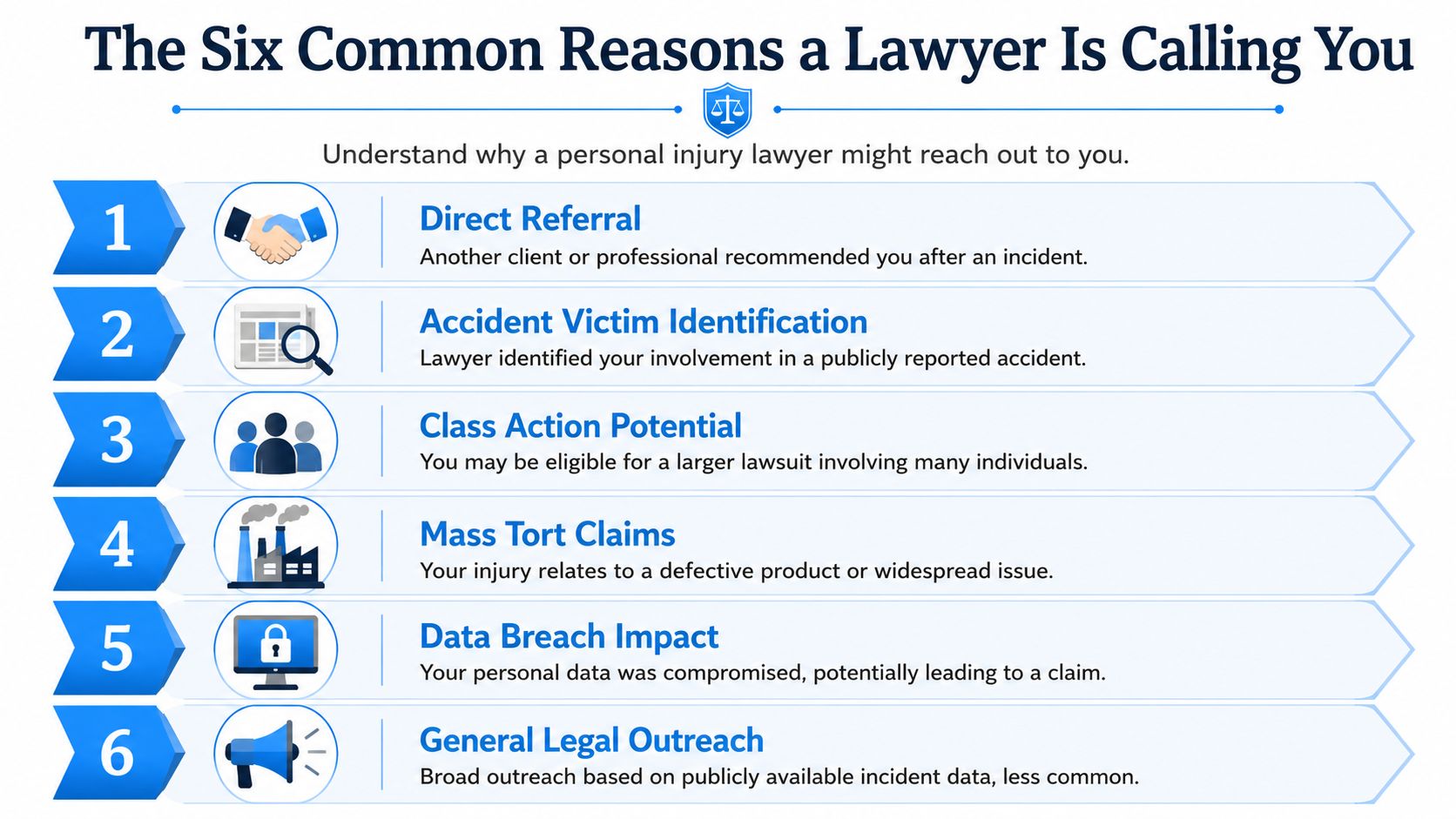
A quick triage view
| Likely reason | What it usually means | Your safest posture |
|---|---|---|
| Direct referral | Someone connected to you suggested you contact counsel | Verify and decide on your own timeline |
| Accident victim identification | The lawyer found your name through a public source and wants to discuss representation | Check credentials and ask how they got your information |
| Opposing side contact | The caller represents another party or insurer and wants information | Give no facts about the incident and end the call |
| Witness or information request | They believe you saw something or have documents or knowledge they want | Confirm the case details before saying anything useful |
| Mistaken identity | They have the wrong person or stale information | Correct them briefly, then disengage |
| Lead-based outreach or unethical solicitation | Your contact information came from a marketing chain, a data broker, or worse | Verify independently and be ready to walk away |
1. A trusted referral
This is usually the safest version of an unexpected call. A former client, another attorney, a doctor, a union representative, or a family member may have passed along your name after hearing about the injury.
A referral still needs verification. Even good referrals can arrive with bad timing, incomplete facts, or pressure you did not ask for. The benefit is that there is often a real chain of trust behind the call.
2. The lawyer found your name through a public record
Lawyers often review accident reports, court filings, police logs, and other public information. If your injury appears in one of those sources, a firm may contact you quickly because early mistakes can affect evidence, medical documentation, and insurance communications.
That kind of outreach is not automatically improper. It does mean you should ask one direct question: how did you get my information?
3. The caller believes you need immediate legal protection
Some lawyers call early because they see a deadline problem, a liability dispute, or a risk that the insurer will lock you into an unhelpful statement. In practice, that can involve preserving video, locating witnesses, sending notice letters, or stopping direct pressure from the insurance side before the record hardens.
A legitimate lawyer should be able to explain the concern in plain terms without demanding that you tell your whole story first.
4. The caller is connected to the other side
This category matters the most. A defense lawyer, insurance lawyer, or lawyer for another party may sound polite and organized. The goal may still be to collect statements that limit your options later.
Do not assume that every lawyer calling after an injury is offering help. Some are gathering facts for a client whose interests conflict with yours. If the caller represents anyone other than you, a short conversation is usually the safest conversation.
5. The call relates to a larger problem than one accident
Some injuries sit inside a broader dispute. A defective product, repeated hazard, construction incident, or worksite event may involve multiple claims and multiple sources of responsibility. Surrounding facts in work injury matters sometimes overlap with questions about records, reporting practices, or even workplace fraud, which can affect how a lawyer evaluates fault and proof.
That does not mean your case is weak. It means the caller may be looking at more than your medical bills alone.
6. The call is based on a stale lead, bad data, or unethical solicitation
Some callers are working from purchased lead lists. Others are using information passed through runners, case brokers, or questionable marketing channels. A few are not lawyers at all.
Watch for vagueness. If the caller cannot state the date, location, or general reason for the call, and tries to get those facts from you instead, do not help fill in the blanks. A real attorney contacting the right person should be able to explain, at least generally, why they reached out.
If the caller needs you to supply the key facts so they can figure out why they called, treat the call as a warning sign.
How to Verify the Caller Is a Legitimate Lawyer
Verification should happen off the phone, on your terms. If someone really is a licensed attorney, they won't object to that. If they push back, that tells you something.
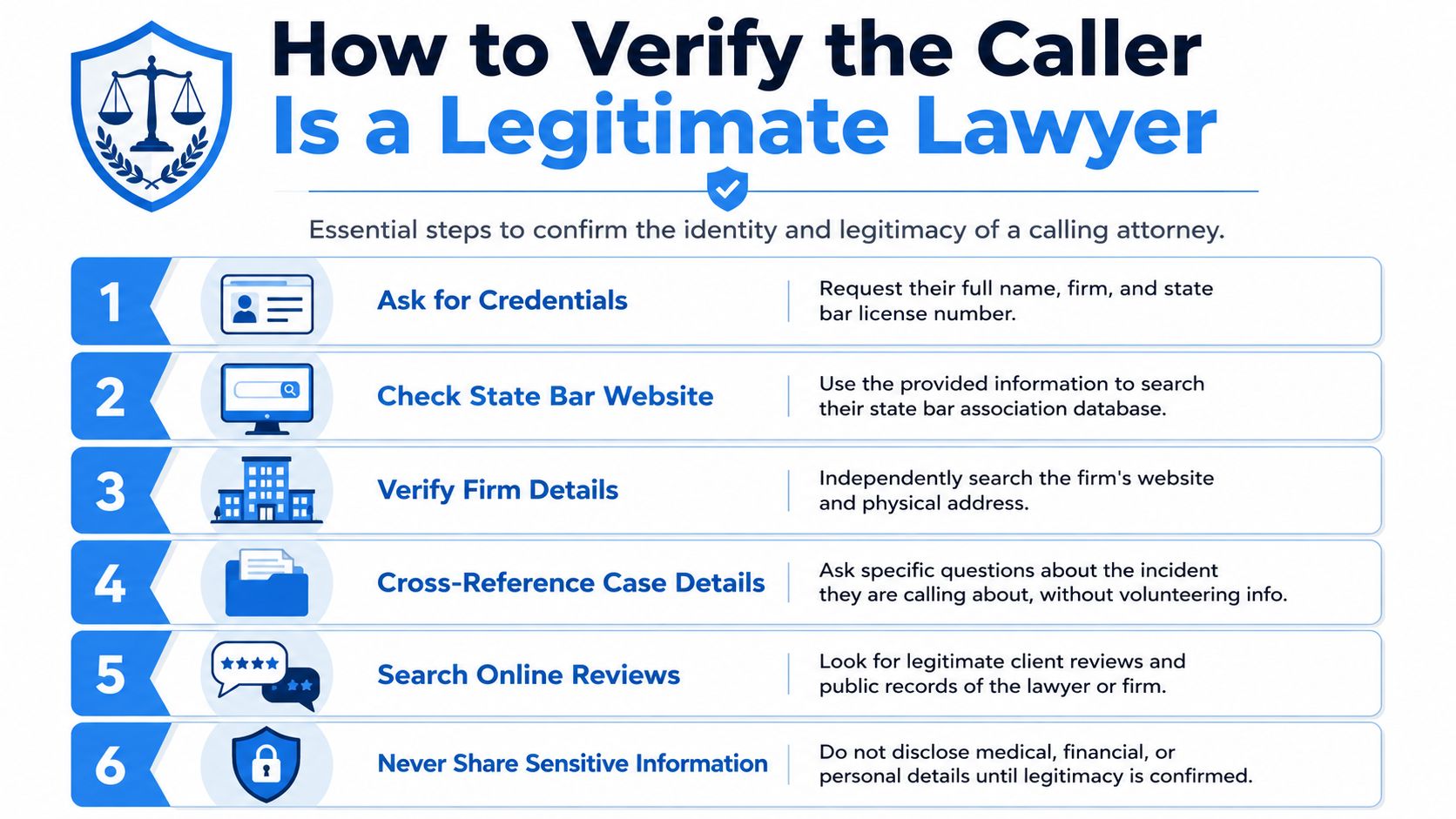
What to check first
Write down these basics before saying anything substantive:
- Full name and firm name: Ask for both. Some solicitors use only a first name or “case manager” label.
- Bar number and state of licensure: A real attorney should be able to provide this without hesitation.
- Office address and main office line: Don't rely on the number that called you.
- How they got your information: The answer matters.
Then verify independently. Search the lawyer through the relevant state bar directory. Search the firm website yourself. Call the publicly listed office number and ask to be connected.
Why source of contact matters
One of the biggest risks isn't just fake identity. It's unethical lead generation. According to Victims Lawyer's warning about runner networks, 30% of new personal injury leads in major U.S. markets stem from illegal runner networks that pay for victim contact information.
That doesn't mean every unsolicited call is improper. It does mean you should ask bluntly, "Who gave you my name and number?" If the answer is murky, defensive, or shifts blame to a “marketing partner,” don't move forward until you verify far more.
Red flags that should end the call
Some warning signs are practical, not technical. Trust them.
- Pressure for immediate signing: Ethical lawyers don't need you to commit in a rush.
- Promises of a guaranteed result: No honest attorney can promise that.
- Requests for money up front during the first cold call: That should stop the conversation.
- Reluctance to identify the exact incident: They may be fishing.
- Links sent by text with instructions to fill out forms immediately: Verify before clicking anything.
If the phone number itself concerns you, basic reverse phone lookup techniques can help you identify whether it connects to a real office, a spoofed line, or a pattern of complaints.
A legitimate lawyer won't mind hearing, "I'm going to verify your credentials and call your office directly."
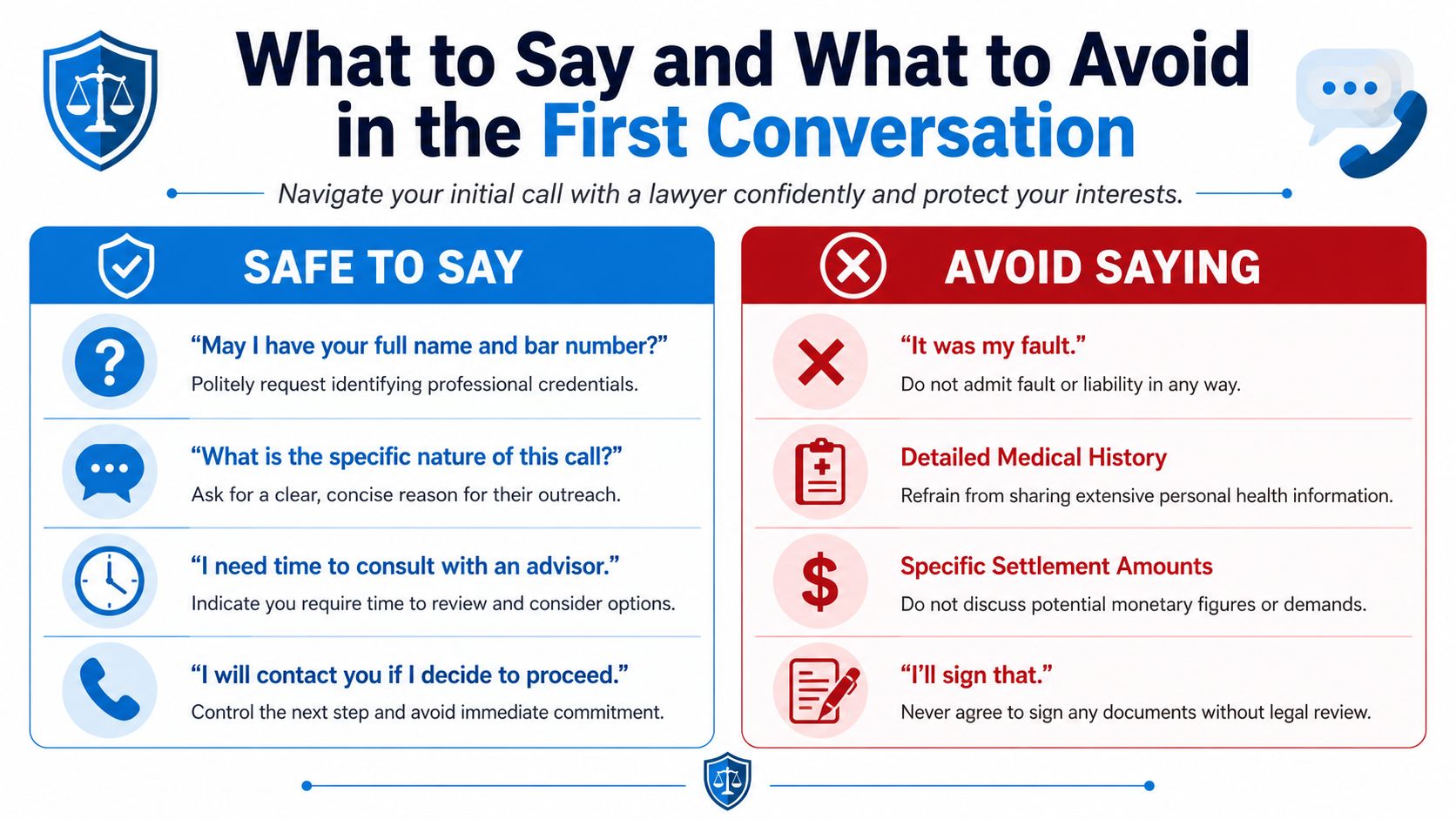
What to Say and What to Avoid in the First Conversation
The first conversation matters because people tend to talk too much when they're nervous. That's exactly what you want to avoid. Your job on that first call isn't to be helpful. Your job is to protect your position.
According to Gutierrez Law's discussion of calls from the other side's lawyer, 68% of accidental injury victims mistakenly believe any lawyer call is an offer of help, while 42% of opposing counsel calls are designed to elicit damaging statements before legal representation is secured.
Safe things to say
These responses keep control in your hands:
- “May I have your full name, firm, and bar number?” Start with identity.
- “What is the specific nature of this call?” Make them define the purpose.
- “How did you get my information?” This is often revealing.
- “I'm not prepared to discuss facts right now.” Short and firm works.
- “I'll review this and contact you if I want to continue.” You control the next step.
Things that can hurt you
Avoid anything that fills factual gaps, narrows your options, or creates a statement the other side can later use against you.
- Don't admit fault. Even casual phrases like “I may have been distracted” can be used against you.
- Don't describe your injuries in detail. Your condition may change, and early statements are often incomplete.
- Don't estimate the value of your case. You don't know enough yet.
- Don't agree to a recorded statement. Not on a surprise call.
- Don't say you feel “fine” just to be polite. That phrase gets repeated later.
A simple script that works
If you feel caught off guard, use this:
I appreciate the call. I'm not discussing the facts of any incident right now. Please give me your full name, firm, and callback number. I'll review your information and decide whether I want to contact you.
That script is effective because it doesn't accuse anyone, but it also doesn't give anything away.
Your Next Steps After an Injury in PA or NJ
A confusing lawyer call often comes before you have your paperwork in order, before you know how badly you're hurt, and before you understand who is trying to help you. In Pennsylvania and New Jersey, the safest next move is to slow the situation down and create your own record before anyone else defines it for you.
Start with your own file
Set up one folder, paper or digital, and keep every document in it from day one. This gives you a clean timeline and helps you spot whether a caller is referring to real facts, partial information, or details they should not have.
| What to gather | Why to keep it |
|---|---|
| Accident or incident report | Confirms date, location, and the people involved |
| Photos of injuries and scene | Preserves conditions that can change quickly |
| Medical visit summaries and discharge papers | Shows when treatment began and how it relates to the event |
| Insurance correspondence | Tracks requests, deadlines, and prior statements |
| Names of witnesses | Preserves independent accounts before memories fade |
| Notes about every call | Helps identify pressure, inconsistencies, or suspicious outreach |
A neat file can protect you from more than one problem. It helps a legitimate lawyer evaluate the case faster, helps you recognize when opposing counsel is fishing for statements, and helps you document a solicitation call that crosses the line.
Protect the claim early
Early case protection is practical, not formal. Filing deadlines can pass. Photos get deleted. Vehicles get repaired. Witnesses stop answering. Insurance adjusters and defense lawyers keep notes from the first contact, including offhand comments that seemed harmless at the time.
That is why waiting for another surprise call is a poor plan. Choose the next contact yourself, after you verify who you are dealing with and after your immediate medical needs are addressed.
If English is not your first language, or you want help understanding legal terms before speaking with anyone about the case, this essential guide to legal language access can help you prepare for that conversation.
A practical decision path
Use this short checklist to decide whether to speak with a lawyer you chose as soon as possible:
- You have significant injuries or ongoing treatment.
- Fault is being disputed, or the story is already changing.
- A lawyer may be calling for the other side, not for you.
- Someone wants a statement, medical authorization, or signed release.
- You are missing work, facing bills, or unsure what insurance should cover.
State-specific experience also matters here. Pennsylvania and New Jersey do not handle every insurance issue, filing rule, or procedural step the same way. A lawyer who regularly handles injury cases in those courts should be able to tell you, in plain language, what needs attention now and what can wait.
The safest next step is to verify the caller, preserve your records, and choose your own lawyer if you want legal help.
Taking Control After the Unexpected Call
An unexpected lawyer call can rattle anyone. It shouldn't control your next move.
The useful way to think about it is this. The call usually falls into one of three buckets. It may be a real offer of representation. It may be contact from the opposing side. Or it may be unethical solicitation wrapped in legal language. Once you recognize those categories, the situation gets much easier to manage.
Your job isn't to solve the case during that first conversation. Your job is to avoid mistakes. Ask who they are. Ask why they're calling. Share almost nothing. Verify independently. Then decide whether you want any further contact.
If English isn't your first language, or you need help understanding legal terminology before speaking with a lawyer, this essential guide to legal language access offers useful context on working with interpreters and protecting understanding during legal conversations.
The strongest position is the calmest one. You don't have to react on the caller's timeline. You can hang up, do your homework, and make the next call yourself.
If you were injured in Pennsylvania or New Jersey and want clear guidance from a firm that handles serious accident and injury cases, Mattiacci Law offers free consultations, direct attorney access, and a no-win, no-fee approach. If a lawyer has already called you and you're not sure whether that contact was helpful, hostile, or improper, speaking with a trusted injury firm on your own terms is often the safest next step.