

Author: John Mattiacci | Owner Mattiacci Law
Published July 1, 2026

If a service dog bites you, the dog's owner or handler is usually the first person legally responsible. In 29 states with strict liability laws, owners can be liable even if the dog had never shown aggression before, and service-dog status does not automatically protect them from a claim.
You may be reading this after a bite in a store, apartment building, workplace, sidewalk, or medical office, trying to sort out two questions at once: who pays for your injuries, and does the fact that the dog was a service animal change the answer.
Most of the time, the answer starts with the handler. It does not end there.
Service-dog cases often become more complicated than ordinary dog-bite claims because the animal had legal access to a place where pets usually aren't allowed. That can make injured people hesitate. They worry they'll be told the bite was just an accident, or that the ADA blocks a claim. Neither assumption is reliable.
The legal question is narrower. Who had a duty to keep people safe, who failed, and whose failure caused the bite? In many cases, the handler is the primary defendant. In others, a business, landlord, or employer may also share responsibility. If you need a broader overview of owner liability in dog attack claims, this guide on when you can sue a dog owner after an attack is a useful starting point.
When a Helping Hand Bites Who Is Held Responsible
A service dog bite catches people off guard for a reason. These animals are supposed to help someone function safely in public. When one suddenly lunges, snaps, or bites, the injury is physical, but the confusion comes just as fast.
The first legal answer is usually straightforward. The handler or owner is almost always the primary party to examine for liability. That is true even when the dog was performing a legitimate disability-related role.
But service-dog cases rarely stay simple for long. Location matters. So does the dog's behavior before the incident, what the business or property owner knew, whether the handler was working at the time, and whether anyone ignored warning signs.
Why these cases feel different
A bite from a pet in a backyard usually points directly to one household. A bite from a service dog in a grocery store or apartment hallway creates more moving parts. The dog had a right to be there under many circumstances. The property owner also had duties to keep the premises reasonably safe. Sometimes an employer put the handler in that setting.
Practical rule: Start by looking at the handler, then widen the lens. In the right case, the path to recovery includes more than one liable party.
That matters in Pennsylvania and New Jersey, where victims often focus only on the dog owner and overlook a business or landlord that let a dangerous situation continue. If staff had prior complaints, if management saw the dog acting out and failed to intervene, or if a landlord knew a tenant's dog posed a risk to other residents, those facts can change the case.
The question that actually decides liability
Courts don't decide these claims based on whether the animal wore a vest or was described as a service dog. They look at legal duty and fault.
A few core facts usually drive the analysis:
- Who controlled the dog: The handler's conduct is usually central.
- Where the bite happened: Public store, apartment complex, job site, or private home all raise different duties.
- What others knew beforehand: Prior warnings, complaints, or visible aggression can matter.
- What damages followed: Medical bills, lost wages, scarring, pain, and other losses shape the claim.
That is why who is liable if a service dog bites someone isn't a one-name answer. The handler is the starting point. Depending on the facts, a second or third defendant may be just as important.
The Critical Legal Difference in Animal Status
Before liability gets sorted out, one question usually comes first. Was the animal legally a service dog, an emotional support animal, or just a pet?
That label matters because public access rules are different. A true service dog is generally allowed in places where pets are not. An ESA and a pet usually don't have those same public-access rights. That difference can affect how a lawyer evaluates a business's responsibility after a bite.
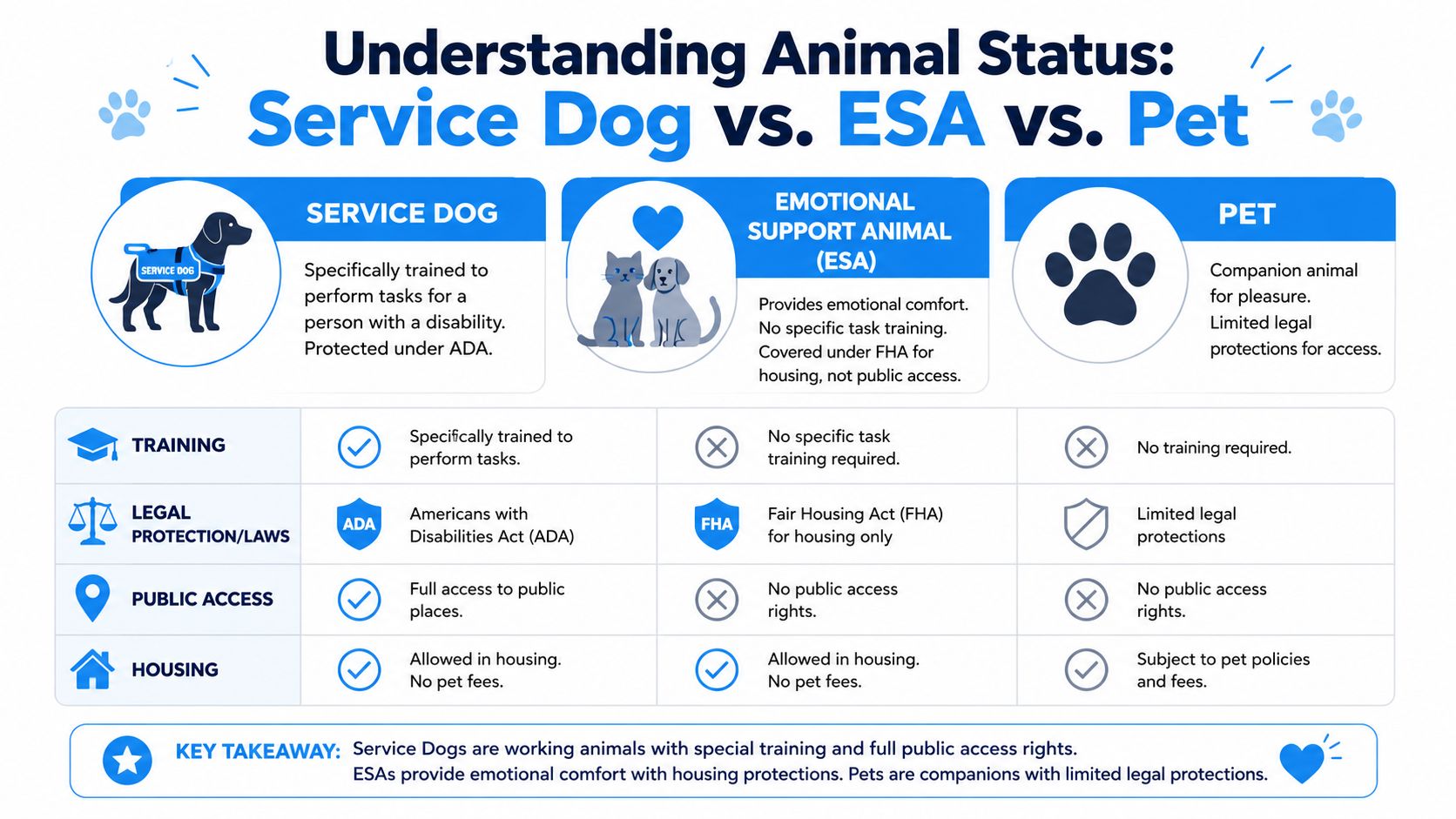
A practical comparison
| Animal type | Training | Public access | Housing status | Why it matters in a bite case |
|---|---|---|---|---|
| Service dog | Trained to perform tasks for a person with a disability | Broad access in many public places | Often protected in housing | The dog may be allowed on site, but that doesn't erase liability for injuries |
| Emotional support animal | Provides comfort, not task-specific training | No broad public-access right like a service dog | Often relevant in housing settings | A business that allows the animal despite a no-pet policy may face different negligence questions |
| Pet | No disability-task training required | Limited access | Ordinary pet rules apply | The animal's presence may itself raise foreseeability and policy issues |
Why businesses and landlords care about the label
If a store has a no-pets policy but knowingly allows a pet inside, that can support a different negligence argument than a bite involving a legitimate service dog. With a service dog, the business may have less room to exclude the animal at the outset, but it still can't ignore dangerous behavior once it appears.
That distinction also explains why victims shouldn't assume there is no claim because the dog was assisting someone with a disability. The dog's legal status affects access rights. It does not erase the duty to prevent foreseeable harm.
A service dog's access rights and a victim's injury claim are two separate legal issues. They overlap, but they are not the same question.
Dog-bite injuries are common enough that the legal system treats them seriously. Approximately 4.7 million dog bites occur annually in the U.S., with nearly 800,000 requiring medical care, and homeowners insurers paid out $1.86 billion in liability claims for dog bites and related injuries in 2025, according to this overview of dog bites and strict liability.
Understanding Strict Liability and the One-Bite Rule
Once the animal's status is clear, the next question is what legal rule applies to the owner or handler. In dog-bite law, two systems come up most often. Strict liability and negligence, often called the one-bite rule.
What strict liability means
Under strict liability, the victim usually doesn't need to prove the owner knew the dog was dangerous. The law places responsibility on the owner because the owner controlled the dog.
A simple analogy helps. If a product injures a consumer because it was defective, the manufacturer may be responsible without the injured person proving the company meant to cause harm. Strict liability in dog-bite law works in a similar way. The focus is less on what the owner knew and more on the fact that the dog caused the injury.
More than half of U.S. states have enacted strict liability statutes, and Justia's overview of dog-bite and attack laws explains that these laws apply to service dogs too. The same source makes another point that matters a great deal in these cases. The ADA does not provide immunity from liability for dog bites.
That means a handler can't defeat a claim just by saying, “This was a service animal.”
What the one-bite rule means
Negligence-based states work differently. There, the victim may need to prove the owner knew or should have known the dog had dangerous tendencies, or that the owner failed to use reasonable care in controlling the dog.
In real life, that often means looking for evidence like:
- Prior aggressive behavior: growling, snapping, lunging, or an earlier bite
- Loss of control: the handler failed to restrain or remove the dog
- Ignored warning signs: the dog was clearly stressed, reactive, or disruptive
- Unsafe conditions: crowded spaces, poor supervision, or refusal to intervene
Why service-dog status doesn't change the core analysis
Many injured people assume a service dog gets a legal pass because it was trained to help someone with a disability. That isn't how these claims work. Service dogs may receive public-access protections, but those protections don't cancel state tort law.
A service dog can still bite. A handler can still be liable. And if another party helped create or ignore the danger, that party can be pulled into the claim too.
The legal protection for disability access is not a shield against paying for the harm a dog causes.
Common exceptions still matter
Even in strict liability states, there are defenses. A victim who was trespassing or provoking the dog may face a reduced claim or no claim at all, depending on the state and the facts. Those are fact-heavy disputes, and insurers often raise them early.
That is one reason these cases need quick investigation. Video footage, witness accounts, incident reports, and medical records often decide whether the bite is treated as a straightforward liability case or a contested one.
When a Business Landlord or Employer Is at Fault
The biggest missed issue in service-dog cases is third-party liability. Many victims assume only the handler can be sued. Sometimes that's true. Sometimes it's a costly mistake.
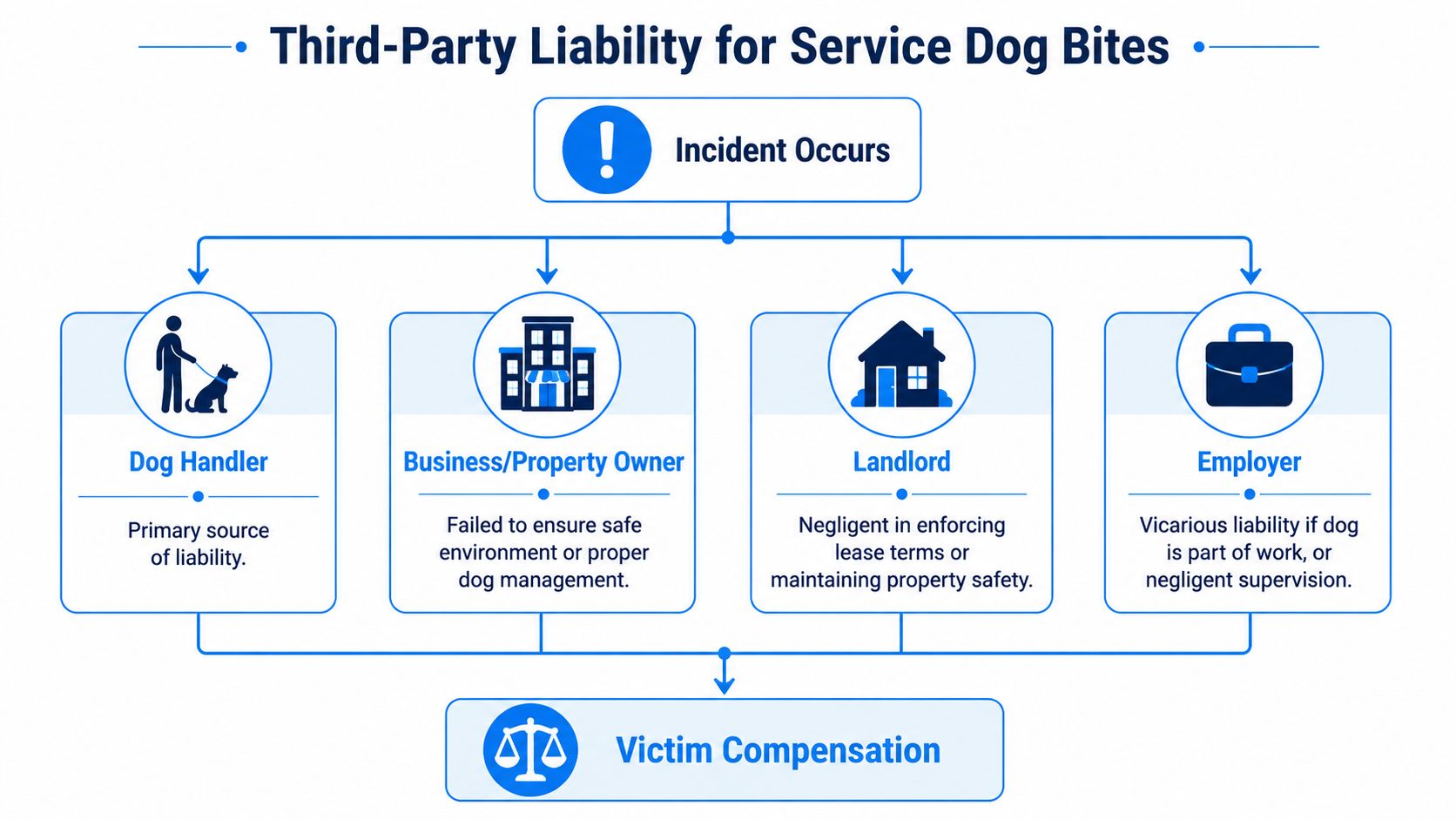
To hold a third party liable, the injured person generally has to prove four things: duty, breach, causation, and actual injury. This explanation of third-party liability in service dog bite cases lays out that framework clearly. In practice, the question is whether the business, landlord, or employer had reason to act and failed to do it.
When a business may share fault
A business isn't automatically liable just because the bite happened on its premises. But a business can face exposure if staff knew the dog was acting aggressively or out of control and allowed the situation to continue.
Take a common example. A customer brings in a service dog. The dog growls at another patron near checkout. Staff members notice but do nothing. Minutes later, the dog bites someone in the same area. That is very different from a bite with no warning.
In that situation, the claim against the business may focus on knowing allowance of a hazard. The key proof often includes employee observations, surveillance video, prior complaints, and incident logs.
- Strong fact pattern: Staff received warnings, saw disruptive behavior, and failed to act.
- Weaker fact pattern: The bite happened suddenly, with no visible warning and no chance to intervene.
If you want a broader feel for how courts treat strict-liability principles in injury cases, reviewing examples of winning strict liability tort cases can help frame the issue.
When a landlord may be part of the case
Landlord liability usually turns on knowledge and control. If a landlord knew a tenant's dog posed a danger to other residents or guests and had the ability to address it, the landlord may face a premises-liability claim.
That can happen in apartment complexes where management has received repeated complaints about a dog rushing doors, snapping in hallways, or threatening neighbors in shared spaces. If the landlord does nothing and a resident gets bitten later, the landlord may not be able to stand behind the idea that this was solely the handler's problem.
When an employer may be responsible
Employer liability usually comes up when the bite occurs in the scope of employment. If a handler was working when the incident happened, the employer may be liable under respondeat superior, the rule that can hold employers responsible for employee conduct connected to the job.
A simple example is a workplace where an employee uses a service dog and the dog bites a customer during normal business operations. Another example is a home-health or field-service setting where the employer knew the dog created safety issues but failed to address them.
The practical mistake victims make is stopping after identifying the dog owner. In a serious case, the deeper insurance coverage is sometimes with the business, landlord, or employer.
What usually works and what doesn't
A viable third-party claim usually needs proof that the non-owner defendant had notice of danger and enough control to do something about it.
What tends to work:
- Witnesses who reported prior issues
- Emails, texts, or written complaints
- Surveillance footage showing warning behavior
- Policies that staff ignored
What usually doesn't work:
- Speculation that the property owner “must have known”
- No evidence of prior warning signs
- A sudden bite with no chance to intervene
Navigating Dog Bite Laws in Pennsylvania and New Jersey
Pennsylvania and New Jersey are neighboring states, but they don't handle dog-bite liability in exactly the same way. That difference matters if you were bitten in Philadelphia, the surrounding suburbs, South Jersey, or across the river in Moorestown.
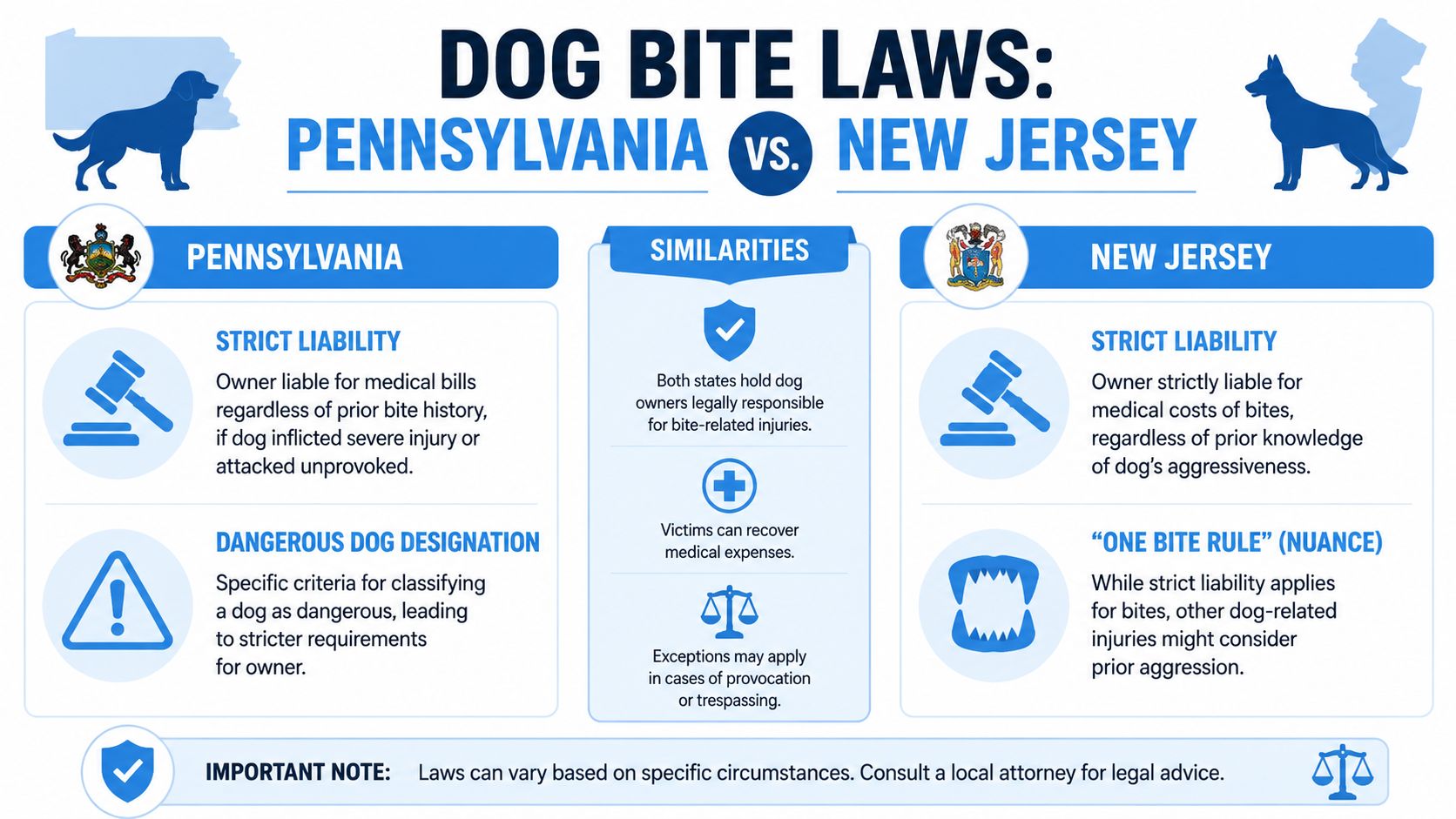
Pennsylvania law in practice
Pennsylvania follows a more nuanced approach than some people expect. In practical terms, owner responsibility can be clear for some losses while other damages may still require proof of fault, depending on the claim and facts.
That matters because the dollars involved in dog-bite cases are not trivial. In Pennsylvania, the average cost per dog bite claim was $88,668 in 2024, ranking second nationally after New York's $110,488. Nationwide, dog bite claims surged 25.6% in 2025 to 28,450, and homeowners insurers paid $1.57 billion in 2024 alone, according to the Insurance Information Institute's dog bite liability analysis.
A Philadelphia example helps. If a service dog bites a shopper in Center City, the handler is still the first target of the claim. But if store staff had prior notice that the dog was causing problems and failed to respond, the case may expand beyond the owner.
New Jersey law in practice
New Jersey is generally viewed as more straightforward in dog-bite cases involving lawful presence. When the injured person was lawfully on the property, the owner often faces a more direct path to liability for the bite itself.
That can matter in a Moorestown apartment or retail setting. If a resident, visitor, or customer is legally present and a service dog bites them, the owner may not have much room to argue they had no prior warning. The dispute often shifts from liability to defenses, damages, and whether a third party also shares fault.
Side-by-side issues that affect real claims
| Issue | Pennsylvania | New Jersey |
|---|---|---|
| Owner liability | Often more nuanced in application | Often more direct for the bite itself |
| Role of negligence evidence | Can be important for parts of the damages analysis | Still relevant for related issues and third-party claims |
| Third-party claims | Business, landlord, or employer may be added with the right facts | Same, especially where notice and control can be shown |
If you're dealing with the owner's side of the issue as well, this explanation of whether a dog may be put down after biting someone helps answer a concern many families raise after a serious incident.
The state line matters. A claim that looks simple in New Jersey may require a more careful negligence analysis in Pennsylvania.
Protecting Your Health and Your Legal Rights
After a service dog bite, the first few hours matter more than is often understood. What you do right away affects both your recovery and the strength of your claim.

Start with medical care
Get medical attention immediately, even if the wound looks small. Dog bites can puncture significantly, damage tissue, and create infection risks that aren't obvious at the scene. Prompt treatment also creates a clean record tying the injury to the attack.
Don't self-edit the seriousness of the bite. If you later need stitches, antibiotics, follow-up treatment, scar care, or time off work, the initial record becomes important evidence.
Build the file before evidence disappears
Next, identify the dog and the handler. Get names, contact information, and if possible, the names of any business employees, security personnel, or property managers who were present.
Then gather evidence while it's still available:
- Photograph the injury: Take clear images right away and over the next several days.
- Document the scene: Include the dog, location, leash or harness, blood, torn clothing, and any warning signs or lack of them.
- Get witness contacts: Neutral witnesses often make or break disputed liability cases.
- Preserve communications: Save texts, emails, incident reports, and messages with the owner or property staff.
If you want a fuller post-incident checklist, this guide on what to do after a dog bite is a practical companion.
Report the bite
Make an official report to the appropriate authority, which may include animal control or the police depending on the location. An official report helps establish the date, place, identity of the dog, and early descriptions of what happened.
That record is especially useful when the other side later changes its story. It can also help uncover prior complaints or behavior issues involving the same dog.
Track every loss
Many people save the hospital bill and ignore the rest. That is a mistake.
Keep a running file of:
- Medical bills and prescriptions
- Follow-up visits and therapy
- Missed work and lost income
- Photos of scarring over time
- Pain, sleep disruption, and daily limitations
Write things down while they're fresh. A short note made the same day is often more credible than a polished recollection months later.
Be careful with insurers
Don't give a recorded statement to an insurance adjuster before you understand the legal issues. In service-dog cases, adjusters often test defenses early. They may ask whether you touched the dog, startled it, ignored warnings, or approached too closely.
Those details matter, but they shouldn't be answered casually or without context. A short, harmless-sounding statement can later be framed as provocation or comparative fault.
Defenses Against a Bite Claim and Why You Need a Lawyer
Even strong service-dog bite claims usually face defenses. The most common are provocation, trespassing, and arguments that the handler had no reason to expect aggression. In some cases, the defense also claims the dog bit while performing a disability-related task, which can complicate the liability analysis.
One nuance worth knowing is that some jurisdictions treat task-performance arguments more seriously than others. This discussion of service dog bite liability notes that in California, an owner may have a stronger defense if the bite occurred during a disability task with no prior aggression, and that 12% of service dog claims in 2025 Virginia court cases were dismissed due to “performance of duty” arguments. That does not mean these defenses win often in Pennsylvania or New Jersey. It does mean the facts need to be developed carefully.
Why legal representation changes the outcome
A lawyer doesn't just file paperwork. In these cases, counsel identifies every viable defendant, secures surveillance footage before it disappears, interviews witnesses before memories fade, and frames the bite within the correct liability rule for the state.
An attorney also knows how to challenge weak defenses. If the owner says you provoked the dog, the response may come from video, witness testimony, the severity and location of the wounds, or evidence that the dog had shown agitation earlier. If a business claims it had no duty, the answer may be hidden in staff reports or prior complaints.
For readers curious about how litigators shape persuasive written arguments, resources on master legal brief writing techniques show why careful fact framing matters so much once a case becomes contested.
When you're asking who is liable if a service dog bites someone, you're really asking who can be held financially accountable for all the harm that followed. That answer is rarely something you should leave to the handler's insurer.
If you were bitten by a service dog in Pennsylvania or New Jersey, Mattiacci Law can evaluate who may be responsible, including the handler, a business, a landlord, or an employer. The firm offers free consultations, direct attorney access, and a no-win, no-fee guarantee, so you can get clear answers about your rights without taking on more risk.