


Author: John Mattiacci | Owner Mattiacci Law
Published January 30, 2026

In Pennsylvania, you generally have two years from the date you were injured to file a personal injury lawsuit. This isn't just a guideline; it's a hard-and-fast deadline. If you miss it, you almost certainly lose your right to seek compensation forever, no matter how clear-cut your case might be.
Understanding Your Two-Year Deadline to File a Claim
Think of the statute of limitations as a countdown clock. The moment you're hurt—whether in a car crash, a slip and fall, or from a faulty product—that clock starts ticking. The law puts this limit in place for a practical reason: to make sure claims are brought forward while evidence is still available and memories are fresh.

Let's walk through a simple example. Say you slip on an icy sidewalk outside a business on January 15, 2024, and break your wrist. Under Pennsylvania law, you have until January 15, 2026, to file your lawsuit. If you wait until January 16, 2026—even just one day late—the court will almost certainly throw your case out.
A Deadline That Applies Broadly
This two-year rule covers a huge range of personal injury situations. It’s written into law under 42 Pa. Cons. Stat. § 5524, and it applies to the kinds of cases our team at Mattiacci Law sees every day: car accidents, truck and motorcycle wrecks, bus collisions, slip-and-falls, construction accidents, dog bites, and injuries from defective products.
The consistency here underscores just how critical it is to act quickly. From the legal system's perspective, two years is considered a reasonable amount of time to get your bearings, understand the extent of your injuries, and start the legal process. For more on how these claims play out, you can find helpful Pennsylvania injury claim statistics from the Lawsuit Information Center.
Key Takeaway: For most personal injury claims in Pennsylvania, that two-year window is absolute. It's designed to protect potential defendants from the threat of old, stale claims and push for disputes to be resolved in a timely manner.
Why This Timeframe Is So Critical
Procrastinating can be a case-killer. Putting together a strong personal injury claim is far more than just filling out a form. It’s an intensive process that requires a detailed investigation.
This often involves:
- Securing critical evidence: This means gathering police reports, surveillance footage, photos from the scene, and witness statements before they disappear.
- Hiring the right experts: We might need to bring in medical specialists to explain your injuries or accident reconstructionists to prove how the incident happened.
- Dealing with insurance companies: Most cases involve complex negotiations with insurers to try and reach a fair settlement before a lawsuit is even filed.
All of these steps take time. The sooner an experienced attorney gets started, the better your chances of building a powerful case.
To give you a clearer picture, we’ve put together a table summarizing the most common deadlines you need to know.
Key Pennsylvania Personal Injury Deadlines at a Glance
This table breaks down the standard time limits for the most frequent types of personal injury claims we handle.
| Type of Claim | Standard Deadline | When Does the Clock Start? |
|---|---|---|
| Car Accidents & Collisions | 2 Years | Date of the accident |
| Slip, Trip, and Fall Injuries | 2 Years | Date of the incident |
| Defective Product Injuries | 2 Years | Date the injury occurred |
| Wrongful Death Actions | 2 Years | Date of the victim's death |
While this table covers the basics, remember that every case is unique. Certain exceptions can change these timelines, which is why it's so important to get legal advice tailored to your specific situation.
When Does the Filing Clock Actually Start Ticking?
Knowing the two-year rule is a great start, but the real question is often more complex: when does that two-year countdown officially begin? In legal terms, this starting point is called the accrual of a claim. Think of it as the moment the starting pistol fires in a race—once it goes off, the clock is running and it won’t stop on its own.
For many personal injury cases, pinpointing this date is straightforward. If you're injured in a car crash, the pistol fires the moment of impact. If you slip and fall on a wet floor in a grocery store, it fires the second you hit the ground. In these clear-cut situations, the injury and the event that caused it happen at the same time, making the start date obvious.
The Challenge of Delayed Injuries
But life—and injuries—aren't always so simple. What happens when the harm isn't immediately obvious? This is where understanding the Pennsylvania personal injury statute of limitations gets far more nuanced. Not all injuries announce themselves with a sudden, unmistakable event.
Consider these common but complicated scenarios:
- A Delayed Concussion Diagnosis: You're in a minor fender-bender and feel shaken but otherwise okay. A week later, you start experiencing persistent headaches, dizziness, and confusion, leading a doctor to diagnose you with a traumatic brain injury (TBI).
- A Slowly Developing Illness: You work in a factory and are exposed to toxic chemicals over several years. You don't feel sick until long after your last day on the job, when you're diagnosed with a serious respiratory condition directly linked to that exposure.
In cases like these, the "date of injury" isn't a single, clear moment. The harm was done earlier, but the true nature and existence of the injury were hidden. To learn more about how these timelines apply specifically to auto accidents, you can read our guide on how long you have to file a claim after a car accident in Pennsylvania. This is where an important legal exception comes into play.
How Pennsylvania Law Addresses Hidden Injuries
Pennsylvania law recognizes that it would be completely unfair to start the clock on an injury you didn't even know you had. The legal system provides a vital protection for these situations, which we will explore in detail in the next section. This concept is crucial because it can potentially shift your filing deadline significantly.
The core principle is that the statute of limitations doesn't begin until you know—or reasonably should have known—that you have been injured and that your injury was caused by someone else's conduct.
This is exactly why immediate and thorough documentation after any incident is so critical. Keeping detailed notes about your health, even if you feel fine at first, creates a timeline that can become invaluable. It helps establish exactly when you first became aware of your injury, which is a key fact in determining when your personal filing clock officially started ticking. Proving this start date is a foundational step in preserving your right to seek compensation.
Critical Exceptions That Can Change Your Filing Deadline
While the standard two-year deadline in Pennsylvania is a hard and fast rule in most personal injury cases, it isn't set in stone. The law is smart enough to know that real life is messy. Certain situations just don't fit neatly into a two-year box, so there are critical exceptions that can effectively pause or extend that filing period.
Getting these exceptions right can mean the difference between having your case heard and having the courthouse doors shut forever. These aren't loopholes; they're common-sense legal principles designed to create a fair playing field, especially when the circumstances of an injury make it impossible to act right away. Two of the most important ones you need to know about are the Discovery Rule and the special rules for minors.
The Discovery Rule for Hidden Injuries
Think about it like this: you wouldn't know to sue a plumber for a faulty pipe the moment it starts a slow, invisible leak behind a wall. You'd only know there's a problem months or years later when the floor starts to buckle. It wouldn’t be fair for your deadline to have expired before you even knew you had a problem, right?
That’s the exact logic behind Pennsylvania's Discovery Rule. This crucial legal concept says that the two-year clock doesn't start ticking until the date you discovered your injury—or, through reasonable diligence, should have discovered it—and realized it was likely caused by someone else's actions.
This decision tree helps visualize when the clock might start for your specific claim.
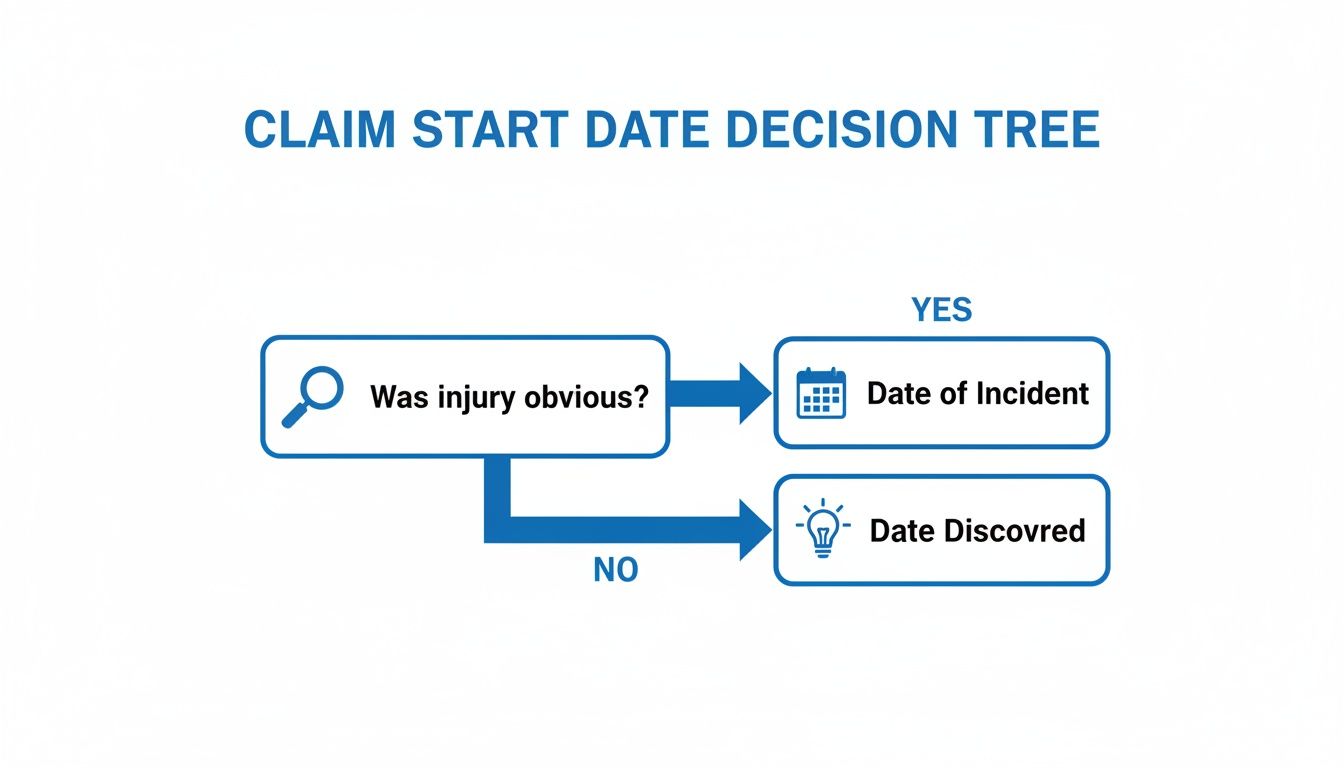
As you can see, the starting line for your case depends entirely on whether the harm was obvious from day one or if it surfaced much later. That's the Discovery Rule in a nutshell.
We see this rule come into play most often in cases involving:
- Medical Malpractice: A surgeon might accidentally leave a sponge inside a patient, but the patient might not feel any effects for years until a mysterious pain leads to an X-ray.
- Toxic Exposure: Someone who worked with asbestos in the 1980s could be diagnosed with mesothelioma decades later. Their two-year window wouldn't start until that diagnosis.
- Defective Medical Devices: A hip implant that was supposed to last 15 years might fail after five. The clock starts when the patient learns the device itself, not just wear and tear, was the problem.
In every one of these situations, the statute of limitations would likely begin on the day the injury was finally pieced together, not way back when the negligent act actually happened.
The Discovery Rule is a lifeline for victims of latent injuries. It ensures your right to justice isn't stolen from you before you even know you've been wronged.
Tolling the Deadline for Minors
The law also takes special care to protect children. When someone under the age of 18 is injured because of another person's negligence, the statute of limitations is paused, or "tolled," until they become a legal adult.
So, for a child, that two-year countdown doesn't begin on the date of the accident. Instead, the clock is frozen. It only starts ticking on their 18th birthday, which means an injured minor has until their 20th birthday to file a lawsuit.
This is a huge deal. It gives a young person—whether they were hurt in a dog bite, a school bus accident, or hit by a car—the chance to grow up and understand the true, long-term consequences of their injuries before they have to make major legal decisions.
It’s a merciful and practical rule, but it exists alongside some very harsh realities. For example, while a minor may have extra time, the deadline for a wrongful death claim remains a strict two years from the date of death. The stakes are incredibly high; some data suggests that 75% of PA personal injury claims fall apart within the first 30 days due to simple procedural mistakes, poor evidence, or just not knowing these rules. You can learn more by reading about these crucial Pennsylvania claim statistics and how they affect victims.
Successfully arguing for one of these exceptions isn't a simple matter of just telling a judge your story. Proving exactly when an injury was "discovered" or applying the right tolling period requires a deep, practical knowledge of Pennsylvania case law. These are complex legal arguments that an experienced attorney needs to build with care and precision.
Special Rules for Wrongful Death and Government Claims
While the standard two-year deadline covers a lot of ground, things get much more complicated—and the deadlines get a lot tighter—in a few specific situations. Two of the most critical are when an injury results in a death, or when you're trying to hold a government agency responsible.
Getting the timing or the procedure wrong in these cases isn't a small mistake. It can completely shut the door on your ability to seek justice for yourself or your family.
The Clock for Wrongful Death Claims
When an accident tragically leads to a person's death, the case is no longer just a personal injury claim; it becomes a wrongful death action. The two-year deadline is still the rule, but when that two-year clock starts ticking is the all-important detail.
For a wrongful death claim, the two-year countdown begins on the date of the person's death, not the date of the accident that caused the fatal injuries.
This is a subtle but massive distinction. Let’s say a construction worker is catastrophically injured on March 1, 2024. He fights for his life for six months but sadly passes away from those injuries on September 1, 2024. His family’s deadline to file a lawsuit would be September 1, 2026—two years from his death, not the initial accident. You can learn more about these critical timelines by reading about the time requirements for filing a wrongful death suit in Pennsylvania.
Navigating Claims Against Government Entities
Trying to sue a government body is a different ballgame entirely. Whether it's a state agency like PennDOT, a city like Philadelphia, or a local transit authority, they have special protections that create an urgent, preliminary deadline you absolutely cannot miss.
Long before you worry about the standard two-year statute of limitations, you must first give the government a formal Notice of Intent to Sue.
Crucial Warning: In Pennsylvania, you have just six months from the date of your injury to file this written notice with the proper government agency. If you miss this 180-day deadline, your claim is almost certainly barred forever.
This six-month notice requirement is a procedural landmine that catches far too many people by surprise. You could think you have a year and a half left to act, but if you failed to file that initial notice on time, your right to sue has already vanished.
Why These Deadlines Are So Strict
The official reason for this short notice period is to give the government agency a chance to investigate the incident while evidence and memories are still fresh. In practice, however, it creates a punishingly tight window for an injured person who is likely focused on their recovery, not legal paperwork.
This tough rule applies in more situations than you might think:
- Tripping on a badly cracked public sidewalk owned by the city.
- Getting hit by a city-operated vehicle, like a sanitation truck.
- Suffering a slip and fall injury in a public park or government building.
- Being injured in a crash involving a SEPTA bus or trolley.
All of these scenarios fall under the brutal six-month notice requirement of § 5522. The complexity and unforgiving nature of these rules show just how important it is to get experienced legal guidance right away, ensuring every step is handled correctly from the very beginning.
Practical Steps to Protect Your Claim After an Injury
Knowing about Pennsylvania's personal injury statute of limitations is one thing, but taking the right steps to protect your claim is where the rubber meets the road. The actions you take right after an accident are crucial; they lay the groundwork for your entire case. Think of it like gathering ingredients for a complex recipe—miss a key item at the start, and the final result just won't be right.

That two-year deadline might seem like a long way off, but evidence has a way of disappearing. Memories fade. And you can bet the insurance company starts building its defense from day one. Acting quickly and deliberately ensures you're prepared long before that deadline starts to loom.
Seek Immediate and Consistent Medical Attention
Your health is always priority number one. But seeking prompt medical care also accomplishes something critical for your case: it creates a clean, undeniable record. Any gaps in treatment or long delays before your first doctor's visit are red flags for insurance adjusters. They'll use that to argue your injuries weren't that serious or were caused by something else entirely.
Follow your doctor's orders to the letter. Go to every follow-up, every physical therapy session, and every specialist consultation. This consistent paper trail directly connects your injuries to the accident and documents their real-world impact over time.
Document Everything Meticulously
Your memory is a powerful tool, but it can't compete with detailed notes taken in the moment. Start a simple journal or use a notes app on your phone to track everything. And I mean everything.
Your documentation should include:
- Daily Pain and Symptoms: Jot down your pain levels, what you can't do physically, and the emotional toll it's taking on you.
- Medical Visits: Log every appointment, what the doctor said, and what prescriptions you were given.
- Missed Work: Keep a running tally of any days you've had to take off and the wages you've lost because of it.
- Expenses: Save every single receipt. Co-pays, medications, crutches, even gas money for driving to appointments—it all adds up.
This logbook becomes an indispensable tool for calculating the full, true value of your damages down the line.
Key Takeaway: The more detailed your personal records are, the stronger the story they tell. This documentation helps prove not just your financial losses but also the profound impact the injury has had on your daily life.
Preserve All Physical Evidence
Physical evidence can be incredibly powerful, but it's often fragile and easily lost. It's up to you to save anything that could be relevant. That might mean keeping the torn, bloody shirt you were wearing in an assault or holding onto the defective ladder that collapsed under you.
Whatever you do, don't repair your damaged car or throw away that faulty product until an attorney has had a chance to get it professionally inspected. Tangible proof like this can be the final piece of the puzzle needed to prove exactly how you were hurt. Getting the legal process right is critical, and you can learn more about the formal steps in our guide on filing a personal injury claim in Pennsylvania.
Be Cautious with Insurance Adjusters
It won’t be long before you get a call from the at-fault party’s insurance adjuster. You must remember their job isn't to help you; it's to save their company as much money as possible. Never, ever give a recorded statement or sign any documents before you've spoken with a lawyer.
Adjusters are masters at asking tricky questions designed to get you to downplay your pain or even admit to some of the blame. Trust me, anything you say can and will be twisted and used against you later. Once you have a handle on the deadlines, it's also smart to understand the procedural nuts and bolts of the legal system; you can find general guidance on how to file court documents to get a better sense of these formal steps.
Why You Can't Afford to Wait to Contact an Attorney
I've seen it happen too many times: someone thinks they have two full years to act, so they put off calling a lawyer. This is one of the most dangerous assumptions you can make after an injury. The Pennsylvania personal injury statute of limitations isn't a friendly suggestion—it’s a hard and unforgiving deadline.
The reality is, building a successful personal injury claim is a marathon, not a sprint. Waiting until the last minute shrinks your most critical asset: time. Evidence has a very short shelf life. Witness memories get fuzzy, security camera footage is recorded over, and the physical scene of an accident is cleaned up and changed forever. A good lawyer needs to get to work now to preserve every critical piece of your story.
Building a Strong Case Doesn't Happen Overnight
That two-year clock isn't just for filing a piece of paper with the court. It's the entire window your attorney has to construct your case from scratch. This process is far more involved than most people realize and requires a tremendous amount of upfront work.
Long before any lawsuit is filed, we are busy:
- Digging for the Facts: This means getting our hands on police reports, finding and interviewing every possible witness, and securing crucial physical evidence before it disappears.
- Bringing in the Experts: We often need to consult with medical specialists who can testify to the true extent of your injuries, or even accident reconstruction experts who can prove exactly how the incident happened.
- Calculating Your True Losses: We meticulously gather every medical bill and proof of lost income. More importantly, we work to understand your future needs to calculate the full and fair value of your claim.
- Battling the Insurance Company: This involves strategic, often drawn-out, negotiations with insurers whose entire business model is built on delaying, denying, and paying as little as possible.
The statute of limitations is the final, absolute deadline to file a lawsuit. It’s not the starting line for building your case. Waiting puts your attorney in a defensive crouch, forced to rush what should be a careful, methodical process.
Acting Quickly Puts You Back in the Driver's Seat
When you reach out to an attorney right away, you hand the advantage back to your side. You give your legal team the breathing room they need to build a rock-solid case, negotiate from a position of undeniable strength, and be fully prepared for trial if the insurance company refuses to be fair.
Don’t let the calendar dictate your right to justice. The Pennsylvania personal injury statute of limitations is unforgiving. Making that early call to an experienced lawyer is the single most powerful step you can take to protect your future and fight for the full compensation you deserve.
Common Questions About Pennsylvania's Injury Deadlines
Even when you know the basic rules, real-life situations can get tricky. Let's tackle some of the most common questions we hear from clients about the statute of limitations in Pennsylvania.
What If I Was Partially at Fault for My Accident?
Pennsylvania uses what's called a “modified comparative negligence” rule. In simple terms, this means you can still get compensation as long as a court doesn't find you 51% or more responsible for what happened.
Your final award is just reduced by your share of the blame. So, if you're awarded $100,000 but are found to be 20% at fault, you’ll walk away with $80,000. But here's the key: this has zero impact on your two-year deadline. You still have to file your lawsuit on time, no matter how fault gets sorted out later.
Does the Deadline Apply If I'm Still Talking to the Insurance Company?
Yes, and this is a huge trap for a lot of people. The two-year clock is for filing a lawsuit in court, not for wrapping up negotiations with an insurance company. Adjusters are very aware of this deadline and some will intentionally drag their feet, hoping you'll miss your window to sue.
Don't ever assume that just because you're in talks with an insurer, the clock has stopped ticking. The only way to officially lock in your right to compensation is by filing a lawsuit before that two-year deadline hits.
What If I Can't Find the Person Who Hurt Me?
This is a common worry, especially with hit-and-run accidents. While it definitely makes things more complicated, it doesn't always mean you're out of options. Your own car insurance policy might have Uninsured/Underinsured Motorist (UM/UIM) coverage, which is designed for exactly this kind of situation.
The statute of limitations is still in play, but your specific insurance policy will have its own rules and deadlines for filing a UM/UIM claim. You need to pull out your policy and act fast to make sure you don't miss any of those internal deadlines.
My Injury Seemed Minor at First, but Now It’s Much Worse. Is It Too Late?
This is a classic "Discovery Rule" scenario. If an injury that seemed like nothing at first turns into something serious down the road, your two-year clock might not have started on the day of the accident. Instead, it likely began on the day you found out—or reasonably should have found out—just how bad the injury was.
For example, maybe that nagging back pain from a slip and fall is later diagnosed as a herniated disc that needs surgery. In that case, your clock might start ticking from the date you got that diagnosis, not the date you fell. Proving this requires solid medical records and a clear timeline, so getting a lawyer involved early is critical.
Figuring out Pennsylvania's injury deadlines takes experience and a proactive game plan. If you're wrestling with questions about your own case, the team at Mattiacci Law is here to give you clear answers and take decisive action. Reach out for a free, no-obligation consultation to protect your rights today by visiting https://jminjurylawyer.com.