


Author: John Mattiacci | Owner Mattiacci Law
Published April 3, 2026

If someone hit your car and the insurance company denied your claim, get one thing straight: a denial is not the end of the road. It's a test. Insurers often send out these letters hoping you’ll just get frustrated and walk away.
You have rights, and you have options. This is your guide to fighting back the right way.
Your Claim Was Denied. What Happens Now?
Getting a claim denial letter after a car accident can feel like a punch to the gut. It shows up filled with confusing legal jargon and policy codes, leaving you feeling powerless and angry.
It's a common tactic, and trust me, you are not alone. The insurance industry’s own data shows that denials are a go-to strategy.
Nationally, between 5% and 15% of all auto insurance claims get denied at some point. That range is wide, but it hides an even bigger problem in certain areas. Some reports have shown initial denial rates as high as 65% within the first 72 hours of a claim. It's an aggressive strategy designed to shut things down before you can even get your bearings.
This Is a Negotiation, Not a Verdict
You have to shift your mindset. A denial letter isn't a final judgment from a court. It’s the insurance company's opening move in a negotiation.
They’re testing you, betting that the stress and confusion will be enough to make you give up on what you're rightfully owed. But you have more power here than you think.
The key is to figure out why they denied the claim, build a strong case with solid evidence, and know exactly when to call in a professional. For drivers in Pennsylvania and New Jersey, there are specific rules and deadlines that control this whole process. For example, you need to know how long an insurance company has to investigate a claim in your state, because that timeline matters.
The process of fighting a denial isn't as complicated as it seems. First, you read their letter carefully to understand their excuse. Next, you gather the evidence to prove them wrong. Finally, you get the help you need to challenge them head-on.
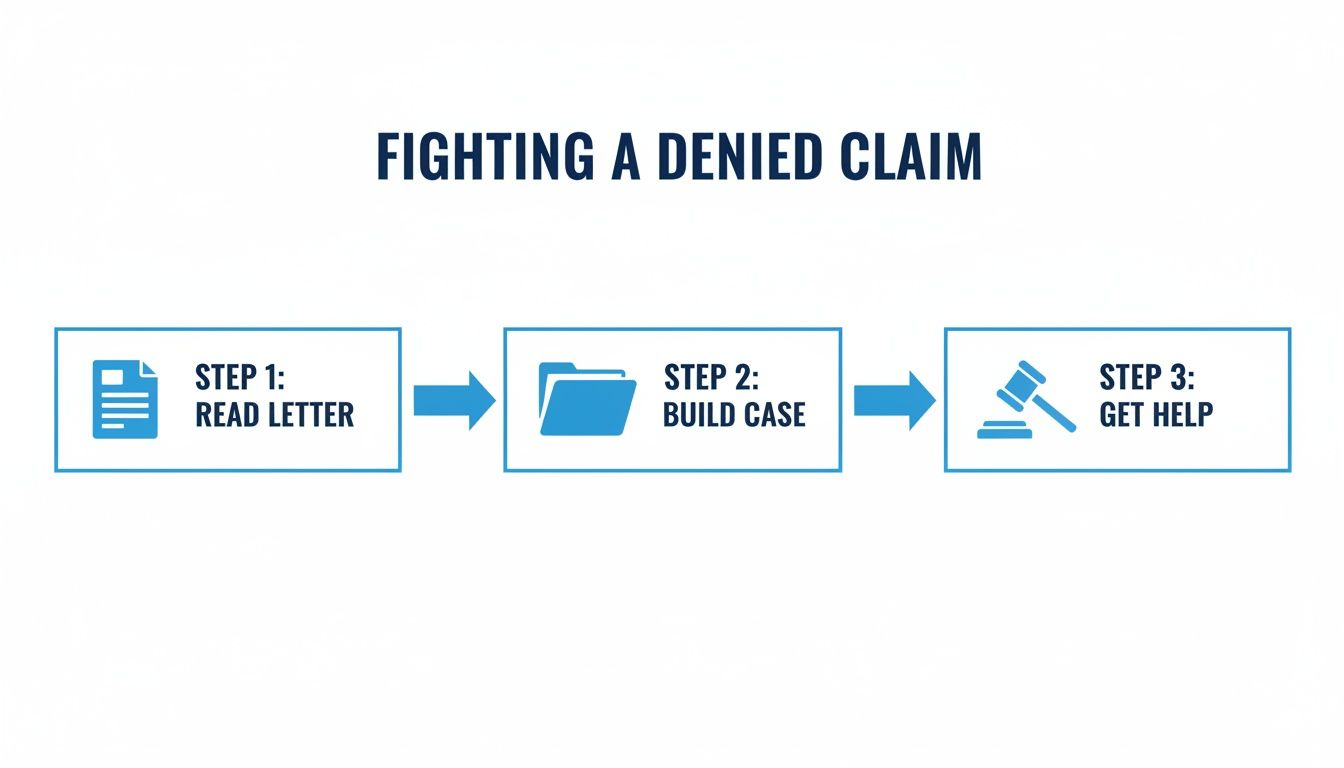
This breaks it down into three simple phases, giving you a clear path from getting that denial letter to taking control of the situation.
Before diving deep, it's smart to have a clear, immediate action plan. The moment you get that denial, your response matters. The table below summarizes the critical first moves you should make to protect your rights.
First Steps After An Insurance Claim Denial
| Action Item | Why It's Critical | Example |
|---|---|---|
| Don't Panic or Argue | An angry phone call won't change their mind and can be used against you. Keep all communication professional and in writing. | Instead of calling the adjuster to yell, send a calm email requesting a copy of their investigation file and the specific policy language they're citing. |
| Request Everything in Writing | Get the official denial reason, the specific policy section they're using, and a copy of their investigation file. This is your starting evidence. | "Please provide a formal denial letter referencing the exact policy exclusion you are applying to my claim, #12345." |
| Preserve All Evidence | Save everything: photos, police reports, witness contacts, medical bills, and repair estimates. Don't throw anything away. | You have photos from the scene and a business card from a witness. Scan them and save them to a dedicated folder on your computer immediately. |
| Review Your Own Policy | Check your own insurance policy for coverages like Uninsured/Underinsured Motorist (UM/UIM) or Collision. You may have a path to payment there. | The other driver's insurance denied your claim. You check your own policy and see you have $50,000 in UIM coverage you can now pursue. |
Taking these steps lays the groundwork for a successful appeal. It shifts the power dynamic from them telling you "no" to you demanding they prove it.
You Have Rights And A Path Forward
Your immediate goal is to take the insurer's argument apart, piece by piece. This guide will show you exactly how to do it.
- Decipher the Denial: We’ll help you cut through the insurance-speak and find the real reason they said no.
- Gather Your Ammunition: You’ll learn how to find and organize the evidence—from police reports to medical records—that directly proves their reason is wrong.
- Draft a Powerful Rebuttal: We'll explain how to write a formal appeal letter that lays out your case so clearly and forcefully they can't ignore it.
If you were hit by an uninsured driver and then had your claim denied, it gets even more complicated. Understanding your rights in that specific situation is critical. You can look over a helpful accident rights claim guide for more background on these types of cases.
Just remember, you do not have to accept the insurance company’s “no” as the final word.
Decoding The Denial Letter: Common Reasons Insurers Reject Claims
When you open that dreaded denial letter, the first thing you’ll notice is the dense, confusing language. That’s intentional. Insurance companies pack these letters with legal jargon and obscure policy references, hoping you'll get intimidated and just give up.
Your job is to see this letter for what it is: not a final verdict, but a roadmap to their strategy. An insurer is legally required to give you a specific reason for the denial. That reason is their official argument—the one you now have to take apart, piece by piece.
Let's break down the most common excuses you’ll see and what they actually mean.
"It's Not Covered": Policy Exclusions And Gaps
One of the oldest tricks in the book is blaming a "policy exclusion" or claiming the at-fault driver didn't have the right coverage. The letter might say the specific circumstances of your accident aren't covered under their policy.
For instance, they might argue the driver was using their personal car for a rideshare or delivery service at the time of the crash. If the driver didn't have a special commercial rider on their policy, the insurer will say the personal policy is void and they don't have to pay a dime.
Another angle is a coverage lapse. The insurance company might claim the at-fault driver forgot to pay their premium, so their policy wasn't active on the day of the accident. This conveniently turns them into an uninsured driver, a mess that suddenly shifts the entire problem over to your own insurance policy.
Key Takeaway: A "policy exclusion" denial is almost always the insurer's attempt to use a technicality to get out of paying. Your first move should always be to demand they send you the exact policy language they're citing so you (or your lawyer) can see if they're telling the truth.
"It Wasn't Our Driver's Fault": Disputes Over Liability
This is the most common battleground by far. The other driver’s insurance company will flat-out deny your claim by saying their driver did nothing wrong. Or, even worse, they’ll say you were partially or completely at fault.
They might claim you were speeding, made a bad lane change, or were looking at your phone—even if the police report clearly points the finger at their driver.
They do this because they know that in states like Pennsylvania (which has a modified comparative negligence rule), you get nothing if you are found to be 51% or more at fault. They will grab onto any tiny detail they can find to push the blame onto you.
Here’s how they usually try to build their case:
- Cherry-Picking the Police Report: They’ll focus on any ambiguous phrase they can find while conveniently ignoring the officer's clear conclusion about who caused the crash.
- Using Biased Statements: They often rely entirely on their own driver's side of the story, acting as if your account and any other witnesses simply don't exist.
- Claiming "Word vs. Word": If there were no independent witnesses or clear video, they’ll just call it a he-said-she-said situation and deny the claim by default, hoping you won’t fight back.
A deep dive into why claims get denied reveals a clear pattern of aggressive tactics. Beyond the ones we've covered, insurers love to argue that injuries existed before the accident or that the medical treatments you received weren't necessary. You can get a better sense of how common these strategies are by checking out this in-depth analysis of claim denial trends.
"You Were Already Hurt": Pre-Existing Conditions And Medical Disputes
If you're claiming injuries, get ready for the insurance company to dig into your entire medical history. A favorite tactic is to claim your injuries are from a "pre-existing condition" and have nothing to do with the accident.
Picture this: you had a minor, symptom-free back issue years ago that you never even treated. Then, you get rear-ended and suffer a painful herniated disc. The insurer will find those old records and deny your claim, arguing the herniation was pre-existing—even though the crash is obviously what caused the new, severe injury.
They also love to deny claims by arguing your medical care was "not reasonable or necessary." The insurer will have their own in-house doctor—someone who has never met you, never examined you, and only looked at your file for a few minutes—declare that your physical therapy was excessive or that your MRI was a waste of money.
This isn't about medicine; it's a strategic move to slash the value of your claim. It's a position you can, and absolutely should, fight with a strong opinion from your own doctor who actually treated you.
Building Your Case To Overturn The Denial

So you got the denial letter. The insurance company has shown its cards and told you exactly why they won't pay. Now it's your turn to build a case that’s so strong, they’ll have to reconsider.
This isn’t about writing an angry email. This is about methodically tearing their argument apart with facts. Think of it like this: your goal is to hand them a file so organized and so convincing that it becomes easier for them to just pay the claim than to keep fighting you.
It’s time to stop reacting and start taking control.
Gather Every Piece Of Evidence
Your first job is to become a detective for your own case. Every single document, photo, and scrap of paper related to the accident matters. Don't dismiss anything. Sometimes the smallest detail is what cracks a case wide open.
This file is your ammunition. Keep it organized.
Key Documents You Need to Round Up:
- The Official Police Report: This is your foundation. Get a certified copy and grab a highlighter. Mark up the officer's notes on fault, any tickets they issued, and their description of how the crash happened.
- Photos and Videos: Gather every single picture from the accident scene. You need wide shots showing the whole area, close-ups of the vehicle damage from different angles, and photos of skid marks or debris.
- Witness Information: Make a list of everyone who saw the accident. You need their full name, phone number, and a quick note about what they told you. If you can get them to write down and sign a statement while it's fresh, that’s even better.
- All Medical Records and Bills: Collect everything. I mean everything—from the first ER visit to your physical therapy appointments, prescriptions, and any specialists you saw. Every bill proves your damages.
And don't stop there. Did the other driver text you an apology after the wreck? Save it. Did you take pictures of your bruises a week later? Add them to the file. For a deeper dive, check out our guide on how evidence is used to prove negligence in Pennsylvania.
Secure Independent Assessments
Insurance companies have their own go-to "experts"—their adjuster who inspects your car, or their doctor who reviews your medical files. These people are on the insurer's payroll, and surprise, surprise, their opinions often favor the insurer. You need your own.
If the denial is over repair costs, don't just take their word for it. Go out and find a trustworthy mechanic to write up their own estimate. A detailed, itemized quote from a respected independent shop is powerful evidence against an adjuster's lowball offer.
The same goes for medical disputes. If the insurer says your injuries were pre-existing, a letter from your own doctor is your best weapon. That letter should state clearly, in their professional opinion, that the car accident was the direct cause of your injuries.
Write A Powerful Demand Letter
Once you have all your proof lined up, it's time to draft a formal demand letter. This isn't just a simple note asking them to pay. It’s a professional legal document that lays out your entire case and demands a specific dollar amount.
Your demand letter is your opening argument. It needs to be firm, factual, and backed up by every piece of evidence you’ve collected. It signals to the insurance company that you're serious and not going away.
Your letter should attack the insurer’s reason for denial head-on. No emotional appeals—just facts. You need to refute their points one by one.
- If they denied based on fault: "Your letter claims I was partially responsible. This is factually incorrect. The attached police report (Exhibit A) shows your insured was cited for a red light violation. Furthermore, the sworn statement from witness Jane Doe (Exhibit B) confirms your driver ran the red light."
- If they denied based on your injuries: "Your denial states my physical therapy was not medically necessary. This is directly contradicted by my treating physician, Dr. Adams, whose report (Exhibit C) explicitly prescribed this care for the herniated disc caused by the collision."
See how that works? Every argument you make is immediately backed by a specific piece of evidence. You're not just telling them they're wrong—you're showing them why they're wrong with proof.
Finally, the letter must end with a clear demand for payment covering your property damage, all medical bills, lost wages, and pain and suffering. This is how you start to turn the tables on a denied claim.
Recognizing And Responding To Insurance Bad Faith
A claim denial is one thing—it’s frustrating, sure, but it’s often a standard part of dealing with insurance companies. But what happens when their behavior crosses a line? Sometimes, an insurer’s conduct goes beyond a simple disagreement and veers into illegal territory known as insurance bad faith.
Insurance companies in Pennsylvania and New Jersey have a legal duty to treat you fairly and honestly. When they use unreasonable or dishonest tactics to get out of paying a legitimate claim, they’re acting in bad faith. This isn't just about losing a dispute; it’s about the insurer breaking the fundamental rules of their own contract with you.
What Does Bad Faith Look Like In Practice?
Spotting bad faith is critical, because it can open the door to recovering more than just your original claim amount. This isn't about you just disagreeing with an adjuster’s valuation. It’s about the insurance company showing a pattern of unreasonable and unfounded behavior designed to wear you down.
You have to watch for the red flags that show the company isn't just investigating your claim, but actively trying to sabotage it.
- Unreasonable Delays: The company drags its feet for months, constantly asking for the same documents you’ve already sent or just going silent for long stretches without any good reason. Their goal? To make you so frustrated that you just give up.
- Refusing to Investigate: They do the bare minimum—or nothing at all. Maybe they ignore the police report, refuse to call your witnesses, or don’t even bother to send someone to inspect your vehicle’s damage.
- Deliberately Misinterpreting the Policy: The adjuster twists the words of your policy to create a bogus reason for denial. We see this all the time—they’ll cite an exclusion that is either vague or clearly doesn't apply to your situation.
- Ignoring Clear Evidence: This is a classic bad faith move. Let’s say you provide dashcam footage that clearly shows the other driver blowing through a red light. But they deny your claim anyway, arguing fault is somehow "unclear." This isn’t a legitimate dispute; it’s a willful refusal to accept reality.
These aren’t just isolated mistakes; they're often calculated strategies. And this problem is widespread. National data on claim denials shows just how common this is, with some states seeing thousands of formal complaints every year. For example, California, Texas, and Florida together account for over 12,800 annual complaints related to claim denials and settlement delays. You can explore the full report on claim denial trends to see a detailed breakdown.
The Difference Between A Tough Negotiation And Bad Faith
It’s crucial to understand that not every low offer or denial is an act of bad faith. An insurance company is allowed to have a different opinion on the value of your car or the extent of your injuries. A legitimate dispute involves a disagreement based on the evidence and the language in the policy.
Bad faith, on the other hand, is when the insurer's actions are unreasonable and they know it, or they act with reckless disregard for the facts.
Real-World Scenario: An insurer gets clear video evidence showing their driver caused a multi-car pile-up. Instead of accepting liability, they deny all the claims for six months, citing an "ongoing investigation." This delay tactic, used despite having conclusive proof, forces victims to go without vehicle repairs or medical payments and is a textbook indicator of bad faith.
Because the line between aggressive negotiating and illegal bad faith can be so fine, proving it often takes a legal expert. An experienced attorney knows the specific bad faith laws in Pennsylvania and New Jersey and can recognize the subtle patterns of insurer misconduct. They can help you not only fight the original denial but also pursue additional damages for the insurance company's illegal behavior.
Why A Car Accident Lawyer Is Your Strongest Weapon

When the insurance company denies your claim after someone hits your car, it feels like a classic David vs. Goliath fight. But it's worse. The insurer has an army of adjusters and lawyers who do one thing all day, every day: find ways to pay you as little as possible.
Hiring an experienced car accident lawyer isn't just about having someone on your side. It’s about getting your own Goliath into the ring. A good lawyer does more than make calls; they systematically tear down the insurer's weak arguments while building you an ironclad case.
Leveling The Playing Field Immediately
The game changes the second you hire an attorney. One of the first things they'll do is send a letter of representation to the insurance company. This is a legal notice that tells the insurer they can no longer contact you directly. Period.
That one letter brings immediate relief. The aggressive calls from adjusters stop. The confusing questions designed to trip you up are over. From that point on, all communication goes through your lawyer, who speaks their language and won't fall for their tricks.
This is critical. Your lawyer takes over the fight, letting you focus on getting better. They manage the deadlines, the paperwork, and the back-and-forth, protecting you from accidentally saying something that could sink your claim.
Building An Independent Investigation
Sure, the insurance company will conduct its own "investigation." But let’s be honest—it’s not about finding the truth. It's about finding an excuse to stand by their denial. A dedicated personal injury lawyer starts from scratch with their own investigation, focused on one thing: proving your case.
This goes way beyond just rereading the police report.
A Lawyer's Investigation May Include:
- Hiring Accident Reconstruction Experts: These are the pros who can analyze skid marks, vehicle damage, and crash-site debris to create a scientific model of what really happened, often proving fault beyond any doubt.
- Finding and Interviewing Witnesses: Investigators can track down witnesses the police missed and lock in their testimony with sworn statements, shutting down the other driver's made-up story.
- Subpoenaing Key Evidence: Your lawyer has the power to demand evidence the insurer prays you'll never see. Think the other driver's cell phone records, or a commercial truck’s maintenance logs showing it was poorly maintained.
An insurer's investigation is about protecting their bottom line. Your lawyer's investigation is about protecting your future. That difference is everything.
Maximizing The Value Of Your Claim
Here’s where a lawyer really makes a difference. They know how to calculate the true, full value of your claim—not just what the adjuster wants to pay. The adjuster will try to convince you it's just about the car repairs and a couple of doctor's visits. That’s almost never the full story.
An experienced lawyer knows how to document and demand payment for every single loss, especially the ones the insurance company would never offer on its own.
A Comprehensive Claim Includes:
- All Past and Future Medical Bills: This covers everything from the initial ER visit to surgeries, physical therapy, medications, and any long-term care you might need down the road.
- Lost Wages and Diminished Earning Capacity: If your injuries kept you out of work, you’re owed for that lost income. If they prevent you from returning to your old job or force you into a lower-paying one, that future loss is a huge part of your damages.
- Pain and Suffering: This is compensation for the physical pain, emotional trauma, and the loss of enjoyment of life you’ve suffered. It’s real, and it has value.
- Property Damage: This isn’t just the repair bill. It includes the diminished value of your car—the loss in resale value it now has simply because it’s been in a wreck.
A good attorney works with medical and financial experts to project these costs over your lifetime. They don't just guess; they build a data-driven demand for the maximum compensation you deserve. For more on finding the right legal partner, our article on how to choose a personal injury lawyer is a must-read.
Most importantly, insurers know which law firms are bluffing and which ones will actually take them to court. A firm with a reputation for trying cases, like Mattiacci Law, is a serious threat. The insurance company knows they can't get away with a lowball offer, because the alternative for them is an expensive and risky jury trial. That reputation alone forces them to the table with a much fairer offer, completely changing the outcome.
Frequently Asked Questions About Denied Car Insurance Claims
When an insurance company denies your claim, it's easy to feel lost and frustrated. You've got bills piling up, a car that needs fixing, and an adjuster who won't budge. We hear the same urgent questions every day from drivers in PA and NJ, so we've put together some straight-talk answers to help you figure out what to do next.
How Long Do I Have To File A Lawsuit In PA or NJ?
This is the big one. Miss this deadline, and your right to sue is gone—forever. It's called the statute of limitations, and courts are incredibly strict about it.
For personal injuries—things like medical bills, lost income, and pain and suffering—both Pennsylvania and New Jersey give you two years from the date of the accident to file a lawsuit.
When it comes to property damage (getting your car repaired), the timeline depends on where the accident happened:
- In Pennsylvania, you have two years for property damage claims.
- In New Jersey, the deadline is much longer—you have six years.
Crucial Insight: Don't wait. Seriously. As time passes, evidence vanishes, witnesses forget key details, and building a strong case gets harder. Getting an attorney involved early is the single best way to make sure your rights are protected long before that clock runs out.
Can I Reopen A Denied Claim With New Evidence?
Yes, and you absolutely should. An adjuster’s initial denial is just their first move, usually based on whatever limited information they have. If you can find new, solid proof that blows a hole in their reason for saying "no," they have to take another look.
So, what kind of evidence makes a difference? Say they denied your claim by blaming you for the crash. You could counter with:
- A witness statement from someone who saw the other driver blow through a red light.
- Dashcam video you found after the fact, or security footage from a nearby business.
- A report from an accident reconstruction expert that proves the crash couldn't have happened the way the insurance company claims.
But just emailing this stuff to the adjuster isn't always enough. A good lawyer knows how to package this new proof into a formal demand letter that basically tells the insurer, "You're going to lose this in court." It forces them to re-evaluate the claim from a position of weakness, not strength.
The Other Driver's Insurance Denied My Claim What Now?
It feels like hitting a brick wall when the at-fault driver's insurance says no. But you're not out of options—not by a long shot. What you do next depends on your own insurance policy and whether you're ready to take the fight directly to the person who hit you.
First, look at your own insurance policy. You might have coverage you didn't even realize could help.
- Collision Coverage: You can use your own collision coverage to get your car fixed. Yes, you'll have to pay your deductible upfront, but here's the good part: your insurance company will then go after the other driver's insurer to get their money back. This is called subrogation. If they succeed, you get your deductible back.
- Uninsured/Underinsured Motorist (UIM) Coverage: If the claim was denied because the other driver was uninsured, or if their policy limits are too low to cover your serious injuries, your own UIM coverage can step in to pay for your medical bills and other damages.
Your other big move is to stop dealing with the insurance company and file a lawsuit directly against the at-fault driver. Their insurer’s denial is just an opinion, not a final verdict. A lawsuit puts the decision in front of a judge or jury, who will rule based on the actual evidence. This often forces the insurance company to come back to the table with a serious offer.
If you're tired of getting the runaround from an insurance company, you don’t have to take them on by yourself. At Mattiacci Law, we prepare every single case as if it's going to trial. It’s a strategy that lets insurers know we mean business right from the start. Contact us for a free, no-obligation consultation to talk about your legal options and how we can fight for the compensation you're owed.