


Author: John Mattiacci | Owner Mattiacci Law
Published March 26, 2026

If someone hit your car and now your back hurts, the first thing you need to do is get it checked out by a doctor. Period. Even if it feels like a minor ache, that post-crash adrenaline can hide some serious damage—think herniated discs or whiplash.
Putting off a medical visit not only puts your health on the line, but it also hands the insurance company an excuse to fight your claim. Your health and legal case depend on the actions you take right now.
What to Do Right Now for Your Health and Legal Case
The minutes and hours after a car accident are chaotic. You're probably shaken up, stressed, and now you’ve got this new back pain to worry about. But every move you make from this point forward matters. To protect yourself, it's critical to know the essential initial steps after a car accident. Acting smart right from the start can change everything.
Prioritize Safety and Medical Care Above All Else
Your first job is to stay safe. If you can, pull your car over to the shoulder and get out of the way of traffic. Flip on your hazard lights. Then, do a quick check on yourself and anyone else in your car for injuries.
But here's the most important thing you can do for your health and any future legal claim: go get a medical evaluation right away. Don’t just brush off back pain. Adrenaline is a powerful painkiller, and what seems like a little soreness could actually be a significant injury waiting to flare up.
Real-World Scenario: We once represented a client in Philadelphia who got rear-ended at a low speed. He felt a bit sore but figured he’d just "walk it off." A few days later, he woke up with excruciating sciatic pain shooting down his leg. The insurance adjuster immediately argued that since he didn't see a doctor on day one, his injury must have happened after the crash. This created a huge hurdle we had to overcome—one that could have been avoided by simply going to an urgent care or ER the same day.
Call 911 and Document Everything
You should always call 911 to report the crash, no matter how minor it seems. A police report is a vital piece of evidence. It creates an official record of the accident, the people involved, and sometimes the officer’s initial take on who was at fault.
When you talk to the police and the other driver, just stick to the facts. Don't apologize or say anything that sounds like you’re admitting fault. Simply explain what happened. Be sure to exchange this information:
- Full name and contact info
- Insurance company and policy number
- Driver's license and license plate number
- The other vehicle’s make, model, and color
This checklist covers the non-negotiable first steps after a crash. Following them lays the groundwork for both your physical recovery and a solid injury claim.
Immediate Actions at the Accident Scene
| Action | Why It's Critical for Your Health & Case |
|---|---|
| Move to Safety & Turn on Hazards | Prevents a secondary crash and protects everyone at the scene from further harm. |
| Call 911 Immediately | Creates an official police report, which is key evidence for establishing fault. |
| Seek Immediate Medical Attention | Documents your injuries right away, preventing the insurer from claiming they happened later. |
| Take Photos & Videos | Captures vehicle damage, road conditions, and the accident scene before it's cleared. |
| Exchange Information | Ensures you have the necessary details to file a police report and an insurance claim. |
| Do Not Admit Fault | Avoid saying "I'm sorry" or anything that could be interpreted as accepting responsibility. |
Following these steps methodically, even when you're shaken up, can make a monumental difference down the road.
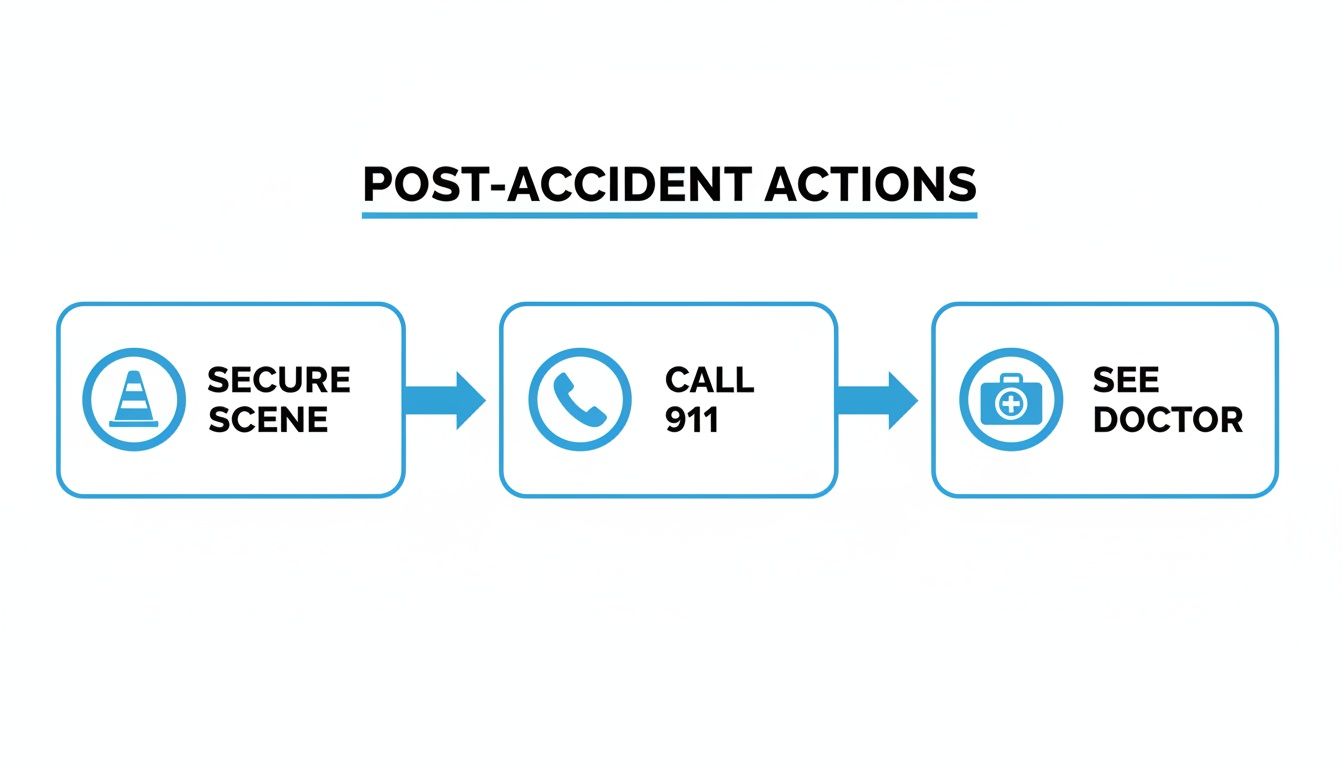
The key takeaway is that securing your safety, calling the authorities, and getting a medical check-up are the building blocks of a strong recovery and a successful injury claim.
The Hidden Dangers of Delayed Back Pain
It's easy to write off a collision as "not that bad," but the forces involved are no joke. Rear-end collisions, which make up about 29% of all crashes, are notorious for causing spinal injuries.
In fact, studies have shown that up to 70% of individuals in low-speed rear-end impacts report back pain within 24 hours, often from muscle strains, ligament sprains, or even a herniated disc. For a deeper look at what to do in the immediate aftermath, check out our guide on what to do after a car accident.
With over 6 million car accidents happening in the U.S. each year, this is a massive problem that can lead to chronic pain if you don't take it seriously from the start. You can explore the latest federal data and learn more about traffic safety trends on NHTSA.gov.
Building Your Evidence From Day One

Okay, you’ve made sure everyone is safe and you have a plan to see a doctor. Now your focus has to shift. From this moment on, think of yourself as a detective building a case, because every single thing you collect is a piece of the puzzle for your injury claim.
Insurance companies will pick apart every detail. That’s their job. So, building a strong, detailed record right from the start isn’t just a good idea—it’s crucial.
If you’re still at the scene and it’s safe, this is where it begins. Your smartphone is your best friend.
Documenting the Scene and Damage
Your goal is to paint a picture of exactly what happened, and a few quick snaps of a dent won’t cut it. You need to show the whole story, the full context of the collision.
Before any cars get moved, start taking photos and videos. Get every angle you can think of.
- Go wide. Get shots of the entire intersection or stretch of road. You want to show the final resting positions of all the cars involved.
- Move in a little. Take pictures that show the full damage to your car and the other vehicle.
- Get close. Capture the specific points of impact—dents, scratches, broken lights, you name it. Don't skip what looks like "minor" damage; it all adds up to tell the story of the force involved.
- Look around. Photograph any skid marks, debris on the road, and relevant traffic lights or signs.
These images are invaluable. They help experts reconstruct the accident and prove the other driver was at fault. More importantly, they help connect the force of that crash to your back injury, which is especially vital if there isn’t a ton of visible damage to the car. Insurers love to argue a small dent couldn't possibly have hurt you. Photos prove otherwise.
Your Most Powerful Tool Is a Symptom Journal
When a client tells me, "someone hit my car and now my back hurts," the first piece of advice I give them is to start a symptom journal. Today. This isn't just a diary for your feelings; it's a log that turns your daily pain and frustration into hard data an insurance adjuster can't easily ignore.
We once had a client with a soft tissue back injury that was completely invisible on an X-ray. The insurance company's first offer was a joke. But she kept a meticulous daily journal, noting her pain on a scale of 1 to 10 and, more importantly, writing down things like, "couldn't lift my toddler out of his crib," or "had to leave the grocery store because the pain was searing." That journal became undeniable proof of how her life had changed. It completely turned the tables on the negotiation.
Your journal should track these key things every single day:
- Pain Level: On a 1-10 scale, how bad is your back pain? Do this in the morning, afternoon, and at night.
- Pain Type: What does it feel like? Is it a sharp, stabbing pain? A constant, dull ache? Is it burning, or do you feel tingling?
- Pain Location: Is the pain stuck in your lower back, or does it shoot down your leg? That could be a sign of sciatica.
- Daily Limitations: What couldn’t you do today because of the pain? Note down everything, from struggling with work tasks and household chores to missing out on social plans.
This kind of detailed record makes it incredibly difficult for an insurance company to downplay what you're going through. To see exactly how we use this kind of evidence in a case, check out our guide on how evidence is used to prove negligence in Pennsylvania.
Collect and Organize All Official Documents
Your personal journal is powerful, but it needs to be backed up by official paperwork. Get a folder—a real one or a digital one on your computer—and keep everything related to the accident and your injury in one place.
- The Police Report: Get a copy of the official police or accident report as soon as it’s ready. It contains the officer's initial thoughts, witness info, and sometimes a preliminary finding of who was at fault.
- Medical Records: Keep everything. Every bill from the ER, every note from your doctor, every receipt for a prescription, and every summary from your physical therapy sessions. This is the paper trail that formally connects your back pain to the crash.
- Repair Estimates: Even if you aren't fixing your car right away, get a written estimate for the damage. It helps establish how severe the impact was.
What you're going through isn't just a personal headache; it's part of a huge public health issue. The World Health Organization (WHO) reports that between 20 and 50 million people suffer non-fatal injuries from crashes every year, and back injuries are one of the most common and disabling outcomes. This isn't a minor thing. You can discover more insights about global road safety on WHO.int.
Navigating Conversations With Insurance Adjusters
It’ll happen faster than you think. Maybe a few days after the crash, maybe just a few hours. Your phone will ring, and on the other end will be an insurance adjuster from the other driver's company. They’ll sound incredibly friendly, concerned, and helpful.
Don't be fooled. Their job isn’t to help you—it’s to protect their company’s bottom line by paying you as little as possible. That first phone call is a minefield, and everything you say can be used to chip away at your claim, especially when you tell them, "Someone hit my car and now my back hurts." You need a game plan before you even think about picking up that call.
What to Say on the First Call
When that adjuster calls, remember one thing: you’re in control. You don't have to give them a detailed story, your entire medical history, or a recorded statement. Your only job is to be polite but firm.
Here are a few simple, powerful phrases to keep in your back pocket:
- "I’m not able to give a statement right now."
- "I'm still in the process of getting medical care for my injuries."
- "I can confirm the basic facts, like the date and location, but I can't discuss my injuries."
- "I won't be providing a recorded statement today."
Stick to your guns. The adjuster might push back, saying you need to give a statement to get your car fixed or have your medical bills paid. This is a classic pressure tactic. If they keep pushing, just politely end the conversation.
The Recorded Statement Trap
One of the first things they’ll ask for is a recorded statement. They’ll make it sound like a simple formality, just a way to "get your side of the story." In reality, it's a tool they use to trip you up and lock you into a story before you know the full extent of your injuries.
They'll ask leading questions designed to get you to downplay your back pain. For instance, they might ask, "So, other than being a little sore, you're doing okay?" If you agree, they'll use that exact quote against you later when that "little soreness" turns out to be a herniated disc that needs months of physical therapy.
Crucial Takeaway: Never, ever give a recorded statement to the at-fault driver’s insurance company without talking to a personal injury attorney first. There's no law that says you have to, and it almost never helps your case.
Politely say no. A simple, "I am not comfortable providing a recorded statement right now" is all you need. You don’t have to explain why.
Resisting the Quick Settlement Offer
Another common play is the fast, lowball settlement offer. The adjuster might call you within a week of the accident and offer you a check for a few thousand dollars to "put this all behind you." When you’re staring at a car repair bill and missing work, that quick cash can feel really tempting.
This is a trap. Back and neck injuries—especially soft tissue damage—often get worse over days or even weeks. What feels like a minor backache today could develop into a chronic condition requiring long-term treatment, injections, or even surgery down the road.
If you take that initial offer, you sign away your right to any future compensation. If your back injury turns into something serious, you'll be on your own to pay for it. A study from the Insurance Research Council found that accident victims who hired a lawyer received, on average, 3.5 times more in settlement money than people who tried to handle it alone.
Your response to a quick offer should always be something like this: "I'm still getting medical treatment and don't know what my future needs will be. I can't consider any settlement offers right now." This keeps all your options on the table and signals that you won’t be rushed into a bad deal.
Understanding Common Car Accident Back Injuries

You might be thinking, "It was just a fender-bender, why does my back hurt so much?" It’s a question we hear all the time. The answer is simple physics. When your car gets hit, your body keeps moving until something stops it—usually a seatbelt, an airbag, or even the steering wheel. That sudden, violent stop can do a real number on the complex structures in your spine.
That jolt can injure any part of your back, from the lower lumbar spine all the way up to your neck. These areas are a sensitive network of bones, muscles, ligaments, and nerves. Damage to any one part can cause problems that stick around for a long time. So when you tell a doctor, "someone hit my car and now my back hurts," they're immediately thinking about a whole range of injuries, many of which don't show up right away.
Common but Serious Back Injuries
Right after a crash, adrenaline and shock can do an amazing job of masking pain, sometimes for days. But once that wears off and the inflammation kicks in, you start to feel the real damage.
Here are some of the most common back injuries we see in car accident cases:
Lumbar Sprains and Strains: This is just a clinical way of saying you've damaged the soft tissues in your lower back. A strain messes with the tendons connecting muscle to bone, while a sprain hurts the ligaments connecting bones to each other. These injuries are invisible on an X-ray but can cause absolutely debilitating pain.
Herniated Discs: Think of the discs between your vertebrae as little cushions. The force of a collision can cause one to shift, rupture, or bulge out of place. We call this a herniated or "slipped" disc. When that disc presses on spinal nerves, it can cause sharp, radiating pain, numbness, or weakness, often shooting down a leg (which you’ve probably heard of as sciatica).
Vertebral Fractures: In more serious impacts, the bones of your spine—the vertebrae—can actually crack or break. This is a major injury, ranging from a more minor compression fracture to a severe "burst fracture" that may require immediate surgery to prevent permanent damage.
These injuries are especially common in certain types of wrecks. For instance, in rear-end collisions—which make up 29% of all crashes—it's estimated that 60-80% of occupants report symptoms right away. That initial pain can easily develop into something much worse, like sciatica or spinal stenosis. You can find more details in these car accident statistics and their implications on ddlawtampa.com.
Why an X-Ray Isn't Enough
One of the biggest mistakes people make is breathing a sigh of relief after a "clear" X-ray. An X-ray is great at spotting broken bones, but it tells you nothing about soft tissue damage. This is a critical point that insurance adjusters love to use to downplay your injuries and offer a lowball settlement.
An X-ray won't show a torn ligament, a strained muscle, or a bulging disc. These are often the true sources of your pain, and they require more advanced diagnostic tools to be properly identified and documented.
To get the full story of what’s going on inside your back, your doctor will likely need to order an MRI. This type of imaging is absolutely essential for diagnosing soft tissue injuries and, just as importantly, proving they were caused by the accident. An MRI can easily cost over $1,000, so it’s vital that your claim is handled correctly to ensure these diagnostic and treatment costs are covered.
The Long-Term Consequences
If they aren’t treated properly, back injuries can haunt you for life. What starts as a nagging ache can spiral into chronic pain that messes with your ability to work, sleep, and just enjoy daily activities. Some of these injuries can even speed up degenerative conditions like spinal stenosis or osteoarthritis, causing brand new problems years down the road.
This is exactly why connecting the medical reality of your injury to the legal side of your case is so critical. While you're dealing with the pain, you might explore some natural pain relief options for back pain to help manage symptoms. But ultimately, securing fair compensation is the key to affording the long-term care you might need, whether that means physical therapy, injections, or even surgery.
When Should You Call a Philadelphia Personal Injury Attorney?
If someone hit your car and now your back is killing you, one of the first questions that probably pops into your head is, "Do I really need a lawyer for this?" Lots of people hesitate. They worry their injury isn't "bad enough" or that hiring a lawyer is way too expensive.
Frankly, that hesitation is exactly what insurance companies are counting on.
The truth is, the moment you have back pain after a crash, you have a potential legal claim that needs to be protected. The right time to call a Philadelphia personal injury attorney isn't weeks or months from now—it’s today.
The Myths That Stop People From Calling
Let's get a few common myths out of the way, because they stop good people from getting the help they deserve. The biggest one is the idea that you have to pay a lawyer out of your own pocket. For personal injury cases, that's just not how it works.
Reputable firms like Mattiacci Law work on a contingency fee basis. Here’s what that actually means for you:
- You pay zero money upfront.
- Your first consultation is always 100% free.
- The law firm advances all the costs to build your case, from expert witness fees to court filings.
- You only pay us if and when we win your case and get you money.
Key Takeaway: The "no-win, no-fee" setup removes all the financial risk from your shoulders. It lets you get a top-tier legal team on your side without ever worrying about the cost.
Another myth? That your injury has to be some kind of life-shattering catastrophe to be worth a call. If your back pain messes with your daily life, makes you miss work, or has you running to doctors and physical therapists, it's serious enough. You deserve to be compensated for all of that, and a lawyer is the person who fights to make it happen.
Why That Free Consultation Is a Big Deal
A free consultation isn't a sales pitch. It's your first strategy session. It's where you get a straight, honest opinion on your case from someone who has handled hundreds of them. You'll learn about your rights, what your claim might be worth, and the specific PA or NJ laws that matter to you.
It's your chance to ask anything you want and get a clear picture of the road ahead. Just as important, it puts the insurance company on notice that you're taking this seriously.
The Power of Having a Trial-Ready Firm in Your Corner
Here’s a little secret the insurance companies don't want you to know: they handle claims completely differently when a respected trial lawyer gets involved. They know a firm like Mattiacci Law doesn't just push paper and take the first lowball offer that comes along.
We prepare every single case from day one as if it’s going all the way to a jury.
What does that look like for your back injury claim?
- We hire medical experts who will review your records and testify about the long-term effects of your injury.
- We bring in accident reconstructionists to prove, without a doubt, that the other driver was at fault.
- We calculate all your losses, including future medical care, lost earning potential, and the very real cost of your pain and suffering.
This aggressive approach forces insurance adjusters to the negotiating table with a fair offer. They know that going to court against a case we’ve built is a huge, expensive risk for them. For our clients, this strategy gets real results—we've recovered millions for back injury victims by proving their long-term losses with expert evidence.
Philly's traffic is no joke—with vehicle miles traveled recently jumping by 1.5%, we're seeing more of those "minor" accidents turn into chronic pain cases that need this exact level of aggressive legal work. You can dig into more data about local and national accident trends on ddlawtampa.com.
Handling Your Claim Alone vs With Mattiacci Law
It might be tempting to handle the insurance claim yourself, especially at the beginning. But the difference between going it alone and having an experienced attorney on your side is massive, particularly with a back injury where symptoms can get worse over time.
Here’s a breakdown of what handling the claim looks like on your own versus with our team.
| Task | Handling It Yourself | With A Mattiacci Law Attorney |
|---|---|---|
| Communicating with Insurers | You deal with adjusters trained to get you to settle for less. Every call is a risk. | We handle 100% of the communication. You focus on getting better. |
| Proving Your Injury | You rely on your own medical printouts, which adjusters often downplay. | We hire and pay for medical experts to prove the long-term impact and costs. |
| Calculating Damages | You might only ask for current medical bills and missed paychecks. | We calculate future medical needs, lost earning capacity, and pain & suffering. |
| Meeting Deadlines | You're responsible for tracking the statute of limitations. Miss it, and your claim is gone. | We manage all state-specific deadlines (PA & NJ) so your rights are protected. |
| Negotiating a Settlement | You're up against a professional negotiator. You likely get a lowball offer. | We leverage our trial-ready case to force the insurer to negotiate fairly from a position of strength. |
| Going to Trial | Unthinkable for most people. You have no experience or resources to win in court. | We are trial lawyers. If they don't offer what your case is worth, we are prepared to fight in court. |
The bottom line is simple: having a local firm that knows the ins and outs of Pennsylvania and New Jersey law is a huge advantage. Both states have a two-year statute of limitations for filing a lawsuit, but exceptions can shorten that window. Missing that deadline means you lose your right to compensation forever. A local attorney makes sure that never happens and builds your case according to the rules that matter, giving you the best shot at a real recovery.
Back Injury Claim FAQs
When someone hits your car and your back starts hurting, the legal questions can pop up almost as fast as the medical ones. After you’ve dealt with the immediate chaos at the scene, you’re left wondering what comes next. Here are the straight-up answers to the most common questions we get from clients in Pennsylvania and New Jersey.
How Long Do I Have to File a Lawsuit?
This is a big one, and the deadline is non-negotiable. In both Pennsylvania and New Jersey, you generally have a two-year window from the date of the accident to file a personal injury lawsuit. This is called the statute of limitations.
Miss that deadline, and you're out of luck. The court will almost certainly refuse to hear your case, and you lose your right to get compensation forever. While a few rare exceptions exist, you should never, ever count on them. This is exactly why it's so important to talk to an attorney long before that two-year mark is even on the horizon.
What Is My Back Injury Claim Really Worth?
There's no magic calculator for this. The real value of a back injury claim is deeply personal and is figured out by looking at everything the accident cost you—financially, physically, and emotionally.
A fair settlement isn't just about the bills you have today. It should cover all your "damages," which typically include:
- Medical Bills: This is everything from the ambulance ride and ER visit to future surgeries, physical therapy, chiropractic care, and pain management injections you might need down the road.
- Lost Wages: We look at the paychecks you've already missed because you couldn't work, plus the money you won't be able to earn in the future if your injury is permanent or limits your job duties.
- Pain and Suffering: This is the compensation for the physical pain, the mental anguish, and the fact that you can't enjoy your life the way you used to before the crash.
Figuring out the true value is a complex process that goes far beyond just adding up receipts. You can get a better sense of the details by reading our guide on how much you can sue for a back injury in Pennsylvania. An attorney’s valuation will almost always be higher than what the insurance company first offers because we build a case based on your future needs, not just your current stack of bills.
A lot of people think a minor fender-bender can’t cause a serious injury. That’s a huge misconception. We see it all the time—even a low-speed collision can jolt your spine and lead to significant back problems that require real medical treatment and a legal fight to get fair compensation.
Who Pays for My Medical Bills Right Now?
This catches a lot of people off guard: do not wait for the at-fault driver’s insurance company to pay your medical bills. They won't pay them as they come in.
You need to use your own health insurance to get the medical care you need right away. Putting off treatment is bad for your health, and it gives the insurer a perfect excuse to argue your injury wasn't that serious to begin with.
Later on, your settlement will be used to pay back what your health insurance covered (this is called subrogation) and to reimburse you for your out-of-pocket costs like deductibles and copays.
Even with safer cars on the road, injuries from crashes are still a huge problem. While the NSC projects a recent drop in the mileage death rate to 1.14 per 100 million vehicle miles traveled, don't let that fool you. Collisions at speeds under 10 mph can absolutely cause lasting back issues. You can find more info about recent traffic safety findings on NHTSA.gov.
If your back is hurting after a car accident, you don’t have to go through this alone. The team at Mattiacci Law is here to answer your questions and fight for every dollar you deserve. Contact us today for a free, no-pressure consultation to go over your case by visiting https://jminjurylawyer.com.