


Author: John Mattiacci | Owner Mattiacci Law
Published May 23, 2026
Negligence per se means that when someone breaks a safety law and that violation causes the kind of harm the law was meant to prevent, the law can treat that violation as automatic evidence of negligence. In practical terms, that can make your injury case simpler because the fight often shifts away from whether the other person acted reasonably and toward proving the violation, causation, and your damages.
If you're reading this after a crash, a fall, or a worksite injury, you've probably already had the same reaction most clients do. The other person broke a clear rule. They ran the light, ignored the code requirement, or skipped a safety step. It shouldn't be so hard to show they were at fault.
That's exactly why negligence per se matters. In the right case, it gives the court a shortcut grounded in a statute, ordinance, or regulation instead of leaving everything to arguments about what a “careful person” would have done. For injury victims in Pennsylvania and New Jersey, that can be a powerful tool, especially in traffic cases and other claims built around public safety rules.
When a Broken Rule Causes Your Injury
A driver blows through a stop sign in Philadelphia and hits your car in the intersection. The police cite the other driver. You end up in the emergency room, miss work, and still hear the insurer say fault needs more investigation.
That is the kind of case where a broken rule matters.
Negligence per se applies when an injury stems from violating a safety law, ordinance, or regulation. Instead of arguing only about whether the defendant acted like a reasonably careful person, the case can center on a more concrete point. What rule applied, who broke it, and whether that violation caused your injury.
For an injured client, that shift matters. A clear statutory violation gives the case structure. It can turn a vague blame dispute into a focused proof problem built on citations, code sections, inspection records, and timing.
I look for that issue early because it often changes how the case should be investigated. In a motor vehicle claim, the key proof may be the traffic citation, scene photos, black box data, or witness accounts about the signal. In a fall or construction case, it may be a building code provision, OSHA-related record, maintenance log, or prior notice of the hazard. The legal theory stays the same, but the evidence is different.
Pennsylvania and New Jersey both use this doctrine, but they do not always use it the same way. In Pennsylvania, a statutory violation can carry substantial weight if the plaintiff is within the class the law was meant to protect and suffered the type of harm the law was meant to prevent. New Jersey courts also examine the statute closely, and in some cases treat the violation as strong evidence rather than ending the negligence inquiry by itself. That distinction affects case strategy from the start.
A broken rule does not win the case by itself. It does, however, give the claim a firmer backbone when the facts line up with the purpose of the rule.
The Four Elements of Negligence Per Se
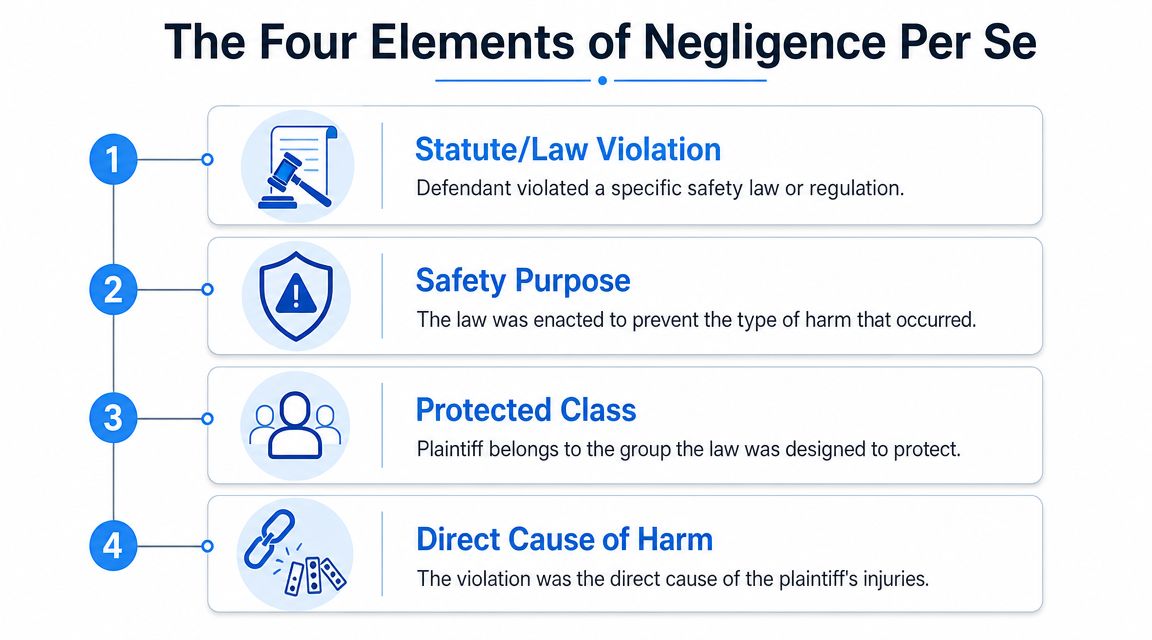
Negligence per se works best when you think of it as a four-part checklist. If one part is missing, the argument weakens. If all four are present, the claim often becomes much more direct.
The rulebook and the broken rule
Start with the first building block. There must be a specific law, regulation, or ordinance that applies to the defendant's conduct. This is the rulebook.
Then comes the second piece. The defendant must have violated that rule.
If a driver runs a red light, if a landlord ignores a required handrail rule, or if a contractor skips a safety regulation, that may satisfy the first half of the framework. The point is precision. A vague claim that someone was careless isn't enough for negligence per se. You need the actual rule they broke.
The protected people and the protected harm
The third part asks who the law was meant to protect. The plaintiff must be in the protected class.
The fourth asks what the law was meant to prevent. The injury must be the type of harm the law was designed to stop.
California's statutory framework is often used to illustrate this structure. Legal summaries discussing Evidence Code §669 describe four familiar elements: a violation of a statute or regulation, protection of a specific class, the plaintiff's membership in that class, and proximate causation of the injury, as discussed in this explanation of California negligence per se under Evidence Code §669.
A simple analogy helps. Think of a smoke detector rule in an apartment building. That rule exists to protect occupants from fire-related injury. If a landlord violates the rule and a tenant is hurt in a fire, the fit is obvious. But if the same violation somehow leads to a totally unrelated loss, negligence per se may not apply because the harm falls outside the rule's purpose.
Core idea: Negligence per se isn't a separate lawsuit. It's a rule that uses a statute, ordinance, or regulation to establish duty and breach, shifting the real fight toward proving the violation and its causal link to the injury, as outlined in this discussion of negligence per se and duty-breach analysis.
What this looks like in practice
When lawyers evaluate whether negligence per se applies, the checklist usually sounds like this:
- What exact rule was broken: A traffic statute, building code, workplace regulation, or safety ordinance.
- Who the rule protects: Drivers, pedestrians, tenants, workers, patients, or consumers.
- What danger the rule addresses: Crashes, falls, collapses, unsafe products, or other defined hazards.
- How the violation caused the injury: The chain between the broken rule and the harm must be clear enough to prove.
That last point is where many people get tripped up. Even when the defendant plainly broke the law, you still need evidence tying that violation to your injuries. A citation helps. It doesn't finish the case by itself.
Ordinary Negligence vs Negligence Per Se
Most injury victims hear the word “negligence” and assume it all means the same thing. It doesn't. The difference between ordinary negligence and negligence per se is strategic, and it can change how a case is built from day one.
One asks what was reasonable
Ordinary negligence is the familiar standard. The question is whether the defendant failed to act as a reasonably careful person would have acted under similar circumstances.
That sounds simple, but in court it often becomes a fight over judgment calls. Was the driver following too closely. Was the property owner slow to fix a hazard. Was the contractor careless. Those cases often require more witness testimony, more expert explanation, and more room for the defense to argue.
If you want a broader look at how fault works generally, this explanation of negligence in Pennsylvania personal injury cases gives helpful background.
The other asks whether a safety law was violated
Negligence per se changes the frame. Instead of debating what a reasonable person might have done, the law itself supplies the standard of care through a safety statute or regulation.
One of the main practical advantages is the burden shift. Once a plaintiff shows evidence of a statutory violation tied to the harm, the law often presumes negligence. That is especially important in cases involving traffic laws, building codes, or workplace safety rules, where a clear violation can stand in for more extensive expert proof on the standard of care, as described in this overview of negligence per se versus negligence.
| Aspect | Ordinary Negligence | Negligence Per Se |
|---|---|---|
| Standard of care | Based on what a reasonably careful person would do | Based on a statute, ordinance, or regulation |
| Main proof issue | Whether the defendant acted unreasonably | Whether the defendant violated a safety rule |
| Role of expert testimony | Often more important | Sometimes less central on breach |
| Main defense focus | Conduct was reasonable under the circumstances | No violation, no causation, or a valid excuse |
| Litigation feel | More subjective | More rule-driven and document-heavy |
What works and what doesn’t
What works in negligence per se cases is specificity. Exact statutory language, citation records, inspection logs, photographs, and timelines matter.
What doesn’t work is treating every violation as an automatic win. If the rule doesn’t protect someone in your position, or the injury isn’t the kind the statute was meant to prevent, the argument can collapse. The doctrine is powerful, but it’s not magic.
Real-World Examples of Negligence Per Se
The doctrine makes the most sense when you see it in real situations.

A driver breaks a traffic rule
A driver looks down at a phone, drifts through an intersection, and causes a chain-reaction crash. If the evidence shows the driver violated a traffic safety law, that violation may serve as the backbone of a negligence per se argument.
In many Pennsylvania car cases, this starts with the same question clients ask right away: did the other driver break the rules of the road? In that context, this discussion of whether speeding counts as negligence in Pennsylvania is useful because speeding violations often frame the liability analysis.
A landlord ignores a code requirement
A tenant uses a dim stairwell in an older building. The handrail required by code is missing or loose. The tenant falls and suffers a serious injury.
That claim may be stronger than a generic premises case because the focus isn’t only on whether the landlord acted carelessly. The sharper question is whether a specific safety code applied, whether it was violated, and whether that violation caused the fall the code was meant to prevent.
A code violation matters most when you can connect it to the exact danger that injured you.
A contractor skips a safety regulation
On a construction site, a trench isn’t secured the way the applicable safety rules require. The trench gives way and a worker is injured. In that setting, negligence per se may arise from a violation of workplace safety regulations or other concrete site rules.
These cases are often document-driven. Accident reports, supervisor communications, inspection records, subcontract agreements, and site photographs can matter more than broad arguments about whether the company was generally careful. That is one reason serious work injury claims need early investigation. Safety-rule cases are won with records before they disappear.
Applying Negligence Per Se in Pennsylvania and New Jersey
A driver runs a red light on Broad Street and crashes into your car. Another driver in Camden crosses the center line in violation of New Jersey traffic law and causes the same kind of wreck. The injuries may look similar. The legal effect of the violation can differ because Pennsylvania and New Jersey do not treat statutory violations in exactly the same way.
That state-by-state difference affects case value, jury instructions, and settlement pressure.
In Pennsylvania, negligence per se is recognized, but courts still ask disciplined questions. Was there a statute or regulation that set a clear standard of conduct? Was the injured person part of the group the rule was meant to protect? Was the injury the kind the rule aimed to prevent? And did the violation cause the harm? In practice, that often means starting with the Motor Vehicle Code, property maintenance rules, or workplace safety regulations, then matching the facts to the purpose of the rule. If your case involves a road-rule violation, this guide on traffic law violations and negligence per se in Pennsylvania gives a more focused local explanation.
Pennsylvania lawyers also have to be careful with shorthand. A citation helps. It does not end the case by itself. Some statutory violations support a negligence per se theory cleanly. Others end up being treated as evidence of negligence rather than an automatic substitute for proving breach, depending on the wording of the statute and how Pennsylvania appellate courts have handled similar claims.
New Jersey requires the same careful approach. Courts regularly consider violations of Title 39 and other safety laws in motor vehicle and premises cases, but a ticket alone is not a verdict. The practical question is whether the violated rule was meant to prevent this specific type of accident and protect someone in the plaintiff’s position. That is where experienced case framing matters. A lawyer has to connect the statute, the facts, and the injury in a way a judge will permit and a jury will understand.
Three pieces usually drive that analysis in either state:
- The text of the rule. General safety language is harder to use than a specific command such as stopping at a red light or maintaining a required handrail.
- The fit between the rule and the injury. The closer the match, the stronger the argument.
- The proof. Police reports, code inspections, photographs, video, black-box data, and witness statements often decide whether the statutory violation has real force in the case.
Medical evidence matters just as much. In vehicle cases, the defense often argues that the rule may have been broken but the injury was minor, preexisting, or unrelated. Treatment records help answer that. For clients dealing with neck pain, back pain, or reduced mobility after a crash, information about post-accident physical therapy can also clarify how recovery records support the damages side of the claim.
That is the practical point. Negligence per se is not a shortcut that wins the case on its own. In Pennsylvania and New Jersey, it is a tool. Used correctly, it can tighten the liability argument and force the defense to fight on narrower ground.
Common Defenses to Negligence Per Se
A broken safety rule does not end the case. It changes the fight.

Defense lawyers usually respond in three ways. They argue the violation did not cause the injury, the rule does not fit the facts, or there was a valid excuse for the violation. In Pennsylvania and New Jersey, those arguments can decide whether negligence per se sharpens the case or fades into the background.
Causation is usually the first line of defense
This is the argument I see most often in practice. The defendant admits the rule was broken, then says the injury came from something else.
A driver may have been speeding, but the defense says the crash happened because another car cut across traffic. A property owner may concede a code violation, but still argue the fall resulted from distraction, poor footwear, or a medical episode. In workplace and contractor cases, the defense often shifts blame to a third party, an equipment defect, or the injured person’s own conduct.
That is why the timeline matters. So do scene photos, vehicle damage, inspection records, surveillance footage, and prompt medical treatment. A statutory violation helps, but a jury still has to see how that violation set the injury in motion.
The defense may argue the statute is the wrong tool
Negligence per se only works when the rule fits the case closely. Defense counsel often attack that fit.
They may argue:
- The law was designed to protect a different group of people
- The law was aimed at preventing a different kind of harm
- The text is too general to supply a clear standard of conduct
- The regulation applies to different facts, a different property type, or a different class of defendant
This comes up often in Pennsylvania and New Jersey premises cases and construction cases. A code section may look helpful at first glance, but if it governs new construction rather than maintenance, public areas rather than private ones, or employees rather than visitors, the court may refuse to treat the violation as negligence per se. Good case framing starts with the exact wording of the rule, not a broad appeal to safety.
Excuse defenses can narrow or defeat the claim
Some violations are admitted but explained. The defense may claim an emergency, impossibility, unclear notice, mechanical failure, or a reasonable effort to comply under difficult conditions.
Courts do not accept those excuses automatically. They depend on proof. If a trucking company claims sudden brake failure, maintenance records matter. If a landlord claims the hazard appeared moments before the incident, inspection logs and repair calls matter. If a contractor says one coverage requirement or safety obligation was handled by someone else, the contract documents and insurance records matter too. For readers who work for themselves or hire subs, this guide to liability coverage for self-employed professionals helps explain how those responsibility disputes often develop.
Early evidence decides many of these defense arguments. Once the vehicle is repaired, the scene changes, or records disappear, the defendant’s explanation gets harder to test. In negligence per se cases, speed matters.
How Negligence Per Se Strengthens Your Injury Claim
A driver runs a red light in Philadelphia and hits your car. A landlord in Camden ignores a smoke-detector requirement and a fire leaves you hurt. In both cases, the broken rule does more than make the conduct look careless. It gives your claim a firmer legal frame.
That matters because injury cases are often won or lost on how clearly liability is defined early. When negligence per se applies, the case is anchored to a specific safety law or regulation, not a vague argument about what someone should have done. That can shorten disputes over fault and put more pressure on the defense to explain why the rule was broken and why that violation did not cause the harm.
For an injured client, that usually changes the work that matters most. The job becomes proving three things with precision: the rule applied to this defendant, the defendant violated it, and that violation caused this injury. In Pennsylvania and New Jersey, that analysis has to be done carefully because courts do not treat every statute, code provision, or ordinance the same way. A traffic statute may support the claim in one case. A building code or administrative rule may require a closer fit between the rule, the injured person, and the type of harm.
A strong negligence per se theory also helps shape damages presentation. Once fault is tied to a broken safety rule, the case can be developed around the losses that follow: medical care, wage loss, reduced earning power, future treatment, and the daily limits the injury creates. That is often especially important for contractors, tradespeople, and self-employed workers whose income does not show up as neatly as a weekly paycheck. If your work situation raises insurance questions too, this guide to liability coverage for self-employed professionals gives useful background on how business risk and coverage issues can overlap.
Strong cases are built fast.
In practice, that means getting the police report, photographs, video, inspection records, maintenance logs, medical records, witness statements, and the exact text of the statute or regulation before the defense has time to recast the facts. A citation can help, but it is rarely enough by itself. The proof has to show how the rule fits the event and why the injury followed from that violation.
For people injured in Pennsylvania or New Jersey, Mattiacci Law handles cases where this kind of rule-based liability analysis can affect both case value and strategy, including car crashes, construction accidents, and premises claims. The phrase matters less than the timing. If a safety rule was broken, identifying that theory early can preserve evidence, narrow the dispute, and put the claim in a stronger position for settlement or trial.
If someone else’s violation of a safety law caused your injury, do not expect the insurance company to frame the case correctly for you. It usually will not. Early legal analysis often makes the difference between a claim that feels arguable and one that is built to prove.
Talk to a Pennsylvania Personal Injury Lawyer Today
If you were injured because someone violated a safety law, traffic statute, or other legal duty, you may be entitled to compensation for medical bills, lost wages, pain and suffering, and other damages.
The attorneys at Mattiacci Law aggressively represent injury victims throughout Pennsylvania and New Jersey in negligence per se and personal injury cases.
Call 215-914-6919 today for a free consultation. There is no fee unless we win your case.
Frequently Asked Questions
What are the four elements of negligence per se?
A law or statute was violated
The law was intended to prevent the type of harm that occurred
The victim belonged to the group the law was designed to protect
The violation directly caused the injuries
What is an example of negligence per se?
Is negligence per se automatic liability?
How is negligence per se different from ordinary negligence?
Can traffic violations be considered negligence per se?
Speeding
Running a red light
Drunk driving
Reckless driving
Failing to yield