


Author: John Mattiacci | Owner Mattiacci Law
Published May 22, 2026
A construction accident changes everything in a few seconds. One fall, one collapsing scaffold, one machine that doesn't stop when it should, and suddenly you're dealing with pain, missed work, pressure from supervisors, insurance paperwork, and a lot of unanswered questions.
Most injured workers in Philadelphia start with the same assumption. They think this is a workers' comp claim and that's the end of it. Sometimes that is the only claim. But often it isn't. If someone other than your employer helped cause what happened, a separate lawsuit may exist, and that second case is often where the full value of the claim lives.
Injured on a Philadelphia Construction Site What Now
If you're reading this from home, from a hospital room, or between calls with your employer, focus on two things. First, get proper medical care. Second, understand that the legal path after a construction injury usually branches immediately, and the early choices matter.
Construction work remains unusually dangerous. Construction work is one of the most hazardous employment sectors in the United States. In 2024, U.S. construction and extraction workers experienced more than 1,000 fatalities, and the industry accounted for roughly 1 in 5 fatal occupational injuries, according to a Philadelphia construction accident resource citing BLS-related national risk data. Those numbers matter for one reason. Serious site injuries are not rare, and neither are disputes over who is responsible.
Start with the right question
The first question usually isn't "How much is my case worth?"
It's this: Was this only a workers' compensation case, or did a third party contribute to the injury?
That distinction changes everything. It affects what damages may be available, what evidence needs to be preserved, how quickly lawyers and experts should get involved, and whether important proof disappears before anyone asks for it.
What helps and what hurts
A few actions usually help right away:
- Getting treated immediately so your injuries are documented by medical providers
- Reporting the incident clearly without guessing or minimizing what happened
- Preserving the scene before equipment is moved, repaired, or discarded
- Identifying every company on site rather than focusing only on your direct employer
What doesn't work is waiting for the accident report to "sort itself out." On construction sites, the condition that caused the injury can be altered fast. Witnesses leave. Contractors point fingers. Records don't stay easy to find.
Practical rule: Treat the first days after a construction accident as evidence time, not just paperwork time.
Your First 48 Hours After a Construction Accident
The first two days matter more than most workers realize. Your health comes first, but these hours also create the medical and factual record that can shape the entire case.
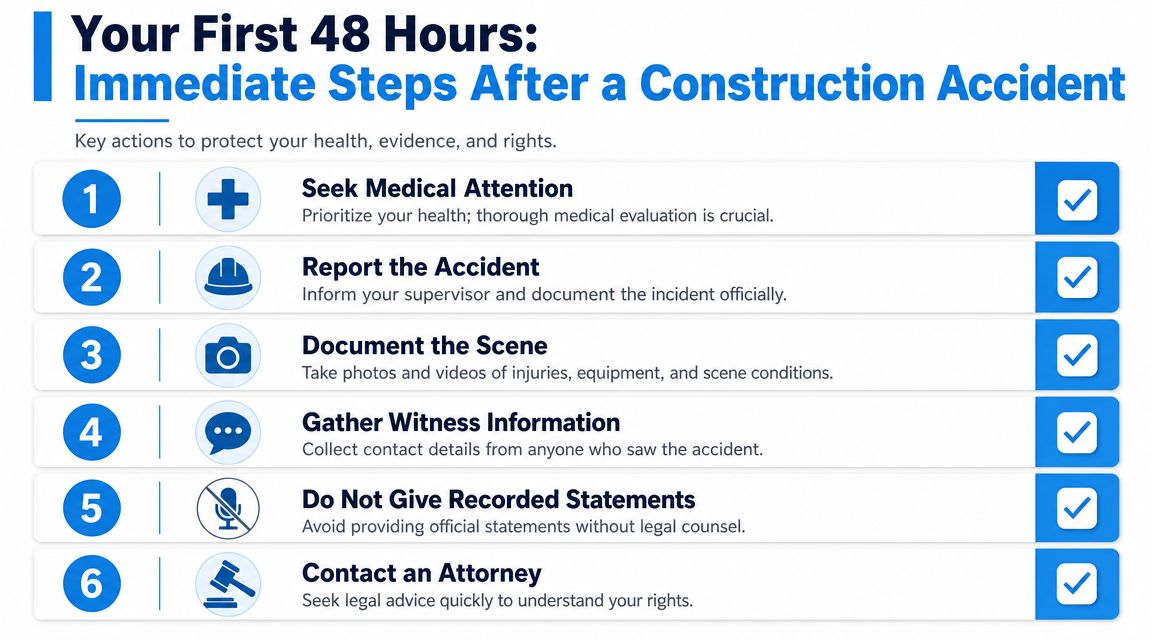
Get medical care and be specific
Don't tough it out. Don't wait to see if the pain fades. Go to the ER, urgent care, occupational medicine provider, or your doctor, depending on the severity of the injury and what emergency treatment you need.
Tell the provider exactly how the accident happened and every body part that hurts. If your back, shoulder, neck, hand, knee, or head hurts, say it. Workers often focus on the obvious injury and leave out symptoms that become major problems later.
Keep these records:
- Discharge papers from the hospital or clinic
- Work restrictions from your doctor
- Prescriptions and referrals for imaging, specialists, or therapy
- Out-of-pocket receipts for medication, travel, braces, or medical supplies
Medical records do more than document treatment. They connect the injury to the event.
Report the accident in writing
Tell your supervisor, foreman, or employer as soon as you can, and do it in a way that creates a record. An email or text is often better than a verbal report alone.
A short, clean report works best:
- State when and where it happened
- Identify the task you were doing
- Describe what failed or what condition caused the incident
- List the injuries you noticed
- Ask for a copy of any incident report if one is created
Don't speculate. Don't write, "It was probably my fault," or "I'm fine." If you don't know why the scaffold shifted or why the lift malfunctioned, say you were injured and the circumstances need to be investigated.
If your employer uses internal forms, complete them carefully. Some workers also benefit from tools that help with streamlining safety reporting, especially when site incidents involve multiple contractors and missing documentation.
Document the scene before it changes
Construction sites don't stay frozen for your claim. Crews keep working. Equipment gets removed. Temporary structures get rebuilt. That's why photos and videos taken early can become some of the most important evidence in the file.
If you're physically able, or if a family member or coworker can help, try to capture:
- The exact area where the accident happened, including floor surface, edges, openings, debris, lighting, ladder placement, scaffold condition, or trench protection.
- The equipment involved, including serial labels, controls, missing guards, damaged parts, fall protection gear, harnesses, lanyards, and anchor points.
- Your visible injuries, as they appear over the next hours and days.
- Signs and site identifiers, including contractor names on trucks, fencing, vests, posted permits, or job boards.
If a machine, tool, harness, or ladder may have failed, assume someone will want it moved quickly. Preserve its identity early.
Protect the legal claim before the clock runs
In Pennsylvania, most personal injury cases, including third-party construction accident claims, must be filed within two years of the injury date, and missing that deadline can bar recovery, as noted by Philadelphia construction injury guidance on the Pennsylvania filing deadline.
That doesn't mean you wait nearly two years and then call a lawyer. It means critical work starts now, while the evidence is still available.
Understanding Your Legal Options Workers Comp vs Third-Party Claim
Many workers hear "you got hurt on the job" and assume that ends the discussion. It doesn't. In Pennsylvania construction cases, there are often two separate legal tracks, and confusing them is one of the biggest mistakes injured workers make.
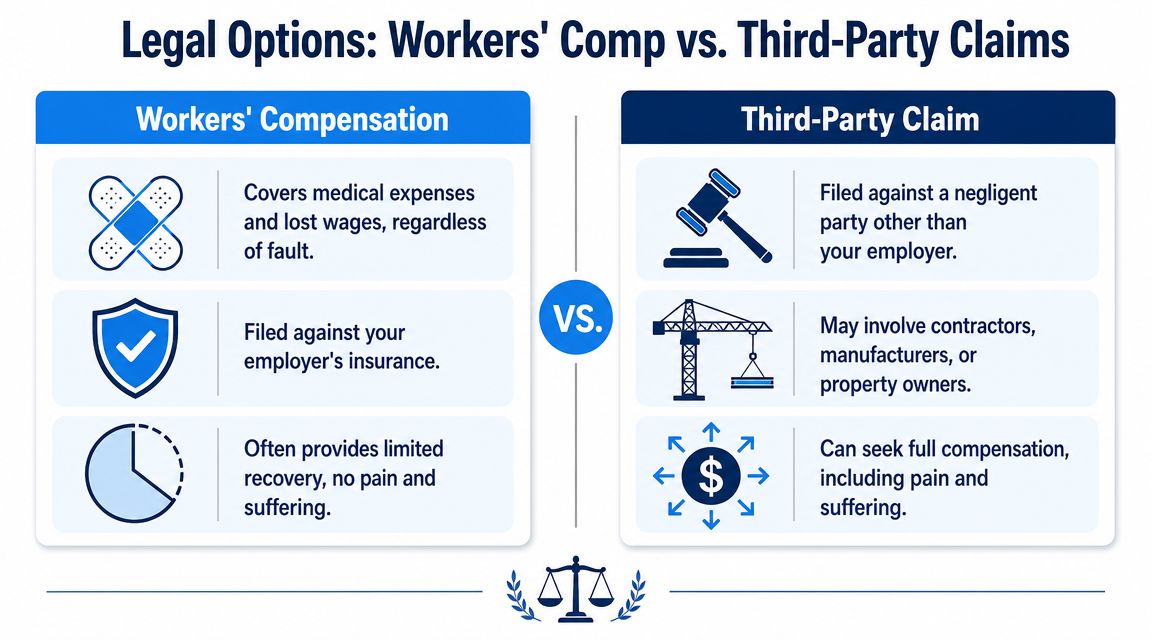
The basic difference
Workers' compensation is generally the exclusive remedy against your employer for an on-the-job injury. It usually provides medical and wage-loss benefits without requiring you to prove your employer was negligent.
A third-party claim is different. It's a negligence case against someone other than your employer, such as a general contractor, subcontractor, property owner, or equipment manufacturer.
Pennsylvania law separates claims this way, and the major danger is treating the case as only a comp matter. A Philadelphia construction injury resource explains that doing so can leave full-value damages for pain and suffering unrecovered if a viable third-party claim exists, as described in this Philadelphia guide to workers' comp and third-party construction claims.
Side-by-side comparison
| Issue | Workers' compensation | Third-party claim |
|---|---|---|
| Who the claim is against | Your employer's workers' comp insurer | A negligent non-employer |
| Fault requirement | Usually no need to prove employer fault | You must prove negligence or product defect |
| What may be recovered | Medical treatment and wage-loss type benefits | Broader damages, potentially including pain and suffering |
| Main limitation | Narrower scope of recovery | More investigation, more proof, more defense pushback |
That distinction is why a worker with a serious injury may have a modest comp case but a substantial third-party case.
Why workers miss the second claim
Workers usually miss third-party claims for practical reasons:
- They only talk to the comp adjuster
- Nobody identifies all companies on site
- The hazard gets framed as a "work accident" instead of a negligence event
- Critical evidence disappears before a lawyer investigates
A useful outside overview of how insurers and claims handling often frame these issues appears in this advisory on employee injury claims. It won't replace legal advice, but it helps workers understand why the first explanation they hear may be incomplete.
If you want a more detailed breakdown of how these two paths differ in a construction setting, this guide comparing workers' compensation and personal injury claims after a construction accident is a useful starting point.
The injury itself doesn't tell you which claim you have. The site relationships, contract roles, and safety failures do.
How to Build a Strong Construction Accident Case
A serious construction case isn't built by saying, "I got hurt badly." It's built by proving exactly how the incident happened, who controlled the dangerous condition, and how the injury will affect your life going forward.
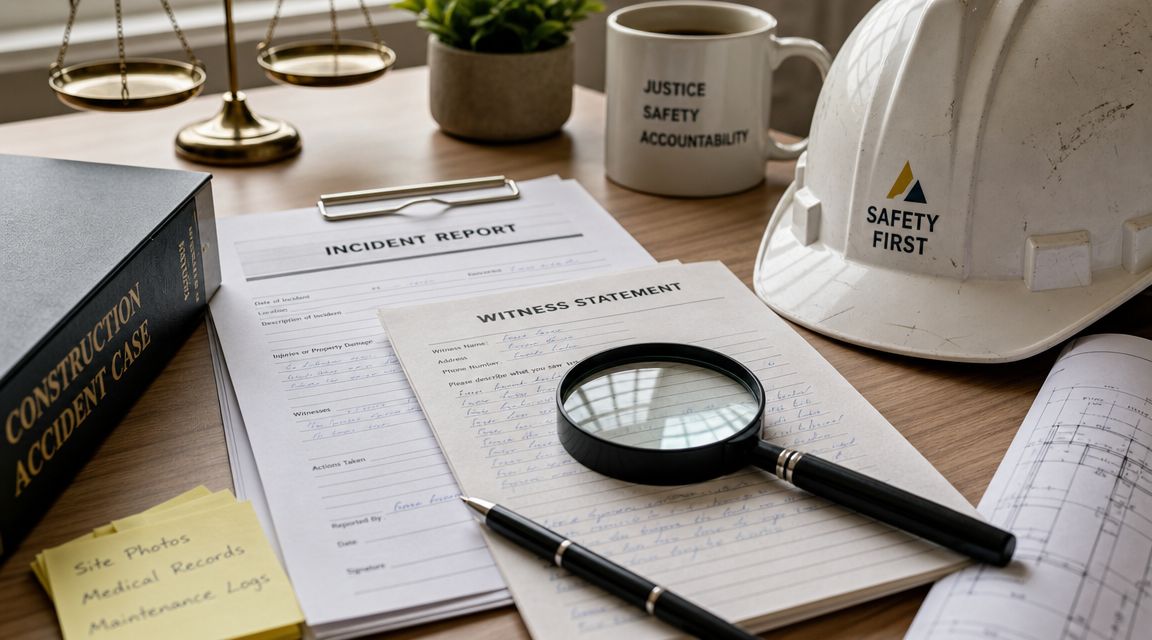
Build the liability map
Strong Philadelphia construction cases usually depend on reconstructing the event in detail. That means securing scene photos, obtaining OSHA and safety records, interviewing all contractors on site, and retaining engineering experts when machinery, fall protection, or scaffolding failures are involved, as explained in this Philadelphia construction accident investigation overview.
The practical question is not just what happened to you. It's who had responsibility for the condition that caused it.
That may include:
- A general contractor that controlled site safety
- A subcontractor that created or ignored a hazard
- A property owner that failed to correct a dangerous condition
- A manufacturer or supplier tied to defective equipment or components
Preserve proof of damages, not just liability
Workers often save the dramatic evidence and ignore the daily evidence. Both matter.
Keep a working file that includes:
- Progress photos showing bruising, swelling, casts, surgical sites, and mobility devices over time
- A recovery journal describing pain, sleep problems, missed family activities, medication side effects, and physical limitations
- Bills and insurance paperwork from every provider
- Pay records and job records showing missed work, reduced duties, or inability to return
- All correspondence from workers' comp, private insurers, and defense representatives
These details help prove how the injury changed your routine, your earnings, and your future work capacity.
OSHA and safety records can matter a lot
In many construction cases, the paper trail tells the story better than the initial accident report. Site safety logs, training materials, subcontractor agreements, inspection records, and OSHA materials can help show whether the event came from a recurring safety failure rather than a random mishap.
For a broader look at how Pennsylvania construction cases are built and evaluated, this Pennsylvania construction accident law guide gives useful context.
When the defense says the incident was unavoidable, the records often say otherwise.
What weakens a case
Several avoidable mistakes can make a good case harder to prove:
- Giving a recorded statement too early without understanding who is asking and why.
- Throwing away damaged gear such as a harness, hard hat, gloves, or tool.
- Posting on social media in ways that minimize the injury.
- Assuming one company is the only defendant before the contracts and site roles are reviewed.
A good construction accident attorney in Philadelphia doesn't just collect records. Counsel turns records, witness accounts, and technical evidence into a coherent liability theory.
Choosing the Right Philadelphia Construction Accident Attorney
Not every injury lawyer is built for a construction case. These files often involve multiple defendants, layered insurance coverage, OSHA issues, expert witnesses, and hard fights over who controlled the work area. If you're interviewing lawyers, treat the consultation like an interview, because it is.
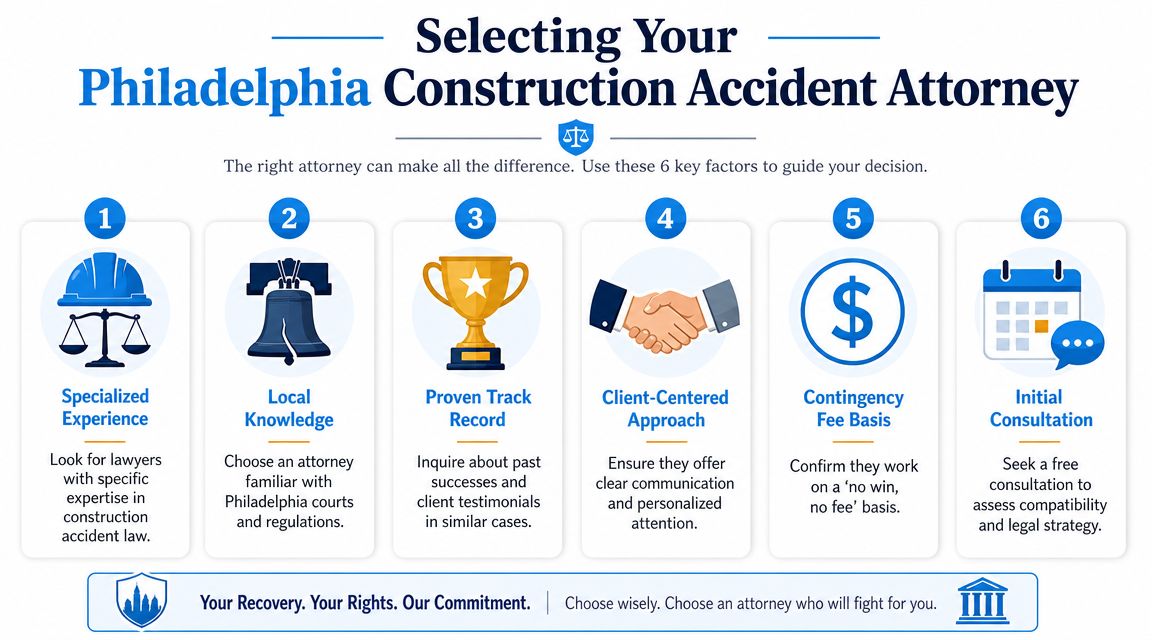
Questions worth asking
Ask direct questions. General promises don't tell you much.
- How do you investigate construction cases? A solid answer should include site evidence, contractor identification, safety records, witnesses, and expert analysis when needed.
- How do you evaluate whether a third-party claim exists? You want a lawyer who immediately thinks beyond comp.
- How do you use OSHA-related evidence? The answer should be specific, not vague.
- Who will handle my case? Find out whether you'll work with the trial lawyer or be handed off.
- What happens if the insurance company won't offer a fair settlement? Listen for trial readiness, not hesitation.
OSHA knowledge matters
One practical marker of experience is whether the lawyer understands how federal safety standards fit into a negligence case. OSHA's most-cited construction standards consistently involve fall protection, scaffolding, and ladders, which means many injuries stem from recurring, documentable safety failures, according to OSHA's list of top cited construction standards.
That doesn't mean every OSHA issue creates liability by itself. It does mean an attorney should know how to use those facts to investigate control, notice, and preventability.
What a good answer sounds like
Here is the difference in plain terms.
| Question | Weak answer | Stronger answer |
|---|---|---|
| Do you handle construction cases? | "Yes, we handle all injury matters." | "Yes. We look at site control, all contractors, equipment history, and safety records." |
| Will you prepare for trial? | "Most cases settle." | "We prepare every serious case as if it may need to be tried." |
| How will I be updated? | "Someone from the office will call you." | "You'll know who your point of contact is and when to expect updates." |
If you want a practical checklist for comparing firms, this guide to finding the best construction accident lawyer in Philadelphia is worth reviewing before you schedule consultations.
A lawyer who only talks about settlement value before discussing liability proof is skipping the hard part of the job.
Contingency fees matter too. Ask how fees work, what litigation costs are advanced, and how liens may affect the final net recovery. A clear answer now prevents frustration later.
How Mattiacci Law Fights for Injured Construction Workers
The workers who tend to benefit most from experienced counsel are the ones with the most at stake. Severe orthopedic injuries, head trauma, crush injuries, spinal injuries, amputations, and fatal cases aren't paperwork claims. They require investigation, expert support, and a legal strategy that accounts for both the workers' comp side and any third-party lawsuit.
Mattiacci Law handles serious injury litigation in Philadelphia and focuses on preparing cases as if they may go to trial. In a construction case, that matters because defendants and insurers usually pay closer attention when they know counsel is prepared to build liability through documents, witnesses, expert analysis, and courtroom presentation rather than just demand letters.
What injured workers often need most
Most clients need more than legal theory. They need answers to practical questions:
- Who can be sued besides my employer
- What evidence should be preserved right now
- How do workers' comp benefits affect a third-party recovery
- What happens if multiple contractors blame each other
- How do future treatment and lost earning capacity get proved
Those questions should be answered early, clearly, and in plain English.
Why direct attorney involvement matters
Construction cases can drift if nobody takes ownership of the liability investigation. A file gets opened. Records are requested. Months pass. By then, witnesses are harder to find and site evidence is gone.
Direct attorney involvement usually helps avoid that problem. It keeps the focus on what drives case value: identifying every responsible party, pinning down the safety failure, and proving the long-term impact of the injury with credible evidence.
Trial posture affects settlement leverage
Insurance companies evaluate risk. If they think the lawyer on the other side won't push the case, they often behave accordingly. If they see a well-developed case with expert support and a real willingness to litigate, the conversation changes.
That doesn't mean every case should be tried. Many should settle. But construction claims usually settle better when the defense believes trial is a real possibility, not a slogan.
If you're trying to figure out whether you have only a comp claim or a full third-party case, get that answer before key evidence disappears. A prompt legal review can identify who may be responsible, what records need to be preserved, and what steps protect your recovery.
If you were hurt on a jobsite and need clear advice about your rights, contact Mattiacci Law for a free, no-obligation consultation. You'll be able to discuss whether a third-party claim may exist, what evidence should be preserved now, and how to protect your case while you focus on recovery.
Frequently Asked Questions About Construction Accident Attorneys in Philadelphia
When Should I Contact a Construction Accident Attorney in Philadelphia?
What Compensation Can I Recover After a Construction Accident in Philadelphia?
Medical expenses
Lost wages
Future medical treatment
Reduced earning capacity
Pain and suffering
Permanent disability
Rehabilitation costs
Emotional distress
The value of a claim depends on the severity of the injuries and the circumstances of the accident.
Can I Sue for a Construction Accident in Pennsylvania?
What Are the Most Common Construction Site Accidents?
Falls from scaffolding or ladders
Falling objects
Electrocution accidents
Machinery accidents
Crane accidents
Trench collapses
Slip and fall accidents
Forklift accidents
These incidents can result in catastrophic injuries or wrongful death.
How Much Is a Construction Accident Case Worth?
Severity of injuries
Medical treatment required
Long-term disability
Lost income
Liability evidence
Insurance coverage
Serious construction accident cases involving permanent injuries often result in higher compensation.