


Author: John Mattiacci | Owner Mattiacci Law
Published May 19, 2026
More than 586 people are hospitalized every day in the United States for a traumatic brain injury, and more than 190 die each day from one, based on CDC surveillance data on TBI-related hospitalizations and deaths in the U.S. reported by the CDC. Those numbers are serious on their own. They still don't tell the whole story.
As a personal injury lawyer, I see the same problem over and over. People think a brain injury claim must involve a coma, brain surgery, or a dramatic ambulance scene. That isn't how many real cases look. A lot of traumatic brain injury claims start with a "minor" crash, a fall, a blow to the head at work, or a patient who was told to go home and rest. Days later, the headaches, memory lapses, dizziness, mood changes, and concentration problems don't go away.
That's why traumatic brain injury prevalence matters. It isn't just a public health topic. It affects how an insurer evaluates your case, how a jury may understand your symptoms, and how your lawyer proves that a mild or delayed-diagnosis injury is still real, disruptive, and compensable.
The Reality of Traumatic Brain Injury in America
The public usually hears about traumatic brain injuries when the facts are catastrophic. A fatal highway crash. A construction fall. A violent impact. But brain injuries also show up in ordinary places. Rear-end collisions. Slip and falls. Workplace incidents. Sports and recreational accidents. Assaults. Medical events that should have been caught sooner.
A traumatic brain injury, or TBI, happens when an external force disrupts normal brain function. Sometimes that means visible trauma. Sometimes it doesn't. A person can look fine, speak clearly, and still be dealing with a brain injury that affects memory, attention, sleep, emotional control, or balance.
Why the numbers matter to injured families
The reason prevalence matters is practical. If you're injured, you need to know whether what you're experiencing is unusual, whether it deserves further evaluation, and whether the legal system takes it seriously. The answer is yes.
On a global scale, TBI remains a major burden. A 2025 analysis estimated 20,837,465 new TBI cases worldwide in 2021, with an age-standardized incidence of 259 per 100,000, and found only a slight decline in incidence from 1990 to 2021, with an estimated annual percentage change of -0.11% in this PubMed-indexed study. That tells you something important. This isn't a rare injury category. It's persistent, widespread, and still affecting millions of people.
What that means after an accident
In a legal claim, brain injury cases often turn on timing and documentation. The first few days matter. So do the first symptoms. So does whether anyone connected your complaints to a possible head injury.
Practical rule: If you have headaches, dizziness, confusion, nausea, light sensitivity, memory problems, or unusual fatigue after an accident, don't wait for those symptoms to become obvious to everyone else.
What works is early medical attention, honest symptom reporting, and follow-up with providers who take post-traumatic symptoms seriously. What doesn't work is brushing it off because you didn't lose consciousness, your imaging was normal, or the initial diagnosis was "just a concussion."
A lot of valid TBI claims get undervalued for exactly that reason.
Why TBI Numbers Are Just the Tip of the Iceberg
The most common mistake people make is assuming TBI prevalence is a clean, settled number. It isn't. The official figures matter, but they're only the visible part of the problem.
Incidence means how many new cases occur over a period of time. Prevalence means how many people are living with the condition. Both are useful. Neither captures every brain injury that happens.

Why mild injuries disappear from the data
A large part of the undercount comes from mild traumatic brain injuries. The National Center for Biotechnology Information notes that 75 to 80% of TBIs are mild, and that relying on hospital coding, insurance claims, and death certificates "vastly" underestimates the true burden. The same source recommends structured self-report screening to better capture lifetime prevalence in the NCBI Bookshelf overview.
That fits what happens in real cases. People don't always go to the emergency room. Some go to urgent care. Some call their primary doctor later. Some never seek care because they assume the symptoms will pass. Others get evaluated for neck pain, shoulder pain, or orthopedic injuries while the brain injury goes unrecognized.
The iceberg problem in legal claims
If you've ever heard someone say, "There wasn't a brain bleed, so it can't be serious," that's a classic insurance-defense shortcut. It ignores how many TBIs never show up dramatically on the first day.
What tends to get missed:
- Delayed symptoms: Trouble concentrating, poor sleep, irritability, or memory problems may appear after the adrenaline wears off.
- Mislabeling: Patients are sometimes described as "shaken up" or "dazed" without anyone fully documenting a head injury.
- No obvious head strike: The brain can be injured by forceful movement, not only by a visible blow.
- Fragmented treatment: One provider sees headaches, another sees neck pain, another sees anxiety. No one puts the whole picture together.
Official statistics count the cases the system captures. They don't count every person whose life changed after a head injury.
For injured people, that matters because defense insurers often lean heavily on what is absent from the chart. No ER diagnosis. No abnormal CT. No neurosurgery consult. They use those gaps to argue the injury wasn't significant. A strong claim answers that with better evidence, better medical framing, and a clear timeline of symptoms.
TBI Prevalence By the Numbers National and Local Data
More than 214,000 TBI-related hospitalizations in 2020 and 68,000 TBI-related deaths in 2023 give a hard baseline for how often these injuries change lives in the United States, as noted earlier. Those figures matter, but from a claim perspective, they capture only the cases serious enough to end up in hospital and mortality reporting systems. Many mild brain injuries, delayed diagnoses, and cases buried inside other trauma records never make it into the public count in a way that reflects their real effect on work, school, memory, sleep, and daily function.
That gap matters in Pennsylvania and New Jersey. A large share of the cases I see come out of ordinary events with enough force to injure the brain but not always enough to trigger an immediate neurological workup: car crashes, truck collisions, falls on unsafe property, and worksite accidents. If you want a local example of how often serious impact events happen, these Pennsylvania car accident statistics help put regional crash exposure into perspective.
National counts help. Claim value depends on what they leave out.
Public health numbers are useful for one reason. They show brain injury is common enough that no insurer should treat post-traumatic cognitive symptoms as rare or speculative. They are less useful if an adjuster tries to use them as a ceiling on what counts as a real case.
A 2025 global burden analysis reported 37,928,494 prevalent TBI cases worldwide in 2021, with an age-standardized prevalence rate of 448 per 100,000 and an age-standardized incidence of 259 per 100,000 in Frontiers in Public Health. That broader view matters because it shows the problem is persistent across health systems, age groups, and injury settings. It also reinforces a point that comes up often in litigation: a brain injury does not need to look dramatic on day one to become expensive and disabling over time.
How to read prevalence data in a legal case
Families usually need a practical translation, not a lecture in epidemiology.
| Measure | What it tells you | Why it matters in a claim |
|---|---|---|
| Hospitalizations | Cases serious enough to be captured in inpatient records | Shows how often TBI requires major medical care |
| Deaths | Fatal brain injuries | Rebuts any claim that TBI is inherently minor |
| Incidence | New injuries during a given period | Supports the argument that brain injury is a common result of trauma |
| Prevalence | People living with TBI | Helps explain future care needs, lost earning capacity, and daily limitations |
I use these numbers for context, not proof. Proof comes from the timeline, the symptom pattern, the medical follow-up, the family observations, the work problems, and the right specialists connecting those facts. That is especially true in mild TBI cases, where the public numbers undercount the very injuries insurers are most likely to challenge.
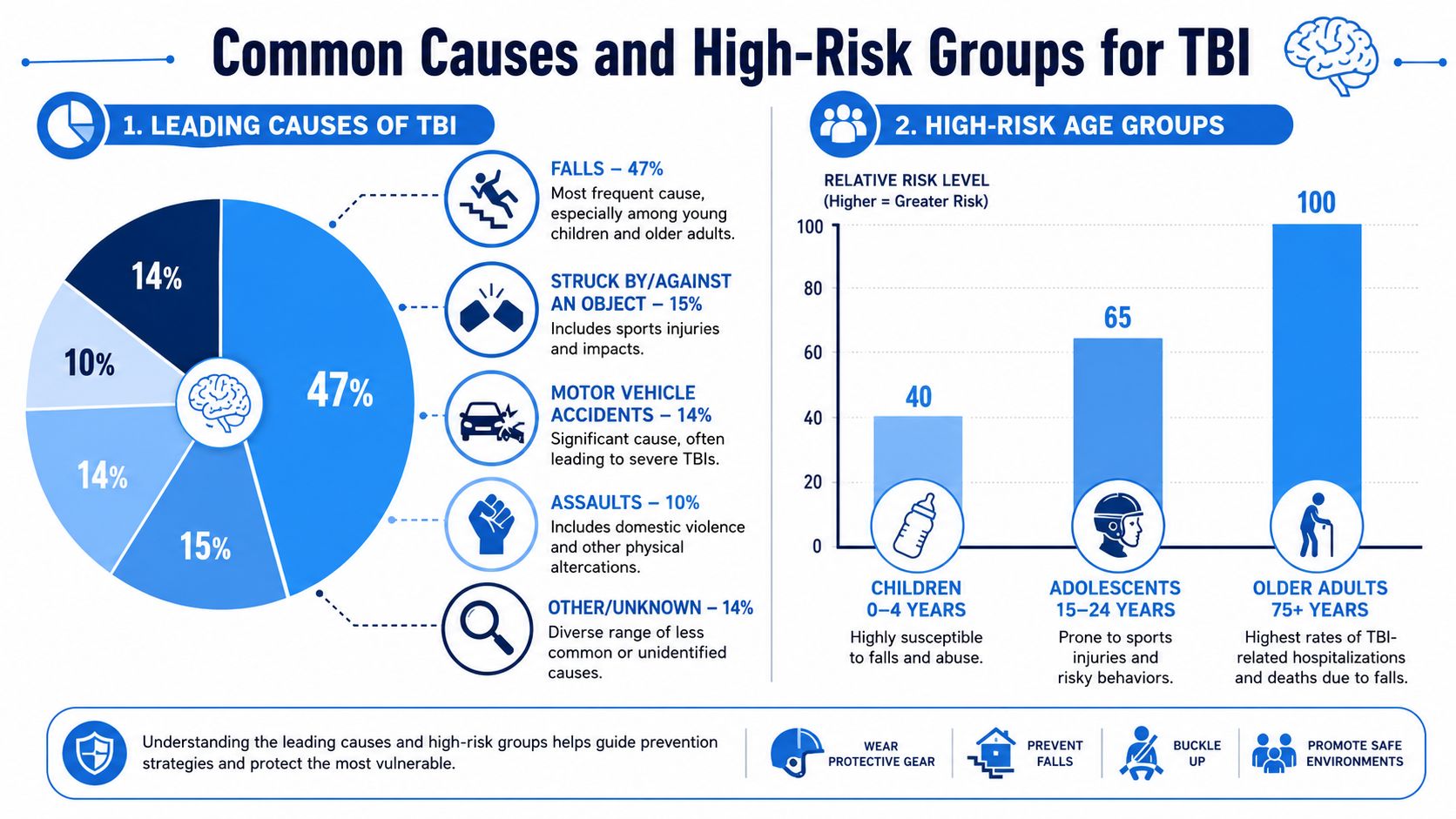
Common Causes and High-Risk Groups for TBI
A brain injury case often starts with a story that sounds ordinary.
An older adult falls in a parking lot and doesn't think much of it until the confusion and balance problems start. A construction worker gets struck by an object, finishes the shift, and later can't focus or tolerate noise. A driver walks away from a crash, then develops headaches, forgetfulness, and sleep disruption over the next week.
Those fact patterns are common because the injury mechanisms are common.

Who faces higher risk
A meta-analysis of U.S. adults found that 18.2% of the general population reported a lifetime TBI with loss of consciousness, with prevalence of 20.8% among males and 11.4% among females. The study found that males had about double the odds of sustaining that kind of injury, with an odds ratio of 2.09 in this PubMed record.
That aligns with what many lawyers and doctors see in practice. Risk rises in settings with more exposure to vehicle crashes, physical labor, falls, impact injuries, and other blunt trauma.
The people most likely to be overlooked
Some groups face not just higher injury risk, but also a greater chance that the injury won't be fully counted, diagnosed, or treated. The CDC notes that American Indian and Alaska Native people and adults age 75 and older have the highest TBI-related hospitalization and death rates, and that lower-income and uninsured people have less access to TBI care on the CDC's health equity page.
That has real legal implications because access problems create documentation gaps.
- Older adults: Falls may be treated as routine aging events instead of serious trauma.
- Rural patients: Distance, transportation, and fewer specialists can delay diagnosis.
- Lower-income workers: People may return to work before symptoms are understood.
- Uninsured patients: Follow-up care may be postponed or never happen.
A weak chart doesn't always mean a weak injury. Sometimes it means the patient didn't get the evaluation they should have received.
In litigation, those gaps need to be explained, not ignored. A good case presentation ties the mechanism of injury, the symptom course, and the barriers to care into one coherent account.
The Lifelong Burden of a Traumatic Brain Injury
The hardest part of a brain injury case isn't always proving that the injury happened. It's proving what the injury continues to do to a person's life.
Some people improve steadily. Others don't. A "mild" diagnosis on paper can still leave someone unable to manage a workday, tolerate busy environments, track appointments, or maintain the patience and emotional control they had before the accident. Families often notice the change before a scan ever does.
What long-term burden actually looks like
The burdens usually fall into several overlapping categories:
- Cognitive problems: memory lapses, slowed processing, poor concentration, trouble multitasking
- Physical symptoms: headaches, dizziness, fatigue, visual problems, sleep disruption, balance issues
- Emotional changes: irritability, anxiety, depression, low frustration tolerance
- Functional losses: reduced work capacity, dependence on others, strain in marriage and parenting
None of those losses exist in isolation. A person who can't sleep develops worse concentration. A person with headaches withdraws socially. A worker with slower processing starts making mistakes, then loses confidence, income, and stability.
Why future impact matters more than the first bill
Consequently, many claims get undervalued. Insurance companies like clean, short timelines. One ER visit. One diagnosis. One discharge. Brain injury cases rarely stay that neat.
Recovery is often uneven. Good days and bad days can alternate for months. That's why practical education matters. Families looking for a plain-language overview of what recovery can look like over time may find these insights into brain injury recovery useful as a starting point.
If you're dealing with post-crash symptoms, it also helps to know what signs often show up after the initial event. This guide to head injury symptoms after a crash in Philadelphia is useful for recognizing issues that people often minimize too early.
Families should keep a symptom journal. Not because it's dramatic, but because memory, mood, fatigue, and concentration problems are easy to forget and hard to reconstruct later.
The hidden costs families carry
The legal system talks about damages. Families experience disruption.
A brain injury can mean repeated specialist visits, therapy, transportation help, work interruptions, medication management, household role changes, and constant supervision in more serious cases. Even when the injured person looks outwardly normal, the home routine often changes first. Someone else starts handling bills. Someone else drives. Someone else tracks medications, appointments, and school pickups.
That's why "full compensation" can't be measured by the first wave of medical expenses alone. A serious claim has to account for how the injury affects earning ability, independence, relationships, and daily functioning over time.
How TBI Prevalence Impacts Your Personal Injury Claim
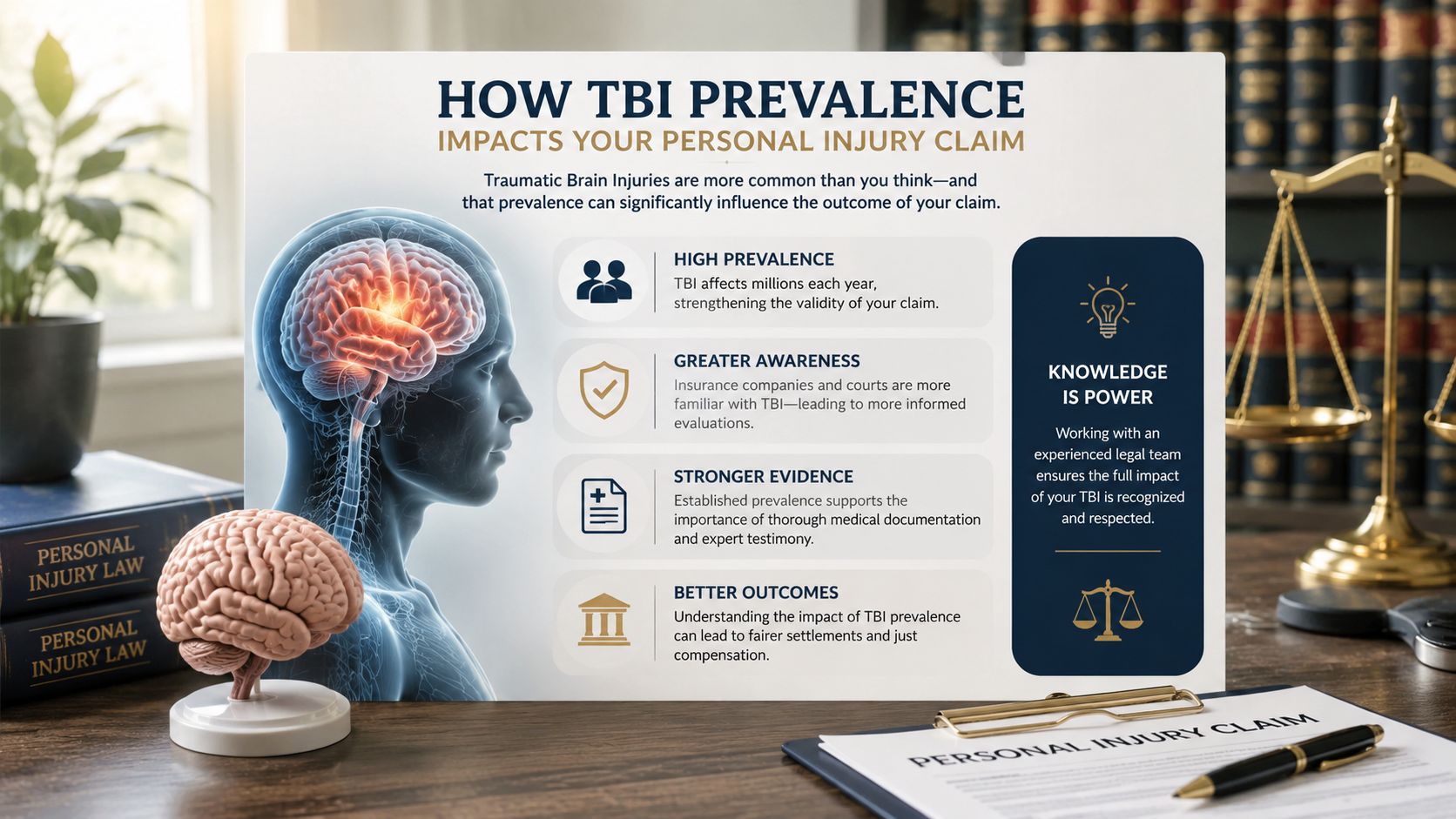
Traumatic brain injuries are common enough that insurers see these claims every day. That does not make them easier to win. It often makes adjusters more practiced at minimizing them, especially when the injury was first labeled mild or missed altogether.
Prevalence matters in a claim for one reason. It helps explain that a normal CT scan, a delayed diagnosis, or a person trying to push through symptoms does not make the injury insignificant. Those are familiar patterns in brain injury cases. The problem for injured people is that insurance companies use those same facts to argue the opposite.
What helps a TBI claim
A strong TBI case is built around proof of change.
Jurors and adjusters need to see what life looked like before the injury, what changed after it, and why those changes trace back to the accident. In practice, the most persuasive evidence is rarely a single dramatic record. It is a consistent paper trail supported by people who have watched the decline up close.
- Early symptom reporting: Tell every provider about headaches, dizziness, confusion, light sensitivity, nausea, poor sleep, memory problems, and irritability.
- Consistent treatment: Gaps can be explained, but regular follow-up makes causation easier to prove.
- Function-based evidence: Show missed work, reduced productivity, driving limits, school problems, household mistakes, and changes in mood or stamina.
- Outside witnesses: Spouses, coworkers, relatives, and close friends often give the clearest before-and-after testimony.
- Specialized evaluation: Neuropsychological testing, speech therapy records, vestibular treatment, and occupational therapy notes often show problems that basic imaging does not.
That last point matters. Many families expect an MRI or CT scan to carry the whole case. Sometimes it helps. Many times, the better evidence is the pattern: repeated complaints, specialist findings, documented setbacks, and testimony that the injured person is not functioning the way they did before.
What hurts a TBI claim
Insurers usually attack mild brain injury claims through the record. They point to missing complaints, delayed treatment, normal scans, old medical history, or a return to work that did not last.
These problems come up often:
- Downplaying symptoms at the start. Injured people often say they are fine because they are shaken up, embarrassed, or focused on getting home.
- Missed appointments or long treatment gaps. The defense uses those gaps to argue the symptoms were minor or unrelated.
- Incomplete charts. If the first provider focused on orthopedic injuries, later records need to clearly document the head injury symptoms.
- Posting a misleading picture online. One smiling photo at a family event can be used against a person dealing with headaches, fatigue, and cognitive problems the rest of the week.
- Misunderstanding insurance rules. In some cases, no-fault coverage affects what gets paid first and how the claim develops. The BDISchool no-fault accident resources give a useful starting point.
Prognosis often drives case value. If the symptoms are expected to interfere with work, schooling, decision-making, or daily independence long term, the claim has to be documented with the future in mind, not just the first few months of treatment.
Why legal help changes the outcome
TBI claims are rarely about one bill or one diagnosis code. They are about building a timeline that makes sense to someone who was not there. That means connecting the accident, the medical follow-up, the symptom progression, the work impact, the family observations, and the expected future limitations.
Prevalence serves as more than a background fact. It helps frame why a mild or initially misdiagnosed brain injury should be taken seriously, but it does not prove your losses by itself. Your lawyer still has to show how this injury changed your earning capacity, your daily function, and your need for future care.
If you want a clearer sense of what drives compensation, this guide on what factors determine brain injury settlements and negotiations breaks down the issues that usually matter most.
If you suspect a brain injury after a crash, fall, or workplace accident, get evaluated, follow through with treatment, and document the problems as they show up in daily life. Mild on paper does not always mean minor in practice. Your claim should reflect the injury you are living with now, and the problems you are likely to carry into the future.