


Author: John Mattiacci | Owner Mattiacci Law
Published May 15, 2026
You hurt your back lifting material, or your shoulder gave out on a repetitive job, or you got hit on a construction site and your doctor took you out of work. Now the paychecks stopped, but the rent, groceries, car payment, and co-pays didn't. That's where workers compensation ttd becomes more than a legal acronym. It becomes the check that's supposed to keep your household afloat while you recover.
Most injured workers in Philadelphia and South Jersey don't call my office because they love paperwork. They call because they're scared something is going wrong. The insurance company is slow. The wage number looks low. A doctor hired by the carrier suddenly says they're fine when they're plainly not. And when the injury seems “simple,” like a strain or sprain, people often underestimate how long healing can really take. If you're dealing with a soft tissue injury, this practical guide on how long muscle strains take to heal can help you compare your recovery pace to what's commonly expected.
Temporary Total Disability, or TTD, is the wage-loss benefit paid when a work injury keeps you from doing your job for a period of time. In Pennsylvania and New Jersey, the rules are local, the deadlines matter, and the insurer's favorite pressure point is often the same. They try to move you to Maximum Medical Improvement, or MMI, before your case is ready for it.
Your Guide to TTD After a Work Injury
TTD starts with a simple reality. You were working. You got hurt. A doctor says you can't work. The law is supposed to replace part of your wages while you heal.
That sounds straightforward. In practice, it rarely feels that way. A warehouse employee may be out with a back injury and assume the insurer will automatically use every paycheck, every overtime shift, and every side job when calculating benefits. A laborer may believe TTD continues until he feels normal again. Both assumptions can cause problems.
What TTD does for you
Think of TTD as a temporary paycheck substitute funded through workers' compensation insurance. It isn't full wages, and it isn't damages in a lawsuit. Its purpose is narrower. It gives you income support during the period when your injury keeps you out of work.
For many individuals, the pressure points are immediate:
- Household bills: Mortgage or rent doesn't pause because your doctor restricted you.
- Medical follow-through: Missed treatment can hurt both your recovery and your claim.
- Employer contact: Supervisors may ask when you're coming back before you have medical clearance.
- Insurance confusion: Adjusters often ask questions that sound casual but affect benefits.
Practical rule: Treat your TTD claim like a medical and wage file at the same time. If either side is weak, the carrier will use it.
What tends to help and what doesn't
What helps is boring but effective. Report the injury promptly. Follow your doctor's work restrictions. Keep pay records. Save every letter, text, and claim form. If the insurer sends you to one of its doctors, go, but don't assume that doctor is there to protect your benefit stream.
What doesn't help is guessing, delaying treatment, or returning to work because you feel guilty. I've seen workers try to “push through” too early, only to aggravate the injury and create a fresh fight over whether the worsened condition is still work-related.
What Workers Comp TTD Actually Means for You
The cleanest way to understand workers compensation ttd is this. It replaces part of your paycheck while your doctor says you can't work because of a job injury. That's the practical meaning.

A paycheck replacement, not a bonus
If your regular paycheck is the money your household runs on, TTD is the backup generator. It's not designed to make you whole in every sense. It's designed to keep income coming in while you're medically unable to earn it.
That distinction matters because workers often mix up three different ideas:
- Medical treatment coverage
- Lost wage benefits like TTD
- A separate injury claim against a third party, if one exists
TTD sits in the second category. It is wage loss protection during a temporary period of total disability.
When you are and aren't in TTD status
You're generally in TTD status when a treating doctor says you cannot perform work because of the work injury. That usually means no regular job and no suitable modified job within your restrictions.
You are not in classic TTD status when:
- You can work with restrictions: That may raise questions about light duty or partial wage loss instead.
- You returned to your normal job: TTD usually ends if you're back earning your wages.
- The insurer says you've reached MMI: That often triggers a dispute, not necessarily a fair result.
The key question isn't whether you want to work. It's whether your medical restrictions actually allow safe work.
Why this benefit exists
The workers' compensation system made a trade. You don't have to prove your employer meant to hurt you. In return, the system limits what you recover and channels the claim through defined benefits. TTD is part of that bargain.
That's why the paperwork can feel impersonal. The adjuster isn't evaluating your pain the way a jury would in a civil trial. The adjuster is looking at wage records, work status slips, treatment notes, and the date someone believes your disability should end.
If you keep that frame in mind, the process makes more sense. Every dispute comes back to one of three questions:
- Was the injury work-related
- Are you medically unable to work
- Is the wage calculation correct
Qualifying for TTD Benefits in Pennsylvania and New Jersey
You don't qualify for TTD just because you got hurt and missed a few shifts. You qualify when the facts line up in a way the workers' comp system recognizes. The good news is that the core requirements are simple.
The basic checklist
Start with these points:
- Work connection: The injury must arise out of your job duties or happen in the course of employment.
- Medical support: A doctor must take you out of work or document restrictions your employer can't accommodate.
- Lost time: You must miss enough time from work for disability benefits to come into play.
- Claim compliance: You need to report the injury and cooperate with the claim process.
If your employer offers a restricted role, don't answer from the gut. Answer based on medical restrictions and the actual job duties. A useful primer on that issue is this guide to light duty work in injury claims.
TTD Eligibility at a Glance Pennsylvania vs. New Jersey
| Rule | Pennsylvania | New Jersey |
|---|---|---|
| Basic injury requirement | Work-related injury or occupational condition | Work-related injury or occupational condition |
| Medical requirement | A doctor must support that you're unable to work or restricted beyond available job duties | A doctor must support that you're unable to work or restricted beyond available job duties |
| Waiting period | A waiting period generally applies before wage benefits start | A waiting period generally applies before wage benefits start |
| Retroactive payment | Benefits may become retroactive if disability lasts long enough under state rules | Benefits may become retroactive if disability lasts long enough under state rules |
| Light duty effect | Suitable available work can affect TTD status | Suitable available work can affect TTD status |
| Main dispute areas | Whether the injury is work-related, whether disability continues, and wage calculation | Whether the injury is work-related, whether disability continues, and wage calculation |
Where workers get tripped up
The legal test sounds clean. Real cases aren't. The most common problems I see are practical ones.
- Late reporting: The worker waits because they think the pain will pass.
- Bad first medical note: The chart says "may return as tolerated," which insurers love.
- Informal job offers: A supervisor says, "We can find something for you," but nothing concrete is documented.
- Incomplete history: The insurer only looks at recent pay or ignores irregular earnings.
If your doctor writes a work note, read it before you leave the office. One vague line can shape the next month of your claim.
A local point that matters
Philadelphia area workers often cross state lines for work. You may live in New Jersey and get hurt in Pennsylvania, or the reverse. That can affect where the claim is handled and which rules control. Don't assume your home address decides everything. The location of the job, the employer, and how the employment relationship was set up can all matter.
How Your Weekly TTD Benefit Amount Is Calculated
This is the part of the claim where small errors turn into months of underpayment.
I see it all the time in Philadelphia area cases. A worker gets hurt, the carrier accepts that some wage loss is owed, then the weekly check comes in low. The adjuster has a spreadsheet. You have a paycheck history. If the spreadsheet leaves out part of your earnings, your benefit can be short every single week until someone forces a correction.

What should count as wages
In Pennsylvania and New Jersey, TTD is generally tied to your pre-injury earnings, not just your base hourly rate. That sounds simple until you look at how people are paid in practice. Overtime, shift differentials, seasonal swings, union jobs, bonuses tied to production, and second jobs can all affect the number.
The wage calculation works like measuring a floor before ordering material. If the carrier measures only the easy parts and ignores the edges, the final number comes out too small.
What belongs in the calculation depends on the facts and on which state's rule controls, but these are the items that often deserve a close look:
- Base pay: Your regular hourly wage or salary
- Overtime: Often a major issue for warehouse workers, drivers, tradespeople, and hospital staff
- Shift differentials or premium pay: Nights, weekends, and specialty assignments may matter
- Concurrent employment: A second job may affect the wage picture in some cases
- Payroll timing: Missing weeks, partial weeks, layoffs, or irregular schedules can skew the average
- Other compensation tied to earnings: Some forms of pay are counted, others are not, and that is where disputes start
Pennsylvania and New Jersey do not handle every wage issue the same way. That matters for workers who live in South Jersey and work in Philly, or the reverse. The right formula depends on where the claim belongs, and insurers know that a confused worker is less likely to challenge a low number.
A practical way to check the insurer's math
Do not assume the first wage statement is right.
Start with your own records. Then compare them line by line to what the insurer used.
- Gather pay stubs, W-2s, direct deposit records, and tax records from before the injury.
- Ask for the wage documents the carrier or employer relied on.
- Compare the dates used in their calculation to your actual work pattern.
- Flag anything missing, especially overtime, premium shifts, or earnings from another job.
- Ask for the rate calculation in writing if the weekly benefit still does not make sense.
This is one area where paper usually beats argument. If your earnings changed from week to week, that does not mean the insurer gets to pick the lowest stretch and call it your average. It means the numbers need to be calculated carefully under the right state rule.
Where insurers gain an advantage
The wage fight does not happen in isolation. It often connects to the medical side of the claim.
If the carrier says your average wage is low, your weekly check drops. If the carrier later pushes a doctor to say you have reached Maximum Medical Improvement in a workers' comp claim, they may try to stop or limit benefits before the wage dispute is fully sorted out. That is one reason I tell injured workers in Pennsylvania and New Jersey to challenge a bad rate early. A low number at the front end can follow you through the life of the claim.
What helps and what does not
What helps is organized proof. Pay stubs, union records, employer payroll printouts, and tax documents give you something concrete to work with. If you were regularly working overtime before the injury, those records should show it.
What does not help is relying on a verbal explanation from the adjuster. If the benefit amount seems off, ask what earnings were used, what dates were used, and why. Then check it yourself.
Bring your last stretch of pay records to any claim review. A lawyer cannot challenge an underpayment without the wage trail that proves it.
Understanding TTD Timelines and Benefit Limits
Some workers are shocked when TTD ends quickly. Others are shocked when recovery drags on for months and the claim becomes a fight. Both reactions are normal. The timeline for temporary disability is rarely predictable in the first week or two.
What the broader claim data shows
One useful benchmark comes from the National Council on Compensation Insurance. Its temporary disability data shows a wide spread in claim duration. One out of four claims lasted 18 days or less, while three out of four lasted 133 days or less, and the distribution was right-skewed, meaning some claims lasted much longer than the middle of the pack, according to this NCCI temporary disability duration analysis.
The takeaway isn't that your case should fit neatly into a chart. It's that short claims are common, but serious injuries can last for months, and some cases stretch far beyond what workers initially expect.
What usually ends TTD
TTD generally stops when one of two things happens:
- You return to work, either at full duty or in a medically appropriate role
- Someone says you reached MMI, meaning your condition has stabilized enough that you are no longer considered temporarily totally disabled
That second point is the one workers often miss. MMI does not always mean you are pain-free. It usually means a doctor believes your condition has improved as much as it's going to through current treatment, at least for now.
If you want a plain-English explanation of that turning point, this overview of what MMI means in workers' comp is worth reading.
Why timing matters so much
The day before an MMI opinion, you may still be receiving temporary wage benefits. The day after, the insurer may argue those checks should stop. That makes medical timing a major advantage in the case.
A doctor's language matters. So does the treatment record leading up to that opinion. If your chart says you're improving but still not able to work, that is different from a chart saying your condition has plateaued and no additional treatment is expected to change function.
Navigating the Claim Process and Common Pitfalls
A TTD claim usually starts. You report the injury. You get treatment. You expect the system to do what it's supposed to do. Problems usually appear later, after the insurer has enough information to start limiting exposure.
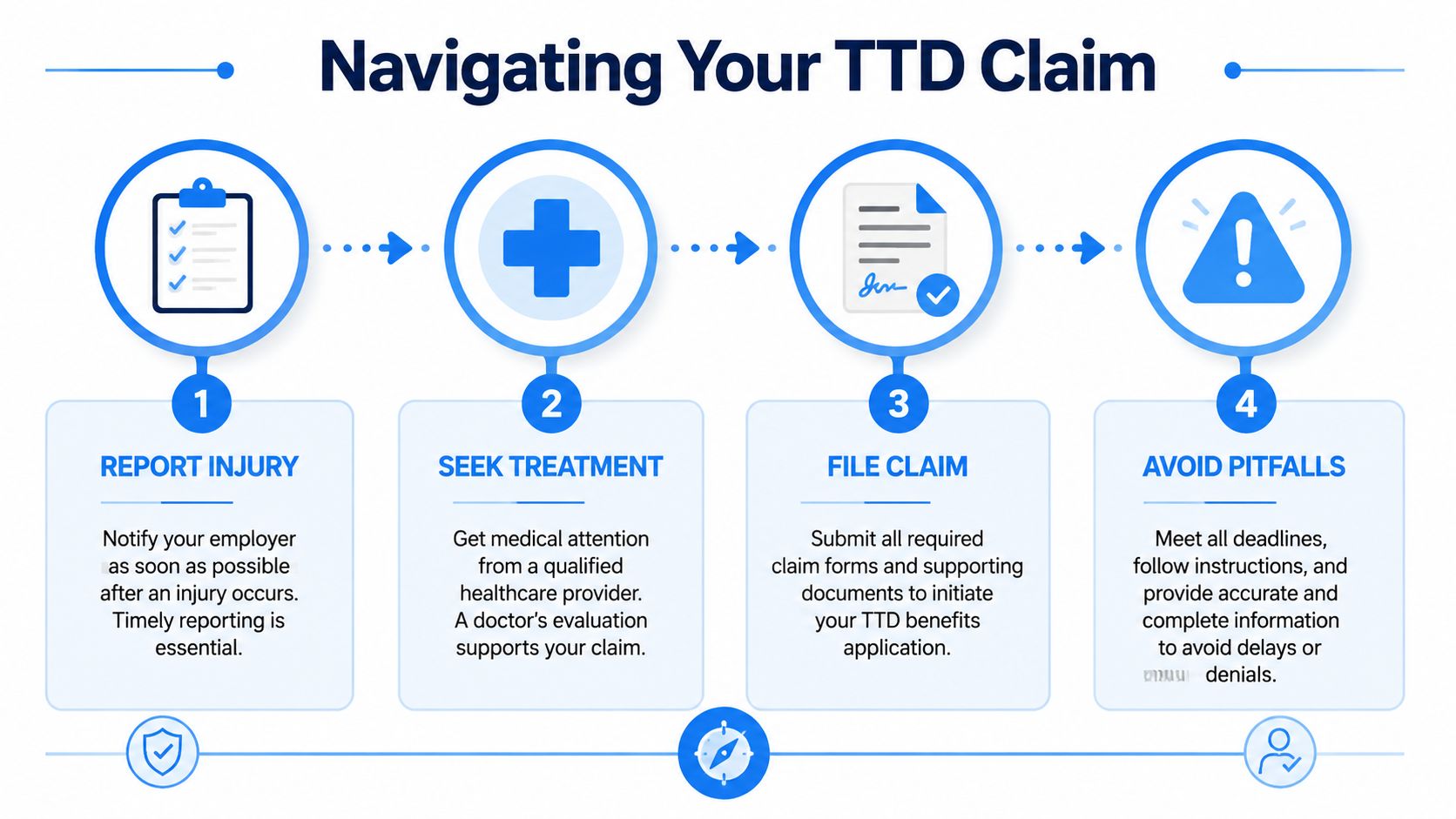
The claim path that tends to work best
The strongest claims are built early, not after a denial. Focus on sequence.
Report the injury fast
Tell your employer what happened, where it happened, and what body parts were hurt. Be accurate. Don't guess if you don't know something.Get medical treatment that addresses work status A treatment note that discusses restrictions is usually more useful than a note that lists pain complaints.
Track every document
Save work notes, appointment summaries, wage records, and letters from the carrier.Treat insurer requests carefully
Recorded statements, broad medical authorizations, and offhand conversations can all shape the file.
The MMI trap
A legal aid explanation of temporary disability benefits highlights a point many injured workers learn too late. Insurers frequently push for early MMI declarations to cap liability, often before a worker is ready, and workers can contest those determinations with independent medical evaluations, as discussed in this temporary disability and MMI guidance.
This is the strategic center of many disputed TTD claims. The carrier doesn't need to prove you're back to normal. It often just needs a doctor willing to say your temporary total period is over.
Here's how that plays out in real life:
- You are still treating, but progress is slower than the insurer wants.
- The carrier schedules an IME, often with a doctor who sees claimants for evaluation rather than treatment.
- The IME report uses MMI language, even if your own doctor still has you off work.
- Benefits get reduced, suspended, or threatened, shifting the burden onto you.
An IME is not a treatment visit. It is an evaluation in a dispute setting. Go prepared, be accurate, and don't treat it like a friendly second opinion.
Common mistakes that weaken a good claim
Workers often hurt their own cases without meaning to.
- Missing follow-up care: Gaps in treatment let the insurer argue you improved.
- Accepting unsafe light duty: If the job exceeds restrictions, trying to be tough can backfire medically and legally.
- Ignoring home care needs: If your injury affects mobility or daily function, practical recovery tools matter. Staying current with Staying informed on home medical equipment can help you understand equipment questions that come up during recovery.
- Believing the first denial letter: A denial is the start of a fight, not always the end of the claim.
When legal review matters
There are moments when a claim shifts from manageable to risky. A low wage calculation is one. An IME is another. A sudden MMI opinion is a major one. If you want to understand the patterns adjusters use when trying to narrow claims, this breakdown of workers comp adjuster tricks is useful.
For workers in Pennsylvania and New Jersey, legal help is often most valuable before benefits stop, not after. Firms such as Mattiacci Law review wage records, compare medical restrictions to actual job duties, and prepare clients for insurer exams so the file reflects the worker's real condition rather than the carrier's preferred version of it.
Frequently Asked Questions About TTD Benefits
What is the difference between TTD and temporary partial disability
TTD usually applies when your work injury keeps you from working at all for a temporary period. Temporary partial disability generally comes into play when you can work in some capacity, but not at your full pre-injury level.
A common example is a worker who can't return to heavy labor but can do restricted work for fewer hours or less pay. The key difference is total inability versus partial earning capacity.
Can I be fired while receiving workers' comp benefits
Employment status and benefit status are related, but they are not the same thing. Employers sometimes terminate workers for reasons they claim are unrelated to the injury. That doesn't automatically answer whether wage-loss benefits should continue.
If you are fired while still medically unable to work because of the injury, do not assume the claim disappears. Get the termination reason in writing, preserve texts and emails, and speak with counsel quickly so the work status issue and the employment issue don't get blurred together.
What should I do if my TTD checks suddenly stop
Take these steps in order:
- Get the reason in writing: You need to know whether the issue is MMI, a return-to-work opinion, paperwork, or something else.
- Call your doctor: Ask whether the current work status note still supports being out of work.
- Collect the recent records: Appointment notes, test results, and restrictions often decide the next move.
- Do not ignore deadlines: Appeals and hearings move on strict timelines.
- Get the file reviewed: A stopped check can often be challenged, but speed matters.
Do I have to accept light duty
Not automatically. The question is whether the job is genuine, available, and within your medical restrictions. "Come in and we'll find something" is not the same as a documented position with defined duties.
If the offered job exceeds restrictions, raises a safety problem, or appears designed to force a refusal, treat that carefully. You want the response to be medically grounded and documented.
When to Contact a Mattiacci Law Attorney for Your TTD Claim
The right time to call is usually earlier than people think. If your weekly rate seems low, your wage history is irregular, or the insurer is hinting that you are suddenly at MMI, your claim has already reached a pressure point.
The same is true if you were offered light duty that doesn't fit your restrictions, sent to an IME, or told your checks are being suspended. These are not minor bumps. They are the moments when a claim's value and stability can change fast.
A lawyer can review the wage calculation, compare your medical records to the insurer's position, and map out whether the carrier is relying on a weak MMI opinion to cut off temporary benefits. That kind of review is especially important in Philadelphia and South Jersey cases, where workers often have physically demanding jobs and inconsistent earnings that insurers may undercount.

If you're dealing with a work injury in Pennsylvania or New Jersey and have questions about TTD, wage calculation issues, an IME, or a sudden MMI finding, contact Mattiacci Law. You can discuss what happened, get a clear explanation of your options, and find out what steps make sense next.