

Author: John Mattiacci | Owner Mattiacci Law
Published May 27, 2026
A concussion is not different from a traumatic brain injury. It is medically classified as a mild traumatic brain injury, and the key difference is severity, not category.
If you're reading this after a car crash, fall, job site accident, or blow to the head, you're probably dealing with mixed messages. The ER may have said “concussion.” Your discharge papers may say “mild TBI.” The insurance company may already be acting like that means minor, temporary, and not worth much. That's where people get hurt twice. First by the impact, then by bad assumptions.
I'll be direct. In a Pennsylvania or New Jersey injury claim, the word used on the chart matters less than the proof behind it. What symptoms started. Whether they got worse. Whether you followed up. Whether your daily life changed. Whether your records show a real functional problem, even if a scan looked normal. If you haven't been checked properly yet, start with prompt medical care and documentation. This guide on how soon you should see a doctor after an accident is a good place to begin.
After an Accident What a Head Injury Diagnosis Really Means
A lot of clients tell me the same thing: “They said it was just a concussion, so I figured I'd be fine.” Then the headaches don't stop. Work gets harder. Sleep falls apart. You forget simple things. Family members notice you're shorter-tempered or foggy. Suddenly “just a concussion” doesn't feel minor at all.
That confusion starts with the labels. Concussion is the everyday term commonly used. Mild traumatic brain injury, or mTBI, is the medical classification. They are not opposing diagnoses. They are the same point on the same injury spectrum.
What the diagnosis is really telling you
When a doctor says concussion, the doctor is usually describing a mild form of brain injury. That doesn't mean fake. It doesn't mean harmless. It means the injury falls on the mild end of a very broad brain injury range.
What matters next is not arguing over vocabulary. It's answering harder questions:
- Did symptoms start right after the incident, or later that day or night
- Are symptoms improving, or are they getting worse
- Can you work, drive, focus, sleep, and function the way you could before
- Did you get follow-up care, not just an ER discharge sheet
Bottom line: In a legal claim, brain injuries are proven through the full story of the injury, not by one word on a discharge summary.
Why this matters in a PA or NJ case
Insurance adjusters love the word “mild.” They use it to suggest the case is small. That's sloppy and often wrong. A mild TBI can still disrupt memory, concentration, sleep, mood, and job performance. If the injury changes how you function, it deserves serious documentation and serious legal attention.
You don't need to panic, but you do need to take the diagnosis seriously. Early records, symptom tracking, specialist referrals, and consistent treatment can make the difference between a claim that gets brushed aside and one that reflects what you're living through.
Defining the Terms Concussion as a Mild Traumatic Brain Injury
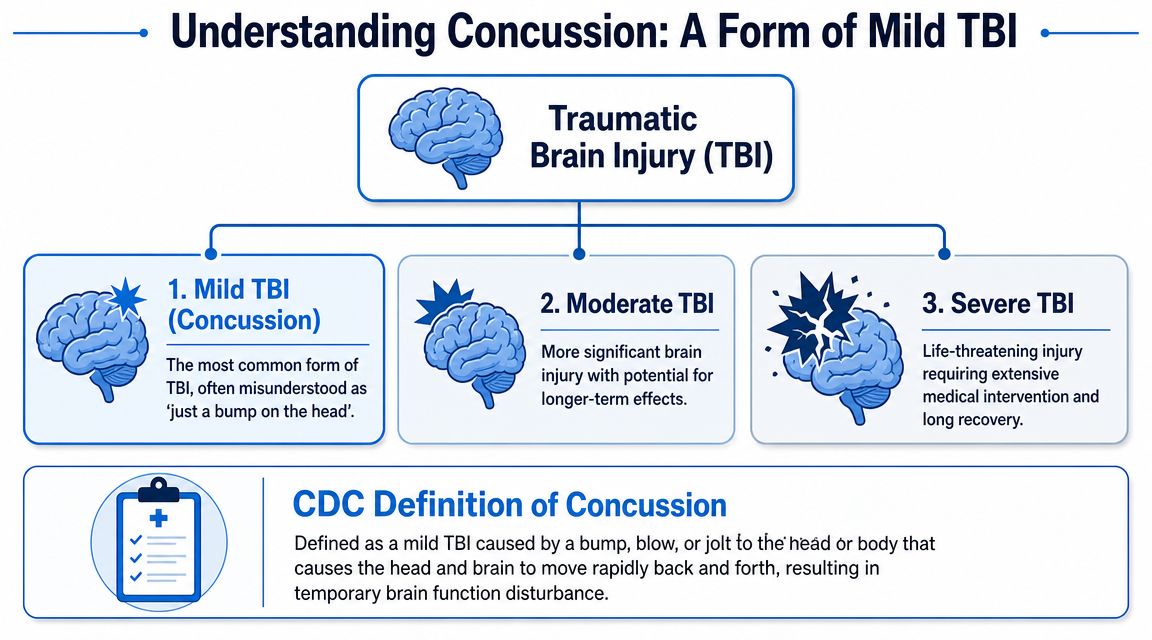
The clearest way to understand traumatic brain injury vs concussion is this: TBI is the umbrella category. Concussion sits under that umbrella as a mild TBI. It is not a separate kind of injury.
To illustrate, consider a burn. “Burn” is the broad category. First-degree, second-degree, and third-degree burns describe severity. Brain injury works the same way. “TBI” names the category. Mild, moderate, and severe describe where the injury falls.
Why doctors use different words
Doctors often tell patients they have a concussion because that term is familiar. In the medical chart, the diagnosis may appear as mild TBI. That difference in wording creates a lot of unnecessary confusion, especially when people later read medical records for an insurance claim or lawsuit.
The public health stakes are not small. The CDC says more than 69,000 TBI-related deaths occurred in the United States in 2021, which is about 190 deaths per day, and lists falls, firearm-related injuries, motor vehicle crashes, and assaults as common causes of TBI in its CDC TBI facts and statistics summary. That data matters because it shows TBI is a broad term covering everything from a concussion after a crash to catastrophic brain trauma.
What people get wrong
The biggest mistake is assuming “concussion” means minor and “TBI” means severe. That's not how medicine works.
Here's the correct way to look at it:
| Term | What it means |
|---|---|
| Traumatic brain injury | The broad diagnosis category for brain injury caused by trauma |
| Concussion | A mild traumatic brain injury |
| Moderate or severe TBI | More serious forms of traumatic brain injury with greater risk of long-term impairment |
A concussion belongs inside the TBI category. If someone tells you they are completely different injuries, they're wrong.
Why this distinction matters legally
The label alone won't decide your case. A defense lawyer or insurance carrier may still try to shrink the claim by focusing on the word “concussion.” Your job, and your lawyer's job, is to focus on evidence of functional loss. If your attention, memory, sleep, work tolerance, balance, or mood changed after the accident, that's the issue.
That's why I tell clients to stop obsessing over whether the chart says concussion or mild TBI. Read the records, yes. But pay even more attention to symptom timing, follow-up care, and day-to-day limitations.
The TBI Spectrum From Mild Symptoms to Severe Impairment
Brain injury doesn't come in one neat package. It runs on a spectrum. At one end, a person may remain awake, have a normal scan, and struggle mainly with headaches, concentration problems, and fatigue. At the other end, a person may face profound cognitive or physical impairment and need long-term support.
That spectrum matters because outcomes vary sharply. A source compiling public health data reports that from 2000 to 2017, nearly 960,000 U.S. deaths were associated with TBI, and notes that people with mild TBI or concussion may recover in weeks or months, while moderate or severe TBI can produce long-term or lifelong effects in its overview of traumatic brain injury facts and statistics.
The comparison people actually need
This information isn't intended as a neurology lecture. Instead, it offers a practical way to tell where an injury may fall on the spectrum. Use this as a working reference, not as self-diagnosis.
| Indicator | Mild TBI (Concussion) | Moderate & Severe TBI |
|---|---|---|
| General classification | Mild brain injury | More serious brain injury |
| Symptoms | Headache, dizziness, fogginess, memory trouble, sensitivity to light or noise, sleep disruption | More substantial cognitive, neurological, speech, motor, or consciousness-related problems |
| Course after injury | Often improves with time and proper care | May involve prolonged recovery and major life disruption |
| Imaging | May appear normal on standard scans | More likely to involve visible structural problems |
| Functional impact | Can still seriously affect work, school, driving, and daily tasks | Often causes broader and more obvious impairment |
| Prognosis | Recovery may occur in weeks or months | Long-term or lifelong effects are more likely |
Severity changes the case, but not in the way insurers claim
A severe TBI is often easier to “see” on paper. There may be intensive care, surgery, obvious deficits, or extensive rehabilitation. A mild TBI is harder because the person may look normal while struggling to think, sleep, or function.
That doesn't make the mild injury less real. It makes the proof more detailed.
What to focus on if the injury seems “mild”
- Consistency: If your records repeatedly document headaches, memory problems, fatigue, or concentration issues, that pattern matters.
- Function: Can you do your job the same way. Can you manage appointments, bills, parenting, driving.
- Duration: A symptom that lingers deserves attention, even if the original diagnosis sounded modest.
The legal mistake is treating all mild TBIs as quick recoveries. Some are. Some are not. Your case turns on what happened to you, not on a generic assumption attached to the word “mild.”
Recognizing Head Injury Symptoms After an Accident
A head injury can fool people in the first day or two. You may feel shaken up, sore, and tired, then assume that's all it is. Hours later, the brain injury picture gets clearer. That delay matters medically and legally.
Johns Hopkins notes that secondary brain injury can unfold over hours to days after the initial impact and warns that worsening headaches, repeated vomiting, increasing confusion, slurred speech, or weakness require immediate medical evaluation in its discussion of traumatic brain injury warning signs.

What to watch in the first 24 to 48 hours
Don't wait for loss of consciousness. Many people with a concussion never black out. Pay attention to symptoms that affect the way you think, feel, and function.
Watch for problems like:
- Head pain that intensifies: A headache that keeps getting worse is not something to shrug off.
- Vomiting more than once: Repeated vomiting after a head injury is a red flag.
- Confusion that increases: Trouble answering simple questions, tracking conversations, or recognizing what's going on needs prompt evaluation.
- Speech or movement changes: Slurred speech, weakness, poor coordination, or unusual clumsiness can signal a more serious problem.
- Wakefulness problems: If someone is hard to wake, that calls for emergency care.
Symptoms that may seem subtle but still matter
Some of the most important brain injury symptoms don't look dramatic. They show up as changes in daily life.
Common issues include:
- Mental fog
- Short-term memory trouble
- Irritability or unusual mood swings
- Sensitivity to light or noise
- Trouble sleeping
- Exhaustion that feels out of proportion
If you're dealing with these after a crash, this guide on head injury symptoms after a crash in Philadelphia is worth reviewing.
If symptoms are stable and gradually improving, that's one pattern. If they're building, spreading, or interfering more each day, that's a different situation and it needs attention fast.
What families should do
If you're caring for an injured spouse, child, parent, or coworker, don't rely on the injured person to judge their own condition. Brain injuries often affect insight. The person may insist they're fine while plainly acting differently.
Keep notes on what you observe. Write down when symptoms started, what changed, and whether the person could sleep, speak, walk, remember, and respond normally. Those notes may help doctors, and later they may help prove the injury timeline if the insurer starts questioning it.
Treatment Recovery and Potential Long-Term Complications
Treatment depends on severity, but the mistake I see most often is oversimplifying recovery after a concussion. People hear “mild TBI” and assume a few quiet days will fix everything. Sometimes that happens. Sometimes it doesn't.
For many mild TBIs, doctors focus on rest, symptom monitoring, gradual return to activity, and follow-up if symptoms persist. Moderate and severe TBIs can involve hospital care, neurology, rehabilitation, and coordinated therapy for speech, movement, cognition, and daily function. The gap between those paths is wide.
Recovery is not just about pain
With a brain injury, recovery is about function. Can you read without getting a headache. Can you tolerate screens. Can you drive safely. Can you process instructions at work. Can you sleep through the night.
That's why I tell clients to measure recovery in practical terms:
- Work capacity: Are you missing tasks, making unusual mistakes, or unable to get through a normal day?
- Home responsibilities: Are cooking, childcare, bills, and errands suddenly difficult?
- Emotional regulation: Are you more anxious, frustrated, withdrawn, or overwhelmed than before?
- Cognitive stamina: Do short periods of concentration leave you wiped out?
When “mild” doesn't feel mild anymore
Some people continue to deal with headaches, dizziness, sleep problems, concentration issues, and mood changes well after the original injury. Even if the diagnosis started as a concussion, its practical impact can become long-lasting.
Recovery should be judged by what you can actually do, not by whether someone once called the injury mild.
That's also why follow-up care matters so much. If a primary doctor recommends neurology, vestibular therapy, speech therapy, or neuropsychological testing, take that seriously. Gaps in treatment make recovery harder and claims weaker.
Support can extend beyond the hospital
Serious brain injury often affects the whole family. A person may need help with transportation, medication reminders, supervision, or daily routines. In those situations, outside support can matter. Families looking for support for neurological conditions in Boise can review the services offered by A Better Solution in Home Care as one example of the kind of practical assistance brain-injured patients sometimes need.
Long-term complications are also why you shouldn't rush back into normal activity just to look “fine.” If symptoms flare with work, driving, screens, exercise, or noise, that information belongs in your medical record. It helps guide treatment, and it helps document damages if the injury claim becomes disputed.
How Brain Injury Severity Impacts Your Personal Injury Claim
Medicine and law frequently collide. A lot of people think a brain injury case rises or falls on a CT scan or MRI. That's false, especially in concussion cases.
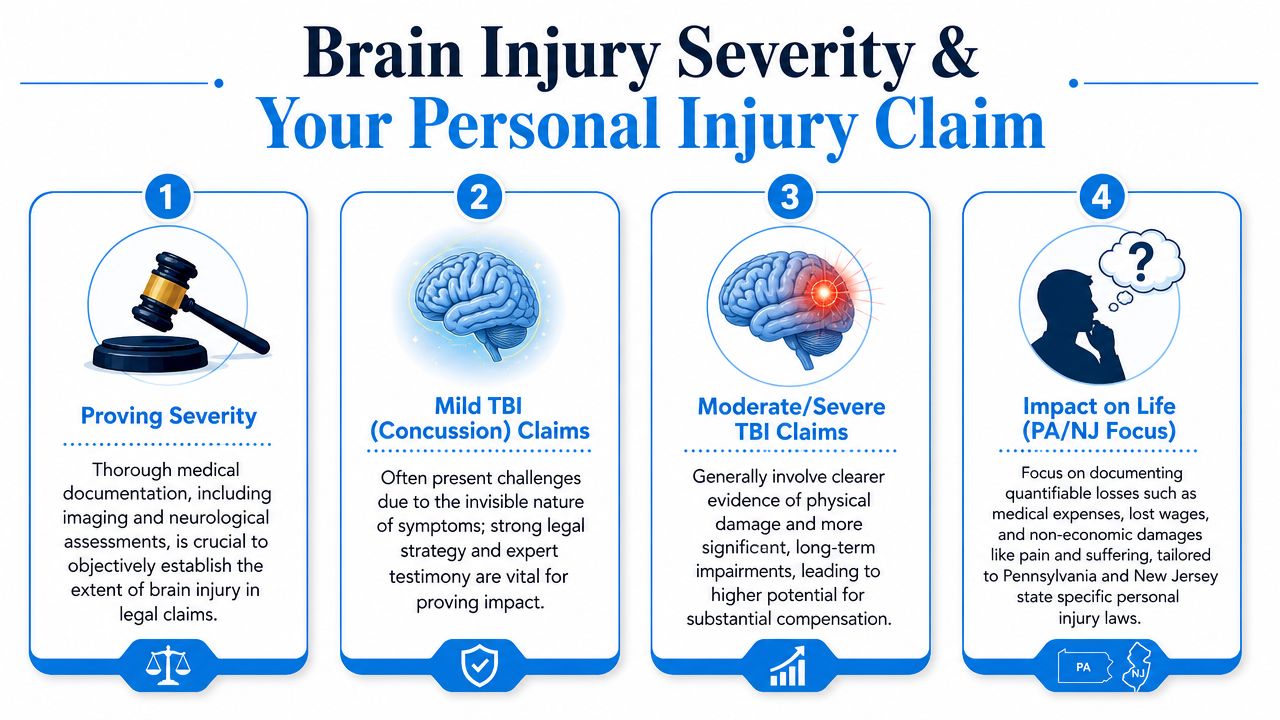
UCLA notes that mild TBI or concussion often produces microcellular brain changes that do not appear on standard CT or MRI scans, and that diagnosis is often clinical, based on symptoms and functional impairment, in its explanation of types of traumatic brain injury. In plain English, a normal scan does not erase a real brain injury.
What insurers do with a “normal” scan
They weaponize it. They argue no bleeding means no injury. They point to the word “mild.” They pretend complaints like memory trouble, headaches, sleep disruption, and slowed thinking are vague or unrelated.
That argument works only when the injured person has poor documentation.
The evidence that actually builds a strong claim
In Pennsylvania and New Jersey, the strongest brain injury cases usually combine medical proof with functional proof. That means showing not only that you were hurt, but how the injury changed your life.
Here's what matters most:
- Detailed medical records: ER notes, primary care visits, neurologist evaluations, therapy records, and referrals all help establish a timeline.
- Symptom journals: Write down headaches, dizziness, memory lapses, sleep disruption, missed work, overstimulation, and daily limitations.
- Neuropsychological testing: When appropriate, this can document cognitive deficits that don't appear on basic imaging.
- Witness observations: Spouses, coworkers, supervisors, and friends often notice changes in mood, memory, focus, and stamina.
- Employment evidence: Missed work, reduced duties, performance problems, and failed return-to-work attempts can be powerful.
- Expense tracking: Keep receipts, copays, medication costs, transportation costs, and records of out-of-pocket help.
The question is not “Did the scan look bad?” The question is “What does the evidence show about how this person functions now compared with before the accident?”
Why legal help matters early
Brain injury claims can go sideways fast if the case is treated like a routine soft-tissue claim. A lawyer handling a TBI case should know how to organize treatment records, identify when specialist input is needed, and frame a “normal imaging” case without apology. That may include working with medical experts, vocational experts, and economists when the facts support it.
For people in Pennsylvania or New Jersey, Mattiacci Law handles serious injury claims involving traumatic brain injuries, including cases arising from vehicle crashes, work injuries, and dangerous property conditions. The key is less about slogans and more about doing the record-building work correctly from the start.
Next Steps for Injury Victims in Pennsylvania and New Jersey
If you think you may have a concussion or other traumatic brain injury after an accident, keep this simple and disciplined. Don't self-diagnose. Don't tough it out for the insurance company. Don't assume a normal scan ends the story.
Follow this checklist
- Get medical evaluation right away. If symptoms are worsening or new red flags appear, go back for immediate care.
- Follow every treatment recommendation. Attend follow-ups, fill prescriptions, complete therapy, and report symptoms accurately.
- Keep a symptom and limitation journal. Write down what hurts, what you forget, what you miss, and what you can't do normally.
- Save every document and receipt. Medical records, discharge papers, work notes, and out-of-pocket costs all matter.
- Do not give a recorded statement to the other side's insurer without legal advice. Brain injury symptoms are often misunderstood or minimized.
- Act before deadlines become a problem. If you're injured in Pennsylvania, review how long you have to file a personal injury claim in Pennsylvania so you don't lose your advantage by waiting.
One final point
The issue in traumatic brain injury vs concussion is not terminology. It's proof. Proof that the injury happened. Proof that symptoms followed. Proof that your daily function changed. Proof that the losses are real.
If you build that proof early, your case stands on much firmer ground. If you wait, minimize symptoms, or skip follow-up care, the insurance company will use every gap against you.
If you're dealing with head injury symptoms after an accident in Pennsylvania or New Jersey, Mattiacci Law can review what happened, explain your options in plain English, and help you preserve the medical and legal evidence your case may depend on. Consultations are free, the firm is available 24/7, and you don't pay a fee unless there's a recovery.