


Author: John Mattiacci | Owner Mattiacci Law
Published May 26, 2026

If you were hurt in New Jersey and think you may share some blame, you can still recover damages as long as you were 50% or less at fault. If you’re 51% or more responsible, New Jersey bars recovery.
That matters because many injured people call a lawyer after the same kind of moment. A crash happens fast, a fall happens even faster, and then the other side starts saying you caused it, or at least helped cause it. Sometimes an insurance adjuster asks questions that sound harmless. Sometimes a property owner claims you “should have been paying attention.” Sometimes there really was shared fault.
The good news is that shared fault doesn’t automatically destroy a claim. The harder truth is that every percentage point matters. In a straightforward car wreck, that can affect settlement value. In a more complicated case involving several defendants, a worksite, a product defect, or a dangerous property condition, fault allocation can shape the whole case.
Injured in an Accident But Partially at Fault What Now
A common New Jersey scenario goes like this. You were hit at an intersection, but the other driver says you changed lanes suddenly. Or you slipped in a store, but the defense argues you were looking at your phone. Or you were hurt on a construction site, and now everyone is pointing at everyone else.
Your first question is usually simple: Can I still bring a claim if I wasn’t perfect?
Often, yes.
New Jersey uses a shared-fault system, so the legal fight isn’t always about proving one person was completely right and the other completely wrong. It’s often about proving who carried the larger share of responsibility, and how that share should be measured. That’s why early evidence matters so much. Photos, witness names, incident reports, vehicle damage, scene conditions, and medical records can all shape the story before the defense does.
What usually goes wrong early
People often hurt their own cases in the first few days without realizing it.
- They apologize casually. A simple “I’m sorry” can later be twisted into an admission.
- They guess instead of sticking to facts. If you don’t know speed, distance, timing, or visibility, don’t estimate.
- They talk to the insurer too soon. Adjusters often ask questions designed to build a comparative fault argument.
- They wait to learn the process. A basic understanding of the claim path helps you avoid early mistakes. This overview of how to file a personal injury claim in New Jersey is a useful starting point.
When fault is disputed, the first version of events often carries outsized weight.
What actually helps
The strongest approach is practical, not dramatic. Get medical care. Preserve what you can. Keep your explanation short and factual. Don’t argue at the scene, and don’t assume the other side’s first accusation is the final answer.
A lot of valid claims start with some uncomfortable facts. The issue isn’t whether the defense can point to something you did. The issue is whether they can prove enough fault to reduce or defeat your recovery.
Understanding New Jersey’s 51% Bar Rule
A common client question sounds like this: “I know I made a mistake, but the other side caused most of this. Do I still have a case?” In New Jersey, the answer often depends on one line. Whether your share of fault stays at 50% or less.
New Jersey uses modified comparative negligence under N.J.S.A. 2A:15-5.1. In plain terms, you can still recover damages if your fault is not greater than the fault of the person or parties you are suing. If your responsibility reaches 51% or more, your claim is barred.

You can recover damages as long as your percentage of fault is not greater than the fault of the person or people you’re suing.
That cutoff matters because New Jersey cases are not limited to simple one-on-one car crash disputes. In a fall case, a property owner may blame the injured person for not watching where they were going. In a construction injury case, fault may be split among a general contractor, a subcontractor, a site manager, and the worker. The rule still works the same way. Your percentage cannot cross the line.
Fault allocation works like dividing a pie. Every slice of responsibility must add up to 100%. A jury may assign part of the blame to you, part to one defendant, and part to another. What matters under the 51% bar is your share compared with the combined fault of the defendants you are pursuing, as noted earlier in the New Jersey jury instruction on comparative negligence.
Where cases are won or lost
This rule turns small factual disputes into major legal disputes. A defense lawyer does not need to prove you caused everything. They need enough evidence to push your percentage high enough to cut down your recovery, or eliminate it entirely.
That is why details carry so much weight. In a vehicle case, it may be speed, following distance, or distraction. In a slip and fall, it may be footwear, lighting, warnings, or whether the hazard was visible. On a job site, it may be training, supervision, safety rules, or who controlled the area where the injury happened.
What clients often get wrong
Some injured people hear “comparative negligence” and assume partial fault is manageable. Sometimes it is. Sometimes it becomes the whole case.
The practical problem is this. If the defense cannot credibly deny that something unsafe happened, they often shift the fight to your conduct. That is not just trial strategy. It affects settlement value early, because insurers price cases based on risk, and a serious fault dispute gives them room to argue down the claim.
The good news is that being partly at fault does not automatically end your case. The real question is whether the evidence keeps your share of responsibility on the recoverable side of the line.
How Fault Percentages Reduce Your Financial Recovery
The easiest way to understand comparative negligence is to run the math on a single example. Assume your full damages are $100,000 before any reduction. Then apply your share of fault to that amount.
The reduction is mechanical
If a jury or negotiated settlement places some percentage of fault on you, that percentage reduces the amount you recover. The law doesn’t reduce only part of the claim. It reduces the award according to your assigned share of responsibility.
Here is what that looks like:
| Example Damage Reductions for a $100,000 Claim | Reduction Amount | Final Recovery |
|---|---|---|
| 10% | $10,000 | $90,000 |
| 30% | $30,000 | $70,000 |
| 50% | $50,000 | $50,000 |
| 51% | $100,000 claim is barred | $0 |
A few examples clients grasp quickly
If your damages are $100,000 and you're found 10% at fault, the reduction is $10,000. Your recovery becomes $90,000.
If the same case lands at 30% fault, the reduction is $30,000. Your recovery becomes $70,000.
If fault reaches 50%, you're still allowed to recover, but only half of the damages. On a $100,000 case, that means $50,000.
If fault reaches 51%, the number doesn't just get a little worse. Recovery drops to zero.
The jump from 50% to 51% is not a small adjustment. It's the point where the claim is barred.
Why this changes settlement strategy
This math explains why insurers spend so much energy arguing over blame. In a disputed case, they don't need to prove you caused everything. They only need to push your share high enough to cut value, or high enough to end the claim entirely.
That is also why surface-level storytelling doesn't work. “It wasn't really my fault” isn't enough. You need facts that support a lower allocation of fault. In practice, that can include scene photographs, witness statements, physical evidence, worksite documents, maintenance records, product instructions, and medical proof that connects the injury to the event the way you say it happened.
The final number on a settlement check often reflects two battles at once. One is over the value of the injury. The other is over the percentage of fault.
Comparative Negligence in Different Accident Types
Comparative negligence in New Jersey is often explained with two cars at an intersection. That's useful, but incomplete. Shared fault also shows up in falls, worksite injuries, medical settings, and defective product cases where the conduct of several people may have contributed to the injury.

Premises liability cases
In a slip-and-fall or trip-and-fall case, the defense often argues behavior. They may say you ignored a warning, took an unsafe path, wore improper footwear, or failed to watch where you were going. The property side usually focuses on notice and condition. Your side focuses on what made the condition dangerous, how visible it really was, and whether the warnings were adequate.
These cases are rarely as simple as “you should have seen it.” Poor lighting, cluttered walkways, liquid on a floor, uneven surfaces, or a hidden transition can all complicate the analysis.
Construction accidents and mixed-cause injuries
Construction cases are even more layered. A worker may be injured while using equipment, climbing, carrying material, or moving through a crowded site. One party may blame worker conduct. Another may blame site coordination. Another may blame equipment, a subcontractor, or a missing safeguard.
That is where comparative negligence becomes less about a single mistake and more about how multiple causes overlap. In that kind of dispute, general guides to New Jersey car accident laws, lawsuits, claims and settlements can help with the fault-allocation concept, but the proof in a construction case is usually very different from a traffic case.
Product liability and strict liability claims
Many people are surprised to learn that New Jersey's Comparative Negligence Act also applies in strict liability cases, including defective product claims. Courts can instruct juries to assign fault percentages in those cases too, considering the plaintiff's conduct along with the product defect, and then mold the verdict to fit the statute, as discussed in this explanation of New Jersey comparative negligence and strict liability claims.
That matters in cases involving tools, machinery, consumer products, or safety devices. The defense may argue misuse, alteration, ignored instructions, or unsafe handling. The plaintiff may argue the product was defective even when used in a foreseeable way.
A strict liability label doesn't erase fault disputes. It changes the theory of liability, but fault allocation can still matter.
How Fault Disputes Impact Your Settlement and Trial
You slip on a wet grocery store floor, break your wrist, and hear the same response many injured people hear: you were looking at your phone, so this is partly on you. In a construction injury case, the story changes but the tactic does not. One contractor blames another. A property owner blames the worker. An equipment company blames misuse. Fault disputes shape the value of the case long before anyone steps into a courtroom.
Insurance carriers use comparative negligence as a pricing tool. If they can argue that a jury may put too much blame on you, they lower their offer and wait to see whether you have the proof to resist it. That happens in car cases, but it also happens in falls, workplace claims involving several companies, and product cases where multiple people or entities may share responsibility.
A disputed liability case usually settles for less than a clear liability case with the same injury unless the evidence is organized early and presented well. The fight is not only about what happened. It is about what can be proven, by whom, and how clearly.
How insurers use fault arguments in settlement talks
Adjusters rarely need to prove your fault to use it against you in negotiation. They only need a plausible argument that creates risk. They point to inconsistent descriptions, missing photos, delayed treatment, unclear incident reports, social media posts, or a witness who remembers events differently. In a fall case, they may argue you ignored an open hazard. In a construction case, they may argue you bypassed a safety step even if the larger problem was poor site control.
That pressure is real because juries do not always divide fault the way injured people expect.
Medical treatment also becomes part of the valuation fight. If the defense argues your symptoms are overstated, unrelated, or exaggerated by a gap in care, settlement value drops. Clear records from doctors who regularly treat interventional pain conditions can help show what injuries were caused by the incident and how those injuries affected your daily function.
How lawyers push back
The answer is evidence tied to a theory of the case.
A lawyer handling comparative negligence has to do more than deny blame. The work is to show why the defense percentage is inflated and why another party's percentage should be higher. In practice, that can mean collecting surveillance video, maintenance logs, inspection records, subcontract agreements, safety manuals, black box data, product design materials, phone records, or testimony from an engineer, doctor, or site safety expert.
In a multi-party case, timing matters. If one defendant settles early or a responsible party is left off the verdict sheet, the percentages can shift in ways that affect both settlement strategy and trial risk. That is one reason lawyers in this area spend so much time on case framing, party selection, and expert proof, not just damages. For a broader explanation of how these claims are built, this overview of New Jersey personal injury law gives helpful context.
Mattiacci Law handles serious injury claims in New Jersey and Pennsylvania, including cases that require trial preparation when liability is contested.
Why multiple defendants change the pressure points
Multi-defendant litigation creates a different kind of fault dispute. In a crash, you may have one other driver. In a worksite fall, there may be a property owner, general contractor, subcontractor, equipment company, and employer-related issues all interacting at once. Each defendant has an incentive to push fault somewhere else, sometimes toward you.
As noted earlier, New Jersey's rules on joint and several liability can make the allocation percentages matter far beyond the verdict form. The practical questions are straightforward:
- Who should be included in the case. Leaving out a responsible party can distort fault allocation.
- Who has insurance or assets. A good percentage against the wrong defendant may still be hard to collect.
- Who benefits from finger-pointing. Defense conflicts can help expose the truth, but they can also make the case harder for a jury to follow.
Settlement and trial strategy should account for both fault percentages and collectability. A strong injury case can still produce a disappointing result if the blame analysis is poorly developed or aimed at parties who cannot satisfy the judgment.
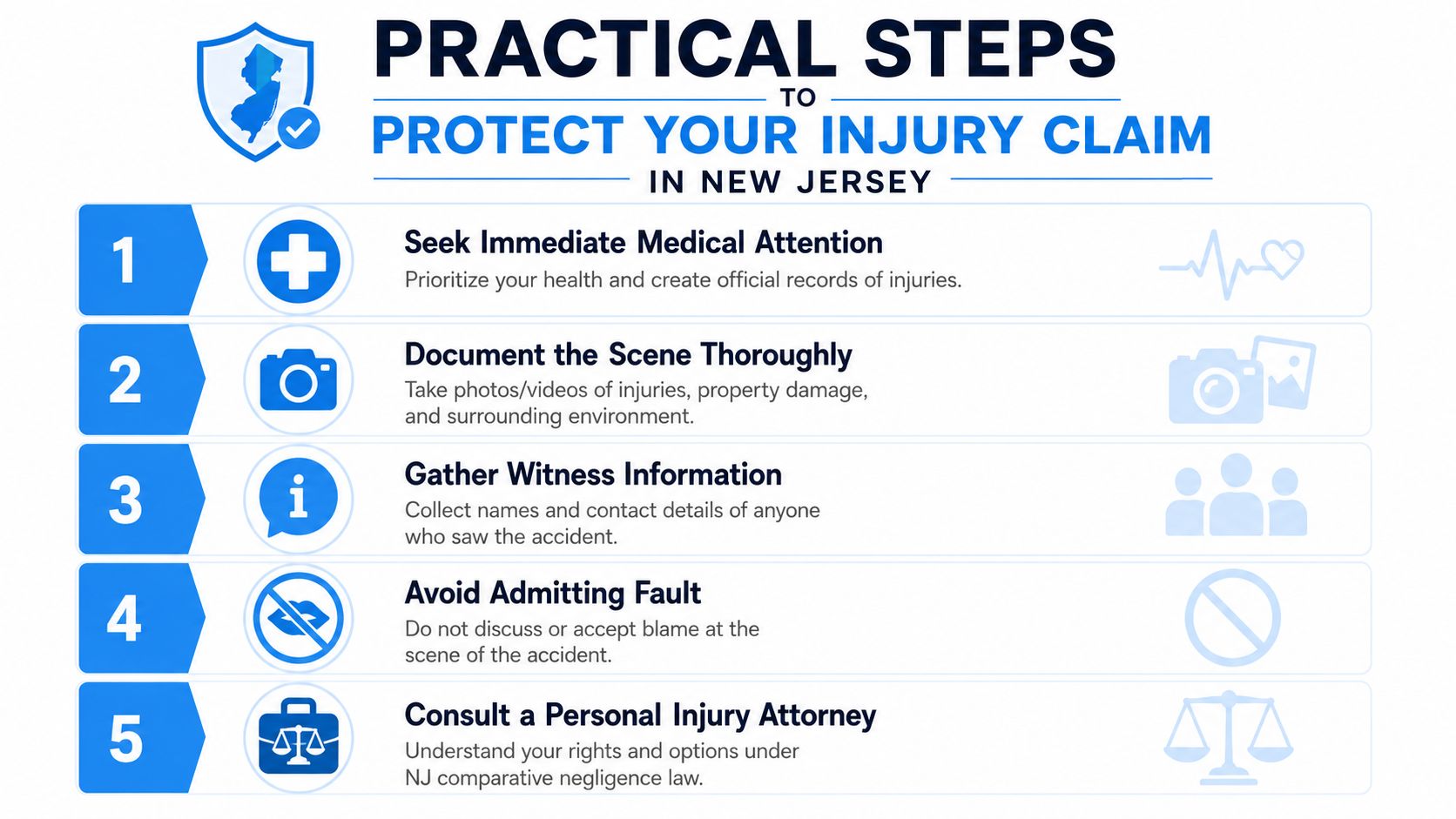
Practical Steps to Protect Your Injury Claim in New Jersey
What you do in the first hours and weeks after an accident can affect how fault gets framed later. If the defense is looking for ways to assign blame, your goal is to preserve facts before they disappear.
What to do right away
- Get medical care promptly. Your health comes first, but treatment also creates records that tie the injury to the event. If pain develops later, say so clearly at follow-up visits.
- Photograph the full scene. Don't just take one close-up. Capture the wider area, lighting, floor conditions, warning signs, vehicles, equipment, debris, weather, and anything else that may explain how the incident happened.
- Identify witnesses early. Neutral witnesses can matter more than either party's version of events.
- Preserve physical evidence. Damaged gear, shoes, tools, helmets, clothing, and product packaging may become important.
- Learn the legal basics before speaking broadly. A practical primer on New Jersey personal injury law can help you avoid preventable mistakes.
What not to do
Some of the worst damage to a claim comes from ordinary, well-meaning behavior.
- Don't admit fault at the scene. You may not yet know what caused the accident.
- Don't give a polished theory too early. Stick to direct facts. Time, place, sequence, injury, and what you observed.
- Don't post casually online. Photos, comments, and jokes can be taken out of context.
- Don't ignore ongoing symptoms. If pain changes, spreads, or lingers, document it and follow up.
Why treatment records matter in fault disputes
In shared-fault cases, the defense doesn't only argue about how the event happened. They may also argue about whether your injuries were caused by the event at all, or whether your limitations are overstated. Clear treatment records help answer that.
For people dealing with ongoing pain after a crash, fall, or work injury, it can help to understand the range of interventional pain conditions that physicians evaluate and treat, because persistent symptoms often need structured follow-up rather than guesswork.
The best evidence is usually the evidence collected before anyone knows a lawsuit is coming.
New Jersey Comparative Negligence FAQs
What if the other driver or property owner lies about what happened
It happens in car crashes, slip and falls, and job site cases. A confident story does not win by itself. The case usually turns on what can be checked later: photos, video, witness accounts, damage patterns, incident reports, and medical records created close in time to the event.
In premises and construction cases, the dispute is often less obvious than in a rear-end collision. The fight may be over lighting, warnings, maintenance, footwear, debris, equipment placement, or whether a hazard existed long enough for someone to fix it. Those details matter because they often expose whether the other side's version holds up.
What if I was a passenger and both drivers were at fault
That is a common multi-party claim. A passenger can pursue damages even when both drivers share blame, and the larger dispute is often about how fault should be divided between them.
Sometimes the defense also looks at the passenger's conduct. Seat belt use, where the passenger was positioned, or whether the passenger distracted the driver can become part of the argument, depending on the facts. That does not mean the claim disappears. It means fault may be split across several people instead of pinned on one person.
Does comparative negligence affect my own insurance rates
Usually, that is an insurance and policy issue, not the same question the court or insurers decide in an injury claim. Comparative negligence determines whether you can recover from the people or companies that caused the injury and how much your recovery is reduced by your share of fault.
Your premium is a separate problem. It may be influenced by your carrier's underwriting rules, your policy, and the type of claim involved.
What if one responsible party is out of state or can't be joined
These cases get technical fast. In a fall, construction injury, or product-related claim, one party may own the property, another may manage it, another may have created the hazard, and another may be missing from the lawsuit entirely. The practical questions become whether fault can still be assigned to that absent party, who appears on the verdict sheet, and whether any judgment can be collected.
That is one reason early case framing matters. If the defense can point to an empty chair and blame someone who is not in the case, it can shrink the share assigned to the defendants who are there. In other cases, adding another responsible party strengthens the claim because it spreads fault away from the injured person.
If the defense is overstating your share of blame, or your case involves multiple defendants, a disputed fall, a construction accident, or a non-vehicle injury with overlapping fault issues, Mattiacci Law can evaluate how New Jersey comparative negligence applies to the facts and which evidence is likely to carry the most weight.