


Author: John Mattiacci | Owner Mattiacci Law
Published May 25, 2026

You leave the hospital with more questions than answers. The complication wasn't explained clearly. Your symptoms got worse after treatment, not better. Now you're staring at discharge papers, follow-up instructions, and a growing suspicion that something went wrong.
That's the moment when individuals begin searching for how to find a medical malpractice attorney. They're not looking for slogans. They need someone who can tell the difference between a bad outcome and a legally viable malpractice claim, and they need that answer fast.
The First Step After a Medical Injury
The first mistake injured patients make is assuming every lawyer who advertises malpractice cases is equipped to handle one. These cases are expensive, document-heavy, and medically technical. A lawyer can't just file a complaint and see what happens.

A medical malpractice case often starts the same way. A patient develops a serious complication after surgery, a diagnosis comes too late, or a warning sign gets missed in the chart. The patient knows something feels off, but can't tell whether it was negligence, a known risk, or just poor communication. That uncertainty is normal.
What matters next is action. Start preserving the facts while they're still easy to gather. Request your records. Write down dates, providers, symptoms, medications, and what you were told at each step. If you need help understanding common categories of provider mistakes, this guide to medical error types is a useful starting point.
Why lawyers screen these cases so hard
Law firms screen malpractice claims aggressively for a reason. Preparing and prosecuting one medical negligence case can cost a law firm more than $100,000 to cover discovery, expert reviews, and court costs, according to this medical negligence litigation review. That financial reality means experienced lawyers usually accept only cases with strong records and provable damages.
Practical rule: If a lawyer shows no interest in records, timelines, or damages during the first conversation, that's not a good sign. Serious firms start with the file, not the pitch.
That selectivity can feel personal when you're already overwhelmed. It usually isn't. A declined case doesn't always mean nothing happened. It may mean the records are incomplete, the damages are unclear, or the economics of the case don't support litigation.
Take care of the legal issue and the human one
People dealing with suspected malpractice are often also dealing with fear, sleep disruption, and loss of trust in medical professionals. Legal help matters, but emotional support matters too. If the experience has left you struggling, trauma help from Interactive Counselling may be a useful resource while you sort out the next steps.
Your first job isn't to prove the whole case yourself. It's to put yourself in a position where the right lawyer can evaluate it quickly and accurately.
Where to Begin Your Attorney Search
A good search starts with building a short list, not hiring the first name you see online. The strongest candidates usually come from three channels: bar associations, trusted referrals, and curated legal directories.
Use bar associations to verify basics
Start with the Pennsylvania Bar Association and the New Jersey State Bar Association if your care happened in this region. These organizations can help you confirm whether a lawyer is licensed and in good standing. That doesn't tell you whether the lawyer is trial-ready, but it does clear the first hurdle.
When you review bar listings, look for more than location. Check practice focus, office address, and whether the attorney regularly handles plaintiff-side civil litigation. A general practice lawyer may be capable in some matters, but malpractice claims require a narrower skill set.
Ask for referrals the right way
Referrals can help, but only if you ask precise questions. Don't ask, “Do you know a good lawyer?” Ask, “Do you know a lawyer who routinely handles plaintiff medical malpractice cases and takes them through trial if needed?”
That wording matters. Friends, coworkers, and even other attorneys often recommend someone they like personally, not someone who regularly handles complex malpractice files.
A useful referral source can be:
- Another lawyer you trust who doesn't handle malpractice but knows who does
- A former client who can speak to communication and follow-through
- A physician outside the disputed care chain who understands which firms are respected in litigation
Use directories as a filter, not a final answer
Online directories like Avvo and Super Lawyers can help you identify attorneys who appear to focus on malpractice work. They're useful for making a list. They're not enough to make a hiring decision.
Here's how to use them well:
| Search method | What it helps with | Limitation |
|---|---|---|
| Bar association listings | License and standing | Doesn't show how the lawyer runs cases |
| Personal referrals | Real-world impressions | Can be based on reputation, not results |
| Legal directories | Finds focused practitioners quickly | Profiles can emphasize marketing over process |
A polished profile can get a consultation. It can't substitute for questions about experts, depositions, and trial preparation.
As you search, keep your list short and intentional. Three strong consultations are usually more useful than ten random calls.
Preparing for Your First Consultation
Most first consultations go wrong because the client talks in conclusions instead of facts. “The doctor ruined my life” may be true emotionally, but it doesn't help a lawyer evaluate liability. A better approach is to organize the case before you ever pick up the phone.

What to gather before you call
Bring structure to the story. The lawyer needs a clean timeline and the records that support it.
- Medical records: Request hospital charts, office notes, discharge papers, operative reports, imaging reports, lab results, and prescription information.
- A dated timeline: List when symptoms began, when you sought care, what each provider said, what treatment followed, and what changed afterward.
- Provider names and locations: Include doctors, nurses if known, hospitals, urgent care centers, specialists, and pharmacies.
- Bills and out-of-pocket costs: Gather statements, invoices, and receipts connected to the injury.
- A symptom journal: Note pain, limitations, missed work, new diagnoses, and how daily life changed.
- Questions for the lawyer: Write them down in advance so you don't forget them during the call.
If you need a clearer sense of what the law requires before that meeting, this explanation of how to prove medical negligence can help you frame the issues.
Prepare to screen the lawyer too
The consultation isn't just about whether the firm wants your case. It's also about whether you want that firm. That means you should arrive ready to ask targeted questions.
Most advice tells you to find a lawyer with “experience,” but rarely explains how to verify it. A better screening framework is to ask whether the firm has tried similar cases to a verdict, how it funds expert witnesses, and who specifically will handle depositions, as discussed in this Best Lawyers malpractice guide.
Bring your records in the most organized form you can manage. A labeled folder beats a long emotional retelling every time.
What not to do before the meeting
Some clients unintentionally weaken the first consultation by making it harder for the lawyer to see the case clearly.
Avoid these habits:
- Don't edit the timeline to sound stronger. If there are gaps or prior conditions, include them.
- Don't rely on memory alone. Dates matter.
- Don't assume the worst fact kills the case. Let the lawyer decide what matters legally.
- Don't sign releases or fee agreements on the first call unless you understand them.
A prepared client gets a better evaluation. That doesn't guarantee the lawyer will accept the case, but it does give you a fair shot at a serious review.
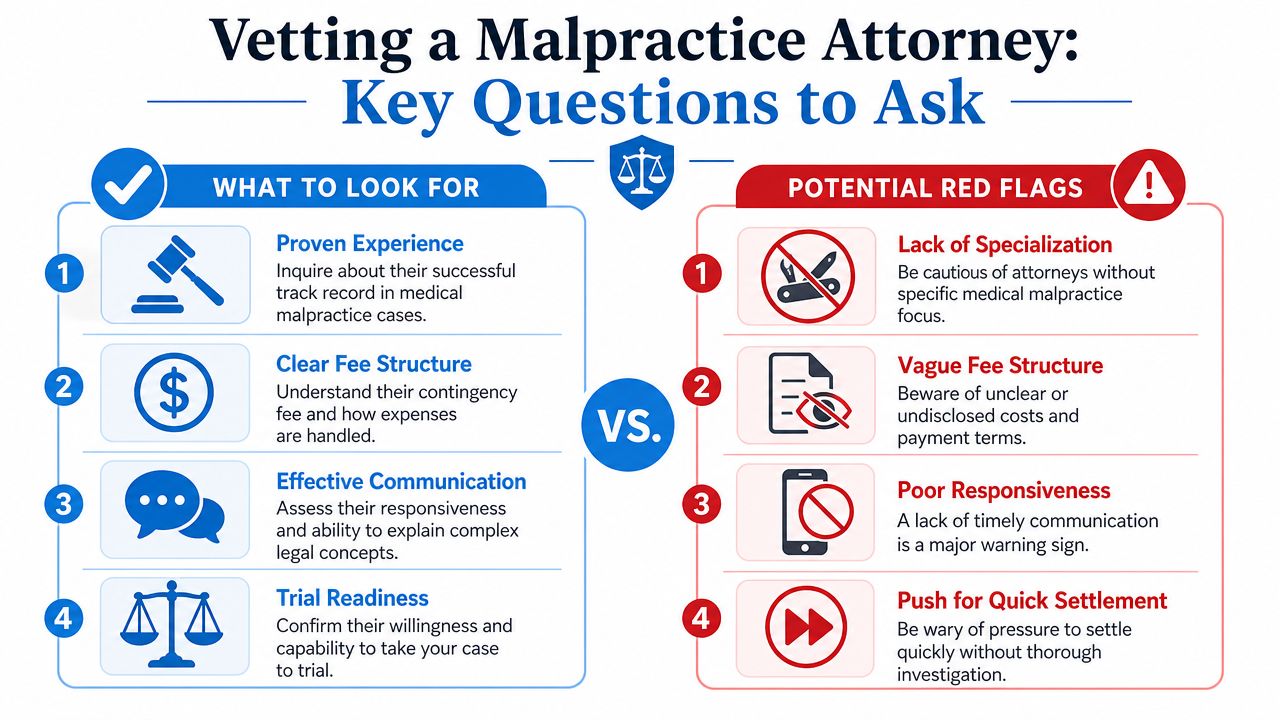
Key Questions to Vet a Malpractice Attorney
A consultation should feel like an interview on both sides. The lawyer is evaluating your case. You should be evaluating whether that lawyer has the discipline, resources, and courtroom readiness to handle it properly.
Ask how they would prove the case
A legitimate malpractice claim must prove four elements: a provider-patient duty existed, the provider breached the standard of care, that breach caused the injury, and the injury resulted in specific damages, as explained in this Super Lawyers overview of malpractice case stages.
A capable lawyer should be able to discuss those elements in your case without hiding behind vague language.
Strong answers sound like this:
- On duty: “That part appears straightforward because this provider was treating you directly.”
- On breach: “The issue may be a delayed response, missed diagnosis, surgical error, or failure to monitor. We'd need records and expert review.”
- On causation: “Even if there was a mistake, we still have to connect it to the injury, not just a bad medical outcome.”
- On damages: “We'd need to document how the injury changed your health, work, or daily life.”
Weak answers are usually generic. If the lawyer says only that the case is “strong” or “worth a lot” before reviewing records, be careful.
Ask about experts, funding, and who does the work
Malpractice cases aren't won by intake staff and advertising copy. They're built by lawyers who know how to investigate medicine, work with experts, and prepare testimony.
Use questions like these:
| Question | Strong answer | Red flag |
|---|---|---|
| Have you handled cases like mine? | Can explain similar fact patterns and legal issues | Talks only about general injury work |
| How do you handle expert review? | Describes a process for identifying and consulting qualified experts | Acts like experts are an afterthought |
| Who will take depositions and manage discovery? | Names the lawyer or team responsible | Says the file will be “handled by the office” |
| Are you prepared to try the case? | Describes a litigation path through trial if needed | Focuses only on quick settlement |
If a lawyer can't tell you who will actually handle your file, you may be meeting the salesperson, not the trial lawyer.
Ask how they communicate when the case slows down
Malpractice litigation can move slowly. That's normal. Silence isn't.
Ask practical questions:
- Who is my point of contact?
- How often will I receive updates?
- Will I hear only when something big happens, or on a regular schedule?
- How quickly do you return calls or messages?
You're not hiring a personality. You're hiring a process. Still, process shows up in how a firm treats you during intake. If calls go unanswered now, don't expect better once the file is open.
Watch for the settlement mill mindset
Some firms sign a high volume of cases and push for early resolution because trying cases is expensive and demanding. That approach may work in simpler claims. It's a poor fit for serious malpractice matters that need full investigation.
A trial-ready lawyer usually asks harder questions. They want records, dates, follow-up care details, and a clear explanation of the harm. That can feel less comforting in the moment, but it's usually a sign the lawyer is evaluating the case seriously.
Decoding Fees Timelines and Red Flags
Most malpractice firms work on a contingency basis. In plain terms, that usually means the lawyer gets paid if there's a recovery. But “no-win, no-fee” doesn't answer every important question.
Read the fee agreement closely
Ask what happens to case expenses. Ask whether expert review, filing costs, records charges, and deposition expenses are advanced by the firm and how they're handled if the case doesn't move forward. A clear answer should be easy to understand in ordinary language.
If the agreement feels rushed, stop. If the numbers or responsibilities aren't clear, ask again. You're allowed to take the contract home and review it before signing.
Deadlines can decide the case before it starts
Timing matters as much as lawyer quality. In some jurisdictions, waiting too long can end the claim before the investigation is complete.
In Texas, claims generally must be filed within two years after completion of medical treatment or hospitalization, and procedural barriers such as damage caps and mandatory expert reports increase the need to contact counsel early, according to this Texas malpractice commentary.
If you're in Pennsylvania, review this guide on the medical malpractice statute of limitations in Pennsylvania as part of your intake preparation. If treatment happened in New Jersey or involved providers across state lines, bring that up immediately during the consultation. Venue and filing rules can matter more than convenience.
The red flags that matter most
Some warning signs are obvious. Others are easy to miss when you're under pressure.
A major red flag is a lawyer who can't clearly describe the litigation process from records collection and expert review through discovery and trial, as discussed in this guide to screening malpractice counsel.
Watch for this short list:
- Pressure to sign immediately: A serious firm should answer questions before asking for commitment.
- Vague discussion of process: If the lawyer can't map the case path, that's a problem.
- No clarity on who handles the file: Intake staff shouldn't be your only contact.
- Disorganization: Lost documents, inconsistent callbacks, and mixed messages during intake usually get worse later.
Good malpractice representation feels methodical. It doesn't feel hurried, fuzzy, or improvised.
Why a Trial-Ready Approach Is Your Advantage
The right malpractice lawyer does more than accept cases. The right lawyer builds them for the hardest version of the fight. That means assuming the defense will challenge liability, causation, damages, and the credibility of your experts from the beginning.

That trial-ready approach changes everything about case handling. The firm gathers records early. It lines up qualified experts instead of waiting for a settlement discussion to stall. It prepares depositions carefully. It also resists the temptation to treat your case like a file to be moved rather than a claim to be proved.
Why this approach screens out weak firms
When you know how to find a medical malpractice attorney, you stop focusing on advertising and start focusing on capacity. Can the lawyer explain the theory of liability? Can the firm finance the work? Can they tell you who will manage discovery, prepare experts, and try the case if necessary?
Those aren't abstract questions. They directly affect the attorney's negotiating power. Insurance carriers and hospital defense teams evaluate the lawyer across the table. They know which firms investigate thoroughly and which firms are built to settle fast.
The strongest position in a malpractice case usually belongs to the client whose lawyer is prepared to keep going.
For patients in Pennsylvania and New Jersey, one option is Mattiacci Law, a Philadelphia-based injury firm that handles medical malpractice matters, offers free consultations, and prepares serious injury cases for litigation. Whether you call that firm or another, the standard should stay the same. Ask hard questions. Expect direct answers. Choose a lawyer whose process matches the stakes of your case.
If you need help evaluating a possible malpractice claim, contact Mattiacci Law for a free consultation. You can discuss what happened, get a clear view of the next steps, and find out whether your case shows the records, damages, and trial-readiness factors that serious medical malpractice litigation requires.