


Author: John Mattiacci | Owner Mattiacci Law
Published April 23, 2026

If you were hurt in a Philadelphia car accident, the standard deadline to file a lawsuit is two years from the date of the crash. But that is only the outside limit, and several much shorter deadlines can damage or even destroy your claim long before those two years run out.
A lot of people reading this are in the same position. You’re trying to get medical care, deal with your car, miss work, answer insurance calls, and figure out whether you even need a lawyer yet. The problem is that accident claims don’t fail only when the two-year lawsuit deadline expires. They also fail earlier when people miss the reporting and notice requirements that seem administrative, but have real consequences.
That’s where people get trapped. They hear “you have two years,” assume they have breathing room, and don’t realize they may need to notify an insurer within 24 to 72 hours, report an injury crash within five days, or send a government notice within six months if a public vehicle or agency is involved. By the time they learn that, the avoidable damage is done.
Your Guide to Philadelphia Car Accident Deadlines
After a crash, individuals often focus on the obvious problems first. Pain. Transportation. Medical bills. Missed paychecks. Deadlines usually feel like a problem for later.
In injury law, that instinct can cost you. The Deadline to File Car Accident Claim in Philly isn’t just one date on a calendar. It’s a series of deadlines, and the shortest one often matters first.
Why the two-year answer is incomplete
The two-year deadline matters because it controls whether you can file a civil lawsuit at all. Miss it, and the court can shut the case down without ever reaching the facts. But before you even get there, other rules can undercut your position.
Some of those rules involve insurance notice. Others involve police or PennDOT reporting. If the crash involved a government vehicle, roadway, or agency, a separate notice rule may apply much sooner than the ordinary lawsuit deadline.
The biggest timing mistake I see is treating the two-year deadline as the only deadline.
What actually protects a claim
What works is acting early enough to preserve options. That means getting medical treatment, reporting the crash properly, documenting what happened, and figuring out right away whether a city, state, or transit entity may be involved.
What doesn’t work is waiting for the insurance company to “finish reviewing things” while the clock keeps running in the background.
Keep one practical idea in mind:
- The lawsuit deadline is the final cutoff: It is not the date you should aim for.
- Short administrative deadlines come first: Missing them can weaken your position or bar certain claims.
- Procedure matters as much as timing: A case can still fail if it isn’t handled correctly after filing.
- Delay hurts proof: Witnesses disappear, memories fade, and records become harder to secure.
If you’re unsure which deadline applies to your crash, assume the shortest one might matter until you confirm otherwise.
Pennsylvania's Two-Year Rule for Car Accident Lawsuits
A crash can happen in one afternoon, and two years later your right to sue can be gone. Under 42 Pa.C.S. § 5524(2), Pennsylvania generally gives an injured person two years from the date of the accident to file a car accident lawsuit.

If a crash were to happen on June 23, 2025, the filing deadline would usually fall on June 23, 2027. Usually is the right word here, because the date the clock starts can become a dispute in some cases, especially if the injury was not immediately obvious. For a closer look at that issue, see this plain-language explanation of when the statute of limitations starts in PA.
What the two-year deadline actually does
This deadline controls your court case, not the entire claims process. It applies to the lawsuit seeking compensation for medical bills, lost income, pain and suffering, and other accident-related losses.
If the complaint is not filed on time, the defense can ask the court to dismiss the case. Courts often grant that request even where fault is clear and the injuries are serious.
I tell clients this plainly. Settlement talks do not stop the clock. Ongoing treatment does not stop the clock. An adjuster saying, "we're still reviewing the claim," does not stop the clock.
Why this rule causes real problems
People hear "two years" and assume they have breathing room. In practice, that assumption causes damage. Waiting six months to see how your injuries develop may feel reasonable, but that delay can leave less time to gather records, locate witnesses, review coverage issues, and identify whether another deadline applies.
That last point matters in Philadelphia cases. The two-year statute of limitations is often treated like the only date that counts, but it is only the final court deadline. A claim can be weakened, and sometimes blocked in part, much earlier by missed notice requirements involving insurance, reporting obligations, or government entities.
A simple way to read the timeline
| Event | Legal effect |
|---|---|
| Crash happens | The two-year lawsuit clock usually starts |
| Insurance claim is opened | The court deadline keeps running |
| Medical treatment continues | The filing deadline usually keeps running |
| Settlement discussions continue | The filing deadline usually keeps running |
| Two years pass without suit | The defense may seek dismissal |
The safe approach is straightforward. Treat the two-year date as the outer limit, then work backward from it as if the shorter deadlines matter first, because many times they do.
Deadlines Shorter Than Two Years You Cannot Ignore
A common Philadelphia case goes like this. Someone knows about the two-year lawsuit deadline, assumes there is time, keeps treating, and waits to deal with paperwork later. Then a shorter notice deadline gets missed, and the fight shifts from the injury itself to whether the claim can still be pursued cleanly.
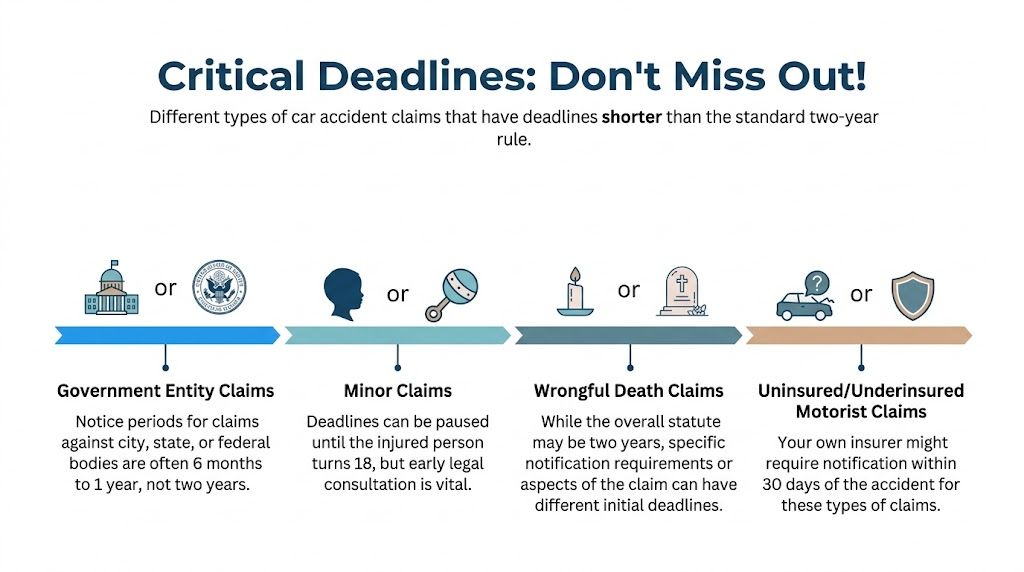
That is the trap. The two-year statute is the court deadline. Several earlier deadlines can affect coverage, proof, and public-entity claims long before a lawsuit would be filed.
Insurance notice can become a problem first
Your auto policy may require prompt notice after the crash. As noted in this Philadelphia accident reporting guide, some insurers set very short reporting windows.
The practical trade-off is straightforward. You do not need to rush into a detailed statement before you know the full extent of your injuries. You do need to put the carrier on notice so it cannot argue later that you waited too long to seek benefits or coverage. That issue comes up often with first-party benefits, uninsured motorist claims, and underinsured motorist claims.
Police reporting affects the proof from day one
Injury crashes also bring reporting obligations. If police are not called to the scene, a delayed report can create a hole in the record that the defense will try to use.
That does not automatically destroy a case. It does make the case harder to prove. The other driver may change the story. Witnesses may disappear. The insurer may question whether the collision caused the injuries you are now treating for. A timely report helps lock down the basic facts before they start drifting.
Government claims run on a much shorter track
If a city vehicle, SEPTA bus, state agency vehicle, or another public entity may be involved, you need to treat the case differently from the start. Pennsylvania law can require written notice well before the standard lawsuit deadline, and the notice rules are technical enough that guessing is risky. This guide to government injury claims and special deadlines in Pennsylvania explains the issue in more detail.
I have seen injured people lose ground here because they did not realize a government body was connected to the crash until months later. Sometimes that is obvious. A SEPTA bus stands out. Sometimes it is not. Road crews, municipal vehicles, and agency ownership questions are easy to miss early on.
If a government entity might be involved, treat that as an urgent issue immediately, not something to revisit after treatment settles down.
What these shorter deadlines really do
These are not minor paperwork dates. Each one protects a different part of the claim.
- Prompt insurance notice: Helps preserve access to policy benefits and reduces late-notice disputes.
- Early police or accident reporting: Creates an official record before memories change and evidence fades.
- Special notice in government cases: Can determine whether part of the claim is barred before the two-year lawsuit deadline arrives.
- The two-year lawsuit deadline: Still matters, but it is often the last deadline, not the first one that can hurt you.
The practical mistake is waiting for perfect information. Early action usually preserves more options. Delay usually gives the insurance company or the defense another argument they did not have before.
Common Exceptions to the Standard Deadline
There are exceptions to the standard deadline, but people often rely on them too casually. In legal terms, this area is often called tolling, which means the clock is paused or delayed under narrow circumstances.
That sounds helpful. In practice, these exceptions are limited and fact-specific.

Claims involving minors
For injured children, Pennsylvania law pauses the limitations period until the child turns 18 under 42 Pa.C.S. § 5533, which means the claim can generally be filed up to age 20, based on the verified Pennsylvania limitations rules provided above.
That does not mean families should wait. Early action still matters because evidence does not pause just because the statute does. Witnesses forget. Records become harder to obtain. Vehicle evidence may be gone. Parents or guardians can often act earlier, and in many cases they should.
The discovery rule
There is also a narrow concept commonly called the discovery rule. In plain English, that applies in unusual situations where a person could not reasonably know about the injury or its cause right away.
Car crashes are usually not the best setting for that argument. In most collision cases, the injured person knows an accident happened and knows they may have been harmed, even if the full medical picture takes time to develop. That’s why this exception should never be treated like a backup plan.
A delayed diagnosis is not automatically the same thing as a delayed deadline.
Why exceptions don’t solve most deadline problems
People often hope there is some legal escape hatch if they waited too long because they were in treatment, dealing with insurance, or unsure whether they wanted to sue. Those facts may be understandable, but they usually do not stop the clock by themselves.
A better way to think about exceptions is this:
| Situation | General effect |
|---|---|
| Minor child injured | The clock is paused until age 18 |
| Injury not reasonably knowable | A narrow discovery argument may exist |
| Ongoing treatment | Usually does not pause the filing deadline |
| Insurance negotiations | Usually does not pause the filing deadline |
If you think an exception might apply, get that analyzed early. The closer you get to any deadline, the less room you have to be wrong.
Filing an Insurance Claim Is Not Filing a Lawsuit
This is one of the most common and most damaging misunderstandings in accident cases. Opening an insurance claim is not the same thing as filing a lawsuit.
An insurance claim is a negotiation with a company. A lawsuit is a formal court action. Those are different tracks, and only one of them protects your court deadline.
Why people get lulled into waiting
Insurance adjusters often stay in contact, ask for records, discuss treatment, and say the claim is under review. To an injured person, that can feel like progress. It often feels like the case is active, so there must still be time.
But insurance communications do not replace filing suit. The legal deadline keeps moving whether the adjuster is responsive, slow, polite, or silent.
What works and what does not
What works is treating insurance discussions as one part of the claim, not the thing that preserves the claim. If the case needs to be filed, it needs to be filed on time regardless of how settlement talks are going.
What doesn’t work is assuming the insurer will warn you before your deadline gets close. That is not their job. Their interests are not the same as yours.
Here is the clean distinction:
- Insurance claim: A request for payment or benefits through an insurer.
- Lawsuit: A complaint filed in court to enforce legal rights.
- Settlement talks: Can continue for a while, but they do not stop the court clock.
- Bargaining power: Drops sharply if the filing deadline passes before suit is filed.
Friendly adjuster communication is not legal protection.
If you remember only one thing from this section, make it this: you can have an open insurance claim and still lose your right to sue if the lawsuit is not filed on time.
Steps to Preserve Your Car Accident Claim
A common mistake in Philadelphia crashes looks like this: the injured driver gets treatment, speaks with the insurance adjuster, waits for the police paperwork, and assumes the primary legal pressure starts sometime before the two-year lawsuit deadline. By then, a shorter notice requirement, a reporting delay, or a filing problem may already have damaged the case.
The safest approach is to protect the claim on several tracks at once. Health comes first, but proof and deadlines need attention right away because some of the shortest deadlines arrive while you are still dealing with pain, repairs, and missed work.
Act early on the records that disappear first
Start medical treatment as soon as you can and follow through. Gaps in care give the insurance company room to argue that you were not badly hurt or that something else caused your symptoms.
Get the crash reported through the channels that apply to your case. That can include police, your own insurer, and, in some cases, a government agency if a city vehicle, SEPTA vehicle, or dangerous road condition is involved. For a local breakdown of reporting timing, see when to report a car accident in Philadelphia.
Then preserve the evidence people often lose in the first week. Save photos, witness names, vehicle information, tow records, discharge papers, prescriptions, repair estimates, dashcam footage, and text or email messages about the crash. Write out a simple timeline while the details are still fresh.
If you received a citation and want to understand it before speaking with counsel, PDF AI’s AI legal traffic ticket analyzer can help you review the document in plain language. It does not replace legal advice, but it can help you sort your paperwork and spot questions to raise.
Filing on time is only part of the job
A case can still run into trouble after the complaint is filed if the paperwork, parties, or service steps are mishandled. Pennsylvania service rules are set out in Pa.R.C.P. 401. Waiting until the deadline is close leaves very little room to correct a wrong defendant name, a bad address, or a service problem before the defense asks the court to dismiss the case.
That is one of the trade-offs I discuss with clients. Waiting can feel easier when treatment is ongoing and settlement talks are active. In practice, delay usually gives you less control, not more.
Get legal guidance before the short deadlines box you in
You do not need to know every rule before you ask for help. You do need to recognize when the case may involve more than the standard two-year lawsuit deadline.
That is especially true if the crash involved a government vehicle, a road hazard, a disputed insurance issue, or serious injuries that may require identifying every potentially responsible party early. Mattiacci Law handles Philadelphia vehicle crash cases and related injury claims.
The goal is simple. Preserve the evidence, meet the shorter notice and reporting deadlines, and leave enough time to file and serve the lawsuit correctly if settlement does not happen.