


Author: John Mattiacci | Owner Mattiacci Law
Published April 28, 2026
You may be reading this a few hours after a crash on Broad Street, Roosevelt Boulevard, I-95, or a neighborhood side street. No officer came. The other driver said it was “just a minor accident.” Now your neck is stiff, your bumper is hanging loose, and the insurance company is asking questions you aren't ready to answer.
That situation is common in Philadelphia. It also creates a dangerous misunderstanding. People assume that if there’s no police report, there’s no real claim. That isn’t true. A missing report changes the job. It means you have to build the record yourself, and you have to do it carefully.
In a No Police Report After Car Accident in Philadelphia case, the strongest claims come from people who stop treating the crash like an inconvenience and start treating it like an evidence problem. Photos, witness details, medical records, surveillance footage, and a clean timeline can do much of the work an officer’s report usually helps with. What matters is speed, accuracy, and avoiding mistakes that give the insurer room to argue.
Why There Is No Police Report For Your Philly Crash
A lot of drivers feel blindsided by this. You call the police after a collision, wait, and then learn no one is coming. Or both drivers pull over, look at the damage, and decide to exchange information because it seems minor. Later, once pain sets in or the other driver changes their story, the missing report suddenly feels like a major problem.
In Philadelphia, that problem often starts with policy, not with anything you did wrong. Since May 3, 2010, the Philadelphia Police Department has followed a policy of not responding to minor car accidents when there are no initial injuries, no death, and no vehicle requiring towing. Those crashes are treated as non-reportable crashes, and no police investigation happens even if someone asks for one, according to this Philadelphia accident reporting explanation.
Philadelphia has a heavy crash volume. The same source notes that the city sees over 10,000 car accidents annually, with more than 63% resulting in injury or death. In that environment, police resources are directed toward crashes that appear more serious at the outset.
What non-reportable really means
“Non-reportable” does not mean unimportant. It means the police may not create the neutral, on-scene record that drivers and insurers prefer.
That missing record matters because a police report usually helps organize the basics:
- Who was involved
- Where the vehicles ended up
- What damage was visible
- Whether anyone complained of injury
- Whether a witness spoke to an officer
Without that structure, the insurance carrier has more room to challenge your version of events.
A no-response crash is still a real crash. The difference is that you have to preserve the proof yourself.
If you're unsure whether your collision should have been reported differently, this guide on when to report a car accident in Philadelphia is a useful starting point.
The practical takeaway
The absence of a police report doesn't end your claim. It changes what will carry the claim. Your evidence package has to do the work that an officer’s report did not do. That starts at the scene, or as close to the scene as possible.
Your Immediate On-Scene Documentation Checklist
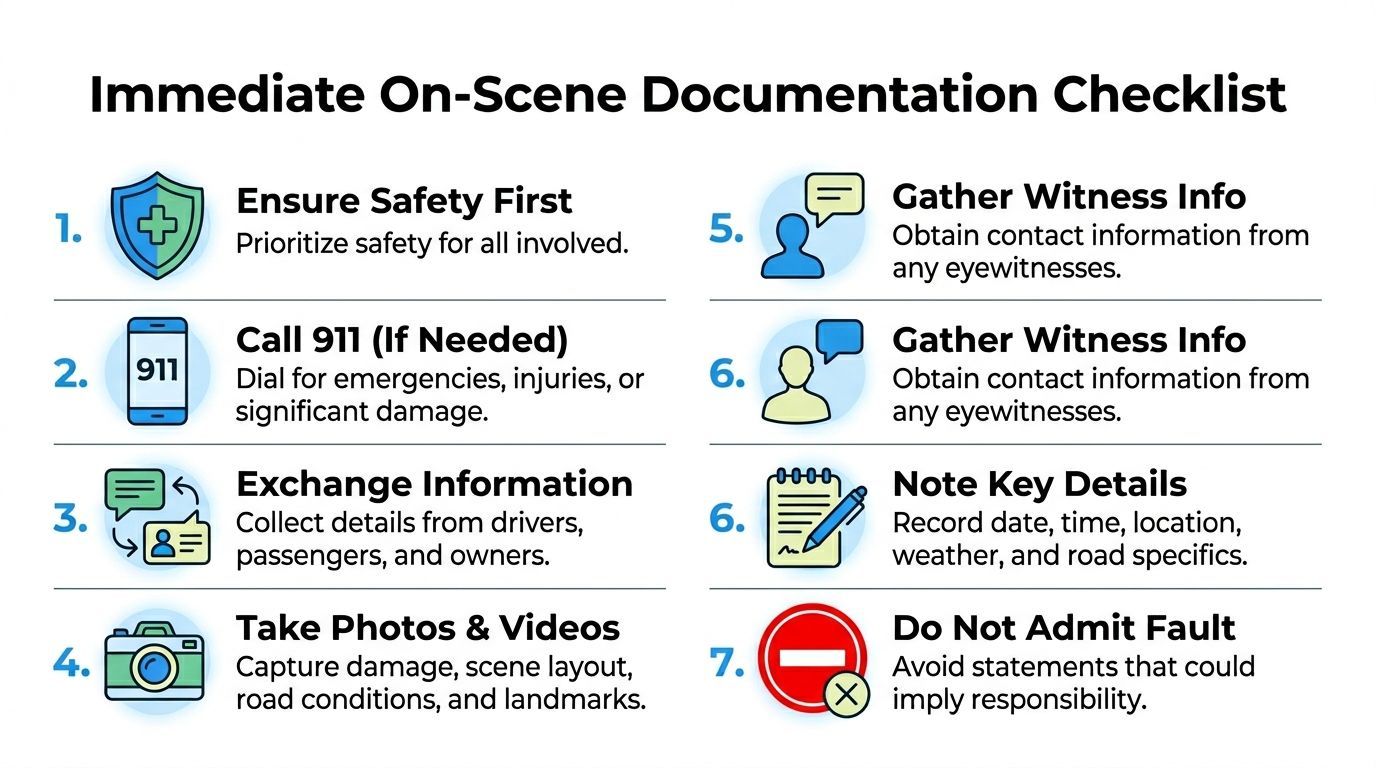
When police don't create the file, you need to start building it before the cars leave the roadway. Think like your own investigator. Every photo, contact detail, and note becomes part of the unofficial report you may rely on later.
What to collect before anyone drives away
Start with the other driver’s identity and insurance information. Don't settle for a first name and a phone number. Get the driver’s license information, insurance card details, license plate, and the make and model of the vehicle. If the person driving is not the owner, note that too.
Practical rule: If you leave the scene without names, policy information, photos, and location details, you create a gap the insurer will try to use later.
Then photograph more than just the dent. Individuals often take one close-up shot of the bumper and think they're done. That won't tell the whole story. Take wide shots showing where the vehicles were, the lane markings, nearby intersections, traffic lights, signs, parked cars, debris, and anything affecting visibility or movement.
Use your phone as if you may need to explain the crash to a stranger months from now.
- Damage photos: Capture each corner of both vehicles, not just your own.
- Context shots: Include the roadway, cross streets, signals, potholes, or obstructions.
- Identifiers: Photograph the license plates and, if possible, the insurance card.
- Scene conditions: Note weather, lighting, and traffic flow.
Witnesses matter more than people realize
If anyone saw the crash, get their name and contact information before they disappear. Witnesses rarely become easier to find later. A quick note in your phone with “man in blue jacket at corner store saw impact” is better than trusting your memory.
You should also make your own notes while the sequence is fresh. Record the time, exact location, direction of travel, what signal or sign controlled the intersection, and anything the other driver said. If they apologized or admitted they didn't see you, don't argue. Just write it down privately.
A practical step-by-step guide on what to do after a crash in Philadelphia can help if you're working through the immediate aftermath.
What not to do at the scene
Some mistakes weaken claims fast.
| Situation | Better move |
|---|---|
| You feel shaken but think you're “probably fine” | Say only what you know. If you feel pain, dizziness, or discomfort, report it |
| The other driver wants to “handle it off the books” | Exchange full information anyway and document the scene |
| You feel bad and want to apologize | Don't discuss fault |
| You're in a hurry and want to leave | Finish gathering evidence first |
The goal isn't to win an argument at the roadside. The goal is to leave with a usable record.
How to File a Belated Accident Report in Philadelphia
A late report can still help, especially if pain appeared after the crash or the other driver stopped cooperating. But in Philadelphia, this process is more inconvenient than many people expect.
Pennsylvania law provides a 5-day grace period to submit an incident report to local law enforcement if it wasn't reported immediately. In Philadelphia, however, the policy requires in-person filing at a police district, and the process can involve 1 to 2 weeks of delay. The same source notes that insurers may undervalue claims without reports by up to 40%, which is why waiting too long can hurt you, according to this explanation of filing a claim without a police report in Philly.
What to bring with you
Go prepared. If you walk in with only a rough memory and no documents, the late report will be thinner than it needs to be.
Bring:
- Your identification
- Insurance information
- The other driver’s information
- Photos from the scene
- Any witness names and phone numbers
- Medical paperwork if symptoms have already started
- A written summary of what happened
That written summary matters. People forget the order of events quickly. A simple page with the date, time, location, direction of travel, and impact description helps you stay consistent.
A belated report is usually better than no official record at all. It just won't replace an on-scene investigation.
What a late report can and cannot do
A late report can create a paper trail showing that you reported the crash and identified injuries or damage after the fact. That can help when the insurer later suggests the incident was too minor to matter.
It cannot recreate the officer’s real-time observations. The vehicles are gone. The debris is gone. Witnesses are gone. The officer isn't documenting the scene as it existed minutes after impact.
That difference is why I tell people to treat a late report as one piece of the file, not the whole file.
Don’t wait for the report before acting
One of the worst delays I see is this: the injured driver thinks, “I’ll file the report and then deal with everything else.” That's backwards. While the late report is pending, continue building the claim.
Do these things immediately:
- Notify your insurer that a crash happened
- Seek medical evaluation if anything hurts
- Save repair estimates and photos
- Preserve witness information
- Identify nearby businesses, homes, buses, or intersections that may have cameras
A pending report should never become a reason to pause the rest of your evidence work.
Building Your Case With Unofficial Evidence
The strongest no-report claims don't rely on one dramatic piece of proof. They rely on a clean package of smaller evidence that fits together. That package should show how the crash happened, who likely caused it, what injuries followed, and why the claim is credible.
One of the most overlooked tools in Philadelphia is video. Recent data shows over 1,200 new city cameras installed since 2024, along with upgraded SEPTA systems. That footage is often accessible through a preservation letter within 72 hours, and it could help reconstruct fault in 35% more no-report cases. The same source states that attorney-secured footage has been shown to boost settlement values by 25-30%, according to this discussion of missing police reports and camera evidence.
Video disappears quickly
The first question after a no-report crash should often be: who might have recorded this?
Look around for:
- Corner stores
- Banks
- Apartment buildings
- Parking lots
- SEPTA vehicles or stations
- Traffic cameras near major intersections
- Private homes with doorbell cameras
It's often assumed video will still be there when it's needed. Often it won't. Systems overwrite footage. Businesses don't keep it forever. If there's any chance a nearby camera caught the collision or the seconds before it, act fast.
If a camera may have seen the crash, preserve first and sort it out later.
Witness statements and recordings
A witness who says, “I saw the whole thing,” can help. A witness whose account is written down or recorded promptly can help much more. Ask witnesses for a short summary by text or email if they're willing. Even a basic message confirming what lane each vehicle was in can matter.
If you're thinking about recording conversations, understand the privacy rules first. Pennsylvania recording issues can get complicated, and a plain-English resource like Typist's recording privacy guide is worth reviewing before you hit record on a phone call or in-person exchange.
Medical records are part of liability proof
People often think medical treatment is only about damages. In no-report cases, it also helps prove timing and credibility. If you were hit and started feeling neck, back, shoulder, wrist, or head symptoms afterward, get checked promptly and describe the cause accurately.
Tell the provider:
- That you were in a car accident
- When it happened
- Where you feel pain
- Whether symptoms started immediately or later that day
That history creates a link the insurer will study closely.
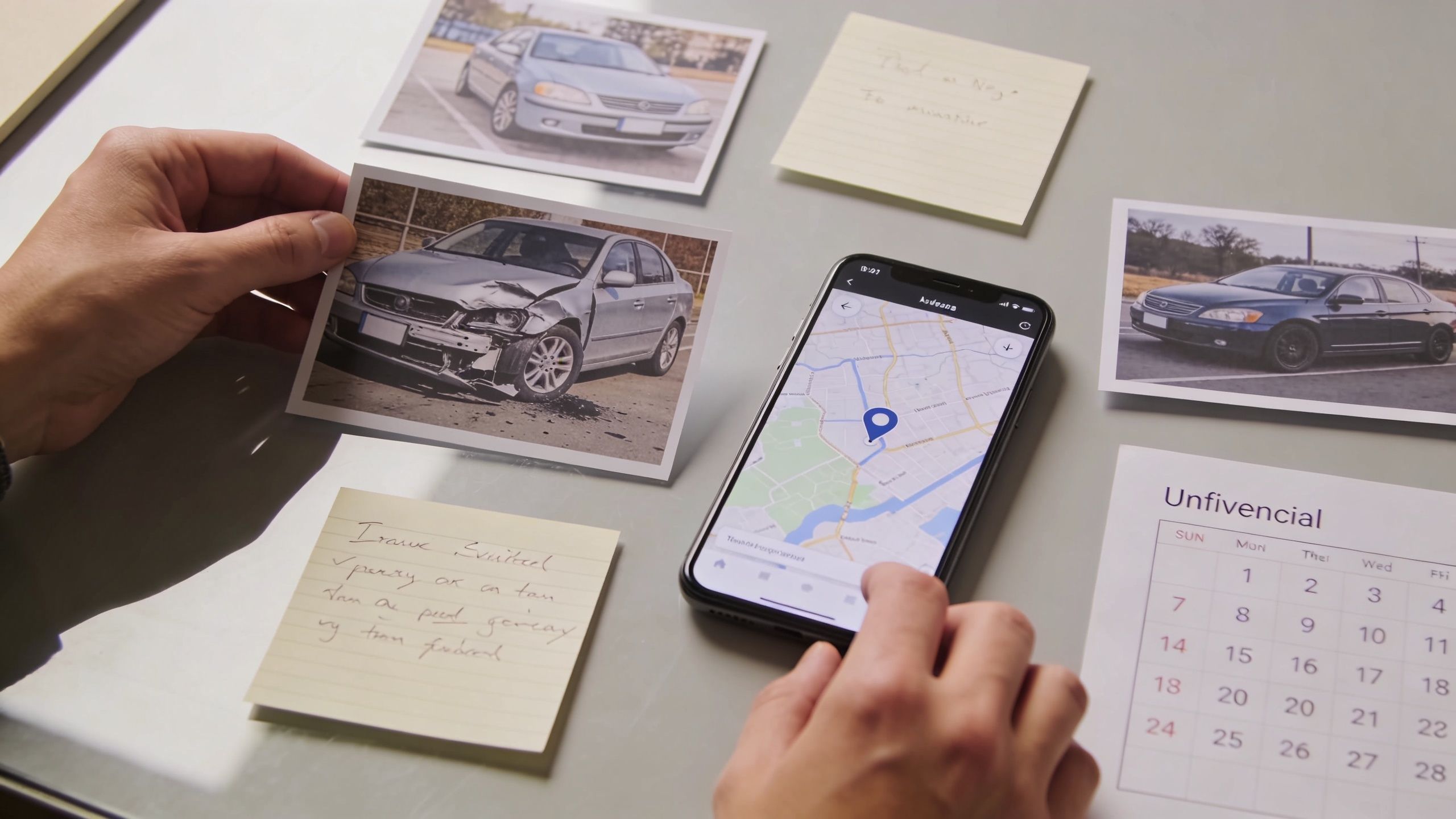
Building the dossier
An unofficial evidence package should be organized, not just collected. Keep everything in one place.
| Evidence type | Why it matters |
|---|---|
| Scene photos and video | Shows damage, roadway context, and vehicle positions |
| Witness details | Supports your version without relying only on your word |
| Surveillance preservation efforts | Can capture the collision or surrounding events |
| Medical records | Connects symptoms to the crash |
| Repair documents | Helps show force and impact location |
Mattiacci Law is one option for handling this kind of file development when a case needs scene reconstruction, witness development, or fast preservation work. Whether you use a lawyer or not, the principle stays the same. Build an evidence package that reads like a report, even if the police never wrote one.
Handling the Insurance Claim Under Pennsylvania Law
Once the scene is over and the evidence starts coming together, the insurance fight begins. This is where many valid claims lose value. Not because the crash didn't happen, but because the carrier sees a missing police report and decides the case is easier to challenge.

In Pennsylvania, no-report claims are often harder to negotiate because fault is less organized from the start. According to this Pennsylvania no-police-report claim analysis, claims in no-report cases are often undervalued by 28% on average. The same source notes that proving fault without a police citation can be challenging, especially where insurers contest crashes involving distracted driving, which is linked to 629 crashes per year in Philadelphia, and that delaying medical treatment for more than 7 days can lead to a 40% rate of causation denial from insurers.
How comparative negligence affects your claim
Pennsylvania follows a modified comparative negligence rule. In practical terms, that means fault can be divided. If the insurer can push part of the blame onto you, it may try to reduce what it pays.
Without a police report, adjusters often argue:
- You changed lanes unsafely
- You stopped short
- You failed to see the other car
- The damage doesn't match the story
- Your injury complaints appeared too late
Your evidence package is the answer to those arguments. Good photographs, a consistent timeline, prompt treatment, and witness support give the adjuster fewer openings.
What to say to the adjuster
You should report the crash. You should not treat the adjuster like a counselor, a friend, or a neutral investigator.
Keep the first conversation tight:
- State the date, time, and location
- Identify the vehicles involved
- Confirm that injuries and damages are still being evaluated
- Do not guess about speed or distance
- Do not agree to a recorded statement without thinking through the consequences
- Do not say you’re “fine” if you are still developing symptoms
The more uncertain the case facts are, the more disciplined your communication needs to be.
If you're dealing with this issue directly, this guide on whether you can file a claim without a police report in Philly gives additional context about how insurers approach these claims.
What works and what doesn't
A clean comparison helps.
| What works | What doesn't |
|---|---|
| Prompt notice to the insurer | Waiting and hoping the other driver stays cooperative |
| Photos, witness info, and medical records | A verbal account with no supporting documents |
| Careful, factual communication | Speculation, apologies, or casual recorded statements |
| Early medical evaluation | Waiting more than a week to see if pain fades |
The trade-off in no-report claims is real. You can still recover. But you don't get the benefit of a built-in neutral narrative. You have to create a stronger file to compensate for that missing piece.
When You Absolutely Need a Car Accident Attorney
Some no-report crashes can be handled directly with the insurer. Others become risky fast. The line usually appears when liability is disputed, injuries are developing, or the carrier starts treating the claim like a credibility contest.
You should strongly consider getting legal help if any of these red flags are present:
- You have any physical symptoms, even if they seemed minor at first
- The other driver denies fault or stopped responding
- There may be surveillance footage that needs immediate preservation
- The insurer wants a recorded statement early
- The adjuster is delaying, minimizing, or making a quick low offer
- A commercial vehicle, SEPTA vehicle, motorcycle, or multiple cars were involved
Why timing matters
In these cases, a lawyer isn't just “for court.” A lawyer can help shape the evidence before it disappears. That may include preserving video, organizing witness accounts, coordinating records, and presenting the claim in a form the insurer has to take seriously.
This is also where law firm intake matters more than people think. If you're trying to understand how serious firms route urgent cases, the role of an intake specialist is a useful example. The first conversation often determines how quickly evidence gets preserved and whether the matter is treated as routine or urgent.
The practical dividing line
If your case involves only property damage and the facts are undisputed, you may be able to manage it yourself. If there is injury, disagreement, delay, missing information, or disappearing evidence, self-handling gets much harder.
A missing police report doesn't make a lawyer mandatory in every case. It does make professional help more valuable when the claim starts to slip.
Frequently Asked Questions
What if the other driver refused to give me information?
Try to get the license plate, vehicle description, location, and photos immediately. If anyone saw the refusal, get their contact details. Notify your insurer right away and write down exactly what happened while it's still fresh. If you later develop injuries, seek medical care promptly and preserve every detail you do have.
I felt okay at the scene, but pain started later. What should I do?
Get evaluated as soon as possible and tell the provider the symptoms started after the crash. Delayed pain is common. The mistake is not the delayed pain. The mistake is ignoring it and creating a gap in the medical timeline.
Does a late police report still help?
Yes, it can help create an official record after the fact. But it usually won't carry the same weight as an officer’s on-scene investigation. Treat it as one supporting piece, not as the entire solution.
What if the insurance company says there’s no proof because there was no report?
That’s exactly why your photos, witness information, repair records, medical records, and any preserved video matter. No police report doesn't mean no proof. It means proof has to come from somewhere else.
Does Full Tort or Limited Tort matter if there was no police report?
Yes. Your tort election can affect what damages you may pursue, separate from the reporting issue. The missing report doesn't erase your policy choice. If there’s an injury claim and you're unsure how your coverage affects it, get the policy reviewed early before you rely on assumptions.
Should I repair my car right away?
Photograph it thoroughly first. Save repair estimates, invoices, and any notes about hidden damage. If repairs begin before the damage is documented, you may lose useful evidence about point of impact and severity.
If you were hurt in a crash and no officer came, don't assume you’re out of options. A missing police report can be worked around, but only if the evidence gets built quickly and correctly. Mattiacci Law handles injury cases in Philadelphia and can evaluate whether your no-report accident has the proof needed to move forward.