


Author: John Mattiacci | Owner Mattiacci Law
Published May 28, 2026
Losing a wrongful death lawsuit usually means your family receives no compensation from that case, but it does not automatically mean you owe the defendant's attorney's fees. You may, however, still be responsible for court costs and case expenses depending on your fee agreement and the rules in the state where the case was filed.
If you're reading this after a defense verdict, you're probably dealing with two shocks at once. The first is emotional. You went through depositions, medical records, expert review, trial prep, and then sat in a courtroom hoping a jury would finally recognize what happened. The second is practical. You're now asking what the loss means for your finances, whether the case is over, and whether anyone can still come after you for money.
Those are the right questions. Families are often told what a wrongful death case can recover if it succeeds. They're told far less about what happens if you lose a wrongful death lawsuit, especially in terms of hidden costs, post-trial exposure, and the differences between Pennsylvania and New Jersey.
Understanding the Verdict and What It Means
The jury comes back after days, sometimes weeks, of testimony. Your family has relived the death in public, heard the defense challenge your evidence, and then the verdict goes against you. The court has made a legal decision. It has not erased the loss, and it has not said your loved one's life mattered less.
A wrongful death case is a civil claim. A defense verdict usually means the court found the plaintiff did not prove the required elements of that claim under the civil burden of proof. That is a narrower conclusion than many families hear in the moment. It does not create criminal liability for anyone, and it does not amount to a finding that nothing wrong happened. It means the evidence presented at trial did not persuade the judge or jury enough to impose civil responsibility on the defendant.
That distinction matters after trial because families often leave with two different questions tangled together. One is emotional: “Did the court just say this death was acceptable?” The other is legal: “What exactly did we fail to prove?” Those questions deserve separate answers.
What a civil loss usually means in practice
In my experience, a wrongful death plaintiff usually loses for one of a few concrete reasons:
- Liability was disputed successfully. The jury may have decided the defendant did not breach a legal duty.
- Causation was too contested. The defense may have persuaded the jury that the alleged conduct was not the legal cause of death.
- The proof was incomplete or less convincing than it needed to be. That often happens in medically complex cases, delayed-death cases, or cases with competing experts.
- The verdict form never reached damages. In many trials, once liability fails, the jury never decides what the family's losses were worth.
Families also need to know what claim lost. A wrongful death claim and a survival action are related, but they are not the same. One focuses on the family's losses from the death. The other can focus on claims tied to the decedent's estate. If you need a clear breakdown, this explanation of a wrongful death claim vs survival action is a good starting point.
That difference becomes especially important in Pennsylvania and New Jersey, where the available claims, allowable damages, and procedural posture of the case can shape what the verdict resolved and what issues may still remain.
Some losses are built long before trial. Cause of death, timing of treatment, preexisting conditions, and the quality of the medical proof often decide these cases before a jury ever enters deliberations. In disputed-death cases, early investigation can matter as much as courtroom presentation. Families still trying to understand the medical proof side of a case may find resources on understanding wrongful death autopsy options helpful, especially where the official findings are incomplete or contested.
A defense verdict means the legal proof fell short on the claims submitted to the court. It does not mean the death was insignificant, and it does not answer every moral question a family is left carrying.
That is why the verdict itself is only part of the picture. The practical meaning of the loss also depends on what claims were dismissed, what post-trial motions are still available, and what financial exposure may follow.
The Financial Reality of a Lost Lawsuit
The hardest financial truth is simple. If you lose, there is no damages award coming from the defendant on that wrongful death claim. But that is only the first layer of the financial picture.
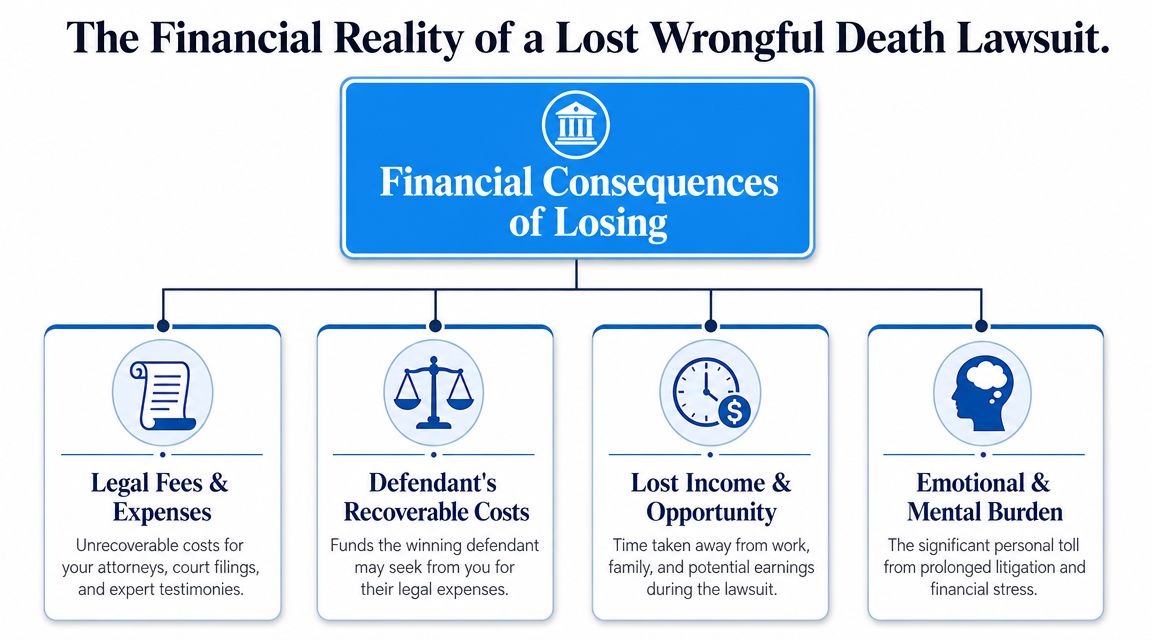
The second layer is better than many families fear. In major U.S. wrongful-death litigation, losing at trial usually means the family receives no damages award for the death claim, but it does not automatically mean they owe the defendant's attorney fees. Many contingency-fee firms advance filing, expert, and investigation costs, and if the case fails those out-of-pocket expenses may still be owed depending on the retainer agreement. Some courts also allow the prevailing party to recover ordinary court costs, as discussed in this analysis of what happens if you lose a wrongful death lawsuit.
Three different buckets of financial exposure
Families often lump every expense together. That causes confusion after a verdict. In practice, you need to separate the categories.
The verdict itself
No plaintiff's verdict means no money is paid to the family for the death claim.Attorney time under a contingency agreement
Most firms handling serious wrongful death cases work on contingency. That usually means you don't pay a fee for the lawyer's time if the case is unsuccessful.Case costs and litigation expenses
Costs can be unexpected. These are the out-of-pocket expenses paid during the case to build it and try it.
What counts as case costs
Wrongful death litigation is expensive because proving liability and damages often requires technical evidence. Depending on the facts, costs can include:
- Expert witnesses: Physicians, economists, engineers, pathologists, or accident reconstruction professionals.
- Depositions: Court reporters, transcripts, videographers, and travel.
- Investigation: Scene inspections, record collection, and document review.
- Court expenses: Filing fees, subpoena costs, and trial exhibits.
These expenses are often advanced by the law firm so the case can move forward. But advanced does not always mean forgiven. The answer depends on the retainer agreement you signed.
Practical rule: Ask for the fee agreement and a current case-cost ledger before you decide whether to appeal, negotiate, or close the file.
Why families are caught off guard
A lot of clients understand “no win, no fee” to mean “no bill at all.” Sometimes that's true. Sometimes it isn't. The language in the contract matters. Some firms absorb costs in a loss. Others reserve the right to seek reimbursement for advanced expenses.
That's also why post-trial money issues can affect estate planning and household finances. If the family is already dealing with debts, probate questions, or final expenses, broad background information about debt after death can help frame what obligations belong to the estate and what may not.
How Defendants Can Pursue Costs and Sanctions
Most families focus on what they owe their own lawyer after a loss. A separate issue is whether the defendant can ask the court to make the plaintiff pay certain amounts after winning.
That risk is real, although it's often more limited than people fear. The overlooked problem in wrongful death litigation is the financial exposure beyond the verdict itself, including the possibility that the plaintiff may be responsible for the other side's taxable court costs, expert fees, or appeal-related expenses in some situations. That gap matters because these cases often require experts and complex proof, as noted in this discussion of how a Colorado wrongful death suit works.

Taxable court costs are the first place to look
A prevailing defendant may file a post-trial request for taxable costs. Those are not the same thing as every dollar the defense spent litigating the case. Courts usually distinguish between ordinary recoverable litigation costs and broader attorney work that each side normally bears on its own.
Typical areas of dispute include:
- Filing-related charges: Fees tied to court process
- Transcript and deposition costs: Sometimes recoverable if reasonably necessary
- Witness-related expenses: More limited and rule-dependent
- Service and copying charges: Often small individually, but they add up
The important point is this. A family can lose the case, recover nothing, and still receive a post-trial cost application from the winning side.
Sanctions are different, and rarer
Sanctions are not routine. They generally require more than losing alone. Courts reserve sanctions for conduct such as filing claims without legal support, abusing discovery, ignoring court orders, or pursuing litigation in bad faith.
That doesn't mean defendants won't threaten sanctions. They sometimes do. But in a legitimately investigated wrongful death case, a sanctions request is usually a separate fight that turns on conduct, not just outcome.
If the defense talks about “fees” after trial, ask whether they mean ordinary taxable costs, expert-related expenses under a specific rule, or actual sanctions. Those are not the same thing.
Offer-of-judgment pressure can change the math
Some jurisdictions have procedural rules that punish a party who rejects a formal settlement offer and then fails to do better at trial. New Jersey is especially important here, because its offer-of-judgment practice can create serious post-verdict consequences.
That means a bad trial result can become more expensive than “we lost and got nothing.” It can trigger a later fight about whether rejecting a prior offer exposed the plaintiff to additional costs or fee-shifting. Families in Pennsylvania and New Jersey need to have their lawyer walk through every formal offer exchanged during the case, not just the verdict sheet.
Exploring Your Legal Options After the Verdict
After a loss, most families ask whether they can appeal. Sometimes they can. But an appeal is not a second chance to present the case better. It is a request for a higher court to review whether the trial court made a meaningful legal error.
That distinction matters because the window to act is limited. If a family loses at trial, the most consequential technical issue is often finality and timing. The case can still be challenged only through appellate review, and that path is constrained by governing appellate rules. A loss can permanently bar compensation for medical bills, funeral expenses, and lost financial support if the claim is not revived on appeal, as explained in this discussion of what happens after losing a wrongful death lawsuit.
Grounds that may justify further review
A family may have a realistic post-trial path when the issue is legal, not emotional disagreement with the jury. Examples can include:
- Improper admission or exclusion of evidence
- Incorrect jury instructions
- A ruling that blocked key testimony
- Procedural errors that affected fairness
- A verdict that may support a post-trial motion under the governing rules
That review starts with the trial record. The transcript, the judge's rulings, the written motions, and preserved objections matter more than anyone's sense that the jury “got it wrong.”
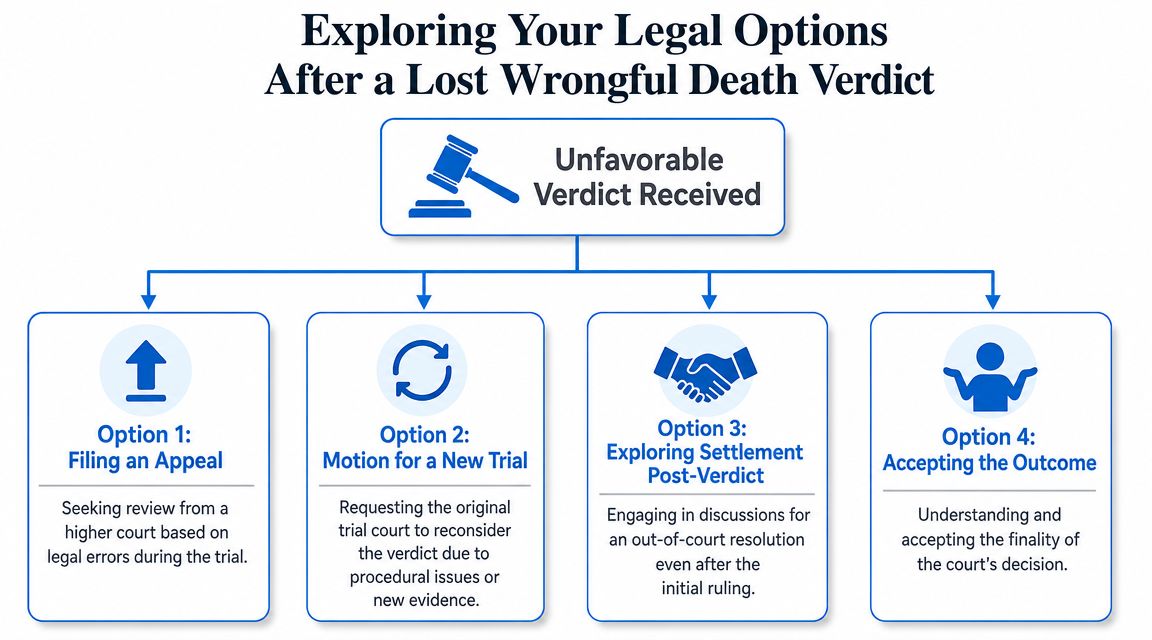
Four practical paths after a defense verdict
File post-trial motions
Trial courts sometimes have authority to revisit specific issues. That might include a motion for a new trial or other relief allowed by local procedure.
Pursue an appeal
This is usually the next level of review if there is a preserved legal issue with real substance.
Explore post-verdict resolution
Some cases still settle after trial, especially if both sides want to avoid the cost and uncertainty of appeal.
Accept the finality of the outcome
This is not surrender. Sometimes it is the most responsible choice once the legal and financial realities are clear.
Deadlines after trial are unforgiving. If you're considering any challenge to the verdict, get the file reviewed immediately.
What doesn't work
What usually doesn't work is appealing because the result feels unfair, because the defense lawyer was aggressive, or because the jury seemed cold. Those reactions are understandable, but appellate courts look for legal error and prejudice, not sympathy.
The first post-trial meeting should answer three questions: Was there a preservable legal issue, what will further review cost, and what is the realistic chance of changing the result?
Pennsylvania vs New Jersey Rules for Lost Cases
Pennsylvania and New Jersey both follow the general rule that a lost civil case can leave the plaintiff with no recovery and some exposure to costs. But the states are not interchangeable. The details matter, especially when evaluating post-trial risk.
For families trying to understand where the case sits in the larger timeline, this guide to the wrongful death statute of limitations in Pennsylvania is helpful background. After a loss, however, the more urgent question is usually not filing the original claim. It's what the rules allow the winning side to seek now.
The practical difference between the two states
Pennsylvania often feels more restrained on routine cost-shifting. New Jersey can become more dangerous when formal settlement procedures were used properly before trial. The most important example is New Jersey's offer-of-judgment framework, which can increase financial exposure after a rejected settlement offer.
That doesn't mean every New Jersey loss produces severe cost consequences. It means families in New Jersey need a sharper post-verdict audit of prior offers, procedural compliance, and what the defense may now demand.
Cost exposure after a lost wrongful death case in PA vs NJ
| Legal Aspect | Pennsylvania Rules | New Jersey Rules |
|---|---|---|
| Basic result after a defense verdict | No recovery on the wrongful death claim, subject to post-trial motion or appeal rules | No recovery on the wrongful death claim, subject to post-trial motion or appeal rules |
| Own lawyer's contingency fee | Usually no attorney fee for lawyer time if the agreement is contingency-based, but case-cost language controls | Usually no attorney fee for lawyer time if the agreement is contingency-based, but case-cost language controls |
| Ordinary court costs | Possible exposure to recoverable court costs under applicable rules and orders | Possible exposure to recoverable court costs under applicable rules and orders |
| Expert-related financial pressure | More limited and heavily rule-dependent | Can become more significant depending on procedural posture and formal offers |
| Offer-of-judgment risk | Not usually the central post-trial cost issue in the same way | Often the biggest danger if a formal offer was rejected and the plaintiff did worse at trial |
| Post-verdict strategy | Review taxable costs, preserved appellate issues, and retainer obligations | Review all of the above plus every formal settlement offer and any fee-shifting implications |
What families in each state should ask immediately
- Pennsylvania families: Ask what specific court costs are recoverable, whether the defense has filed a bill of costs, and what your own retainer says about advanced expenses.
- New Jersey families: Ask those same questions, then ask for every formal offer of judgment exchanged in the case and an analysis of any resulting fee-shifting exposure.
- Both states: Request a written post-trial checklist. You want deadlines, cost categories, and the recommended next move in one place.
The right post-verdict conversation is state-specific. A generic answer is not good enough.
Practical Next Steps for Your Family
The week after a defense verdict is usually the hardest one. Bills start coming in, relatives ask whether you can appeal, and the case that carried so much hope suddenly turns into a stack of deadlines and financial questions. Families do better when they slow the process down and make decisions in the right order.
Start with a focused post-trial conference
Set a meeting with trial counsel promptly and ask for a document-based review, not just a conversation from memory. You need a clear explanation of what happened in court, what deadlines are now running, and what money issues could surface next in Pennsylvania or New Jersey.
Ask for these items before or during that meeting:
- The verdict sheet and any jury interrogatories
- Key trial rulings that may affect post-trial motions or appeal
- A copy of the retainer agreement
- An itemized list of case expenses already advanced
- Any defense filing seeking costs, fees, or sanctions
- A calendar of post-trial and appellate deadlines
That meeting should answer three practical questions. Why did the case fail. What financial exposure exists now. Is there a legally supportable basis to challenge the result.
Separate grief from strategy
Families often want to do something immediately. That instinct is understandable, but it can get expensive fast.
An appeal, a motion for a new trial, or a fight over costs may be the right call. It may also add months of stress and more expense without changing the outcome. The decision should be driven by the record, the deadlines, and the actual financial consequences of each option.
I tell families to look at the case in two tracks at once. One track is legal merit. The other is household stability. If a surviving spouse is managing mortgage payments, childcare, probate issues, or loss of income, those pressures matter. A sound legal plan has to account for them.
Get a second opinion when the explanation is thin
A second opinion is useful when counsel gives conclusions without walking you through the reasons. It is also useful when the post-verdict cost picture is unclear, especially in New Jersey cases where rejected settlement offers can create added fee exposure.
Consider bringing in another lawyer if:
- You were told there is no appeal, but no one can point to the specific rulings or preserved issues
- The defense is demanding costs or threatening sanctions and the basis is not explained clearly
- You received an expense statement that does not match what you understood about expert fees, depositions, or trial preparation
- You want appellate counsel to review the transcript and motion record independently
If your family is screening new counsel, use a practical checklist instead of relying on a sales pitch. This guide on how to find the best wrongful death lawyer in Philadelphia is a good place to start.
Make a written plan for the next 30 days
Do not leave the lawyer's office with only general impressions. Ask for a short written plan detailing the next month.
That plan should identify who is responsible for ordering transcripts, objecting to any bill of costs, evaluating post-trial motions, and advising you about appeal deadlines. It should also spell out the expected cost of each path. In lost wrongful death cases, hidden expense often causes more harm than the verdict itself. Families need to know whether they are dealing only with their own advanced case costs or also with possible court-awarded costs and fee-shifting arguments.
Plain language helps here. So do numbers.
Grief does not stop because the trial ended badly. Families still make better decisions when they have a clear timeline, a realistic budget, and honest advice about what can still be changed.
Frequently Asked Questions
What happens if you lose a wrongful death lawsuit?
What is a wrongful death lawsuit?
Can you appeal a wrongful death lawsuit after losing?
Why do wrongful death lawsuits fail?
How do you file a wrongful death lawsuit?
Step 2: Identify eligible surviving family members and legal representatives.
Step 3: File the wrongful death lawsuit before the statute of limitations expires.