


Author: John Mattiacci | Owner Mattiacci Law
Published February 8, 2026

When you’re grieving the loss of a family member, legal deadlines are the last thing on your mind. But in Pennsylvania, there’s a critical timeline you absolutely need to know: the statute of limitations for wrongful death claims is strictly two years from the date your loved one passed away.
This deadline isn’t a suggestion; it’s a firm legal cutoff. Missing it can permanently close the door on your family’s right to seek justice and compensation.
Understanding the Two-Year Window for Justice

Think of this two-year period as a countdown clock that starts ticking the moment a person dies due to someone else’s negligence or wrongful act. The law exists for a practical reason—to make sure claims are filed while evidence is still available and witness memories are fresh.
Once that two-year clock runs out, the ability to hold the responsible party accountable in civil court is usually gone for good.
The Stakes of Missing the Deadline
The consequences here are incredibly high. If the personal representative of the estate files a lawsuit even one day late, the court will almost certainly dismiss the case, no matter how strong the evidence is. This unforgiving reality is why it’s so important to understand your family’s rights as soon as possible.
This isn’t just a theoretical problem. Court statistics in Pennsylvania show that over 15% of wrongful death filings face challenges based on the statute of limitations. A significant number of those are dismissed because the family waited too long. You can learn more about how courts apply these rules from legal experts discussing the Pennsylvania wrongful death statute.
The two-year deadline isn’t just a procedural hurdle; it’s the gateway to justice for your family. Protecting this timeline is the first and most critical step in pursuing accountability and securing the financial stability your loved one would have provided.
While the two-year rule seems simple, it’s not always cut and dried. There are a few complex exceptions that can “pause” or extend this window, such as when a surviving child is a minor or when the cause of death wasn’t discovered right away.
Because of these nuances, it’s vital to have an experienced legal professional review the specifics of your situation. Getting advice early is the best way to ensure your family’s rights are fully protected.
Pennsylvania Wrongful Death Claim Timeline at a Glance
Navigating a wrongful death claim involves several key deadlines, but the two-year statute of limitations is the most important one. This table breaks down the standard timeline to give you a clearer picture.
| Key Event | Standard Time Limit | Critical Importance |
|---|---|---|
| Date of Death | The clock starts now | This is the trigger date for the entire legal timeline. |
| Wrongful Death Filing Deadline | 2 years from the date of death | Missing this deadline almost always results in a permanent bar to recovery. |
| Survival Action Filing Deadline | 2 years from the date of death | This separate but related claim follows the same strict two-year timeline. |
This timeline underscores the urgency involved. While grief takes time, the legal system does not wait. The sooner you understand your deadlines, the better positioned you’ll be to make informed decisions for your family.
Wrongful Death Claims vs. Survival Actions
When a family in Pennsylvania loses someone because of another person’s negligence, the law sees two different kinds of harm. This means there are two distinct legal claims that can be filed: a wrongful death claim and a survival action. It’s vital to understand the difference because, in most cases, you need to pursue both to get full justice for your family.
Think of it this way: one claim is for the family’s loss, and the other is for the loved one’s own suffering before they passed. They’re two sides of the same coin, and both are essential for holding the responsible party fully accountable.
Even though they’re separate claims, they are tied together by the same strict two-year wrongful death statute of limitations in Pennsylvania. Both have to be filed within two years from the date of death.
The Wrongful Death Claim: For the Family’s Loss
A wrongful death claim is brought by the surviving family members—usually a spouse, children, or parents. The whole point of this claim is to compensate them for the huge losses they’re now facing because their loved one is gone. This isn’t about the deceased’s pain; it’s about the family’s pain and the hole that’s been left in their lives.
Damages in a wrongful death claim are meant to cover things like:
- Loss of financial support: This covers the income, benefits, and other financial contributions the person would have provided over their lifetime.
- Funeral and burial expenses: The direct costs of laying a loved one to rest.
- Loss of companionship and guidance: This is for the intangible, but deeply felt, loss of love, comfort, advice, and mentorship.
- Value of household services: This includes the value of everyday tasks the person handled, like childcare, home repairs, or managing finances.
This claim directly tackles the financial and emotional damage the family has to deal with as they try to move forward.
The Survival Action: For the Deceased’s Suffering
A survival action, on the other hand, is filed by the personal representative of the deceased’s estate. This claim “survives” the person’s death, letting the estate demand compensation for the harm the deceased personally went through before they died. It’s as if the person who passed away is filing the claim themselves, through their estate.
A survival action essentially steps into the shoes of the deceased, demanding compensation for the pain, suffering, and financial losses they experienced between the moment of injury and the moment of death.
Damages in a survival action are intended to compensate the estate for:
- The deceased’s conscious pain and suffering: This covers any physical pain, emotional trauma, or fear the person felt after the accident but before they passed.
- Lost earnings: This is for any wages the deceased lost between the time they were injured and when they died.
- Medical expenses: All the bills for medical care related to that final injury are included here.
Any money recovered in a survival action goes into the deceased’s estate. From there, it’s distributed based on their will or, if there isn’t one, Pennsylvania’s intestacy laws.
Knowing the unique purpose of each claim is a crucial part of building a complete legal strategy. For a more detailed breakdown, you can learn more about the differences between a wrongful death claim vs a survival action and see how they apply in different situations. While both fall under the same two-year deadline, they compensate for very different types of harm. A skilled attorney will know how to pursue both to make sure your family gets the full measure of justice they deserve.
When the Two-Year Clock Actually Starts Ticking
Pinpointing the exact start date for the wrongful death statute of limitations in Pennsylvania is one of the most critical steps in any claim. Many people mistakenly believe the two-year clock begins on the date of the negligent act or accident, but that’s a dangerous assumption.
In almost every case, the legal clock starts ticking on the date of death. This distinction is incredibly important, especially when a loved one endures a long fight for their life after an injury.
From Incident to Passing: The Real Start Date
Imagine a construction worker falls from scaffolding because of a safety violation. He’s rushed to the hospital and fights for his life for three months before he ultimately succumbs to his injuries.
- Date of Accident: January 15, 2024
- Date of Death: April 15, 2024
- Filing Deadline: April 15, 2026
The two-year statute of limitations doesn’t start on the day of the fall. Instead, the clock officially starts on the day he passes away. This gives the family a full two years from the date of their actual loss to file a wrongful death claim.
The timeline below helps visualize these critical points, from the initial incident all the way to the final filing deadline.
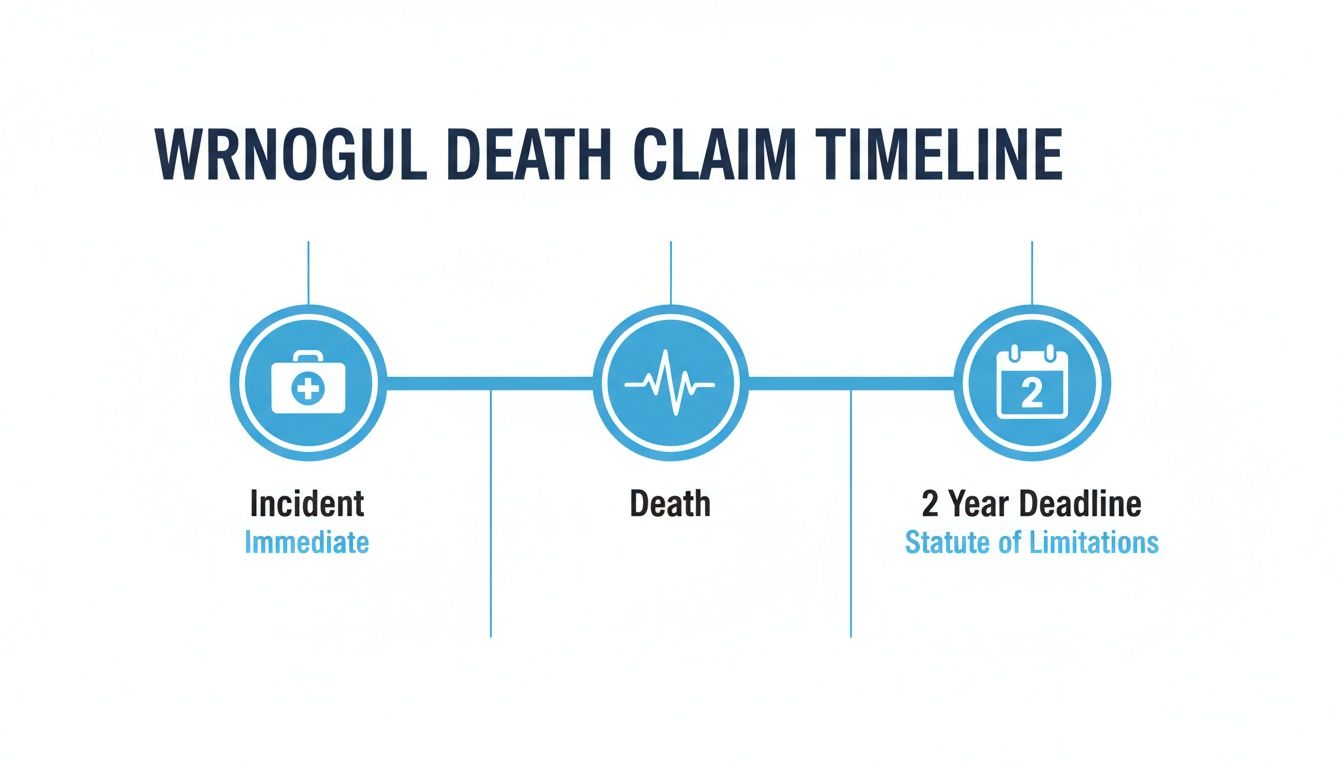
As you can see, the date of death is the legal trigger, not the date of the incident that caused the fatal injuries.
Introducing the Discovery Rule
While the date of death is the standard starting point, Pennsylvania law gets that some situations aren’t so cut and dry. This is where a crucial legal principle known as the Discovery Rule comes into play. It can be a lifeline in cases where the true cause of death wasn’t—and couldn’t have been—known right away.
The Discovery Rule says that the statute of limitations clock doesn’t begin until the point when the injury or its cause was discovered, or reasonably should have been discovered.
Think of it as an exception for hidden harm. The law recognizes it would be deeply unfair to start the clock on a problem that a family had no way of knowing existed.
Understanding how the clock truly begins for these claims sometimes means looking at the detailed work involved in determining a death’s circumstances, like in unattended death investigations by police and coroners.
How the Discovery Rule Works in Practice
The Discovery Rule most often shows up in complex medical malpractice cases. For instance, consider a patient who passes away after what everyone believed was a successful surgery. The family naturally assumes the death was due to the patient’s underlying condition.
But a year later, a whistleblower reveals that the surgical device used had a known defect that both the manufacturer and hospital covered up. In this scenario, a court would likely rule that the statute of limitations clock started when the family discovered the true cause of death—the defective device—not on the actual date of death.
To successfully use the Discovery Rule, you have to prove two things:
- Reasonable Diligence: You couldn’t have known about the cause of death earlier, even if you were being reasonably careful and paying attention.
- Hidden Cause: The cause of death was inherently hidden, concealed, or just not obvious from the information you had at the time.
This rule is a powerful tool, but it’s applied narrowly and requires a very compelling legal argument. It really underscores why it’s so important to have an attorney investigate all the circumstances around a death, because the true start date for your claim might not be what it first seems.
Key Exceptions That Can Pause or Extend the Deadline
While that two-year deadline for a wrongful death claim in Pennsylvania is notoriously strict, it’s not set in stone. The law gets that certain situations make it unfair, or even impossible, for a family to file a claim within that standard window. These specific circumstances can trigger exceptions that “toll”—or pause—the countdown clock, giving families a crucial lifeline.
Think of the statute of limitations as a stopwatch. In most cases, it starts ticking on the date of death and runs without interruption for two years. But under the right conditions, the law lets you hit the pause button. That pause can last for months or even years, and the stopwatch only starts running again once the situation that triggered it is resolved. Figuring out if one of these exceptions applies to your family is a huge deal.
The Minority Tolling Rule Protecting Children
One of the most important exceptions is the minority tolling rule. This rule is all about protecting the rights of kids who have lost a parent. It’s a commonsense rule that recognizes a minor child can’t legally file a lawsuit on their own.
So, the law pauses the two-year clock for a child beneficiary until they turn 18. For example, if a parent dies in a workplace accident and leaves behind a 10-year-old child, the statute of limitations is tolled for eight years. The clock won’t start ticking for that child’s claim until their 18th birthday, giving them until they turn 20 to file.
This exception makes sure a child’s right to seek justice for losing a parent isn’t lost just because they were too young to take legal action at the time. It preserves their chance to hold the responsible party accountable once they’re a legal adult.
This rule is a powerful protection. It ensures the most vulnerable family members have a fair shot at getting the compensation they deserve for the loss of their parent’s support, care, and guidance.
Fraudulent Concealment and Hiding the Truth
Another critical exception is called fraudulent concealment. This one comes into play when a defendant actively and intentionally hides evidence or misleads a family about what really caused their loved one’s death. The law simply won’t reward a wrongdoer for successfully covering up their own negligence.
Imagine a hospital falsifies medical records to hide a surgical error that led to a patient’s death. The family, trusting what they’re told, believes the death was due to unavoidable complications. If the truth finally comes out three years later, the statute of limitations would likely be tolled. The clock would start from the date the fraud was discovered, not the date of death.
To use this exception, you generally have to prove a few things:
- The defendant took active steps to hide the truth.
- You couldn’t have reasonably discovered what happened despite your best efforts.
- You filed the claim soon after uncovering the concealed information.
This rule stops at-fault parties from getting away with deceit and gives families a chance to seek justice once the truth is finally out in the open.
Other Important Tolling Provisions
Beyond the exceptions for minors and fraud, Pennsylvania law recognizes a few other scenarios that can pause the statute of limitations clock. These are less common, but they can be just as important depending on the facts of the case.
- Incapacity of the Plaintiff: If the person in charge of filing the claim (the estate’s personal representative) is legally incapacitated, the clock might be paused until they are competent again.
- Defendant’s Absence from Pennsylvania: If the person or company responsible for the death leaves Pennsylvania and can’t be served with legal papers, the time they are gone might not count against the two-year deadline.
These exceptions can be tricky to apply and often require a sophisticated legal argument. For a deeper dive into how these and other rules can affect your case, check out our guide on exceptions to the personal injury statute of limitations in PA. Each of these tolling rules highlights why you absolutely need a professional legal review. An experienced attorney can dig into the unique facts of your case to see if an exception applies, potentially saving your family’s right to file a claim even if you think the deadline has already passed.
Special Rules for Claims Against Government Entities
When a government agency’s negligence causes a wrongful death, the usual two-year statute of limitations isn’t the only deadline you need to worry about. Far from it. Suing a government body—whether it’s a city, a county, or a state agency like PennDOT—involves a completely different playbook with a much shorter, unforgiving timeline that often catches grieving families by surprise.
This is all because of a legal principle called sovereign immunity. It’s an old concept that once shielded the government from almost all lawsuits. While Pennsylvania has relaxed those rules for certain types of negligence, it replaced them with a series of strict procedural hoops you have to jump through perfectly just to get your case in the door.
The Critical Six-Month Notice Requirement
The biggest and most important hurdle is the notice of intent. Before you can even think about filing a lawsuit against a government entity, you are required to give them formal written notice of your claim within just six months of the date of death. This isn’t a suggestion; it’s a hard and fast rule.
If you miss this six-month deadline, your case is almost certainly over before it begins. It doesn’t matter if you still have plenty of time left on the two-year wrongful death statute of limitations. Failing to provide this initial notice will almost always lead to a swift dismissal of your lawsuit.
You can think of the six-month notice as a mandatory heads-up for the government. The law forces you to alert them to the incident and your plan to seek damages long before you file a formal lawsuit, giving them an early chance to investigate the claim on their own terms.
This notice has to be in writing and must include specific details about what happened, like the date, location, and the harm that was caused. The requirements are incredibly precise, which is why it’s critical to have an attorney handle this communication to make sure it’s done right. You can read more about the unique challenges of these cases in our guide to government injury claims and special deadlines in Pennsylvania.
How This Works in a Real-World Scenario
Let’s look at a practical example. Imagine a driver is killed when their car hits a massive, unmarked pothole that a PennDOT road crew failed to repair on a state highway. The family is heartbroken and spends the next several months grieving and trying to put their lives back together.
Here’s how the deadlines would break down:
- Date of Death: February 1, 2024
- Six-Month Notice Deadline: August 1, 2024
- Two-Year Filing Deadline: February 1, 2026
If the family waits until September 2024 to contact a lawyer, they have already blown past the crucial six-month notice deadline. Even though they technically have more than a year left on the main statute of limitations, their claim against PennDOT (a state agency) will likely be barred forever.
This procedural trap shows just how urgent these cases are. The standard timeline simply gets thrown out the window when a government defendant is involved. Any delay in getting legal advice can permanently close the door on your family’s right to seek justice. The second you suspect government negligence played a role in a loved one’s death, that six-month clock starts ticking.
How to Protect Your Family’s Rights Before Time Runs Out

Knowing about Pennsylvania’s wrongful death statute of limitations is one thing. Taking the right steps to protect your family’s future is another. When you’re reeling from a loss, figuring out what to do next can feel overwhelming. This is your roadmap—a clear guide to safeguarding your legal rights long before that two-year clock runs out.
The single most important step you can take is talking to an experienced wrongful death attorney. Right away. The time immediately following a loss is when evidence is fresh and memories are sharpest. An attorney can jump in to start investigating, preserve critical proof, and take over communications, freeing you and your family to focus on grieving.
Building the Foundation for Your Claim
As soon as you can, start gathering the essential paperwork. This initial effort creates the bedrock for a strong legal claim and stops crucial information from getting lost in the chaos.
Your lawyer will guide you through this, but the key documents usually include:
- The Official Death Certificate: This is the most important document for establishing the date of death, which officially starts the statute of limitations clock.
- Relevant Medical Records: Any and all records connected to the final illness or injury are vital to proving what happened.
- Accident or Police Reports: These give an official, third-party account of the incident that led to the death.
- Financial Documents: Things like pay stubs, tax returns, and benefit statements are key to calculating the economic losses your family has suffered.
Pulling this information together early on gives your legal team a major head start in building your case.
Critical Next Steps and What to Avoid
Beyond just collecting documents, a few other actions are foundational. One of the first legal moves is to open an estate for your loved one and have a personal representative appointed. This isn’t just a suggestion; it’s a legal requirement. Only the personal representative has the authority to file a wrongful death or survival action claim.
A huge mistake families make is talking to insurance adjusters before hiring a lawyer. Adjusters are trained to protect their company’s bottom line. Anything you say can—and likely will—be used to limit or flat-out deny your claim. Politely refuse to give any statements and point all calls to your attorney.
It’s also worth understanding the role of private autopsies in wrongful death cases as a way to proactively strengthen a potential claim. By taking these organized, deliberate steps, you empower yourself during an unimaginable time and ensure you’re building the strongest possible case for justice and accountability.
Frequently Asked Questions
When you’re dealing with a devastating loss, questions are bound to come up. Below are some straightforward answers to the most common concerns families have about the wrongful death statute of limitations in Pennsylvania.
What Happens If I Miss the Wrongful Death Deadline?
Missing the two-year deadline has harsh and permanent consequences. The court will almost certainly throw your case out, no matter how strong your evidence is. It means your family is legally blocked—forever—from seeking compensation for your loss.
Think of the statute of limitations not as a guideline, but as a locked door. Once that two-year window closes, the door is shut for good.
Who Can File a Wrongful Death Lawsuit in Pennsylvania?
Pennsylvania law is very specific on this point. Only the personal representative of the deceased’s estate can legally file a wrongful death lawsuit.
This person acts on behalf of the estate and all its beneficiaries—the family members who will ultimately receive any compensation. This typically includes the surviving spouse, children, or parents.
Even though the family members are the ones who benefit, the personal representative is the only one who can actually start the lawsuit. It’s a critical first step that has to be handled correctly.
Is the Deadline Different for Medical Malpractice Cases?
The standard two-year deadline from the date of death usually still applies. However, wrongful death claims tied to medical malpractice are often far more complex because of something called the Discovery Rule.
If the medical mistake that led to the death wasn’t immediately obvious, the two-year clock might not start ticking until the day the malpractice was reasonably discovered. For instance, if a fatal misdiagnosis is only uncovered in an autopsy report months later, an attorney could argue the clock started on that later date. This is exactly the kind of legal detail that makes these cases so challenging.
Can I Handle a Wrongful Death Claim Without a Lawyer?
It’s a huge risk, and one we strongly advise against. Wrongful death claims are a minefield of complex legal rules, strict evidence requirements, and aggressive defense lawyers paid by insurance companies. One small mistake can sink your entire case.
A personal injury firm that focuses on these cases handles all of that for you. They work on a contingency fee basis, meaning they only get paid if they win your case and recover money for your family. There’s no upfront cost or financial risk, so you can get expert legal help when you need it most.
If your family is facing the unimaginable loss of a loved one because of someone else’s carelessness, you don’t have to carry this legal burden alone. The dedicated team at Mattiacci Law is here to protect your rights and fight for the justice you deserve. Contact us for a free, no-obligation consultation to understand your options. Visit us at https://jminjurylawyer.com to learn more.