

Author: John Mattiacci | Owner Mattiacci Law
Published March 24, 2026
When another driver doesn't report an accident in Pennsylvania, the responsibility to document the crash and prove what happened falls entirely on you. Their silence is a gamble—they're betting they can just walk away as if nothing happened. Your job is to make sure they lose that bet.
What To Do When The Other Driver Disappears
It’s one of the most frustrating things that can happen after a crash. You exchange information (or maybe they just take off), and you expect them to do the right thing and call their insurance company. But then… nothing. They go completely silent.
This isn’t just bad manners; it’s a deliberate move to make your life harder. When the other driver fails to report the accident, you're immediately up against a wall.
- Proving Fault: Without their report, it's your word against thin air. Their insurance company will be skeptical and might even try to claim their driver wasn't involved at all.
- Insurance Delays: Your claim can get stuck in limbo. The other driver’s insurer might say they can’t move forward without a statement from their policyholder, leaving you to wait and wait.
- A Potential Hit-and-Run: If they never report it, this could easily turn into a hit-and-run investigation. That's a serious crime in Pennsylvania, but it also complicates your claim.
This simple decision tree shows you exactly what to do when the other driver goes quiet or flees the scene.
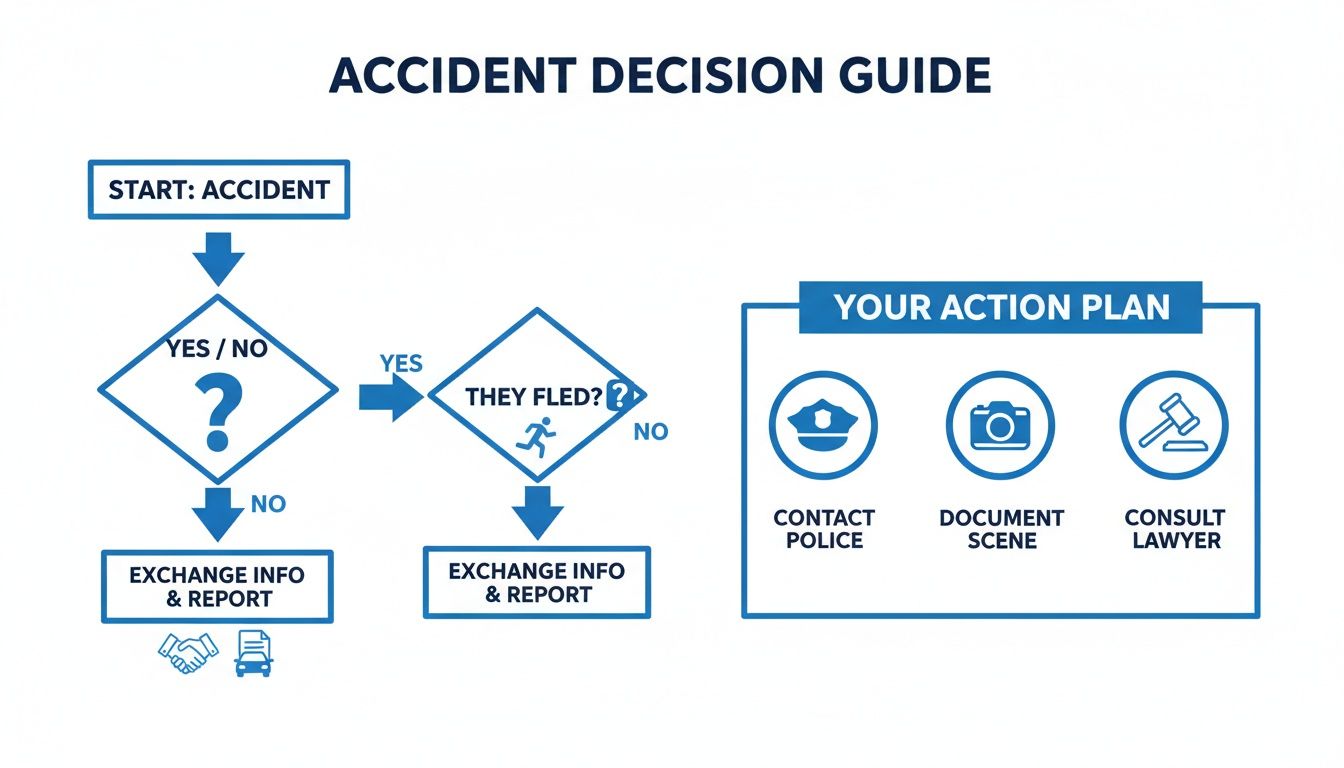
The bottom line is you have to take control right away. Call the police, document everything, and get a lawyer involved to start building your case. It’s your only defense against an irresponsible driver.
Your Immediate Action Plan
You can't afford to sit around and hope the other driver has a change of heart. That's a losing game. With PennDOT projecting over 115,000 crashes statewide by 2026—that’s about 13 accidents every hour—your odds of running into someone who won't play by the rules are higher than you think.
The moment you realize the other driver isn’t reporting the accident, you have to stop being a victim and start being an investigator. Your actions in the first few hours are what will build the foundation for your entire case.
This isn't the time to wait and see what happens. You need a clear, aggressive plan.
Your Immediate Action Checklist For An Unreported Accident
When the other driver tries to erase the accident by not reporting it, every step you take matters. This checklist breaks down your most critical moves to protect your claim.
| Step | Action Required | Why It's Critical |
|---|---|---|
| Call 911 | Report the accident to the police immediately, even if it seems minor. Tell them the other driver is not cooperating or has left the scene. | Creates an official, unbiased record of the crash. A police report is the single most important piece of evidence you can have. |
| Document Everything | Take photos of both cars, the license plate, the surrounding area, and any visible injuries. Get names and numbers from any witnesses. | Builds a visual record that can't be disputed. Witness statements provide third-party validation of what happened. |
| Seek Medical Care | Get checked out by a doctor or at an urgent care clinic right away, even if you feel fine. Tell them you were in a car accident. | Officially links any injuries to the crash. Delays in treatment give the insurer an excuse to argue your injuries aren't related. |
| Notify Your Insurer | Call your own insurance company and report the accident. Explain that the other driver is not reporting it. | Puts your insurer on notice and allows you to start a claim under your own policy if necessary (like for Uninsured/Underinsured Motorist coverage). |
Following these steps creates a paper trail that speaks for you when the other driver stays silent. It's how you take back control and build an undeniable record of the truth.
There's a clear playbook for what to do after a car accident, and following it is your best defense against a driver who won't own up to their mistake.
Understanding Pennsylvania's Accident Reporting Laws
After a car crash in Pennsylvania, you can't just drive away and hope for the best. There’s an official playbook everyone has to follow. Knowing these rules is crucial, especially when the other driver decides to ignore their legal duties and go silent.
The law isn’t just a suggestion—it's a set of mandatory steps designed to keep everyone safe and accountable. When a driver fails to report a crash, they aren't just making a simple mistake. They’re breaking the law.
When An Accident Must Be Reported
In Pennsylvania, the law is very clear. You are legally required to report a car accident to the police immediately if it results in:
- Any injury, no matter how minor it seems at the moment.
- The death of any person.
- Vehicle damage so bad that a car needs to be towed from the scene.
If your accident checks any of those boxes, you must call 911 from the scene. The police report created by the responding officer becomes the official record of what happened, laying the foundation for any future insurance claims or legal action. It’s a step you absolutely cannot skip. You can learn more about how serious this is in our guide on whether it is illegal to not report a car accident.
Think of it like this: the police report is the "official game tape" that everyone—from law enforcement to insurance adjusters—will review to understand what happened. Your own report to your insurance company is the "ticket" that gets you into the game to make a claim. You need both to protect yourself.
What if the police don’t come to the scene of a reportable accident? The responsibility doesn't just disappear. Both drivers are still required to act. Each one must file a written report with PennDOT within five days.
The PennDOT Driver's Accident Report Form AA-600
This brings us to a critical piece of paperwork: the PennDOT Form AA-600. If police don't file a report for a crash that caused an injury or disabling vehicle damage, you have to fill out and mail this form to PennDOT yourself.
This form is your official, written account of the accident. Forgetting or failing to file it when required can cause huge problems for your claim down the road. It could even lead to penalties like a suspension of your driver's license.
The Serious Consequences Of Not Reporting
So, what happens if the other driver doesn’t report the accident in Pennsylvania? The penalties they face are severe, and their failure to act can quickly turn into a serious crime.
Not reporting an accident isn’t just a paperwork mistake; it’s a crime. Pennsylvania law demands that drivers report any crash causing injury, death, or disabling damage within five days. Failing to do so can lead to hit-and-run charges, a crime that has been on the rise across PA, especially in crashes involving pedestrians and cyclists.
This is exactly why the other driver's silence is so dangerous for you. It turns what could have been a straightforward insurance matter into a potential criminal investigation. Their choice not to report isn’t just irresponsible—it's an illegal act that immediately complicates your path to getting fair compensation for your injuries and damages. Understanding these state-specific duties is fundamental, and there are many helpful Pennsylvania legal resources available to clarify what's required.
How An Unreported Crash Derails Your Insurance Claim
When the other driver leaves the scene or refuses to file a report, your path to getting paid becomes a complete mess. Insurance companies run on paperwork, and without the other party’s official statement, their insurer has a ready-made excuse to deny or drag out your claim. They’ll usually cite "insufficient evidence" or say they can't move forward without their driver’s side of the story.
Their silence isn’t just an inconvenience—it’s a strategy. It intentionally creates a "he said, she said" situation where they haven't said a thing. This gives their insurance company an easy way out, letting them protect their bottom line by either putting your claim on a shelf to collect dust or rejecting it outright.
Suddenly, the entire burden of proof falls on you. This is precisely why those actions you took right after the crash—calling the police and taking photos—are so critical. You’re no longer just the victim; you're the only reliable source of facts for a crash the other driver tried to make disappear.
The Insurer's Playbook For Delays And Denials
When an at-fault driver goes quiet, their insurance company almost always follows a predictable script designed to make you frustrated enough to give up. The adjuster will act like their hands are tied or claim they can’t verify the crash even happened.
You’ll hear a lot of the same excuses:
- "We can't reach our client." The adjuster will tell you they’ve left messages and sent letters but have gotten no response, so they can’t confirm coverage or accept liability.
- Questioning if the crash even happened. Without their driver's report, they might subtly suggest the accident didn't occur the way you described or even question the damage to your vehicle.
- Citing a "lack of official confirmation." They’ll use the missing statement from their policyholder as a reason to stall, hoping you’ll eventually get worn down by the delay.
This whole routine is about creating uncertainty. They know a stalled claim costs them nothing, but it puts enormous financial and emotional strain on you. Even in a normal crash, understanding the proper procedure for filing an auto insurance claim is key, but things get way more complicated when one side refuses to cooperate.
Your Personal Insurance Safety Net: Uninsured Motorist Coverage
When the other driver vanishes or their insurer won't play ball, it’s time to turn to your own personal safety net: Uninsured/Underinsured Motorist (UM/UIM) coverage. This is a critical piece of your own auto policy that you pay for specifically for these kinds of situations.
Think of UM coverage as your plan B. It’s the backup you put in place to protect yourself from irresponsible drivers. When the at-fault party is unidentified (like in a hit-and-run) or their insurer won't pay, your own policy steps in to cover your losses.
This coverage is designed to pay for the exact same things the at-fault driver's insurance should have covered, including:
- Medical bills
- Lost wages
- Pain and suffering
Don’t worry—filing a UM claim is not an admission of fault. In Pennsylvania, your insurance company is legally forbidden from raising your rates for a not-at-fault accident, and that includes a hit-and-run or dealing with an uninsured driver.
Turning The Tables On The Insurance Companies
This is where having a skilled law firm in your corner makes all the difference. An experienced attorney can take the evidence you gathered—the police report you insisted on, the photos from the scene, and any witness info—and completely flip the script on both insurance companies.
A trial-ready lawyer doesn't just ask for a fair payment; they build a case that compels it. They will formally present your carefully documented claim to the at-fault driver's insurer, making it painfully clear that their client's silence isn't a valid defense. That legal pressure is often enough to make them drop the delay tactics and start negotiating in good faith.
And if the other insurer still refuses to cooperate? Your attorney will pivot and immediately file your UM claim, making sure all the paperwork is handled correctly while aggressively pursuing the compensation you’re owed from your own provider. We manage the fight so you can focus on getting better.
Building a Rock-Solid Case When the Other Driver Goes Silent
When the other driver doesn’t report an accident, they’re counting on their silence to create confusion. Your job is to make their story—or lack of one—completely irrelevant. Building a strong case starts the moment the crash happens, and it’s all about gathering hard facts that speak for themselves.
Their words don't mean a thing when you have undeniable proof. The goal is to collect so much evidence that what they say (or don't say) doesn't matter. It’s not just about snapping a few photos; it’s about piecing together a story that can’t be twisted.
Your On-Scene Evidence Checklist
The chaos right after a crash is temporary, but the evidence you collect is permanent. This is your one and only shot to capture the scene exactly as it is. Your adrenaline will be pumping, but focusing on these key steps will protect you down the road.
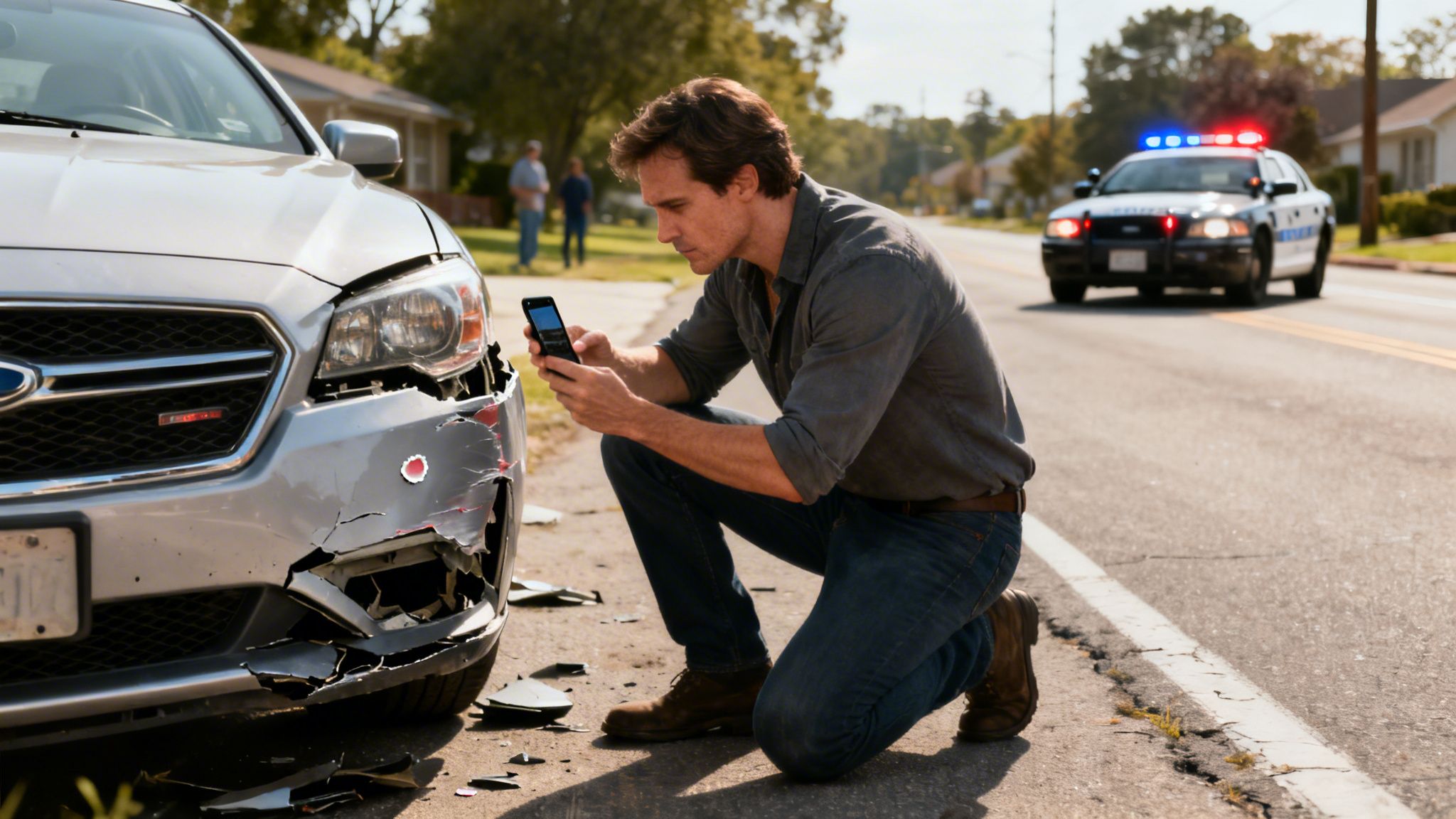
Your smartphone is your best friend here. Use it to document the scene before anything gets moved.
- Vehicle Positions: Get wide-angle photos showing where the cars came to rest. Capture how they’re positioned in relation to each other, the lane markings, and the shoulder. This tells the story of the impact.
- Property Damage: Now get up close. Take detailed pictures of the damage on all cars involved, not just yours. Look for impact points, scrapes, and especially any paint transfer. A tiny chip of their paint on your bumper can be the key to proving contact.
- The Surrounding Area: Widen your view. Photograph any skid marks, broken glass, or debris on the road. Also, capture nearby traffic signs, signals, and a general sense of the weather and road conditions.
- Witness Information: An independent witness is your most powerful tool against a dishonest driver. Politely ask anyone who saw what happened for their name and phone number. A neutral third-party account can shut down a false story instantly.
Every photo and every phone number you collect helps build your case. A strong foundation from the start makes it much harder for the other driver's insurance company to poke holes in your claim.
Finding the Digital Breadcrumbs
These days, almost every accident leaves a digital footprint. This type of evidence is objective, time-stamped, and incredibly hard for a silent or lying driver to argue with. It can turn a "he said, she said" mess into a closed case.
When a driver’s story—or their silence—is contradicted by a video, their credibility is shot. An experienced attorney knows exactly where to look for these digital clues and has the legal tools to get them.
Key Digital Sources to Look For:
- Dashcam Footage: If you have a dashcam, save that video file immediately. If you don't, ask other drivers who stopped if their camera might have caught the crash.
- Surveillance Video: Scan the area for nearby businesses. Gas stations, stores, and office buildings often have security cameras aimed at the road. An attorney can send a formal spoliation letter demanding they preserve that footage before it’s automatically erased.
- Event Data Recorders (EDRs): Think of this as the "black box" inside most modern cars. It records crucial data like speed, braking, and steering in the seconds right before a collision. A lawyer can hire an expert to download this data, giving you a scientific account of what happened.
Why does this matter? Imagine the other driver claims you slammed on your brakes, but their car's EDR shows they never even touched their own brakes. That one piece of data completely demolishes their story and helps prove their negligence.
Every photo, witness, and digital file tells a piece of the story. You're not just collecting random information; you're building the undeniable truth of what happened. For example, photos showing heavy front-end damage to their car and rear-end damage to yours make it almost impossible for them to claim you backed into them. Learning how evidence is used to prove negligence in Pennsylvania shows just how critical these details are for protecting your rights.
When you're up against a driver who refuses to report the accident, gathering this proof isn't just a good idea—it's everything. It's how you make sure the truth wins.
Navigating The Criminal And Civil Justice Systems

When the other driver doesn't report an accident, you’re suddenly thrown into two completely different legal worlds: the criminal system and the civil system. It’s crucial to understand how they work, because each one has a totally different goal.
Think of it like fighting a battle on two separate fronts. On one front, you have the Commonwealth of Pennsylvania going after the driver for any crimes they committed, like a hit-and-run. That’s the criminal case, and its entire purpose is to punish them for breaking the law.
On the other front, you and your personal injury lawyer are fighting to get you paid for your losses. This is your civil claim, and our goal is to recover money for your medical bills, lost income, and pain and suffering.
The Two-Front Battle Explained
The criminal and civil cases are independent of each other. The state can charge the other driver whether you file a lawsuit or not. And you can pursue your claim for financial compensation even if the driver is never charged with a crime.
The Criminal Case: This battle is fought by the District Attorney's office. Their job is to prove the driver is guilty of a crime "beyond a reasonable doubt." If they win, the driver faces penalties like fines, a suspended license, or even jail time.
The Civil Case: Your attorney fights this battle for you. Our goal is to prove the driver was negligent "by a preponderance of the evidence"—which is a much lower standard of proof. A win here results in a settlement or verdict that covers your damages.
This is exactly why you need an experienced lawyer. We keep our eyes on the prize: your financial recovery. We let the state handle the punishment.
When a driver fails to report a crash, they open themselves up to both criminal charges from the state and a civil lawsuit from you. The table below breaks down the key differences between these two legal paths.
Criminal Penalties Vs Civil Liability In Pennsylvania
| Aspect | Criminal Case (Hit-and-Run) | Civil Case (Personal Injury Claim) |
|---|---|---|
| Purpose | To punish the driver for breaking the law. | To compensate you for your financial and personal losses. |
| Who Files? | The District Attorney on behalf of the state. | You and your personal injury attorney. |
| Standard of Proof | Guilt must be proven "beyond a reasonable doubt." | Negligence must be proven by a "preponderance of the evidence." |
| Potential Outcome | Fines, license suspension, community service, or jail time. | A financial settlement or jury verdict to pay for your damages. |
| Your Role | You are a witness for the prosecution. | You are the plaintiff seeking financial recovery. |
As you can see, the criminal case is all about public justice, while the civil case is about your personal justice and financial well-being.
How A Criminal Conviction Becomes Your Ultimate Weapon
Even though the two cases are separate, a win on the criminal front can be a game-changer for your civil claim. If the other driver gets convicted of a hit-and-run or a related traffic offense, we can often use that conviction as undeniable proof that they were at fault for the crash.
This is a legal principle called negligence per se. In simple terms, it means that because the driver broke a safety law (like the law requiring them to stop), they are automatically considered negligent. It shuts down any arguments from their insurance company that they weren't to blame.
A criminal conviction puts the at-fault driver's insurer in a terrible spot. Their client’s credibility is shot, and they know they’re facing a losing battle in court. They can no longer hide behind excuses or try to shift the blame to you.
Suddenly, that conviction gives us the leverage we need to demand a fair settlement. The insurance company knows that going to trial would be a complete disaster for them. It transforms your claim from an uphill fight into one with a clear path to getting you paid.
Why You Need a Fighter, Not Just a Lawyer, Right Away
When the other driver doesn’t report an accident, it’s not an oversight. It's a deliberate choice, and it completely changes the game. Their silence is a loud and clear signal that they’re planning to fight you, and their insurance company will take that as a green light to deny or dispute your claim.
This isn’t the time for a lawyer who just sends a few letters and hopes for a fair settlement. That passive approach is doomed from the start. You need an attorney who is ready for a courtroom battle from day one. It sends a powerful message to the insurance companies: we’re not going to be stalled, lowballed, or ignored.
Flipping the Script by Preparing for Trial
A trial-ready firm like Mattiacci Law works differently. We prepare every single case as if it’s going to end up in front of a jury. This isn't just talk; it's a core strategy that gives you leverage right out of the gate.
When an insurer sees we’re already building a case for court—subpoenaing records, hiring experts, and getting ready for depositions—they know we mean business. They realize that trying to wear us down with delays is just going to cost them more in the end.
This aggressive preparation is the single most effective way to deal with the hostile situation created when the at-fault driver goes silent. It forces the insurance company to negotiate based on the facts and the strength of our case, not on the hope that you’ll eventually get frustrated and give up.
- We Start Digging Immediately: We don't wait for the other side to play nice. We launch our own investigation right away, tracking down witnesses, securing surveillance footage, and gathering every piece of evidence we need.
- We Bring in the Experts: In hit-and-run cases, we work with professional investigators to find the missing driver. We also bring in accident reconstruction experts who can scientifically prove what happened, making the other driver’s story—or lack thereof—irrelevant.
- We Negotiate from a Position of Strength: Our negotiations are always backed by the very real threat of a lawsuit. We present our evidence and make our demands knowing we are fully prepared to take the fight to court if they refuse to be fair.
Finding a Missing Driver Is Our Problem, Not Yours
One of the biggest fears victims have is, "What if they never find the person who hit me?" With a trial-ready firm, that burden shifts from your shoulders to ours. Our team has the resources and experience to conduct an exhaustive search.
We treat a missing driver like a puzzle that needs to be solved. We use every tool we have, from canvassing the area for witnesses to using legal channels to identify a vehicle from just a partial license plate. And even if the driver remains a ghost, our thorough investigation strengthens your Uninsured Motorist (UM) claim by proving to your own insurance company that every possible effort was made.
Hiring a firm that lives and breathes trial preparation means you’re not just getting a lawyer—you’re getting a team of advocates ready for a fight. It signals to every insurance adjuster involved that your claim is serious and backed by a team that won't back down. This allows you to step away from the conflict and focus on what really matters: your recovery. We handle the battle so you can get your life back on track.
Got Hit By A Driver Who Didn't Report It? Here's What To Know.

It's a frustrating situation. You followed the rules after a crash, but the other driver either gave you fake information, promised to report it and didn't, or just drove off. Now you're left wondering what happens next. Here are the answers to the questions we hear most often.
How Long Do I Have To Report A Car Accident In Pennsylvania?
Technically, the law gives you some wiggle room, but you shouldn’t use it. Pennsylvania requires you to report a crash immediately if anyone is hurt or a vehicle can't be driven away.
If for some reason police don't show up at the scene of a crash like that, you have five days to file a written report yourself with PennDOT (Form AA-600). But honestly, waiting is a huge mistake. The longer you wait, the more it looks like the accident wasn't a big deal—and that’s exactly what an insurance company wants to argue. Reporting it right away creates an official record and shows you took it seriously from the start.
What If I Cannot Find The Driver Who Hit Me?
If the driver disappears and you can't identify them, it's officially a hit-and-run. At that point, your main source for compensation flips from their insurance to your own, specifically your Uninsured Motorist (UM) coverage.
This is the exact scenario UM coverage was designed for. Think of it as your own personal safety net for when the at-fault driver is uninsured or, like in a hit-and-run, can’t be found.
You need to notify your insurance company and open a UM claim as soon as possible. A good personal injury lawyer can handle that for you while also launching their own investigation to track down the driver who fled.
Will My Insurance Rates Go Up If I File A UM Claim?
No. Pennsylvania law is very clear about this: your insurance company cannot legally raise your rates or penalize you for an accident that wasn't your fault. Since a hit-and-run is never the victim's fault, making a UM claim shouldn't affect your premiums one bit.
If your insurer tries to jack up your rates or threatens to drop your policy after you file a not-at-fault claim, they could be acting in bad faith. If that happens, call an attorney right away.
Can I Still Get Compensation If The Other Driver Is Never Found?
Yes, absolutely. This is precisely why you have Uninsured Motorist (UM) coverage on your policy. It’s insurance you’ve paid for to protect yourself when the person responsible for your injuries can't be held accountable.
This coverage is there to pay for things like:
- Your medical bills, both now and in the future
- Wages you lost because you couldn't work
- Your pain and suffering
Getting a fair payout will come down to how well you've documented everything and the coverage limits on your policy. An experienced lawyer knows how to build a strong claim and negotiate with your own insurance company to make sure they pay what you're rightfully owed.
When the other driver tries to disappear, you need a law firm that knows how to find the truth and fight for your rights. The trial attorneys at Mattiacci Law prepare every case to win in court, sending a clear message to insurance companies that you will not be ignored. Contact us today for a free, no-obligation consultation at https://jminjurylawyer.com.