

Author: John Mattiacci | Owner Mattiacci Law
Published March 27, 2026
That phone call from the other driver's insurance company is one you won't forget. You know the other driver was at fault, but the adjuster on the line is telling you a completely different story—they're blaming you.
It’s frustrating, and it’s designed to be. But here's the most important thing to remember: when an insurance company disputes fault, it’s not the end of the road. It’s the beginning of a fight. And it means the ball is now in your court to prove your case.
Your Guide to Pennsylvania Insurance Fault Disputes

This isn’t just about telling your side of the story anymore. To win a fault dispute in Pennsylvania, you have to build a rock-solid case backed by hard evidence and a smart understanding of the state’s laws. The insurance company has a team of adjusters and lawyers whose entire job is to pay out as little as possible. Your job is to make it impossible for them to deny what you're owed.
This guide will walk you through exactly how to do that.
Turning a Disputed Claim into a Successful One
We're going to pull back the curtain on the entire dispute process. Think of this as your playbook for countering the insurance company's tactics and protecting your right to fair compensation. Here’s what we’ll cover:
- Pennsylvania's Comparative Negligence Rule: We’ll break down how this state-specific rule works and why it’s so critical to your financial recovery.
- Building Your Case: You'll learn exactly what evidence you need to gather to build an argument so strong the insurer can't ignore it.
- Navigating the Process: We'll guide you through every step, from the first negotiation call and sending a demand letter to mediation and, if it comes to it, filing a lawsuit.
This isn't just about fighting back—it's about being two steps ahead. An insurer’s dispute is a strategic challenge. With the right evidence and a clear plan, it’s a challenge you can absolutely win. The goal is to make your position so undeniable that paying you fairly becomes their only logical option.
And make no mistake, challenging insurers is often necessary. They don't always play fair. In 2026 alone, the Pennsylvania Insurance Department (PID) recovered almost $133 million for consumers. A massive $16.4 million of that was for claims that were wrongly denied or underpaid—many of which started as fault disputes. You can see more details in the PID's annual reports on consumer protection.
When you get that notice that the insurer is contesting fault, what you do in the first few hours and days is critical. You need to act deliberately to protect your rights and preserve the evidence that will make or break your claim. The table below outlines your immediate action plan.
Initial Steps When an Insurer Disputes Fault
| Action Item | Why It's Critical in a PA Fault Dispute |
|---|---|
| Do Not Give a Recorded Statement | Adjusters are trained to ask leading questions to get you to accidentally admit partial fault. Politely decline until you've spoken with a lawyer. |
| Preserve All Evidence | Save photos, videos, the police report, and contact info for witnesses. This is the proof you'll use to counter the insurer's arguments. |
| Get a Copy of the Police Report | The officer's on-scene determination of fault is powerful, even if it's not the final word. It's a key piece of evidence in your favor. |
| Continue All Medical Treatment | Gaps in treatment give the insurer an excuse to argue your injuries aren't serious. Follow all of your doctor's orders without exception. |
| Contact a Car Accident Lawyer | An experienced attorney knows the insurer's tactics and can take over all communication, protecting you from their strategies. |
These first steps are your foundation. By taking control of the situation right away, you shift the power dynamic and show the insurance company that you're prepared to fight for the compensation you deserve.
Why Insurers Dispute Fault and Their Common Tactics
Getting that call from an insurance adjuster questioning who was at fault can feel like a personal attack. But you have to understand, it’s not personal at all. It’s business. Insurance companies are for-profit businesses, and their whole model boils down to a simple equation: collect more in premiums than they pay out in claims.
Every dollar they pay on your claim is a dollar that comes straight out of their bottom line. Because of this, adjusters are trained and given every incentive to find reasons—any reason—to pay you less or deny your claim completely. Disputing fault is one of their go-to moves.
Think of the insurance company less like a neutral fact-finder and more like a prosecutor building a case against you. Their main goal is to shift as much of the blame as they can onto your shoulders. Even sticking you with just a small percentage of fault can save them thousands of dollars under Pennsylvania’s comparative negligence rules. This financial incentive is what drives their entire playbook.
The Insurer’s Playbook for Disputing Liability
Insurance adjusters don’t just wing it; they follow a time-tested playbook to build a case against you. Knowing their moves is the first step to protecting yourself. Their goal is always to gather information that can be twisted, used out of context, or spun to make you look at least partially responsible.
Watch out for these classic strategies:
- Requesting a Recorded Statement: One of the first things an adjuster will do is call you and ask to record your conversation. They’ll sound friendly, maybe even concerned, but they are hunting for any inconsistencies or admissions. A simple "I'm not sure" can be spun as you being uncertain about what happened, while a polite "I'm okay" can be used later to argue your injuries aren't that serious.
- Cherry-Picking from the Police Report: The police report is a key piece of evidence, but an insurer won't always see it that way. They might completely ignore the officer’s final conclusion and zero in on one small, unfavorable detail. For instance, they could harp on a note that you seemed "distracted" for a second, even if the report clearly states the other driver blew through a red light.
- Misinterpreting Your Words: Adjusters are pros at asking leading questions designed to trap you. They might ask something like, "So you didn't see the other car until right before the impact, correct?" Answering "yes" to that can be used to paint you as inattentive, completely ignoring the fact that the other driver was speeding or merged into your lane without warning.
The entire strategy is about creating doubt. The insurer doesn't have to prove you were 100% at fault. They just need to stir up enough ambiguity to justify assigning you a piece of the blame, which lets them legally reduce what they have to pay you.
Advanced Tactics Insurers Use
When there's a lot of money on the line, insurance companies will move beyond these initial tactics and bring out the big guns. These more advanced methods are all about creating a competing "expert" story that favors their side.
A common move is to hire their own accident reconstructionist or investigator. These so-called experts are on the insurance company’s payroll, and—surprise, surprise—their reports often conclude exactly what the insurer wants them to. They’ll analyze skid marks and vehicle damage to create a scenario where you share the fault, even if it flies in the face of witness statements and the actual physical evidence.
They might also put you under surveillance or dig through your social media profiles. That picture you posted of yourself taking a short walk? They’ll present it as "proof" your injuries are exaggerated. A casual comment you made about the accident online can be taken out of context to sound like an admission of fault. It’s a full-court press designed to find any weakness and drive down the value of your claim. Once you see these moves for what they are, you can avoid their traps and know when their "investigation" is really just an effort to build a case against you.
Understanding Pennsylvania's Comparative Negligence Rule
When an insurance company starts arguing about who was at fault, they’re not just trying to be difficult. They have a very specific goal in mind, and it all comes down to a Pennsylvania law known as modified comparative negligence. This rule is the playbook they use to reduce or completely deny your claim.
Think of it like this: your total damages—all your medical bills, lost wages, and pain—make up a whole pie. But if you’re found even a little bit responsible for the accident, this law determines how much of that pie you actually get to keep.
The 51% Bar Rule Explained
Here in Pennsylvania, we have what lawyers call the “51% Bar Rule.” It sounds a little technical, but it’s actually pretty simple, and it has two parts that can make or break your case.
First, whatever percentage of fault you’re assigned gets taken directly out of your compensation. Let’s say a jury decides your case is worth $100,000, but they also think you were 20% to blame for the crash. Your final award gets cut by that 20%, so you would walk away with $80,000.
But here’s the second part—the “bar.” It’s a hard and fast cutoff. If you are found to be 51% or more at fault, you are legally barred from getting a single penny. Your compensation doesn’t just get reduced; it drops straight to zero. This is the cliff the insurance company is trying to push you over.

This is exactly why adjusters fight so hard over what seem like tiny details. They don’t need to prove you were the main cause of the wreck. All they have to do is convince a jury you were just slightly more than half responsible, and poof—their company owes you nothing.
To see how this plays out with real numbers, take a look at the table below. It shows what happens to a hypothetical $100,000 award as your percentage of fault goes up.
How Your Percentage of Fault Affects Compensation in PA
| Your Percentage of Fault | Insurer's Payout | Can You Recover Damages? |
|---|---|---|
| 0% | $100,000 | Yes, you get the full amount. |
| 10% | $90,000 | Yes, but your award is cut by 10%. |
| 30% | $70,000 | Yes, but your award is cut by 30%. |
| 50% | $50,000 | Yes, but your award is cut by half. |
| 51% | $0 | No. You are completely blocked from getting anything. |
As you can see, that one extra percentage point from 50% to 51% makes all the difference. It’s a financial cliff, and it's why these fault arguments are so intense.
How Insurers Argue Percentage of Fault in Practice
An adjuster will dig into every part of your story, looking for any little thing they can use to pin some blame on you. Things you might think are totally irrelevant can become the heart of their argument for raising your fault percentage.
Here are a few real-world examples we see all the time:
- Car Accidents: The other driver blows through a red light and T-bones you. It seems open-and-shut. But the adjuster finds out you were going just 5 mph over the speed limit. They’ll argue that if you’d been going slower, you could have avoided the crash, making you partially to blame.
- Slip and Falls: You slip on a puddle in a grocery store that had no warning sign. The store’s insurance company gets the security footage and sees you glancing at your phone a few seconds before you fell. Their argument? You were distracted and not watching where you were going.
- Construction Accidents: A tool falls from a scaffold and hits you. The contractor’s insurer might claim you were in a restricted "hard hat area" without wearing one, even if you were never told to.
In every one of these scenarios, the insurer's goal is the same: find a reason—any reason—to shift blame onto you. Their argument doesn't need to be perfect; it just needs to sound plausible enough to a jury. If you want a more detailed breakdown, you can see how comparative negligence in Pennsylvania is explained in different types of cases.
This is why the whole fight in a disputed claim often comes down to proving the other party was more than 50% at fault. Every single percentage point is a battle, and winning that battle takes solid evidence that tears down the insurer’s story and proves who was truly responsible.
How to Build an Evidence-Based Case to Prove Fault
When the insurance company says they're "disputing fault," what they're really saying is, "We don't believe your side of the story." To win that argument, you can't just tell them what happened—you have to prove it. Building a strong case is about laying down one piece of solid proof after another until their arguments have nowhere left to go.
Your job is to paint a crystal-clear picture of the accident and who was responsible. This isn’t about just dumping a pile of papers on an adjuster’s desk. It’s about strategically using evidence to dismantle their case piece by piece, leaving them with no room to argue.
The Cornerstones of a Powerful Claim
Think of your evidence in layers, starting with the stuff you can grab right at the scene. These first few pieces are often the foundation for your entire claim.
- Photographs and Videos: What you can capture with your phone in the minutes after a crash is pure gold. Document everything from every angle you can think of. Get shots of where the cars ended up, any skid marks on the road, traffic signs, road conditions, and scattered debris. These images freeze the scene in time and stop the other driver from changing their story later.
- The Official Police Report: It’s not the absolute final word on who’s at fault, but the police report is a huge piece of objective evidence. It has the officer's initial thoughts on what happened, diagrams of the accident, and statements from everyone involved. Getting a copy of this report is a must-do. It gives you a crucial, unbiased starting point for your claim.
The evidence you collect doesn't just back up your story; it actively tears down the insurance company's arguments. Every photo showing the other car over the yellow line or a witness statement confirming you had the green light chips away at the adjuster's ability to blame you.
- Witness Statements: Independent witnesses are incredibly persuasive because they have no skin in the game. If anyone saw what happened, get their name and phone number right away. A statement from a neutral third party that backs up your version of events can be the single most powerful tool to shut down a fault dispute. You can learn more about how different types of proof are used to establish negligence in Pennsylvania.
Advanced Evidence Gathering and Expert Analysis
Once you’ve got the basics covered, a law firm focused on trial-readiness will take things to the next level. This means digging deeper to build a case that won’t just convince an adjuster, but could stand up in front of a judge and jury if it comes to that.
This is where preserving the physical evidence is critical. In a car wreck, that might mean making sure the vehicle's "black box," or Event Data Recorder (EDR), gets downloaded before the data is lost or overwritten. If you slipped and fell, it means holding onto the faulty shoes you were wearing.
It’s also essential to keep detailed medical records. Your treatment history needs to draw a clear, unbroken line from the accident straight to your injuries. By getting consistent medical care and following your doctor's advice, you take away the insurer's favorite tactic: arguing that your injuries were already there or aren't as bad as you say.
Finally, a powerful move is to fight fire with fire by hiring your own experts. Insurers lean heavily on their own hired guns to spin a story that helps them. That's why a good law firm will bring in their own trusted specialists to counter them. An accident reconstruction expert, for instance, can use physics and engineering to create a scientific model of the crash. They can prove exactly how it happened and scientifically shut down the insurance company's theories.
This is the kind of expert-backed proof that turns a disputed claim into one they simply can't deny.
Navigating the Dispute Process from Negotiation to Lawsuit
When the other driver’s insurance company digs in their heels and disputes fault, you can’t just sit back and wait. You have to force the issue. This is where the real fight begins, and it follows a clear path from negotiation all the way to a lawsuit if that's what it takes.
It all starts when your lawyer sends the insurance company a demand letter. Think of this as the official start of the battle. It's a detailed package that lays out your entire case: the story of the crash, the evidence proving their driver was at fault, and a full breakdown of every dollar you're owed.
This isn't some simple note asking for cash. A strong demand letter includes:
- A complete list of your medical bills and what you'll need for future care.
- Proof of your lost wages and any impact on your ability to earn a living.
- A specific demand for your pain, suffering, and the emotional toll the accident took.
- Copies of everything that backs it up, like the police report and your medical records.
As you go through this, it helps to have a rough idea of what your case might be worth. Tools like a Personal Injury Settlement Calculator can give you a ballpark estimate.
From Negotiation to Mediation
Once the demand letter is out, the negotiation phase kicks off. This is where an insurance adjuster’s knowledge of your law firm really matters. Adjusters know which lawyers will take a lowball offer to avoid a fight and which ones will see them in court. A firm's reputation for being trial-ready makes them take your demand seriously right from the get-go.
If the first round of talks goes nowhere and the adjuster’s offer is just plain insulting, the next move is often mediation. This is a more formal sit-down with a neutral third-party—the mediator—who tries to help both sides find a middle ground. The mediator can’t force anyone to settle, but their job is to get a deal done.
The evidence you gathered from day one is what gives you leverage in these talks.
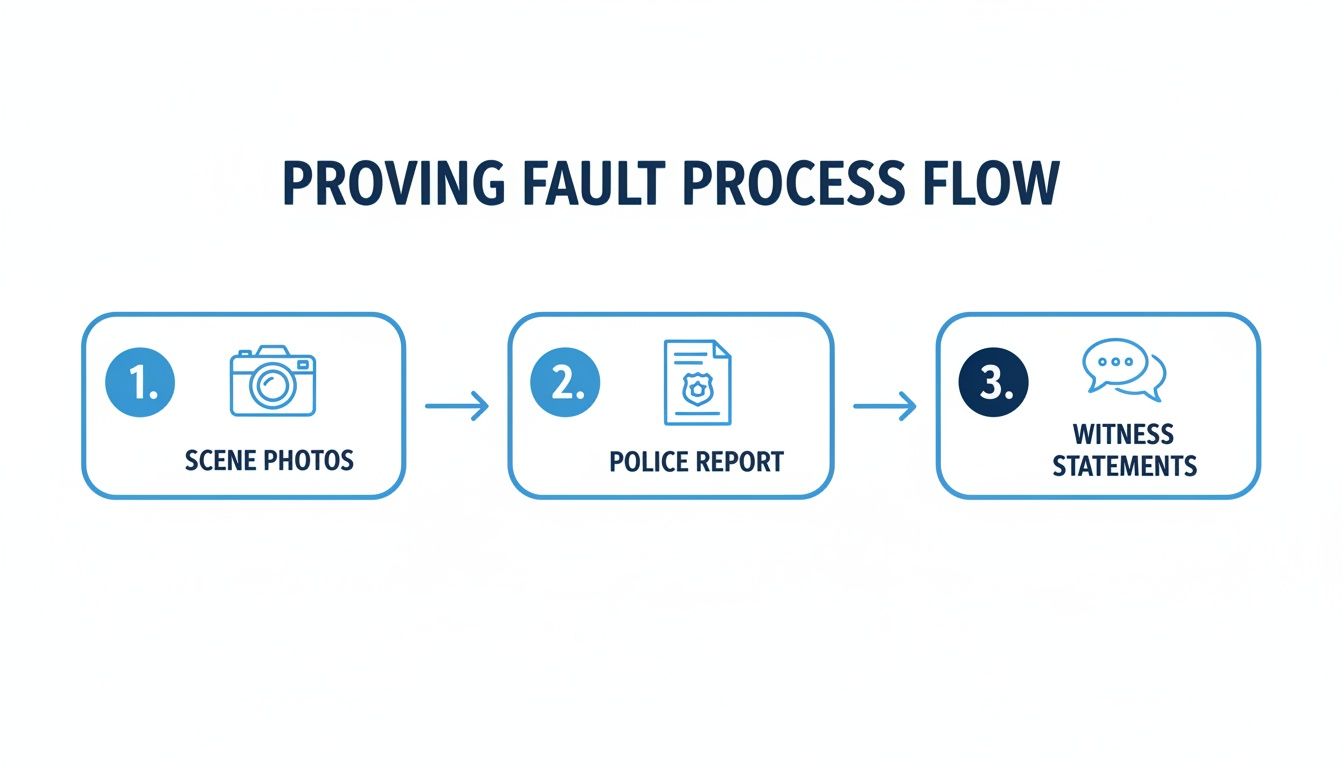
Things like scene photos, the police report, and what witnesses have to say are the foundation for shutting down an insurer's dispute.
The Decisive Step of Filing a Lawsuit
If the insurer still won’t make a fair offer after negotiation and mediation, it’s time to file a lawsuit. This is the final step, and it officially pulls the case out of the insurance company's control and puts it in the hands of the court system. For many adjusters, getting served with a lawsuit is the wake-up call that finally makes them get serious about negotiating.
Filing a lawsuit starts the "discovery" process. Now, your attorney can legally force the other side to hand over evidence, question witnesses under oath (depositions), and demand documents they were hiding. This pressure is often what leads to a much better settlement offer. If not, your case heads toward a trial where a jury will have the final say. You can learn more about what happens when their insurance denied liability and what your options are.
You absolutely have to know that a clock is ticking. In Pennsylvania, you have a two-year statute of limitations to file a personal injury lawsuit. That clock starts on the date of the accident. If you miss that deadline, your right to recover money is gone. Forever.
This two-year window is exactly why you can't let an insurer waste your time. Pennsylvania law actually puts them on a deadline, too. They must acknowledge a claim within 10 business days and usually have to wrap up their investigation within 30 days. If they want more time, they have to tell you why in writing every 45 days. Getting a lawyer involved early ensures your rights are protected long before that two-year deadline gets close.
Why a Trial-Ready Lawyer Is Your Strongest Asset

When an insurance company starts disputing fault, it can feel like you’re suddenly in a fight you can’t possibly win. They have entire teams of adjusters and lawyers whose only job is to poke holes in your story and pay you as little as possible. Trying to take them on by yourself is a huge gamble, and it almost always ends with lowball offers, frustrating delays, and a lot of stress.
This is where having the right attorney completely changes the game. But I don't mean just any lawyer—you need one who prepares every single case as if it's headed straight for a jury.
Changing the Insurer's Calculation
Here’s a little inside baseball: insurance companies keep score. They know which law firms will actually go to court and which ones will just accept a quick, cheap settlement to close the file. The moment they see a trial-ready firm like Mattiacci Law representing you, their entire playbook has to change. They know their usual delay-and-deny tactics aren't going to work.
This isn’t about being aggressive just to get to a courtroom. It's about using the credible threat of trial to force the insurer to negotiate from a much weaker position. Preparing for trial means we're digging deep from day one—launching exhaustive investigations, bringing in top experts, and building a case backed by so much hard evidence that the idea of facing a jury becomes a massive financial risk for them.
The goal is pretty simple: we make settling with you for the full and fair amount the most attractive option for the insurance company. They see we are ready, willing, and able to take them all the way to court, and suddenly, their willingness to offer a real settlement skyrockets.
This is, without a doubt, your strongest asset when an insurance company disputes fault in Pennsylvania.
From Frustration to a Just Recovery
A trial-focused lawyer does more than just push back against the insurer's arguments; they take back control of the story. They can anticipate the adjuster's next move, use solid evidence to dismantle any claims of shared fault, and keep you from falling into common traps—like giving a recorded statement that they can twist and use against you later.
When you're looking for representation, little things matter, too. How a firm manages its calls and ensures clients can always get through is a big indicator of how they run their practice. Things like efficient law firm communication show a commitment to being organized and client-focused, which is just as important as courtroom skill.
Don’t let an insurance dispute get in the way of your physical and financial recovery. You have rights. With a powerful advocate in your corner, you can turn this incredibly frustrating process into a just outcome. Contact Mattiacci Law for a free, no-obligation consultation, and let's talk about how we can fight for you.
Common Questions About Pennsylvania Fault Disputes
When an insurance company starts fighting you on who’s at fault, a million questions probably pop into your head. It’s confusing and frustrating. Let’s clear up some of the most common ones that come up when you're in this fight.
Can I Still Get My Medical Bills Paid If Fault Is Disputed in PA?
For car accidents, yes. Pennsylvania is a "choice no-fault" state, which is a bit of a lifesaver here. It means your own car insurance policy’s Medical Benefits—often called PIP coverage—pays your initial medical bills up to your policy limit, regardless of who caused the crash.
This is huge. It lets you get the treatment you need right away while your lawyer battles it out with the other driver’s insurer over liability. For other types of injuries, like a slip and fall, getting bills paid is tied directly to proving fault, so getting that dispute settled quickly becomes even more critical.
What Exactly Is an Insurance Bad Faith Claim in Pennsylvania?
A bad faith claim isn't just about the insurer disagreeing with you. It happens when they deny or drag out your claim without any good reason. Think of it like this: they have clear evidence that their driver was 100% at fault, but they ignore it. Or they refuse to even conduct a real investigation. Or they use endless delays to try and wear you down so you’ll accept a ridiculously low offer. That's bad faith.
Under Pennsylvania law (42 Pa.C.S. § 8371), proving bad faith means you can recover a lot more than just what your claim was worth. A court can award you interest, your attorney's fees, and even punitive damages, which are designed to punish the insurance company for their conduct.
How Long Does It Take to Settle a Disputed Fault Claim?
This is the classic "it depends" answer, but honestly, it’s the truth. The timeline can be anywhere from a few months to more than two years.
If you have a slam-dunk case with undeniable evidence, your lawyer might be able to get it settled relatively fast through direct negotiations with the adjuster. But if the insurance company digs in its heels, refuses to be reasonable, or the case involves complicated evidence that needs expert reports and a lawsuit, the process is naturally going to take longer. A good lawyer keeps the pressure on constantly to move things forward and stop the insurer from using stall tactics against you.
When an insurance company tells you they are disputing fault, take it as a clear signal: you're in for a fight and you need someone tough in your corner. The team at Mattiacci Law prepares every single case as if it's going to trial. This forces insurers to take your claim seriously and negotiate in good faith. If you're facing a battle over your claim, contact us for a free consultation to understand your rights and see how we can help you get the compensation you deserve.