

Author: John Mattiacci | Owner Mattiacci Law
Published March 29, 2026

If you were just hit by a commercial truck in Pennsylvania, the next few minutes are pure chaos. Your first moves, though, can make or break your case. Your top priority is simple: call 911 for police and medical help. Then, if you're able, grab your phone and start documenting everything.
What to Do Immediately After a Truck Accident in PA
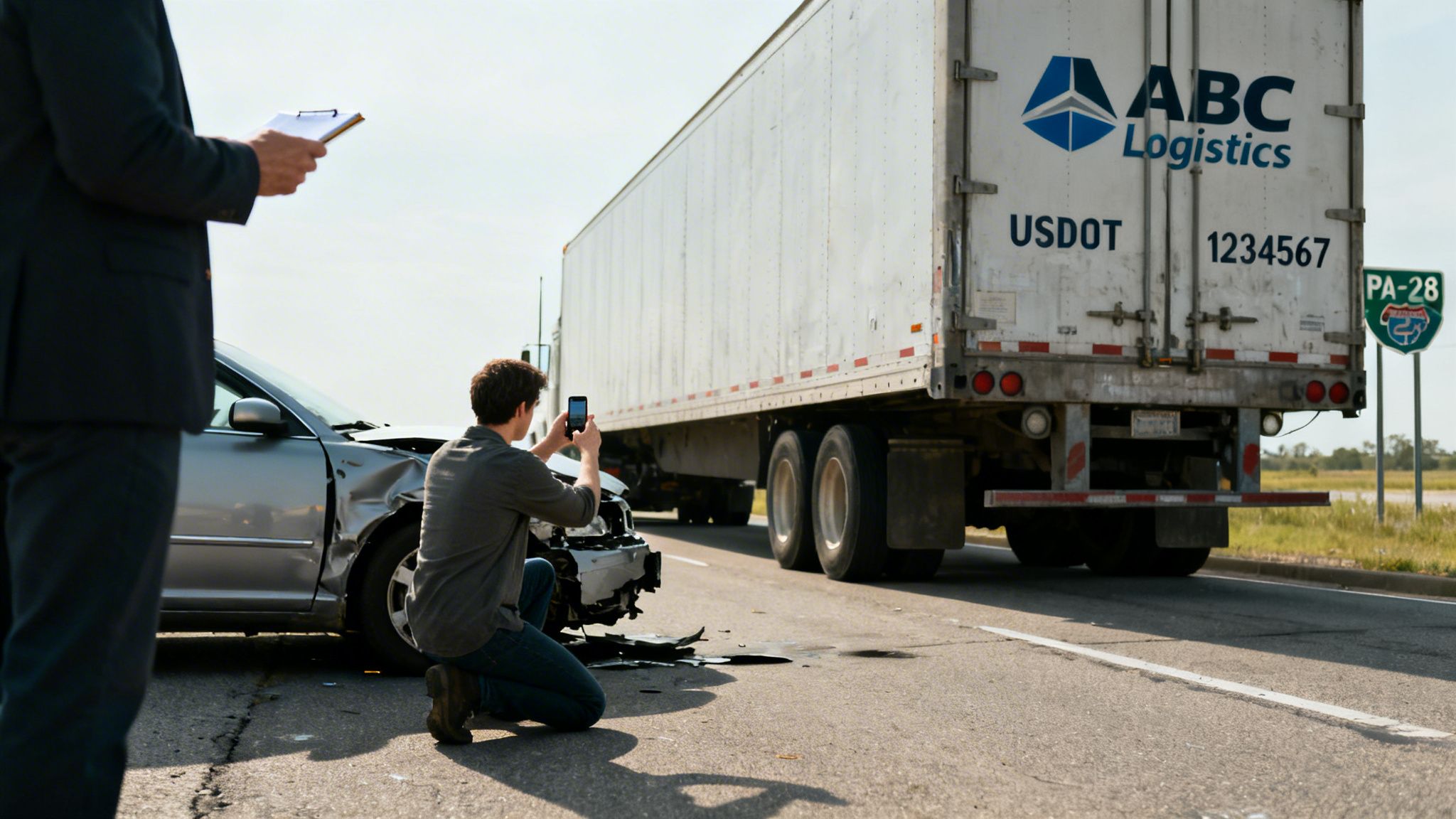
The moments after a crash with a semi-truck are disorienting. Adrenaline is pumping, which can easily mask serious injuries, and your head is spinning. But what you do right here, right now, matters immensely for both your health and any future legal claim you might have.
Your first job is to take care of yourself. Let the paramedics check you out, even if you feel fine. I can't tell you how many clients have walked away from a crash feeling okay, only to wake up the next day in severe pain. Soft tissue damage, concussions, and even internal bleeding don't always show up right away.
When you call 911, be sure to tell them a commercial truck is involved. This is a key detail that triggers a specific response.
Turn Into Your Own Investigator at the Scene
After you've handled your immediate safety, your smartphone is your best friend. Start taking pictures and videos of everything. You’re creating a permanent, unbiased record of the scene before it gets cleaned up.
Try to capture these specific details:
- The Big Picture: Get wide shots showing where the vehicles ended up, the flow of traffic, any stop signs or traffic lights, and the general layout of the road.
- The Commercial Truck: Take photos of the truck and trailer from every angle. Zoom in on the company name, DOT numbers, and license plates. This is critical for identifying exactly who is responsible.
- All Vehicle Damage: Document the damage to your car and the truck, taking both close-up shots and photos from further away to show the full extent.
- The Road Itself: Snap pictures of any skid marks, debris, potholes, or poor weather conditions like rain or ice. This evidence can disappear fast.
Think of it this way: your photos and videos freeze the scene in time, preserving details that an official investigation might miss.
Choose Your Words Carefully and Collect Information
Your conversations with the truck driver, witnesses, and the police are just as important as the photos you take. You need to be cooperative, but also very guarded.
Never, ever apologize or say anything that sounds like you’re admitting fault. Even a simple "I'm sorry this happened" can be twisted by an insurance company to mean you took the blame. Stick to exchanging the basics with the driver: name, contact info, and their insurance carrier.
Crucial Tip: The trucking company’s insurance adjuster will likely call you, maybe even at the scene. Do not give them a recorded statement. Their job is to find any reason to pay you as little as possible. Just politely decline and tell them your attorney will be in touch.
When the police arrive, give them a straight, factual account of what happened. Only state what you know for sure—don't guess about things like speed or exact distances. If anyone stopped to help, get their name and phone number. A good witness is worth their weight in gold because their story is seen as completely neutral.
Taking these steps lays the foundation for your case and helps answer the crucial question of who pays for medical bills after a truck accident. You’re protecting your health and your legal rights from the very start.
Why Truck Accident Claims Are So Complex
When you’re hit by a commercial truck in Pennsylvania, the aftermath is nothing like a typical car crash. The sheer physics of an 80,000-pound rig colliding with a passenger vehicle almost always results in catastrophic damage.
But the legal battle that comes next is just as overwhelming. These cases are layered with complexities you just don’t see in a standard fender bender.
In a normal car accident, you’re usually dealing with one other driver and their insurance company. After a truck wreck, the web of who could be at fault is much wider and far more tangled. It almost always extends well beyond the person who was behind the wheel.
Multiple Companies Can Be at Fault
Figuring out who’s really to blame means launching an immediate, aggressive investigation. It’s not just about the driver. Several different companies could have played a role, and each one will have its own insurance carrier and legal team ready to point the finger somewhere else.
Here are some of the parties we investigate right away:
- The Truck Driver: Was the driver tired, distracted, speeding, or under the influence? Their logbooks, driving record, and toxicology reports are often ground zero for the investigation.
- The Trucking Company: Did they hire a driver with a bad record? Did they cut corners on maintenance or push their drivers to break safety rules to meet deadlines? This is a huge factor.
- The Cargo Loader: If the cargo inside the trailer was loaded incorrectly, it can shift and cause the driver to lose control. The company that loaded the freight could easily be responsible.
- The Truck Manufacturer: A defect in the truck’s brakes, tires, or steering system can lead to sudden mechanical failure. When that happens, the manufacturer of the truck or its parts may be on the hook.
Identifying these players is just the first step. Proving they were negligent requires a deep understanding of the trucking industry and its rules. You can find more on this in our guide to the differences between truck and car accidents in Pennsylvania.
Federal Rules and Corporate Pressure
The trucking industry is governed by a thick book of federal laws called the Federal Motor Carrier Safety Regulations (FMCSA). These rules control everything from how many hours a driver can be on the road (hours-of-service) to mandatory vehicle inspections and driver training files.
A classic scenario we see all the time is a trucking company pushing a driver to "bend the rules" to make a tight delivery schedule. This pressure leads directly to drivers skipping mandatory rest breaks, faking their logbooks, and driving while dangerously fatigued.
This kind of corporate negligence is a powerful factor in many truck accident cases. When drivers ignore hours-of-service rules, get distracted, or speed to make up time, these massive trucks become ticking time bombs.
The tragic results show up in PennDOT’s statistics. In 2022 alone, there were 7,522 tractor-trailer collisions on Pennsylvania roads. Those crashes led to 110 deaths—a five-year high for fatal heavy truck accidents in the state.
The Insurance Company Is Already Working Against You
Maybe the biggest challenge is the immediate and aggressive response from the trucking company and its insurer. They are not waiting around for you to call a lawyer. Often, within hours of a serious crash, they have their own rapid-response team on the way to the scene.
This team, which usually includes investigators and lawyers, has one job: to control the story and minimize how much money their company has to pay.
They’ll be looking for any scrap of evidence to shift blame onto you, getting statements from witnesses before you can, and trying to secure critical evidence like the truck’s "black box" data for themselves. These are professionals paid to protect their company’s bottom line. It’s exactly why you need an experienced advocate fighting for you from day one.
Building a Powerful Evidence File for Your Claim
The moment a commercial truck collides with your vehicle, the clock starts ticking. Before the scene is even cleared, the trucking company and its insurance carrier are already in motion, building a defense designed to minimize or deny your claim. To level the playing field, you and your attorney need to build a stronger, evidence-backed case.
A successful truck accident claim is won with undeniable proof. It’s not just about what happened, but why it happened. And some of the most powerful proof is digital, locked away inside the truck itself.
Think of it like an airplane’s "black box." Every modern commercial truck has an Electronic Logging Device (ELD) and an Engine Control Module (ECM) that record a goldmine of data. This isn't just a simple GPS log. These devices capture a second-by-second story of the truck's speed, when—or if—the driver hit the brakes, and whether they were driving longer than the law allows. It's an objective account of the final moments before the crash.
Securing Critical Trucking Company Records
That black box data is just the tip of the iceberg. The trucking company's offices hold a treasure trove of documents that can expose a history of negligence, but this evidence won't just be handed over. In fact, it can be legally destroyed if you don’t move fast.
This is why one of the very first things we do is send a spoliation letter. This is a formal legal demand that puts the trucking company on notice, legally requiring them to find and preserve every piece of potential evidence related to the crash. Without this letter, they could simply follow a routine document destruction schedule, and crucial proof could be gone for good.
This legal notice demands they save things like:
- Driver Qualification File: This file contains the driver’s entire professional history, from their job application and training records to their driving record (MVR) and any past violations.
- Maintenance and Repair Logs: Were the truck’s brakes inspected regularly? Were the tires in good condition? These records can tell us if a mechanical failure was a ticking time bomb.
- Hours-of-Service (HOS) Logs: This is the data from the ELD, proving whether the driver was drowsy and violating federal laws by driving too many hours.
- Post-Accident Drug and Alcohol Test Results: Federal rules mandate these tests after any serious or fatal accident. The results are critical.
- Bills of Lading and Dispatch Records: These documents show the cargo, the delivery schedule, and can reveal if the driver was under immense pressure to speed.
A spoliation letter is a shot across the bow. It tells the trucking company and its insurer, "We know what evidence you have, we know the rules, and you are now legally obligated to preserve it." If they ignore this demand, they can face serious penalties in court—sometimes the judge will even instruct the jury to assume the destroyed evidence would have hurt their case.
The diagram below shows just how many players get involved in a typical trucking claim, which is why securing evidence from every source is so essential.
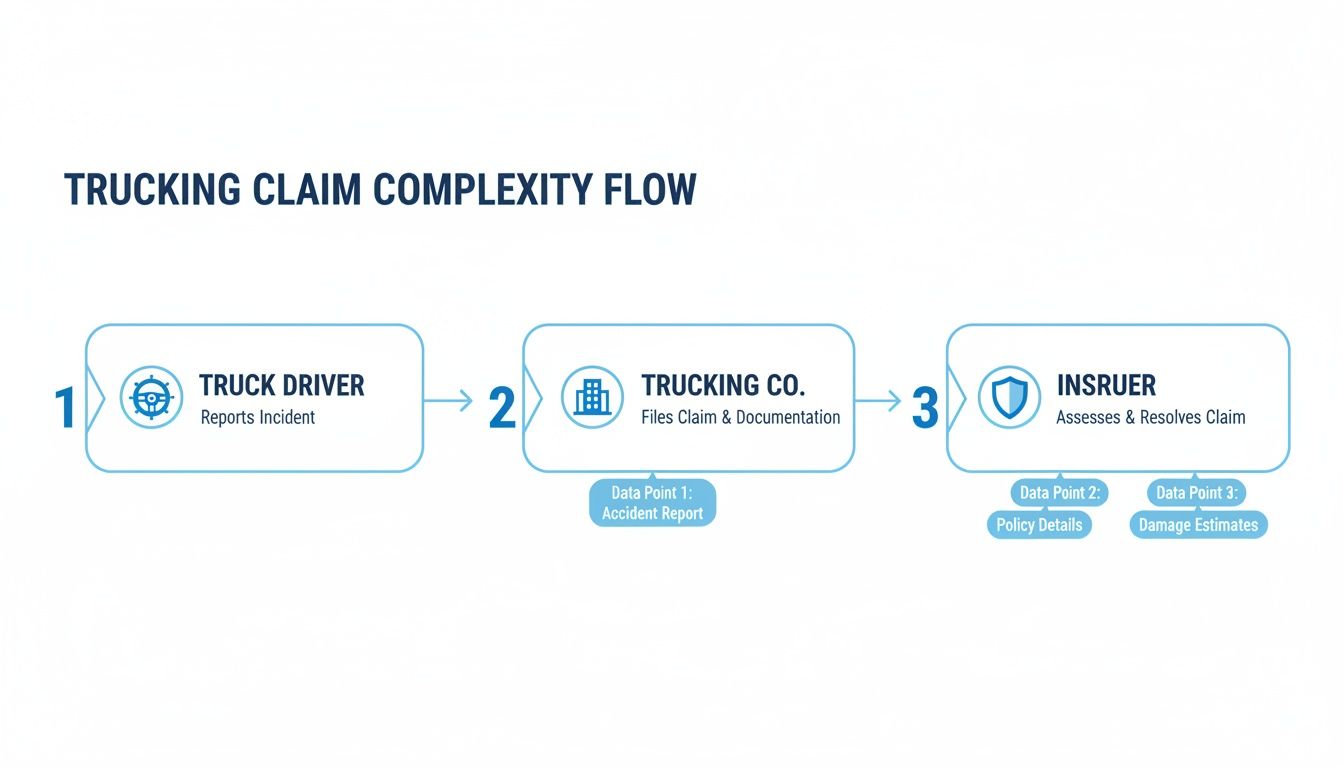
As you can see, a claim winds its way from the driver to their employer and then to a massive insurance company, with legal and procedural hurdles at every step.
To build a compelling case, your attorney will methodically gather specific pieces of evidence that connect the dots between the trucking company’s actions and your injuries.
Critical Evidence for Your Pennsylvania Truck Accident Claim
This checklist outlines the essential evidence your attorney will gather to build a compelling case against the trucking company and its insurer.
| Evidence Category | Specific Items to Secure | Why It's Crucial for Your Case |
|---|---|---|
| The Driver | Driver Qualification File, drug & alcohol test results, driving record (MVR), and personal logbooks. | Reveals the driver's history, training (or lack thereof), and whether they were impaired or had a pattern of unsafe driving. |
| The Truck | ELD/ECM data ("black box"), maintenance logs, inspection reports, and repair records. | Provides an objective account of speed, braking, and hours on the road. It can also prove the company neglected critical repairs. |
| The Company | Dispatch records, bills of lading, driver communication logs, and internal safety policies. | Exposes company practices, such as pressuring drivers to speed or violating federal safety regulations to increase profits. |
| The Crash Scene | Police accident report, photos/videos from the scene, witness statements, and expert accident reconstruction analysis. | Establishes the core facts of how the collision occurred and helps counter any attempt by the defense to shift blame. |
Each piece of this evidence tells part of the story. When woven together, they create a powerful narrative that insurance companies and juries can’t ignore.
Your Role in Documenting the Aftermath
While we focus on the trucking company, you have an equally critical role: documenting the human cost of the collision. The insurance company has a file on you; it’s time to build your own.
Don't rely on your memory—it fades. Start a journal as soon as you can. This isn’t just about keeping notes; it's about creating a detailed record of how this accident has torn through your daily life.
Think of it as your personal impact statement. Here’s what to track:
- Your Medical Journey: List every doctor's appointment, therapy session, and procedure. Note the date, the provider, and your key takeaways from the visit.
- Your Pain and Symptoms: On a regular basis, describe what you're feeling. Use a 1-10 pain scale, but also describe the type of pain—is it a sharp, shooting pain or a dull, constant ache?
- Your Daily Life Disruptions: This is huge. Write down every way your injuries get in the way of normal life. Can you no longer lift your child? Is it a struggle to walk the dog, do laundry, or enjoy a hobby you once loved? Be specific.
This journal becomes the voice of your experience. It transforms your "pain and suffering" from a vague legal term into a concrete, undeniable reality that medical bills alone can never show.
Navigating Pennsylvania's Specific Accident Laws
When a commercial truck hits you in Pennsylvania, it's not enough to just gather evidence. You have to understand the state’s specific legal rules, because they set the stage for your entire case. These aren't just minor details—they directly control whether you can get money for your losses. Two rules in particular are absolutely critical to know from day one: the statute of limitations and the comparative negligence doctrine.
First off, there’s a clock ticking. In Pennsylvania, you have just two years from the date of the accident to file a personal injury lawsuit. This is called the statute of limitations. Two years might sound like a lot, but in a complex truck accident case, it’s a sprint. Investigating the crash, gathering all the evidence, and dealing with insurers can burn through that time faster than you'd believe.
Miss that two-year window, and the courthouse doors slam shut. It doesn't matter how badly you were hurt or how clear the trucking company's fault is. They won't have to pay you a dime. This deadline is unforgiving, which is why acting fast is so important.
How Fault Is Shared in a Pennsylvania Truck Accident
Another critical law is Pennsylvania's modified comparative negligence rule. This rule comes into play when both sides might be partially to blame for the crash. It's a system insurance companies love to use to their advantage.
The rule says you can still get paid for your damages as long as you are found to be 50% or less at fault for what happened. But here's the catch: your total compensation gets reduced by your percentage of fault.
Let's break that down with a real-world example:
- Say a jury decides your total damages are $500,000.
- But the insurance company convinced them you were partially to blame, and the jury assigns you 20% of the fault.
- Your final award is then cut by that 20% ($100,000), meaning you walk away with $400,000.
But this is where the rule gets brutal. If you're found to be 51% or more at fault, you're completely barred from recovering any money. You get nothing. Insurance adjusters know this inside and out, and they will work hard to pin as much blame on you as possible to either shrink their payout or avoid it completely.
These collisions are incredibly dangerous, and the state's own data proves it. In 2022, Pennsylvania's roads were the scene of a shocking 8,223 heavy truck accidents, which led to 164 fatalities. These numbers show just how much risk these commercial vehicles add to our roads. You can see more details in these Pennsylvania truck accident statistics on phillylaw.com.
Dealing With Powerful Insurance Carriers
Trying to navigate insurance policies after a truck accident is like walking through a minefield. Trucking companies are backed by massive commercial policies and armies of experienced adjusters and lawyers whose only job is to protect the company's bottom line.
They will pick apart every detail, searching for any small inconsistency in your story or any admission that could be twisted to assign you fault under the comparative negligence rule. This is why having an experienced lawyer in your corner is so critical. We handle all communications, shielding you from their tactics and making sure you don't accidentally say something that could torpedo your own claim. For a closer look at these issues, you can check out our guide on Pennsylvania truck accident laws.
Calculating the Full Value of Your Truck Accident Claim
After getting hit by a commercial truck in Pennsylvania, that first settlement offer from the insurance company can feel like a lifeline. But here's the hard truth: that first offer is almost always a lowball.
Real compensation isn’t just about covering your first round of medical bills. It’s about making sure you’re financially secure for the long road ahead—which could mean years, or even a lifetime, of challenges. Figuring out what your claim is truly worth is a detailed process, and it goes way beyond just adding up receipts.
Tallying the Tangible Costs or Economic Damages
These are the straightforward, calculable financial losses you’ve suffered because of the crash. Think of them as anything that comes with a price tag. While they seem simple on the surface, projecting them accurately into the future takes real expertise.
This category is a complete accounting of every dollar the accident has cost you and will continue to cost you for years to come.
These costs typically cover:
- All Medical Care (Past and Future): This is the biggest piece of the puzzle for most victims. It covers everything from the ambulance ride and hospital stays to surgeries, specialist appointments, and prescriptions.
- Rehabilitation and Therapy: Serious injuries often demand long-term physical, occupational, or vocational therapy. These sessions are absolutely essential for your recovery and for regaining strength after surgery or a life-altering injury.
- Lost Wages and Income: This is the money you lost from being out of work while you recovered. We prove this with pay stubs, employment records, and tax returns.
- Loss of Earning Capacity: This is a forward-looking calculation, and it's a huge deal. If your injuries stop you from returning to your old job or force you into lower-paying work, this is what compensates you for that difference over your lifetime.
Imagine a construction worker who suffers a severe back injury. He can no longer handle the physical demands of his job and has to switch to a desk job that pays $30,000 less per year. If he had 20 years left until retirement, his loss of earning capacity could easily top half a million dollars. This is exactly why we bring in vocational and financial experts to project these long-term losses down to the dollar.
Valuing the Human Cost or Non-Economic Damages
While economic damages cover your financial losses, non-economic damages are meant to compensate for the immense human cost of the crash. These are the losses that don't come with a receipt but are every bit as real and devastating.
In Pennsylvania, these damages are a critical part of your claim. They acknowledge that your life has been fundamentally changed and that your suffering has a real, compensable value.
This is where keeping a personal injury journal becomes so powerful. It provides a day-to-day account of your struggles that we can use to show what you've been through. The scale of these losses often mirrors the sheer violence of the crash itself. In Pennsylvania, large trucks are involved in over 6,000 crashes each year, and the impact is devastating. State data shows 164 deaths resulted from 8,223 heavy truck crashes in 2022 alone. You can dig deeper into these sobering figures by reviewing Pennsylvania truck accident statistics.
The most common types of non-economic damages include:
- Pain and Suffering: This compensates for the physical pain, discomfort, and emotional distress you endure from your injuries, both now and in the future.
- Loss of Enjoyment of Life: This is about your inability to participate in hobbies, activities, and life experiences you once loved. A passionate gardener who can no longer kneel in their garden, or a parent who can't lift their child, has suffered a profound and very real loss.
- Disfigurement and Scarring: Visible scars or physical deformities can cause significant emotional distress, embarrassment, and a loss of self-confidence.
- Emotional Trauma: This covers conditions like anxiety, depression, insomnia, and PTSD that frequently follow a violent and traumatic truck wreck.
There’s no simple formula for calculating these damages. It takes a skilled lawyer to build a compelling narrative that shows a jury or an insurance adjuster the true, human impact of the crash. We do this by weaving together your story, testimony from family and friends, and expert medical opinions to paint a clear, undeniable picture of everything you have lost.
Why a Trial-Ready Lawyer Makes All the Difference

When you’ve been hit by a commercial truck in Pennsylvania, you’re not just up against a driver. You’re facing a massive corporation and its insurance company—and they have a whole team of lawyers whose only job is to protect their bottom line.
This isn't a fair fight. They have deep pockets and a clear playbook: pressure you into accepting a fast, lowball offer while you're still hurt and overwhelmed.
To level the playing field, you need more than just any lawyer. You need an advocate who prepares every single case as if it's headed to trial, right from day one.
The Power of a Trial-Ready Approach
This "trial-ready" mindset changes everything. It sends a clear message to the trucking company and its insurer: you’re serious, and you won’t be pushed around.
When they see your attorney digging for evidence, hiring top-tier experts, and building an airtight case for a jury, their whole calculation shifts. Suddenly, the thought of a long, expensive court battle—one they could very well lose—starts to look a lot worse than just offering a fair settlement.
This approach isn’t about being aggressive for the sake of it. It’s about being so thoroughly prepared that the other side knows a lowball offer is just a waste of everyone's time. An attorney who only focuses on settling quickly can leave a lot of money on the table. A true trial lawyer knows the best settlements are often secured on the courthouse steps, precisely because they are ready and willing to walk inside and fight.
What to Look for in a Pennsylvania Truck Accident Lawyer
Choosing the right lawyer is the single most important decision you'll make for your case. This isn't like a standard car accident claim. Truck accident litigation is a highly specialized field, and not every personal injury attorney has the right skills or resources.
Here’s what really matters when you’re making your choice:
- A Proven Track Record in Truck Litigation: Don't be afraid to ask for specific results. Have they actually taken on major trucking companies? Do they have a history of securing multi-million dollar verdicts and settlements in cases like yours?
- Deep Knowledge of Trucking Laws: Your lawyer has to be an expert in both federal FMCSA regulations and Pennsylvania's specific traffic laws. They need to know the rules on hours-of-service, vehicle maintenance, and driver qualifications cold.
- The Resources to Go the Distance: Fighting a trucking giant costs money. A top firm will have the financial strength to hire the best accident reconstructionists, medical experts, and economists needed to build your case without cutting corners.
You are not just hiring a lawyer; you are partnering with an advocate who will become your voice. This person should be directly accessible to you, providing clear explanations and consistent updates so you are never left in the dark.
The Client Protection of a Contingency Fee
It’s completely understandable to worry about the cost of hiring a top-tier lawyer, especially when you’re out of work and medical bills are piling up. That’s exactly why the best personal injury lawyers work on a contingency-fee basis.
This arrangement is simple: you pay no upfront costs or legal fees. Your attorney’s fee is just a percentage of the compensation they recover for you. If they don’t win your case, you owe them nothing.
This "no-win, no-fee" structure does two important things. First, it gives everyone access to the best legal help, no matter their financial situation. Second, it shows your lawyer is confident in your case and fully invested in getting the best outcome. They’re taking on all the financial risk because they believe in you and your right to justice.
Your Top Questions About Pennsylvania Truck Accidents Answered
When you’ve just been in a crash with a commercial truck, your head is spinning with questions. Here are the straightforward answers to the questions we hear most often from people in your exact situation.
How Long Do I Have to File a Truck Accident Lawsuit in Pennsylvania?
You have a two-year window. That’s it. In legal terms, this is called the statute of limitations, and it’s a hard deadline starting from the date of the crash.
This isn't something you can get an extension on. If you miss that two-year mark, the courts will almost certainly throw out your case, no matter how badly you were hurt or how clear the truck driver’s fault was.
Should I Talk to the Trucking Company's Insurance Adjuster?
No. Do not give a statement, recorded or otherwise, to the trucking company’s insurance adjuster. Their job is to save their company money, period.
They are trained to ask tricky questions designed to get you to say something that hurts your claim. They might sound friendly, but they are not on your side.
Let your attorney handle all communications. This is your best defense. A simple, polite, "My lawyer will be in touch," is all you need to say.
What if I Was Partially at Fault for the Accident?
This is a common worry, but it doesn't automatically kill your case. Pennsylvania follows what’s called a "modified comparative negligence" rule.
It works like this: you can still recover money as long as you are found to be 50% or less at fault for the crash. Your final compensation will simply be reduced by your percentage of fault. So, if you were found 10% at fault, your award is reduced by 10%. But if a jury decides you were 51% or more to blame, you get nothing.
If you were hit by a commercial truck in Pennsylvania, you shouldn’t have to fight this battle on your own. At Mattiacci Law, we prepare every single case as if it's going to trial, fighting to get you the full and fair compensation you deserve.
For a free, no-strings-attached consultation to go over your case, contact us today at https://jminjurylawyer.com.