


Author: John Mattiacci | Owner Mattiacci Law
Published April 13, 2026
You got through the accident, went home, and thought the worst was over. Then your ankle, knee, wrist, or leg started to swell. Maybe it happened that night. Maybe it showed up the next morning when the adrenaline wore off. Now you're wondering whether it's a normal bruise, a sign of something serious, or a problem the insurance company will later claim “couldn’t have been from the crash.”
That concern is justified.
In Philadelphia, injury cases are common, and serious ones are not rare. Philadelphia County recorded 20,175 total hospitalizations from injuries, including 1,141 from auto accidents in the most recent hospitalized injury profile available for the county (Reiff Law Firm). Swelling after an accident can be minor. It can also be your first visible sign of a fracture, internal bleeding, vascular injury, or a soft tissue injury that insurers love to minimize.
If you're dealing with Swelling After Injury From Accident in Philly, your job is simple. Protect your health first. Then create a record that makes it hard for an adjuster to twist the facts later.
Your First Response to Post-Accident Swelling
A lot of clients describe the same sequence. They exchange information, talk to police, tell everyone they’re “shaken up but okay,” and get home. A few hours later, they can’t get their shoe on. Their knee stiffens. Their wrist starts puffing up. By morning, the swollen area looks different enough that they know something’s wrong.
That delay doesn’t make your injury less real.

What you should do in the first hours
Start with the basics.
- Get off the injured area: If putting weight on it makes the swelling worse, stop pushing through it.
- Take photos right away: Even if the swelling seems mild, capture what it looks like at the start.
- Write down the timeline: Note when the accident happened, when swelling first appeared, and what changed.
- Seek medical evaluation when symptoms are building: If you’re unsure how quickly to act, this practical guide on when to see a doctor after a car accident is useful because it frames the issue the right way. Early medical care protects both your recovery and your claim.
Practical rule: If swelling is new, visible, and tied to a recent accident, treat it as evidence and as a medical symptom. It’s both.
The mistake that hurts people twice
The biggest early mistake is assuming swelling is “just soreness.” That costs people in two ways.
First, the injury may worsen without proper care. Second, the insurance carrier may later argue that if you were really hurt, you would’ve done something sooner.
You don’t need to panic. But you do need to act with purpose. The first 48 hours matter because that’s when symptoms often become clearer, treatment decisions start, and the paper trail begins.
Immediate At-Home Care for Minor Swelling
Not every swollen joint or limb means you need an ambulance. If the swelling is mild, you’re able to move the area carefully, and you don’t have emergency warning signs, start with RICE. That means rest, ice, compression, and elevation.
The point isn’t to “tough it out.” The point is to calm the initial inflammation while you watch the injury closely.
How to use RICE correctly
Here’s what usually works best for minor post-accident swelling at home:
Rest
Stop the activity that triggered pain or increased swelling. If your knee buckled in a fall or your wrist slammed into a steering wheel, don’t keep testing it every hour to see if it’s “better now.”
Ice
Apply cold to the swollen area in short intervals. Use a wrapped ice pack, not direct ice against the skin.
Compression
A snug elastic wrap can help control swelling. It should feel supportive, not tight enough to create numbness, tingling, or color change.
Elevation
Raise the injured area above heart level when you can. Gravity helps reduce fluid buildup.
What works and what doesn’t
A few real-world trade-offs matter here.
| Approach | Usually helps | Usually backfires |
|---|---|---|
| Rest | Reduces aggravation of injured tissue | “Testing” the injury over and over |
| Ice | Helps in the early period after injury | Sleeping with ice on the skin |
| Compression | Useful if it supports without constricting | Wrapping so tightly that fingers or toes tingle |
| Elevation | Helpful for ankles, feet, knees, and lower legs | Sitting upright all day with the limb dependent |
Keep watching, not guessing
Minor swelling can settle with time and basic care. But if it gets larger, hotter, darker, or more painful, stop treating it like a routine bruise.
A home-care plan is only appropriate when symptoms stay mild and stable. The moment they don’t, the plan changes.
Don’t medicate yourself into ignoring the problem. Pain relief may reduce discomfort, but it won’t tell you whether you’re dealing with a torn ligament, fracture, or something deeper under the surface.
Red Flags That Require a Trip to the Emergency Room
Swelling becomes an emergency when it points to a dangerous underlying injury. That’s the issue people miss. They focus on the puffiness itself when they should be asking what’s causing it.
After a crash or other trauma, swelling can signal deep vein thrombosis, internal bleeding, fractures, or Morel-Lavallée lesions, which are closed degloving injuries often found in the hip region (30.4%) and thigh (20.1%) after high-impact trauma (Reiff Law Firm).
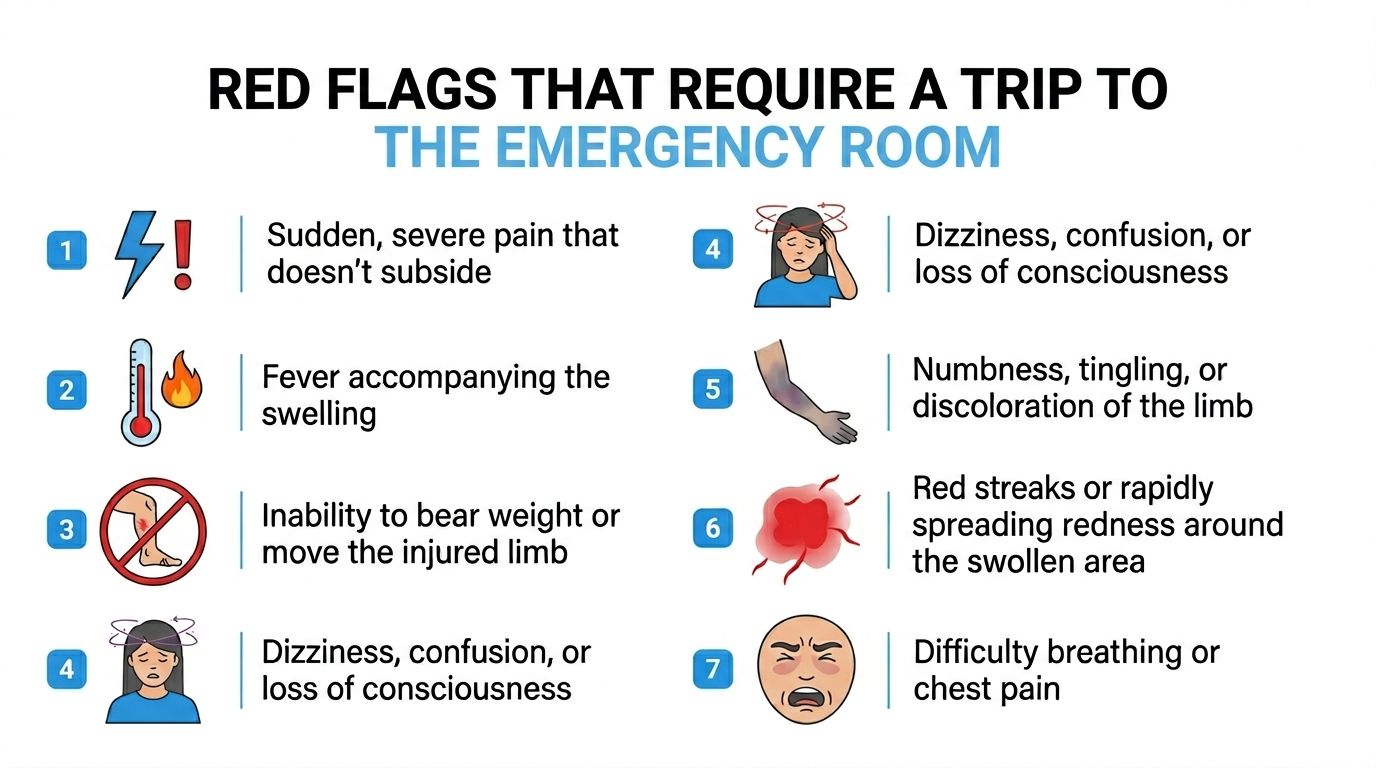
Go to the ER if you have these warning signs
- Rapid swelling: If the area balloons quickly after the accident, that can point to significant structural damage.
- Heat, redness, or unusual warmth: Especially in a leg, that can raise concern for a blood clot or infection.
- Skin discoloration: Darkening, redness, or patchy color changes need attention.
- Severe pain or increasing pressure: Pain that keeps rising instead of easing is a bad sign.
- Numbness or tingling: That can mean nerve involvement or compromised circulation.
- Inability to bear weight or use the limb: Don’t “walk it off” if your body clearly won’t let you.
- Chest pain or trouble breathing: If swelling is connected to a possible clot, this becomes an emergency fast.
Why leg swelling deserves extra caution
When swelling affects the calf, thigh, or whole leg after an accident, be careful. A clot can form after vessel injury or immobility. If that clot breaks loose and travels to the lungs, it can cause a pulmonary embolism, which is life-threatening.
That’s why sudden leg swelling after a car crash is never something I tell people to casually monitor for a week.
The injury many people have never heard of
A Morel-Lavallée lesion is one of the more overlooked post-traumatic injuries. It happens when shearing force separates tissue layers and creates a fluid collection. It may not look dramatic at first, and that’s part of the problem.
If swelling sits over the thigh, hip, pelvis, or knee after a hard impact and doesn’t behave like a simple bruise, ask whether deeper imaging is needed.
The ER is not just for broken bones sticking out of the skin. It’s for situations where the swelling is warning you that something serious may be happening underneath.
How to Document Swelling for Your Philly Injury Claim
Insurance companies downplay what they can’t neatly see on an X-ray. Swelling creates a visible timeline. If you document it properly, that timeline becomes evidence.
Because post-injury swelling usually peaks within 48 to 72 hours, medical records that track that progression help link the injury to the accident and counter disputes about timing and causation (JM Injury Lawyer).

Build a record an adjuster can’t easily dismiss
Do these things in a disciplined way:
- Photograph the injury daily: Use the same angle, similar lighting, and include something for scale if possible.
- Measure the area: A soft tape measure around a calf, knee, ankle, wrist, or forearm can show change over time.
- Log the details: Write down pain, stiffness, warmth, bruising, and whether the swelling spreads.
- Record function loss: Note if you can’t climb stairs, grip tools, kneel, drive, or stand through a shift.
- Match symptoms to dates: If the swelling worsened the day after the accident, write that down precisely.
What insurers usually argue
When swelling appears after the scene, carriers often make one of three arguments:
| Insurance argument | What your documentation does |
|---|---|
| “You weren’t hurt that badly.” | Shows visible progression over time |
| “It started too late to be from the accident.” | Connects symptom onset to the event in a dated timeline |
| “There’s no objective proof.” | Combines photos, measurements, and medical notes into objective support |
Use your medical visits strategically
When you see a doctor, don’t just say “it hurts.” Be specific.
Say where the swelling is, when it started, whether it increased, whether the skin is warm, whether you can bear weight, and what daily tasks you can’t do now. Ask the provider to note those details in the chart.
For a broader checklist on preserving proof after a crash, this guide on how to document evidence after a car accident is worth reviewing.
Medical care treats the injury. Medical records explain the injury. For a claim, you need both.
If you leave the timeline vague, the insurer will fill in the gaps in a way that helps them. Don’t hand them that opportunity.
Understanding Your Recovery Timeline and Potential Complications
Recovery rarely moves in a straight line. A lot of people expect swelling to steadily go down every day. That isn’t how it always works.
Pain and swelling can build after trauma because the body is dealing with more than surface bruising. There’s a secondary injury process where bleeding, inflammation, pressure, and reduced blood flow can worsen tissue damage after the initial event. That’s one reason symptoms can intensify over the following days instead of fading immediately (PubMed Central).
What a normal course may look like
A useful baseline for swelling is this:
- Minor injuries: often settle within a few days
- Moderate injuries: may last longer and interfere with movement
- Severe injuries: can persist for weeks and usually require active medical management
If you want a practical overview of expected duration, this page on how long swelling should last after injury lays out the timeline clearly.
When swelling becomes a long-term problem
Some people improve and move on. Others don’t.
Research cited in Philadelphia accident guidance states that 21% of car accident victims experience clinically significant pain up to six months after the accident, and long-term conditions such as post-traumatic arthritis can cause ongoing pain, stiffness, and swelling (Philly Personal Injury Lawyer).
That matters if your swelling keeps returning, never fully resolves, or comes with stiffness and reduced range of motion.
Problems that need follow-up, not patience
Watch for patterns like these:
- Persistent joint swelling: especially in a knee, ankle, or wrist that still isn’t functioning well
- Burning pain with swelling: this can point toward nerve-related complications
- Temperature change and severe sensitivity: rare, but concerning for conditions such as CRPS
- Swelling tied to activity months later: often means the injury didn’t fully heal or was more serious than first thought
Healing that stalls out deserves a second look. “Give it more time” is not always good advice.
Clients get frustrated in this situation. They’re told the fracture healed or the scan looked “fine,” yet their body is still telling a different story. If that’s happening, don’t minimize it. Ongoing swelling can support a claim for future treatment, work disruption, and long-term pain if the medical evidence is built correctly.
When and Why to Call a Philadelphia Injury Lawyer
You should call a lawyer when swelling is affecting treatment, work, mobility, or the way the insurer is handling your claim. You don’t need to wait until the case is a mess.
Pennsylvania insurers use delayed-onset swelling as a reason to deny or lowball soft tissue claims, and one cited source reports that Pennsylvania courts upheld higher awards in 22% more soft tissue cases in 2024 to 2025 when delayed proof was presented (Brandon J. Broderick). That doesn’t mean every delayed-swelling case wins. It means proof matters.
The right time to get legal help
Call sooner rather than later if:
- The insurer is questioning causation: They’re saying the swelling started too late or came from something else.
- Your records are incomplete: A lawyer can help identify what medical documentation is missing.
- You’ve missed work or physical duties: Lost wages and functional limits need to be framed properly.
- The injury involves ongoing care: Follow-up imaging, specialists, or long-term symptoms change case value.
- The adjuster is pushing a quick settlement: Fast money usually arrives before the full injury picture does.
What legal representation changes
A lawyer doesn’t make swelling disappear. A lawyer helps make sure the record reflects what happened.
That means organizing your photos, treatment chronology, work restrictions, and provider notes into one coherent causation story. It may also mean working with medical experts or reconstruction professionals when the insurer keeps pretending a “soft tissue” case must be minor.
For people dealing with any claim where medical proof and functional loss are central, this discussion of the importance of legal representation is useful because it shows a broader truth. Documentation alone isn’t enough if nobody presents it effectively.
If you’re weighing whether it makes sense to involve counsel, this page on should I get a lawyer after an accident in Philly addresses the practical side of that decision.
One option is Mattiacci Law, a Philadelphia-based personal injury firm that handles accident claims involving medical documentation disputes, insurer negotiations, and litigation when needed.
The bottom line is simple. If your swelling has become a point of medical concern or an excuse for the insurance company to pay less, legal help stops being optional strategy and starts becoming protection.
If you’re dealing with swelling after an accident and you’re getting mixed messages from doctors, adjusters, or your own body, talk to Mattiacci Law. The firm handles Philadelphia injury cases involving car crashes, truck accidents, construction injuries, and other serious claims, and can review how your symptoms, records, and timeline affect your right to compensation.