

Author: John Mattiacci | Owner Mattiacci Law
Published January 22, 2026
When a car crash isn’t clear-cut, the first question is always the same: what happens if both drivers are at fault in Pennsylvania?
The short answer is you can still recover money for your injuries, but only if you are found 50% or less responsible for the accident. This is the core of Pennsylvania’s shared fault system, and understanding it is critical to protecting your rights.
Your First Question: What Happens When Both Drivers Share Blame?
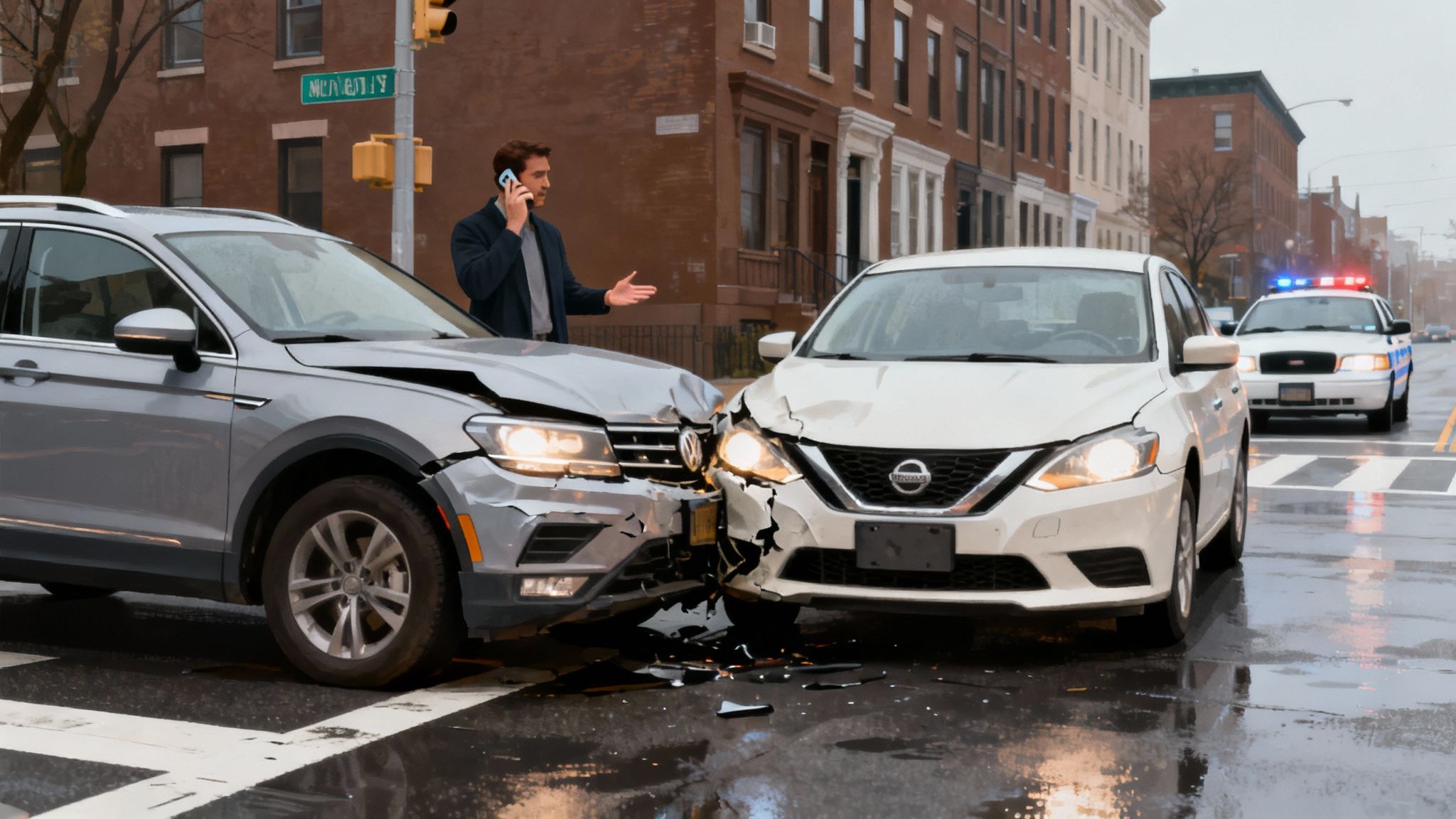
The moments after an accident are pure chaos. On top of the shock and potential injuries, there’s the gnawing uncertainty when it’s not obvious who caused the crash. A lot of people mistakenly believe that if they’re even a little bit to blame, they can’t get any compensation.
Fortunately, that’s not how it works in our state.
Pennsylvania law uses a system called modified comparative negligence. The best way to think of it is a pie chart of responsibility. After a crash, insurance companies and courts will try to figure out what percentage of the blame each driver deserves. That percentage has a massive impact on your case.
The 51% Bar Rule Explained
Here’s the most important piece of the puzzle: Pennsylvania has a strict 51% threshold. As long as your share of the fault is 50% or less, you are legally entitled to recover damages from the other driver.
But the moment your responsibility is calculated to be 51% or more, you are completely barred from getting a single dollar from them.
This rule creates a high-stakes situation where a single percentage point can be the difference between a fair recovery and getting nothing at all. Let’s say your damages—medical bills, lost wages, and pain—total $100,000. If you’re found 20% at fault, you can still collect $80,000. But if that fault number ticks up to 51%, your recovery drops to zero.
A Common Philadelphia Scenario
Picture this: you’re making a left turn at a busy intersection in Center City. The light turns yellow, and you start your turn, but an oncoming car barrels through the intersection and hits you. In a situation like this, fault is rarely black and white.
A jury or insurance adjuster might decide:
- You are partially at fault for turning when the path wasn’t completely clear.
- The other driver is partially at fault for speeding up to try and beat the red light.
They would then dig into the evidence—traffic camera footage, witness accounts, the police report, and the damage to the vehicles—to assign a percentage of fault to each of you. It’s a detailed investigation, not a simple blame game. You can learn more about Pennsylvania’s specific car accident laws and what to know to see how these factors come into play.
To make this simple, we’ve put together a table summarizing how Pennsylvania’s at-fault rules work.
Pennsylvania’s At-Fault Accident Rules at a Glance
| Your Percentage of Fault | Can You Recover Damages? | How Your Compensation Is Affected |
|---|---|---|
| 0% – 50% | Yes | Your compensation is reduced by your percentage of fault. |
| 51% or more | No | You are barred from recovering any damages from the other driver. |
As you can see, staying at or below that 50% mark is everything. An experienced attorney’s job is to build a case with strong evidence to keep your percentage of fault as low as humanly possible, ensuring you get the compensation you deserve.
Understanding Pennsylvania’s 51% Bar Rule
When a car accident isn’t clear-cut, and both drivers share some of the blame, Pennsylvania law has a very specific way of handling things. It’s a legal concept called modified comparative negligence, but what it really boils down to is something we call the 51% Bar Rule.
Frankly, this rule is the single most important factor that will decide whether you can get a dime for your injuries and damages.
Think of it this way: your right to compensation is on a cliff’s edge. If you’re found to be 50% or less at fault for the crash, you’re on safe ground and can recover money. But the second you’re found to be 51% responsible, you fall off the cliff. Your claim becomes worthless, and you are barred from recovering anything from the other driver. It’s a harsh, all-or-nothing cutoff.
How the Math Works in Real Life
This isn’t just an abstract legal idea; it directly impacts the check you receive. Your final compensation is reduced by whatever percentage of fault is assigned to you.
Let’s use a real-world example to make this crystal clear.
Suppose your total damages—medical bills, lost income, car repairs, and pain and suffering—add up to $100,000.
- Scenario 1: You are 20% at fault. The insurance company will reduce your $100,000 award by your 20% share of the blame ($20,000). You can walk away with $80,000.
- Scenario 2: You are 50% at fault. You’re right on the line. Your award is cut by your 50% share ($50,000), but you can still recover the remaining $50,000.
Now, here’s where that razor-thin margin comes into play.
- Scenario 3: You are 51% at fault. You’ve crossed the threshold. Because you are considered more responsible than the other driver, your ability to recover compensation completely disappears. You get $0.
This is the tough reality of our state’s system. A single percentage point can be the difference between getting the money you need to rebuild your life and getting nothing at all.
Assigning the Critical Percentages
So, who gets to decide these all-important percentages? It’s not a guess. It’s the result of a detailed investigation where insurance adjusters—and later, a jury if your case goes to trial—sift through all the evidence to figure out exactly what happened. For a deeper dive into the legal mechanics, you can learn more about what comparative negligence is in Pennsylvania law from our comprehensive guide.
They will scrutinize every detail to assign responsibility, focusing on key evidence like:
- The Official Police Report: This is the first official record. It contains the officer’s initial take on the accident, diagrams, and notes on who was ticketed.
- Witness Statements: What did other people see? Independent witnesses who have no stake in the outcome can provide an unbiased account of who did what.
- Traffic and Security Camera Footage: Video is king. Footage from a traffic light, a nearby business, or a dashcam can provide undeniable proof of what happened.
- Physical Evidence: The scene of the crash tells a story. We’re talking about skid marks, the final resting position of the cars, and the specific damage on each vehicle.
Every piece of evidence is a puzzle piece. A citation against the other driver for speeding is a huge point in your favor. On the flip side, if cell phone records show you sent a text a few seconds before impact, your percentage of fault is going to climb. This is precisely why having a skilled legal team fighting to find, preserve, and correctly interpret this evidence is so critical.
How Fault Percentages Are Actually Determined
So, how does an insurance adjuster or a jury land on a specific number like 20% or 60% at fault? It’s not a guessing game. It’s a meticulous, evidence-based process where investigators piece together the moments leading up to a crash to build a clear picture of what really happened.
Think of it like being a detective at the scene of the crime. The goal is to collect all the clues and assemble them into a logical story. The strength of that story—and the evidence backing it up—is what determines whether your share of the blame stays below that crucial 51% mark.
Building the Case with Critical Evidence
The foundation of any claim where fault is shared is solid evidence. Each piece of proof is a building block; the more you have, the stronger your position becomes. Investigators for both sides will be looking at a few key sources right away.
- The Police Report: This is ground zero. It contains the officer’s on-scene observations, a diagram of the accident, notes on who got a ticket, and statements from everyone involved.
- Witness Testimonies: An independent witness—someone with no skin in the game—can be a game-changer. Their unbiased account of someone blowing through a red light or making an illegal turn can completely shift the percentages.
- Physical Evidence: The crash scene itself tells its own story. Skid marks show who slammed on the brakes and how fast they were going. The location of debris can pinpoint the exact spot of impact. Even where the cars ended up provides vital clues about the physics of the collision.
The image below gives you a no-nonsense look at how Pennsylvania’s 51% Bar Rule plays out in real dollars and cents.
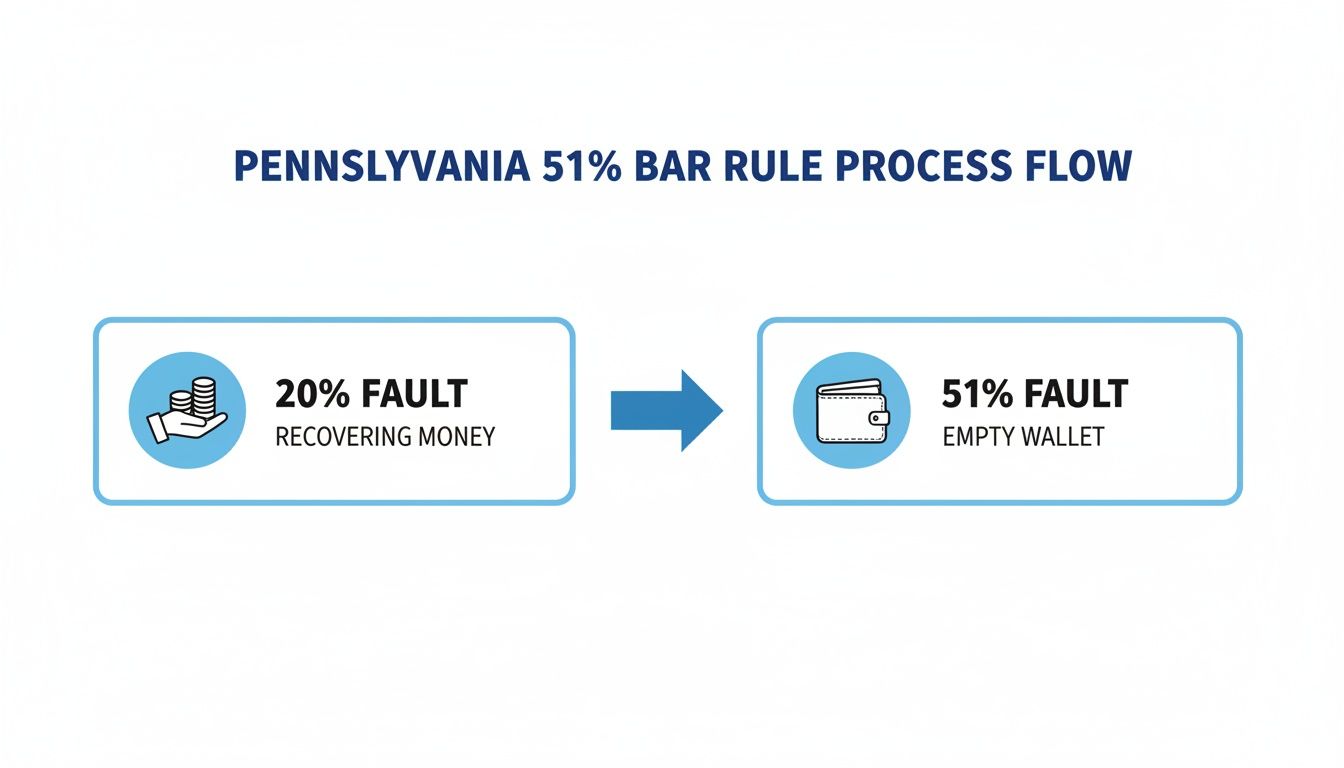
As you can see, the difference between being found 20% responsible and 51% responsible is stark. One means you can recover compensation for your damages, and the other means you get nothing.
To build a compelling case, your attorney will gather and scrutinize every piece of available information. The following table breaks down the most common types of evidence and what they’re used to prove.
Key Evidence Used to Determine Fault
| Type of Evidence | What It Helps Prove | How to Obtain It |
|---|---|---|
| Police Report | Initial assessment of fault, traffic violations, road conditions, and witness information. | Request a copy from the police department that responded to the accident. |
| Witness Statements | An unbiased, third-party account of events, such as speeding or running a stop sign. | Your attorney can contact and formally interview anyone listed on the police report or found through investigation. |
| Scene Photos & Videos | Vehicle positions, property damage, skid marks, debris fields, and traffic signs. | Take them yourself immediately after the crash (if safe), or obtain them from police or other parties. |
| Dashcam/Surveillance Footage | Objective, undeniable proof of how the accident unfolded, often capturing the key moments. | Request footage from nearby businesses, traffic authorities, or the other driver (through legal channels). |
| Vehicle “Black Box” Data | Precise data on speed, braking, steering, and acceleration right before impact. | An expert can download this Event Data Recorder (EDR) information, typically requiring a court order or consent. |
| Expert Analysis | Scientific reconstruction of the crash to determine speeds, angles, and driver actions. | Your personal injury attorney will hire a qualified accident reconstructionist for complex cases. |
This collection of evidence provides the raw data needed to argue your case effectively and push back against an insurance company’s attempt to place unfair blame on you.
The Power of Visual and Expert Analysis
In a he-said, she-said situation, nothing cuts through the noise like a video. Footage from a traffic camera, a nearby business’s security system, or your own dashcam can instantly settle a dispute by providing clear, objective proof.
This is especially true in the congested streets of Philadelphia. With so many intersections and heavy traffic, it’s common for liability to be genuinely contested. This is why digging for evidence like traffic footage and witness accounts is so vital. A quick look at Pennsylvania’s urban car accident statistics shows just how many crashes happen in these environments, making strong evidence absolutely essential.
For really complicated crashes, we often bring in an accident reconstruction expert. These are specialists who use physics and engineering to scientifically analyze the evidence. They can determine vehicle speeds, impact angles, and driver actions with incredible accuracy.
An expert’s opinion can be the one thing that convinces an insurer or a jury that the other driver was primarily at fault. For instance, a reconstructionist might analyze the crush damage on both cars and calculate that the other driver had to be going 20 mph over the speed limit. That kind of hard science is very tough for an insurance company to argue against.
Ultimately, determining fault is a fact-finding mission. Every photo, every witness, and every data point matters. That’s why having a legal team that knows what to look for and how to use it is your best defense to keep your share of fault as low as possible.
Common Scenarios Where Both Drivers Share Fault
It’s one thing to talk about legal theories like comparative negligence, but it’s another thing entirely to see how they apply on the streets of Philadelphia. The idea of shared fault really clicks when you look at the kind of everyday accidents where blame is rarely a 100/0 split.
These situations can get messy. Often, both drivers genuinely believe the other person was completely in the wrong. But when you dig into the details, it frequently turns out that both made a mistake in the critical moments before the crash.
Left-Turn Collisions
Left-turn accidents are a textbook example of shared fault. Picture this: a driver is turning left at a busy intersection. They think the coast is clear but misjudge the speed of an oncoming car. At the same time, the driver of that oncoming car is speeding up, trying to “beat the light” before it turns red.
When they collide, who’s at fault? Both of them.
- The Turning Driver: In Pennsylvania, you have a legal duty to yield to oncoming traffic. If you turn into someone’s path, you’re almost guaranteed to get a piece of the blame, even if the other car was speeding.
- The Oncoming Driver: Speeding is illegal and dangerous. If they had been driving the speed limit, the turning car might have had plenty of time to get through the intersection safely, or the crash may not have happened at all.
An insurance adjuster will scrutinize evidence like traffic cam footage and data from a car’s “black box” to figure out the oncoming car’s speed and the timing of the turn before assigning fault percentages.
Unsafe Lane Changes and Merges
Think about the chaos on the Schuylkill Expressway during rush hour—it’s a perfect storm for lane-change accidents. Imagine a driver needs to merge but doesn’t bother to use their turn signal. The driver in the next lane over is looking at their phone and doesn’t see the other car drifting over until it’s too late.
The resulting sideswipe is a classic case of shared fault. Both drivers messed up.
An adjuster would probably say the driver who didn’t signal made an unsafe maneuver, but the distracted driver failed to pay attention and take defensive action. The final fault percentage really boils down to which mistake is considered the primary cause of the collision.
Even a simple T-bone at an intersection can get complicated. We cover this in our guide on who’s at fault if both drivers claim the green light in PA.
Rear-End Accidents with Complications
Most people assume the driver who hits someone from behind is automatically at fault. Usually, that’s true. But there are exceptions where the lead driver can share some of the blame. The most common one involves a “brake check” or a sudden, unexpected stop.
For instance, if the lead driver slams on their brakes for no good reason—not for an animal or a road hazard—they can be found partially responsible for creating a dangerous situation. Of course, the driver behind them still has a duty to keep a safe following distance.
Here’s how an investigator would break it down:
- The Lead Driver’s Actions: Was the stop abrupt and unnecessary? Did they give any warning? If not, they helped cause the crash.
- The Following Driver’s Actions: Were they tailgating? A driver who leaves enough room can usually stop in time, even if the car ahead brakes suddenly.
Investigators will look to see if the second driver was following too closely, which would increase their share of fault. They’ll also try to find out why the lead car stopped so suddenly, which could reduce their blame. As you can see, figuring out fault is a detailed calculation, not a simple blame game.
Dealing with Insurance When You’re Partially At Fault
After a crash where you might share some of the blame, one of the first calls you’ll get is from the other driver’s insurance adjuster. It’s absolutely crucial to remember one thing: the adjuster is not on your side. Their job isn’t to help you; it’s to save their company money by paying out as little as they possibly can.
This means their number one goal is to pin more of the fault on you. The more blame they can shift your way, the less their company is on the hook for. These adjusters are professional negotiators, and they use the same playbook day in and day out to get the job done. Knowing their tactics is your best defense.
Watch Out for These Common Insurance Adjuster Tactics
Insurance adjusters are often trained to sound friendly and concerned, but every question they ask is carefully crafted to get you to say something that weakens your claim. They’ll try to pressure you into making a simple mistake that could end up costing you thousands.
Keep an eye out for these two common traps:
- The Recorded Statement Request: The adjuster will likely tell you that giving a recorded statement is just “standard procedure” or something they “need” to process your claim. The truth is, they’re hoping you’ll say something—anything—that can be twisted to sound like you’re admitting fault. They’re also listening for you to downplay your injuries or give a detail that contradicts the police report. Never give a recorded statement to the other driver’s insurance company without first speaking to a lawyer.
- The Quick Settlement Offer: If it looks like the other driver was clearly the more negligent one, you might get a settlement offer surprisingly fast, sometimes within days of the accident. This can feel like a relief, but it’s almost always a trap. They are dangling a small amount of money in front of you, hoping you’ll take it before you even know the full extent of your injuries or what your final medical bills will look like. Once you accept that offer, your case is closed for good.
The strongest move you can make is to simply and politely decline to discuss the details of the accident. Tell them that your attorney will be in touch and that all future communication should go through your lawyer’s office. This puts up a crucial barrier that stops you from accidentally sabotaging your own case.
What to Say (and What Not to Say)
When you’re talking to any insurance company, even your own, less is always more. Just stick to the basic, undisputed facts of what happened. Never offer your opinion, never apologize, and never guess about details you’re not sure about.
For anyone injured in the Philadelphia area, these shared-fault situations are especially tricky. Things like speeding, distracted driving, or whether seatbelts were worn can dramatically shift how fault is assigned. In Pennsylvania, those percentages are everything—they determine whether you can recover any money at all under our 51% fault rule.
Talking to Your Own Insurance Company
While you need to be cautious with the other driver’s insurer, you do have a duty to cooperate with your own. Your policy requires you to report the accident to them promptly. When you make that call, keep it short and factual.
- Give them the date, time, and location of the crash.
- Provide the names and insurance info for everyone involved.
- If you have it, provide the police report number.
If your adjuster starts asking for specifics about your injuries or for a play-by-play of the accident, it’s perfectly fine to say you’re still getting medical care and the crash is being investigated. This is especially critical if you find that the insurance company says you’re at fault when you’re not; that’s a red flag that you need to be very careful with every word. Let them know your attorney will handle any further questions. This ensures your rights are protected from the very beginning.
Why An Experienced Attorney Is Crucial In Shared-Fault Cases

When fault is shared in a Pennsylvania car accident, the line between receiving fair compensation and getting nothing is razor-thin. This is precisely where having a skilled car accident lawyer isn’t just a good idea—it’s essential. They become your investigator, your strategist, and your champion.
An attorney’s work starts long before any paperwork is filed. A good lawyer knows the police report is only the beginning of the story, not the final chapter on who was at fault. They immediately launch their own independent investigation to get the full picture.
Building Your Strongest Case
Our legal team digs deep to uncover evidence that insurance adjusters either miss or, frankly, would rather ignore. This isn’t a passive process; it’s an aggressive, front-loaded effort to protect your claim from day one.
- Securing Critical Evidence: We move fast to preserve evidence that can disappear, like traffic camera footage that gets erased on a loop or locating witnesses who left the scene before police could get their statements.
- Hiring Experts: In complicated crashes, we bring in accident reconstruction experts. These specialists use physics and engineering to prove exactly how the collision happened, analyzing everything from skid marks to impact angles to tell the true story.
- Challenging the Insurer’s Narrative: We scrutinize every detail to poke holes in the insurance company’s version of events and fight back against their attempts to unfairly pin more blame on you.
Every single one of these steps is aimed at one goal: minimizing your percentage of fault. Tipping the scales even slightly, from 51% down to 49%, can literally be the difference between a successful claim and a total loss.
A skilled attorney prepares every single case as if it is going to trial. This trial-ready approach sends a powerful message to the insurance company that you are serious, providing critical leverage during settlement negotiations.
An Investment In Your Recovery
Insurance companies have entire teams of adjusters and lawyers working around the clock to protect their profits. Trying to face them alone, especially when fault is being debated, puts you at a massive disadvantage. Hiring a lawyer levels that playing field.
Of course, when you’re looking for an attorney, you need to understand the financial side of things, including how a retainer works with a lawyer. Here at Mattiacci Law, we simplify it: we work on a contingency fee basis. That means you pay us absolutely nothing unless we win your case.
Don’t think of hiring an attorney as a cost. It’s an investment in your financial future. It ensures that a powerful insurance company can’t bully you into a lowball settlement and gives you the best possible shot at getting the compensation you deserve under Pennsylvania’s unforgiving 51% rule.
Common Questions We Hear About Shared Fault Accidents
When you’re trying to recover after a car accident, the last thing you want is a legal headache. But if you think you might share some of the blame, it’s natural to have questions. Here are the straightforward answers to some of the most common concerns we hear from clients right here in the Philadelphia area.
What Happens If the Other Driver and I Disagree on Who’s At Fault?
Disagreements over fault are incredibly common. In fact, it’s rare for both drivers to see things the same way, especially when the cause isn’t immediately obvious. This is exactly why a thorough, evidence-based investigation is a must.
Your most important move? Never admit fault. Not at the scene, not to the other driver, and definitely not to an insurance adjuster. Let the evidence do the talking. The final decision on fault percentage will be pieced together from the police report, any witness accounts, photos of the scene, vehicle damage, and other critical details gathered by investigators and your lawyer.
I Got a Ticket. Does That Mean I Can’t Get Any Compensation?
Not at all. Getting a traffic ticket after a crash doesn’t automatically mean you are more than 50% responsible under Pennsylvania’s civil law. While the ticket is one piece of the puzzle, it’s not the final word on who is liable for your injuries.
A skilled attorney can put that ticket into context. For instance, maybe you were cited for an improper lane change, but the other driver was texting and speeding well over the limit. We can build a powerful argument that their reckless behavior was the primary cause of the collision, meaning you could still be entitled to compensation.
The Bottom Line: A traffic ticket makes things more complicated, but it doesn’t shut the door on your claim. Fault is determined by looking at the entire accident, not just a single citation.
How Long Do I Have to File a Lawsuit in Pennsylvania?
Pennsylvania law sets a strict deadline, known as the statute of limitations, for filing a personal injury lawsuit. For nearly all car accident cases, you have two years from the date of the crash to take legal action.
This is a hard and fast deadline. If you miss it, you permanently lose your right to pursue compensation, no matter how serious your injuries or how strong your case is. It’s absolutely vital to speak with an attorney well before this two-year period runs out so they have enough time to investigate your accident and protect your rights.
If you were hurt in an accident where fault is being questioned, the stakes are simply too high to go it alone. The team at Mattiacci Law knows how to build the strongest possible case and will fight to secure the fair compensation you deserve. Contact us 24/7 for a free, no-obligation consultation to go over the details of your case.