

Author: John Mattiacci | Owner Mattiacci Law
Published January 10, 2026

It’s one of the most common questions after a car accident: if you get hit from behind, is the other driver automatically at fault? While it might seem that way, the answer in Pennsylvania is a bit more complicated.
So, is the rear driver always at fault? No, not automatically. However, there is a very strong legal presumption that they are, and overcoming that presumption is the key to these cases.
The Myth of Automatic Fault in Rear-End Collisions
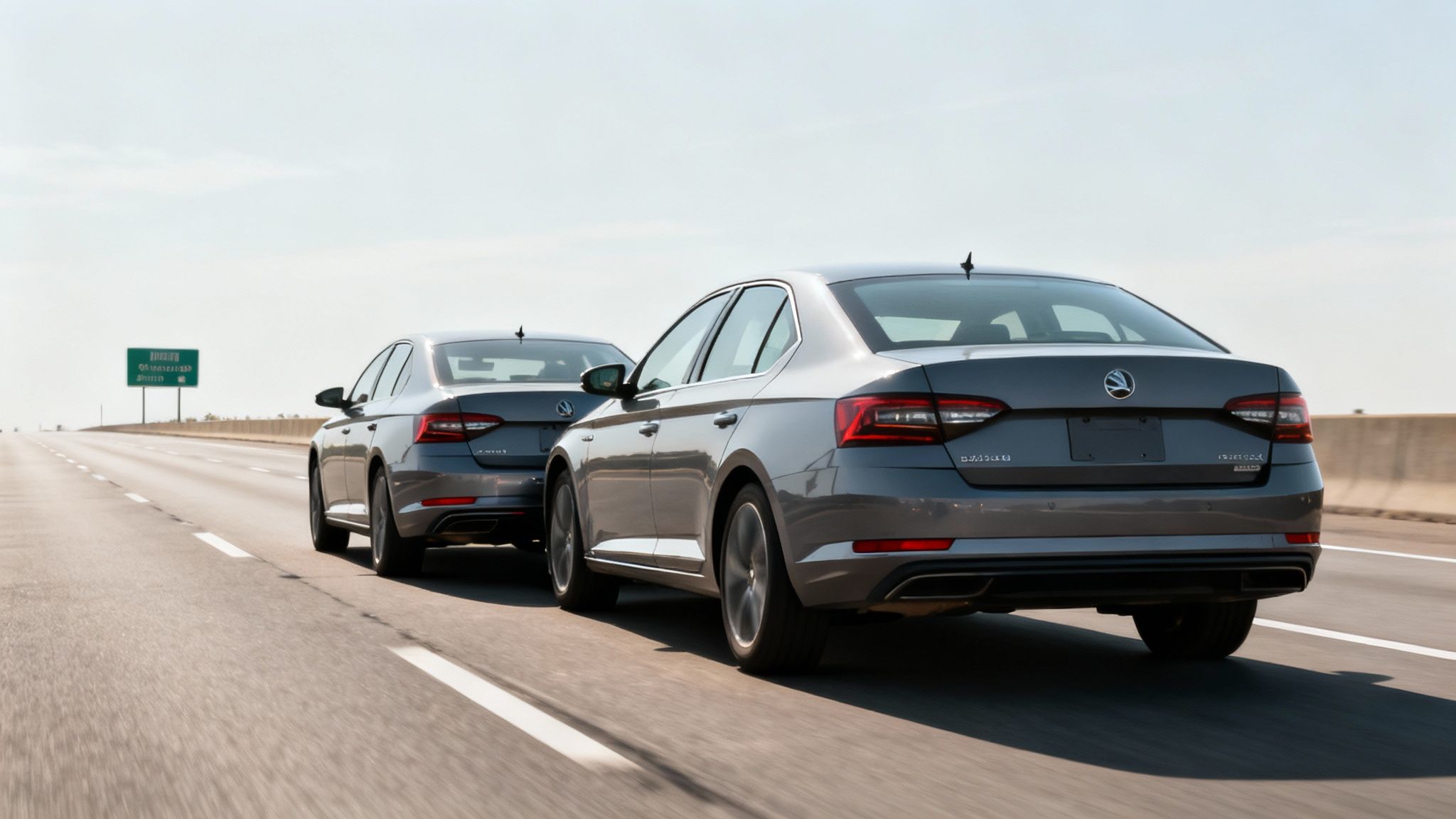
When one car hits another from behind, the gut reaction for everyone—from police officers to insurance adjusters—is that the trailing driver messed up. And often, they did. But Pennsylvania law is designed to look at the whole picture, not just the final impact.
This common assumption starts with a fundamental traffic law known as the “assured clear distance ahead” rule. This is the legal foundation for almost every rear-end accident claim in the state.
Think of it as the golden rule of following another vehicle: you must always leave enough room between your car and the one in front of you to stop safely, no matter what happens. This rule creates a powerful legal assumption—a rebuttable presumption—that the driver in the back was negligent. It means the system starts with the belief that the rear driver is to blame, and it’s up to them to prove otherwise.
The “Assured Clear Distance Ahead” Rule Explained
At its core, the assured clear distance ahead rule is about proactive safety. It puts the responsibility squarely on every driver to manage their speed and following distance so they can react to anything that might pop up, whether that’s a deer in the road or the car ahead slamming on its brakes.
Because of this rule, the law presumes that if a driver had been paying attention and keeping a safe buffer, they could have avoided the crash. It’s why the person who got rear-ended usually has the upper hand from the start.
And these aren’t rare incidents. Data from the Pennsylvania Department of Transportation (PennDOT) consistently shows that rear-end collisions account for roughly one-fifth of all reported crashes statewide, making them one of the most frequent types of accidents. You can discover more about Pennsylvania’s crash statistics to see just how common they are.
Key Takeaway: The law doesn’t declare the rear driver is always at fault. Instead, it places the primary duty on them to prevent the collision. A successful claim often depends on proving that a specific exception to this general rule applies to your accident.
When you get into a rear-end collision, you quickly learn that the law has a default setting. And that setting usually points the finger at the driver in the back. But why?
It all boils down to a fundamental principle of Pennsylvania law: every driver has a non-stop duty to control their vehicle. This isn’t just a suggestion; it’s the core of how we keep roads safe. When a rear-end crash happens, the legal system immediately questions whether the trailing driver lived up to that responsibility.
The specific rule at play here is called the “Assured Clear Distance Ahead” rule. It sounds a bit formal, but the concept is pure common sense. It means you must drive at a speed that allows you to stop your car within the stretch of road you can clearly see ahead of you.
Think of it this way: the law expects you to drive as if the car in front of you could suddenly slam on its brakes for a deer, a child, or a red light you can’t see yet. You have to leave enough room to stop without hitting them, no matter what. That’s the lens an insurance adjuster or jury uses to look at these accidents.
What Does the Law Expect From a Following Driver?
This core rule puts a few specific obligations on the driver in the rear. It’s not just about not tailgating; it’s about actively anticipating and being ready for the unpredictable nature of traffic. The law assumes that a rear-end crash means the following driver dropped the ball on one of these duties:
- Keeping a Safe Following Distance: This is the big one. You need a buffer zone—enough space and time to react if the car ahead makes a sudden move.
- Paying Attention: A driver’s eyes need to be on the road, scanning for brake lights, turn signals, and changes in traffic flow. Distraction is a leading cause of these entirely preventable accidents.
- Expecting the Unexpected: Normal driving involves sudden stops. The law expects you to be ready for the car ahead to brake for a legitimate reason at any moment.
Because these responsibilities are placed so heavily on the following driver, the burden of proof starts with them. The first question in any rear-end collision claim is, “Why couldn’t you stop?” This immediate assumption of fault means the rear driver has to come up with a very good, evidence-backed reason why the crash wasn’t their fault.
In the eyes of the law, a rear-end collision is a failure to maintain control. The starting point is always that the rear driver violated their duty to keep a safe distance. To shift that blame, you need powerful proof that the lead driver did something so negligent or unexpected that no reasonable driver could have avoided the crash.
When the Lead Driver Shares the Blame
While the law starts by looking at the rear driver, that assumption isn’t set in stone. The “assured clear distance ahead” rule is a powerful legal standard, but it has its limits. It was put in place to stop accidents caused by tailgating and distracted driving, not to give a free pass to lead drivers who create a hazard themselves.
The whole conversation shifts from, “Why didn’t the trailing driver stop in time?” to “Did the front driver do something negligent that made the crash impossible to avoid?” If the answer to that second question is yes, the fault calculation can be turned completely on its head. To prove it, you have to show the lead driver’s actions were sudden, unexpected, and unreasonable for the situation.
Common Scenarios Where Fault Can Shift
Some actions by the front driver are well-known contributors to rear-end collisions. We’re not talking about minor driving errors here; these are major failures in their duty to drive safely. It’s like the lead driver actively threw an obstacle in the road that no reasonable person following them could have seen coming.
These situations usually fall into a few distinct categories:
- Aggressive or Malicious Actions: This is where “brake-checking” comes in—the dangerous act of slamming on the brakes for no legitimate reason, often to scare or intimidate a driver behind them. It’s not a defensive driving tactic; it’s a form of road rage and clear negligence.
- Mechanical Failures: Every driver has a responsibility to keep their vehicle in safe, working condition. If someone is driving with broken or malfunctioning brake lights, the driver behind them gets zero warning they’re slowing down. This is especially dangerous at night or in bad weather.
- Unpredictable and Unsafe Maneuvers: This bucket covers a wide range of bad decisions. Suddenly throwing a car in reverse on a busy street, pulling out into traffic without looking, or cutting someone off with an abrupt lane change can all make a collision unavoidable for the car behind.
This flowchart gives you a simple visual guide for how fault is typically assigned in these crashes.
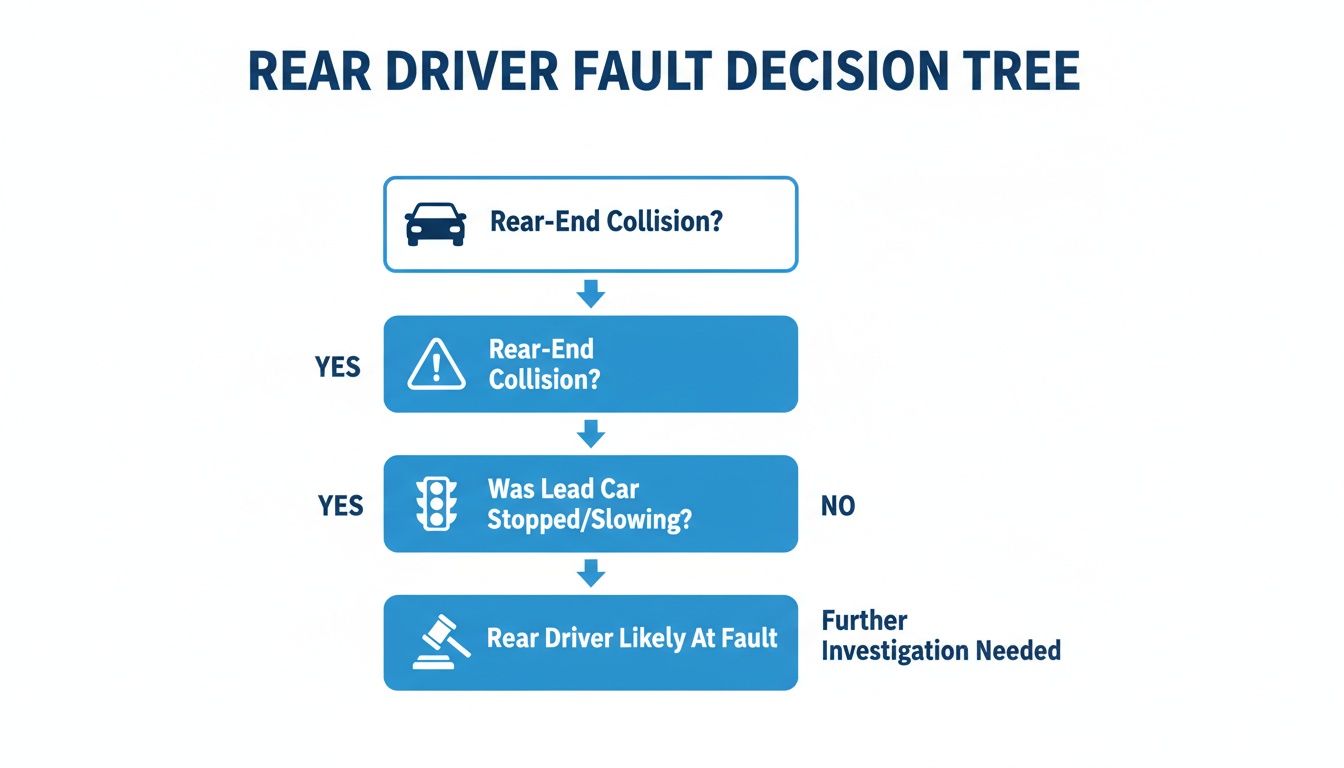
As you can see, the starting point is always the legal assumption that if the car in front was just slowing down or stopping normally, the blame begins with the driver who hit them.
Putting It All Together With Examples
To really see how this plays out, let’s walk through a couple of real-world scenarios.
Example 1: The Faulty Brake Lights
Picture yourself driving down a dark country road at night. The car in front of you starts to slow down for a turn, but their brake lights are burned out. You have no idea they’re braking until you’re right on their bumper. You slam on your own brakes, but it’s too late. In a situation like this, there’s a very strong argument that the lead driver’s failure to maintain their car was the real cause of the crash.
Key Insight: A following driver’s duty to stop safely depends on getting the right signals from the car ahead. When those signals are missing because of someone else’s negligence, the lead driver can be found partially or even entirely at fault.
Example 2: The Unsafe Lane Change
Now, imagine you’re on a multi-lane highway. A car in the lane beside you suddenly swerves directly into your path, cutting you off. They immediately have to brake because traffic is slowing down in front of them. You were just given zero time to react or create a safe following distance. The rear-end collision that follows was triggered by the other driver’s reckless and illegal lane change, not your failure to stop.
These exceptions are absolutely critical. They show that when you ask, “Is the rear driver always at fault in Pennsylvania?” the real answer is: it all comes down to the specific, moment-by-moment actions of every driver involved.
How Pennsylvania’s Negligence Law Divides Fault
Car accidents are rarely a simple black-and-white affair. More often than not, an investigation reveals that both drivers share some of the blame for what happened. When that’s the case, Pennsylvania law doesn’t just toss the claim out; it has a specific system for sorting out who was responsible for what.
This system is called modified comparative negligence. It sounds a bit technical, but the core idea is pretty straightforward. Imagine the total fault for the crash is a pie cut into 100 pieces. The court’s job is to figure out how many pieces of that “fault pie” belong to each driver.
Under this rule, you can only recover money for your injuries if your slice of the pie is smaller than the other driver’s. To be precise, you must be found 50% or less responsible for the crash.
The 51 Percent Bar Rule in Action
Pennsylvania law draws a very firm line in the sand at 51%. If a judge or jury decides you were 51% or more at fault for the accident, you are legally blocked from receiving any money from the other driver. It’s a harsh cutoff, often called the “51% bar rule.”
This rule is exactly why proving the other driver’s degree of fault is so critical. Shifting even a small percentage of blame can mean the difference between getting the compensation you need and walking away with absolutely nothing. You can dive deeper into how this works in our guide on comparative negligence in Pennsylvania law.
Let’s walk through a real-world example to see how this plays out financially.
Scenario: A driver gets rear-ended, but it turns out their brake lights weren’t working. The other driver was following too closely. A court finds the lead driver was 20% at fault for the faulty equipment, and the rear driver was 80% at fault for failing to maintain a safe distance. The lead driver has $100,000 in damages.
Because the injured driver’s fault (20%) is well below the 51% cutoff, they can still recover damages. But their final award gets reduced by their percentage of fault.
Here’s the math:
- Total Damages: $100,000
- Lead Driver’s Fault: 20%
- Reduction Amount: $20,000 (20% of $100,000)
- Final Payout: $80,000
This breakdown shows why every single detail matters. For the rear driver, proving the broken brake lights contributed to the collision is crucial. It reduces their own percentage of fault and, if they were also injured, could even open the door for them to recover their own damages.
Gathering the Right Evidence to Build Your Case
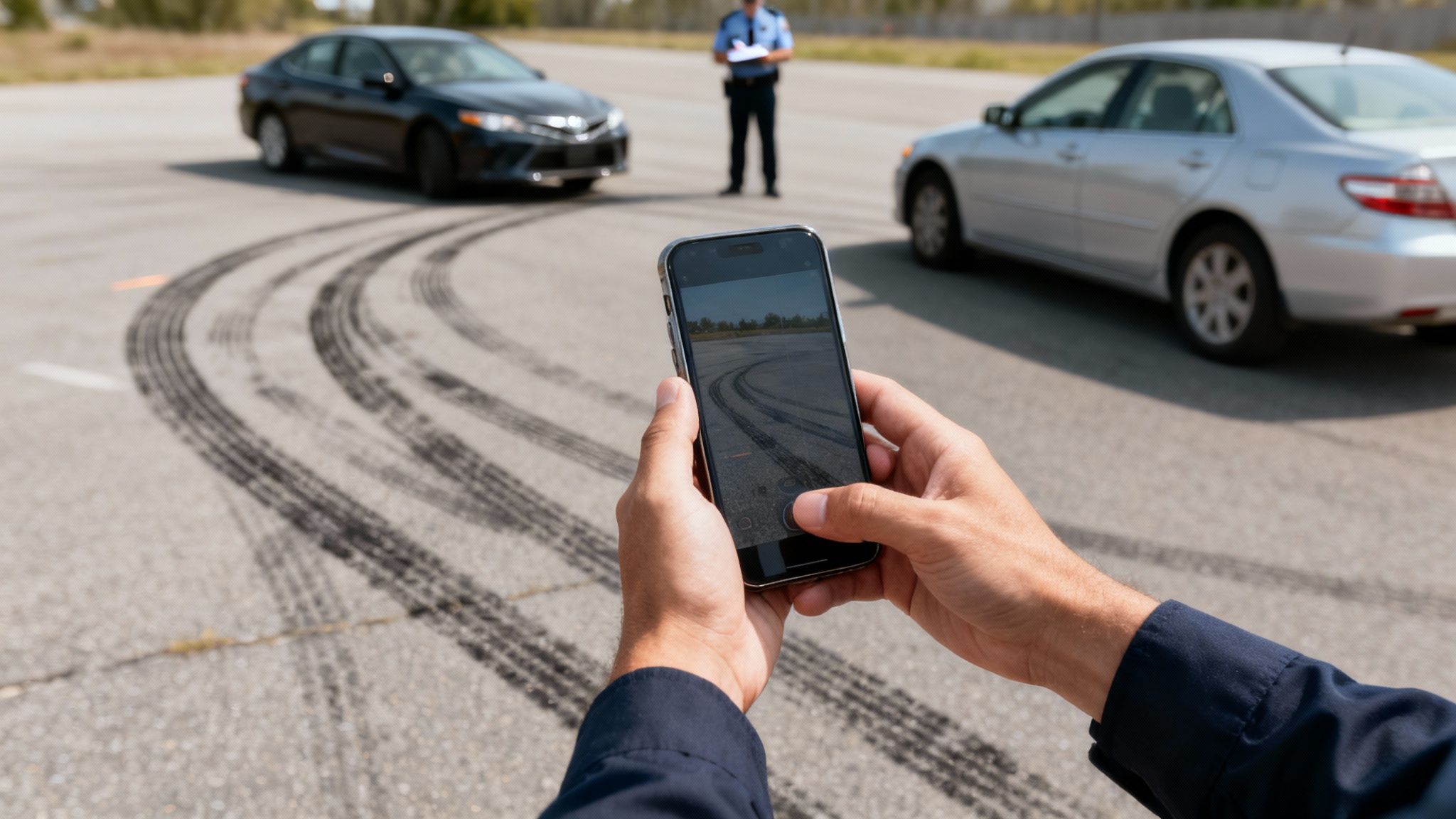
If you’ve been in a rear-end collision and weren’t at fault, your word alone won’t be enough to overcome the default assumption that the rear driver is to blame. You need cold, hard proof.
Those first few moments after a crash are chaotic, but they’re also your single best chance to gather the raw evidence that tells the true story of what happened.
Think like a crime scene investigator. Your job is to document everything exactly as it is before a single car gets moved or a tow truck arrives. Pull out your phone and start taking photos and videos from every possible angle. You’ll want to capture the positions of the cars, the extent of the damage, any skid marks on the road, and even the weather and road conditions at that moment.
Your Post-Accident Evidence Checklist
Once you’ve made sure everyone is okay and called 911, it’s time to switch into preservation mode. The police report is a critical document, but it’s just one piece of the puzzle. The evidence you collect yourself can fill in the gaps and prove the other driver was negligent.
Here’s what you should focus on immediately:
- Photographic Proof: Your smartphone is your most powerful tool. Get wide shots of the whole scene, then zoom in for close-ups of the damage on both vehicles. Don’t forget to photograph license plates, nearby street signs, and any debris scattered on the road.
- Witness Information: People who saw the crash are neutral observers. If anyone stopped, ask for their name and phone number. A bystander’s account can be incredibly powerful in supporting your side of the story.
- Official Documentation: Always, always get a police report. When the officer shows up, stick to the facts and avoid admitting any fault. This report becomes the official record of the accident.
- Medical Records: Get checked out by a doctor as soon as you can, even if you feel perfectly fine. This step creates a documented link between the accident and any injuries you may have, which is absolutely vital if you need to file a personal injury claim later.
Crucial Takeaway: Evidence doesn’t last forever. Witnesses drive away, cars get towed, and the full extent of your injuries might not be obvious for days. Acting fast to document everything gives your attorney the ammunition they need to push back when an insurance company tries to place the blame on you automatically.
From Scene to Case File
Every photo you take and every witness statement you get helps build the narrative of your case. A skilled attorney knows how to piece these elements together to reconstruct the accident, challenge inaccuracies in the police report, and argue effectively with insurance adjusters. For a more in-depth look, you can learn about what evidence you need to win a Pennsylvania car accident claim.
As your case progresses, you might encounter legal steps like depositions. Looking at a sample deposition notice can give you a better idea of what to expect. In the end, it’s this mountain of carefully collected proof that elevates your case from a simple “he said, she said” argument into a compelling, fact-based claim for compensation.
How a Skilled Car Accident Attorney Can Help
That first police report? It’s almost never the full story. And the insurance adjuster’s initial decision? It’s designed to protect their company’s profits, which usually means sticking with the easy assumption that the rear driver is to blame. This is precisely where having a sharp legal team on your side can make all the difference.
An experienced attorney isn’t just a paper-pusher. We launch a full-blown investigation to get to the truth, digging much deeper than the surface-level details in the initial report. Our job is to piece together a clear, factual story of what really happened.
Building a Case Beyond the Crash Report
To successfully challenge the automatic presumption of fault, you need a solid, evidence-based strategy. A good lawyer can take critical steps that are nearly impossible for you to handle alone.
- Subpoenaing Key Evidence: We have the legal authority to demand crucial evidence. This could be traffic camera footage, cell phone records that prove another driver was distracted, or even vehicle maintenance logs that reveal a history of brake failure.
- Consulting Experts: We bring in the pros. Accident reconstruction specialists can analyze everything from skid marks to the crush depth on the vehicles, creating a scientific model that shows exactly how the collision unfolded.
- Interviewing Witnesses: Our investigators are skilled at tracking down witnesses and getting detailed, credible statements. We do this quickly, before memories start to fade or people become hard to find.
When you’re dealing with a complicated crash or serious injuries, the support from specialized personal injury law firms becomes invaluable. They have the resources and know-how to push back against the insurance company’s tactics and protect you from being unfairly blamed.
An attorney’s main job is to take apart the insurance company’s story and replace it with a stronger one—a story built on hard evidence and expert analysis.
At the end of the day, our mission is to make sure you don’t get stuck with the blame for an accident that wasn’t your fault. A dedicated traffic accident lawyer in Pennsylvania will fight to defend your rights and secure the full compensation you deserve.
Common Questions We Hear About Rear-End Collisions
Even when you understand the basic rules, the real world is messy. Every accident is different, and specific situations can leave you wondering where you stand. Here are some straightforward answers to the questions we get asked most often.
What If I Was Pushed into the Car in Front of Me?
This is a classic “chain-reaction” crash, and it happens all the time. If you were stopped safely behind another car and a third vehicle slammed into you from behind, pushing your car forward into the one in front, the fault almost always lies with the driver who started the chain reaction.
In this scenario, you’re more of a victim than a cause. The law recognizes that you had no control, so you generally wouldn’t be held responsible for the damage to the car you were pushed into.
How Does Distracted Driving Affect Who’s at Fault?
It has a huge impact. Proving the other driver was texting, programming their GPS, or just not paying attention is incredibly powerful evidence of their negligence. This cuts both ways—it can be used against a rear driver who wasn’t watching the road or a lead driver who stopped erratically because they were distracted.
A skilled attorney can often get a court order for the other driver’s cell phone records, which can be the key to proving they were distracted and cementing your case.
Key Insight: In Pennsylvania, distracted driving is a major violation of a driver’s duty to be safe. Proving it can completely flip the script on who is presumed to be at fault in a rear-end collision.
How Long Do I Have to File a Car Accident Claim in PA?
Pennsylvania law gives you a deadline, known as the statute of limitations, to file a personal injury claim. For most car accidents, that deadline is two years from the date the crash happened.
While two years might sound like plenty of time, it’s a mistake to wait. You should contact an attorney as soon as possible for a couple of key reasons:
- Evidence Disappears: Your legal team needs to act fast to preserve critical evidence. Things like security camera footage from a nearby business or witness memories can be lost forever if you delay.
- Building a Stronger Case: The sooner your lawyer can start investigating, the stronger and more detailed your claim will be.
Navigating the aftermath of a rear-end accident takes experience and a dedication to finding out what really happened. The legal team at Mattiacci Law is ready to dig into the details of your case and fight for the full compensation you deserve. For a free, no-obligation consultation, visit us at https://jminjurylawyer.com.