

Author: John Mattiacci | Owner Mattiacci Law
Published January 21, 2026

When a car crash happens because someone made an illegal U-turn, figuring out who’s at fault is usually pretty simple. In Pennsylvania, the driver pulling that illegal move is almost always going to be held responsible for the accident. Why? Because breaking a clear traffic law, like ignoring a “No U-Turn” sign, creates a very strong legal assumption that they were negligent.
Who Is at Fault in a Pennsylvania U-Turn Accident
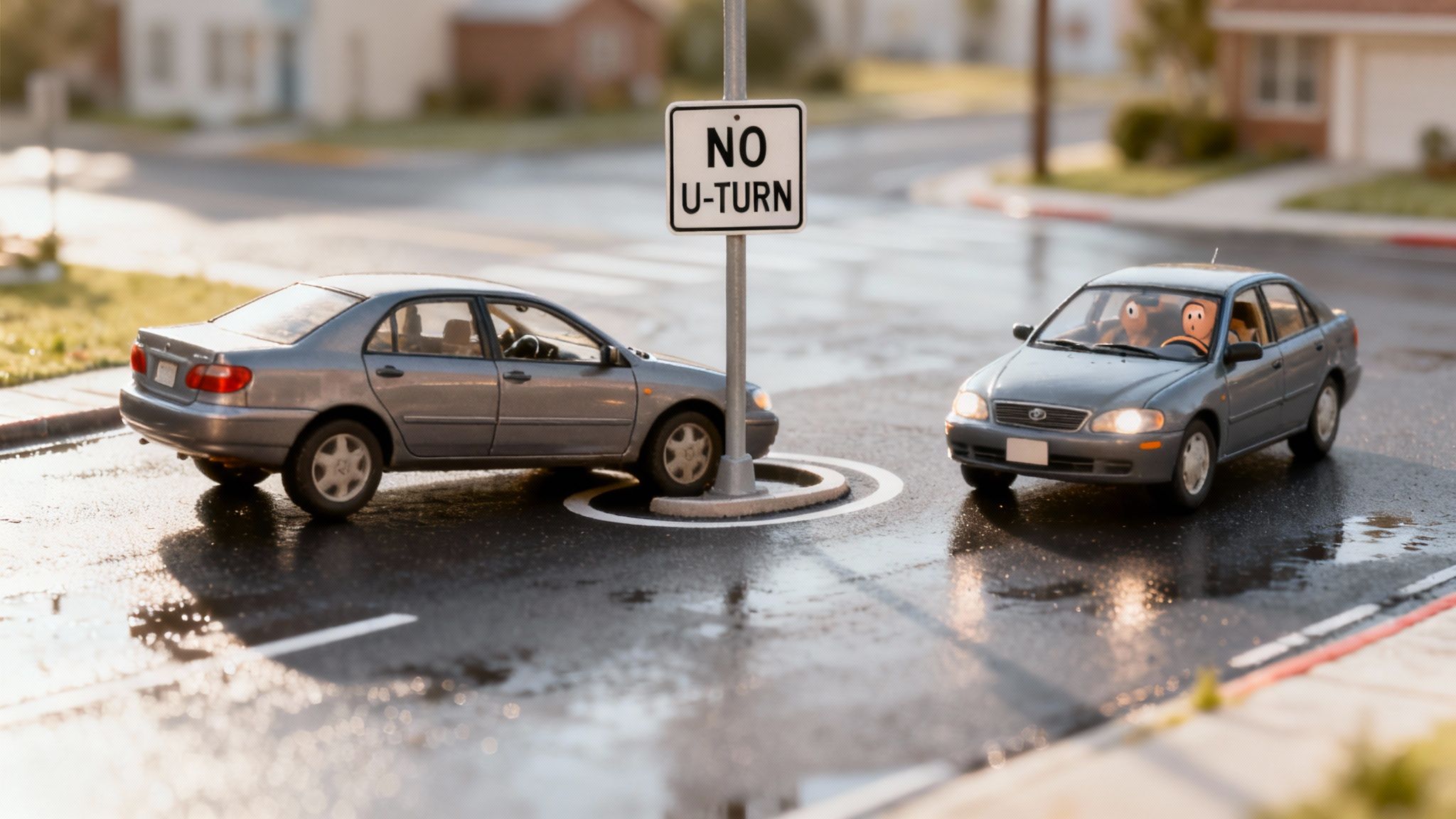
Sorting out liability in an illegal U-turn crash often boils down to a powerful legal shortcut called negligence per se. This concept cuts right through the typical back-and-forth about who was being careless.
Think of it this way: traffic laws are there for a reason—to prevent predictable dangers. A “No U-Turn” sign isn’t just a suggestion; it’s placed at an intersection because making that turn is a known hazard. When a driver ignores that sign and causes a wreck, the law basically says their negligence is automatic. They broke a safety rule, and that action directly caused the harm.
The Immediate Presumption of Fault
In Pennsylvania, every single driver on the road has a basic duty of care to drive safely and not hurt others. Pulling an illegal U-turn is a textbook violation of that duty. That one action creates a powerful presumption of fault that’s incredibly tough for the at-fault driver’s insurance company to fight.
This legal shortcut is a huge advantage for the person who was hit. Instead of getting bogged down in a debate over who was more careless, the focus shifts right to the fact that a safety law was broken. The case for this strong presumption is built on a few key elements:
- A Specific Law Was Broken: The driver violated a traffic statute, like Pennsylvania Vehicle Code Section 3332.
- The Law Was for Safety: The rule they broke was specifically designed to prevent the exact type of accident that happened.
- You Were in the Protected Group: As another driver, cyclist, or pedestrian, you’re exactly who the law was meant to protect.
- The Turn Caused Your Injuries: The illegal U-turn was a direct cause of your injuries and other damages.
By making an illegal turn, the driver essentially forfeits their argument. Their decision to disregard a clear traffic law makes them the primary cause of the collision, establishing a clear path for victims to seek justice and compensation.
This gives you a confident starting point, which is crucial when you’re dealing with injuries from a crash. You can move forward with your claim knowing the law is already on your side.
Understanding PA U-Turn Laws and Negligence
So, why is the driver making a U-turn almost always the one at fault? It really comes down to the specific, strict rules they broke. Pennsylvania law is incredibly clear on this, leaving very little room for argument. These statutes aren’t just suggestions; they’re designed to stop drivers from making dangerous maneuvers that get people hurt.
The legal bedrock for these cases is Pennsylvania Vehicle Code Section 3332. This law lays out a handful of non-negotiable conditions a driver must meet before even thinking about making a U-turn. Breaking any one of these rules isn’t just a simple traffic ticket—it’s a direct failure of their legal duty to keep others on the road safe.
The Strict Rules of the Road
Think of a legal U-turn like a high-stakes driving test. A driver has to pass several safety checkpoints before they can proceed. If they fail even one, the turn is illegal, and any crash that happens because of it is on them.
Under Section 3332, a U-turn is only allowed if it can be done safely and without getting in anyone else’s way. This sounds simple, but the law adds specific requirements that are often impossible to meet on busy or complex roads.
- You Need a Clear Line of Sight: The driver has to be able to see any approaching traffic from both directions for at least 500 feet. This rule alone makes U-turns illegal in countless everyday situations, from city streets to hilly country roads.
- Don’t Interfere with Traffic: The turn can’t force other drivers to react. If another car has to slam on its brakes or swerve out of the way to avoid hitting you, that U-turn was illegal from the start.
- Know the No-Go Zones: The law flat-out forbids U-turns in certain high-risk areas, no exceptions.
These rules set a very high bar. In the real world, especially in a place like Philadelphia, finding a spot where you can legally and safely make a U-turn is a lot harder than most people think.
Where U-Turns Are Always Illegal
Beyond the general safety rules, the law points out specific places where a U-turn is never okay, no matter how clear the road might look. These are spots where the risk of a crash is just too high to begin with.
A driver pulling an illegal U-turn is like a captain steering their ship directly into a busy shipping lane without looking—they’ve ignored clear warnings and created an unavoidable danger for everyone else. This blatant disregard for the rules of the road is what builds a powerful personal injury claim.
Knowing these absolute no-go zones makes proving fault much more straightforward. Pennsylvania law Section 3332 is clear: when drivers make unsafe U-turns, they’ve breached their duty of care, creating a direct path to liability. U-turns are also explicitly banned on the Pennsylvania Turnpike and other major highways. When a driver ignores these rules, fault becomes automatic if a crash occurs. You can learn more about how these specific PA statutes determine fault on jminjurylawyer.com.
The most common prohibited locations are:
- On a curve: A driver’s view is blocked, making it impossible to see what’s coming and judge distances.
- Near the crest of a hill: Just like a curve, a hill blocks the view of oncoming traffic. You can’t see them, and they can’t see you.
- Anywhere a “No U-Turn” sign is posted: These signs aren’t just suggestions. They’re put there by traffic engineers who have already determined that the area is too dangerous for that kind of turn.
Breach of Duty: The Legal Consequence
When a driver tries to make a U-turn on a curve, can’t see 500 feet down the road, or just ignores a sign, they have legally breached their duty of care. In the eyes of the law, that breach is the negligent act that caused the crash.
Picture this: a driver is on a busy road and decides to whip a quick U-turn to get to a store on the other side. They’re coming up to the top of a small hill, but they figure the road looks clear enough. As they swing their car across the oncoming lane, another vehicle traveling at the speed limit comes over the hill with absolutely no time to react.
That collision is the direct result of the U-turning driver’s illegal decision. They violated Section 3332 by making a turn where their visibility was completely compromised. That one unlawful move provides the clear-cut evidence needed to prove they are 100% liable for the accident and all the harm that followed.
Why Improper Turns Are a Serious Danger in Philadelphia
An illegal U-turn can feel like a small thing—just a quick, impatient move to save a few seconds. But the reality is much, much uglier. These aren’t just minor traffic violations. They are a known and persistent cause of horrific accidents, serious injuries, and even deaths across Pennsylvania.
What happened to you wasn’t just a fluke or bad luck. It was part of a dangerous pattern of behavior that puts everyone on the road at risk.
The data tells a grim story. When a driver decides to ignore a “No U-Turn” sign or makes a turn without a clear view, they instantly become a sudden, unpredictable hazard. The fallout from this kind of negligence is recorded year after year in statewide crash reports, and it confirms what you now know firsthand: these maneuvers are incredibly dangerous.
The Statewide Impact of Improper Turns
The numbers don’t lie. Across the Commonwealth, improper turning is consistently one of the top driver mistakes leading to a crash. We’re not talking about an occasional problem; this is a chronic issue with devastating consequences.
An illegal U-turn turns a predictable road into a chaos zone. For the drivers who are following the rules, there’s often zero time to react to a vehicle suddenly slicing across their path. A collision becomes almost unavoidable.
Official data backs this up. In one recent year, improper turning was the second most common cause of all car accidents in Pennsylvania, causing a staggering 13,313 crashes. And that wasn’t a one-off. In 2022, the same mistake led to 13,079 crashes and 63 fatalities. A deep dive into these Pennsylvania crash statistics on zavodnicklaw.com shows a deadly trend that repeats itself year after year.
This is powerful stuff. It completely shuts down any attempt by the at-fault driver or their insurance company to claim their illegal U-turn was just a “small mistake.” It was a statistically proven danger.
Philadelphia: A Hotspot for Turning Accidents
As bad as the statewide numbers are, things get even more intense in dense urban areas. In Philadelphia County, you’ve got a perfect storm: heavy traffic, confusing intersections, and people on foot everywhere. Making an illegal U-turn here isn’t just a bad idea—it’s exceptionally reckless.
The sheer volume of cars, trucks, and buses in the city means one driver’s bad decision can easily spark a multi-vehicle pileup or a catastrophic T-bone crash. These accidents often involve:
- Motorcyclists: Riders are already hard to spot and have zero protection. A car suddenly whipping around in front of them is a recipe for disaster.
- Bicyclists and Pedestrians: In a city packed with bike lanes and crosswalks, an abrupt U-turn can easily take out a cyclist or pedestrian who had the right of way.
- Delivery Drivers and Commercial Vehicles: The constant churn of commercial traffic adds another layer of risk, and these big vehicles simply can’t stop on a dime.
Year after year, Philadelphia County unfortunately leads the state in total car accidents. In 2021 alone, the county saw 10,417 car accidents—more than any other county in Pennsylvania. This isn’t just a random statistic; it highlights the extra duty of care every single driver has on our city streets.
When a driver makes an illegal U-turn in Philly, they aren’t just breaking a rule. They are showing a profound disregard for the safety of everyone around them in one of the most hazardous driving environments in the state. This local context makes your case stronger, showing that the driver’s negligence was even worse given the well-known risks of city driving.
How to Build an Unshakeable Case Against the At-Fault Driver
The law might seem to be on your side when a driver makes an illegal U-turn and hits you. There’s a strong legal assumption that they’re at fault, but that’s no guarantee you’ll get paid what you deserve. Insurance companies are masters at muddying the waters and will jump on any chance to shift the blame or slash the value of your claim.
To get the compensation you’re owed, you need to turn that “strong assumption” into a cold, hard fact. Think of yourself as a detective at a crime scene. Every piece of evidence you gather helps tell the story, and when you put it all together, it creates a narrative that’s impossible to argue with. The minutes and hours right after a crash are your only window to collect this raw evidence before it’s gone for good.
The Foundation of Proof: Your Official Police Report
The single most important document you’ll have is the official police report. When an officer shows up, they aren’t just there to direct traffic; they’re creating an objective, third-party record of exactly what went down. This report is the bedrock of your claim.
Inside that report, you’ll typically find:
- A Crash Diagram: A simple sketch showing where the cars were before, during, and after the collision.
- Driver and Witness Statements: The first-hand accounts from everyone involved, captured right at the scene.
- Traffic Citations: This is huge. If the other driver got a ticket for an illegal U-turn (a violation of Section 3332), it serves as powerful evidence of negligence per se.
- The Officer’s Notes: Details about road conditions, the weather, and physical clues like skid marks or debris.
Getting your hands on a copy of this report is step one. It gives you a neutral, authoritative account that insurance adjusters have a very hard time disputing.
The data below shows just how common and dangerous improper turns are across the state. It’s a real problem.
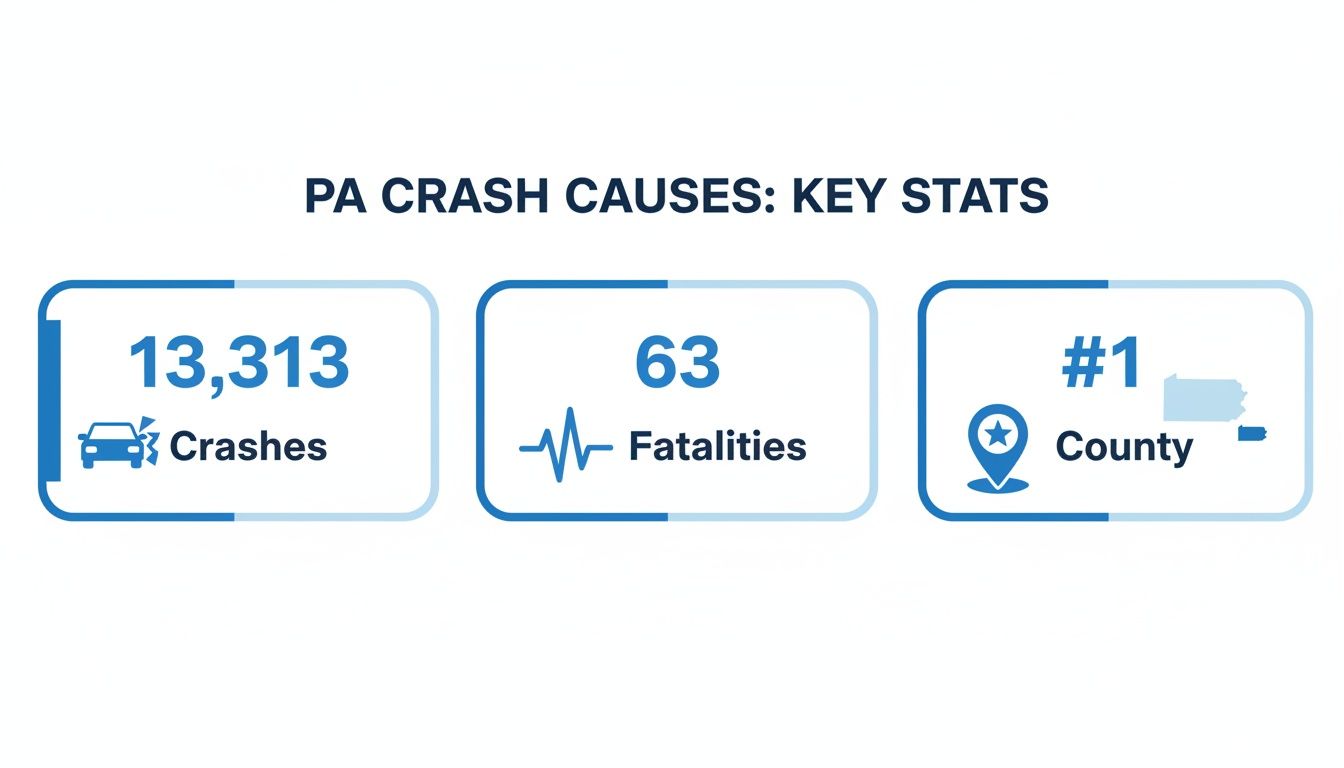
These numbers make it clear: crashes from improper turns aren’t just isolated incidents; they’re a major public safety issue in Pennsylvania.
Capturing the Scene: What to Document
In today’s world, everyone has a powerful evidence-gathering machine in their pocket. Your smartphone’s camera can be your best friend after a crash, capturing the reality of the scene in a way words never could.
Every photo you take tells a story. The angle of the vehicles proves the point of impact. The skid marks reveal braking distance. The damage to your car demonstrates the force of the collision. This visual evidence systematically dismantles the other driver’s excuses.
Here’s your at-the-scene photo checklist:
- Vehicle Damage: Get wide shots showing both cars, then move in for close-ups of every dent, scratch, and broken part. This helps experts figure out the speed and angle of the crash.
- Scene Overview: Take pictures of the whole area—the intersection, the road, and any relevant traffic signs (especially a “No U-Turn” sign). Don’t forget skid marks and debris on the pavement.
- Visible Injuries: If you have cuts, bruises, or any other visible injuries, take pictures of them right away.
- Video Evidence: Scan the area. Are there security cameras on nearby businesses or homes? Ask witnesses if they have a dashcam. That footage can be pure gold.
Advanced Evidence and Expert Analysis
Sometimes, a case is more complicated and you need to bring in the heavy hitters. Accident reconstructionists are the forensic scientists of car crashes. They use a combination of physics, engineering, and specialized software to create a data-driven re-creation of the accident.
These experts can analyze the length of a skid mark to calculate speed, examine the “crush” damage on a vehicle to determine the force of the impact, and put all the data together to show a jury precisely how the other driver’s illegal U-turn caused your injuries. Building a winning legal argument requires careful preparation, much like using essential legal document templates to organize key information into a compelling case.
At Mattiacci Law, we treat every case like it’s headed for trial. That means we start gathering all the evidence from day one, from the police report to expert testimony. We aim to build a case so solid that the insurance company sees the writing on the wall and offers a fair settlement instead of facing us in court.
Securing the Compensation You Deserve After an Accident
Once you prove the other driver’s illegal U-turn was the reason you crashed, the conversation turns to a simple but critical question: what are you actually owed for everything you’ve been through? This is about so much more than just getting your car fixed. It’s about getting financial help for every single loss you’ve suffered—from the obvious medical bills to the invisible ways this has upended your life.
The legal system splits these losses, or damages, into two main buckets. Understanding both is the key to making sure you don’t leave money on the table when you need it most.
Tallying the Concrete Losses: Economic Damages
The first bucket is filled with what we call economic damages. Think of these as the black-and-white costs—the ones that come with a receipt, an invoice, or a pay stub. It’s the money that came directly out of your pocket or the income you’ll never get back because of the wreck.
These are the clear, calculable losses:
- Medical Bills: This isn’t just the ambulance ride and the ER visit. It covers everything: ongoing physical therapy, future surgeries you might need, and prescriptions.
- Lost Wages: If your injuries forced you to miss work, you have a right to be paid back for every single dollar of income you lost.
- Future Lost Earning Capacity: Sometimes, injuries are so severe you can’t go back to your old job, or maybe can’t work at all. This damage category calculates the wages you would have earned over the rest of your career.
- Property Damage: This is pretty straightforward. It’s the money to repair or replace your vehicle and anything else of value that was destroyed in the crash.
Valuing the Human Cost: Non-Economic Damages
The second bucket holds the non-economic damages, and honestly, this is often the bigger and more important one. These are the devastating human losses that don’t have a price tag. They exist to compensate you for the ways the accident has fundamentally changed your life for the worse.
Non-economic damages acknowledge a simple truth: the worst part of a serious crash is rarely the stack of medical bills. It’s the pain, the fear, and the frustration of not being able to live your life the way you used to. This is where a skilled lawyer really fights for you.
This is compensation for things like:
- Pain and Suffering: This covers the physical pain and the mental and emotional toll the accident has taken on you.
- Loss of Enjoyment of Life: You used to love hiking, playing with your kids, or gardening, but now you can’t. This damage category addresses that loss.
- Disfigurement and Scarring: This is compensation for permanent physical changes that impact how you look and, often, how you feel about yourself.
The reality of these accidents is stark. Over 110,000 crashes happened on Pennsylvania roads in 2023, injuring more than 66,000 people. The numbers are staggering, and behind each one is a real person whose life was turned upside down. You can find more details about Pennsylvania’s crash statistics and accident trends on kalraylaw.com.
Your Insurance Policy Matters: Full vs. Limited Tort
Here in Pennsylvania, your ability to get paid for non-economic damages depends heavily on a choice you made when you bought your car insurance: Full Tort or Limited Tort.
- Full Tort: If you chose this, you keep your full right to sue the at-fault driver for all your damages, including pain and suffering, no matter how severe your injuries are.
- Limited Tort: This is the cheaper option, but it comes with a big catch. It limits your right to sue for pain and suffering unless your injury is legally considered “serious.” The law defines this as death, a serious impairment of a body function, or permanent serious disfigurement.
For people with Limited Tort, having an experienced attorney is non-negotiable. We know how to review your medical records and build the case that your injuries meet that “serious injury” threshold, unlocking your right to full and fair compensation.
Fighting the Insurance Adjuster
Let’s be clear: the insurance adjuster is not on your side. Their job is to protect their company’s profits by paying you as little as they possibly can. They are trained negotiators who will use common tactics like offering a fast, lowball settlement before you even know how bad your injuries are. Or they’ll try to get you on a recorded call to twist your words and pin some of the blame on you.
This is where having a trial-ready lawyer from Mattiacci Law completely changes the game. We take over all communications with the insurance company. We put together a meticulously documented demand package that details every single one of your economic and non-economic losses. We negotiate from a position of strength because they know we aren’t afraid to go to court. And when insurers know you’re ready for a fight, they’re much more likely to offer a settlement that’s actually fair.
Why a Trial-Ready Lawyer Makes All the Difference

After a crash caused by an illegal U-turn, you’re not just healing from your injuries—you’re also up against the other driver’s insurance company. And make no mistake, their goal is simple: pay you as little as they possibly can. It’s their entire business model.
This is why having an experienced Philadelphia car accident lawyer in your corner isn’t just a good idea; it’s how you level the playing field.
A real legal team doesn’t just shuffle papers. We take the whole overwhelming process off your shoulders so you can focus on getting better. From the very first day, that means launching our own deep investigation to find and preserve every shred of evidence before it vanishes. We’re talking about getting the police reports, tracking down witnesses while their memories are fresh, and digging up any video footage that can help build your case on a rock-solid foundation.
The Power of Trial Preparation
At Mattiacci Law, we have a core belief that gives our clients a serious advantage: we prepare every single case as if it’s going to trial. This isn’t just a slogan; it’s an approach that completely changes the dynamic of your claim.
Insurance companies are smart. They keep files on law firms and they know who they’re dealing with. They know which attorneys will fold and take a quick, lowball offer, and they know which ones are ready, willing, and fully able to take them to court. Our reputation is one of your greatest assets.
When an insurance adjuster sees your lawyer is already building a case for a jury—hiring medical experts and bringing in accident reconstructionists—their whole risk calculation shifts. Suddenly, the thought of facing a well-prepared trial attorney in a courtroom makes them far more likely to offer a fair settlement.
This trial-first mindset means we build your case for maximum strength from the get-go, not as a last-ditch effort when a claim gets denied.
A Partnership Built on Trust and Access
The last thing you need after a crash is more stress. You shouldn’t have to worry about paying a lawyer upfront or being left in the dark about your own case. We get it, which is why we’ve removed those barriers completely.
Our commitment to you is simple:
- A No-Fee Guarantee: You pay us absolutely nothing unless we win your case. Period. Our interests are aligned with yours, which means there’s zero financial risk for you to seek the justice you deserve.
- Direct Attorney Access: When you have a question, you speak directly with your lawyer. We believe that clear, consistent communication is the key to your peace of mind throughout this process.
Choosing the right lawyer is the single most important decision you’ll make for your case. By picking a firm that builds every case for the courtroom, you send a powerful message that you will not be lowballed or pushed around. You get a skilled, powerful advocate whose only job is to fight for the best possible outcome for you and your family.
Common Questions After a Pennsylvania U-Turn Accident
When you’re trying to heal after a crash, the last thing you need is a mountain of legal questions. Let’s cut through the confusion and get straight to the answers you’re looking for.
What if the Other Driver Claims I Was Speeding?
Don’t be surprised if this happens. It’s one of the oldest tricks in the book—a classic defense tactic insurance companies use to muddy the waters and shift blame. They’re trying to use Pennsylvania’s modified comparative negligence rule to their advantage.
Here’s how it works: if a jury finds you were partially to blame for the crash, they can reduce your compensation by that percentage. But—and this is a big but—the other driver has to prove you were more than 50% at fault for the accident. When their illegal U-turn is what set the whole thing in motion, that’s a very tough sell.
A good lawyer will fight back against these false claims with hard evidence, like accident reconstruction data, witness testimony, and a close look at the physical damage to both vehicles.
How Long Do I Have to File a U-Turn Accident Lawsuit in PA?
The clock starts ticking the moment the accident happens. In Pennsylvania, the statute of limitations for most personal injury claims is a strict two years from the date of the crash.
This isn’t a suggestion; it’s a hard deadline. If you try to file a lawsuit even one day after that two-year window closes, the court will throw your case out, and you’ll lose the right to seek compensation forever. That’s why it’s so important to talk to an attorney quickly—it gives them time to preserve crucial evidence before it disappears and make sure every legal deadline is met.
Can I Still Sue if I Have Limited Tort Insurance?
Yes, in many cases, you absolutely can. People often think Limited Tort insurance shuts the door on their ability to get paid for pain and suffering, but that’s not the whole story. The law carves out some very important exceptions, with the biggest one being if you sustained a “serious injury.”
So, what counts as “serious”?
Pennsylvania law defines a “serious injury” as a personal injury resulting in death, serious impairment of a body function, or permanent serious disfigurement.
Figuring out if your injuries meet that legal standard is key. An experienced personal injury lawyer can dig into your medical records and work with your doctors to show how the injury has truly impacted your life, clearing the way for you to pursue the full compensation you’re entitled to.
If another driver’s illegal U-turn turned your life upside down, you don’t have to navigate the path forward alone. At Mattiacci Law, we know how to build a powerful case that holds negligent drivers accountable. To get a free, no-strings-attached evaluation of your case, contact our team today.