

Author: John Mattiacci | Owner Mattiacci Law
Published January 11, 2026

Here’s how we determine who is at fault when an accident happens at a Pennsylvania intersection. It all boils down to one core legal concept: negligence.
At its heart, negligence simply means one driver failed to act with reasonable care, and that failure caused the crash. The person who was careless—whether by breaking a traffic law or just driving irresponsibly—is the one legally on the hook for the damages.
Understanding How Fault Is Determined
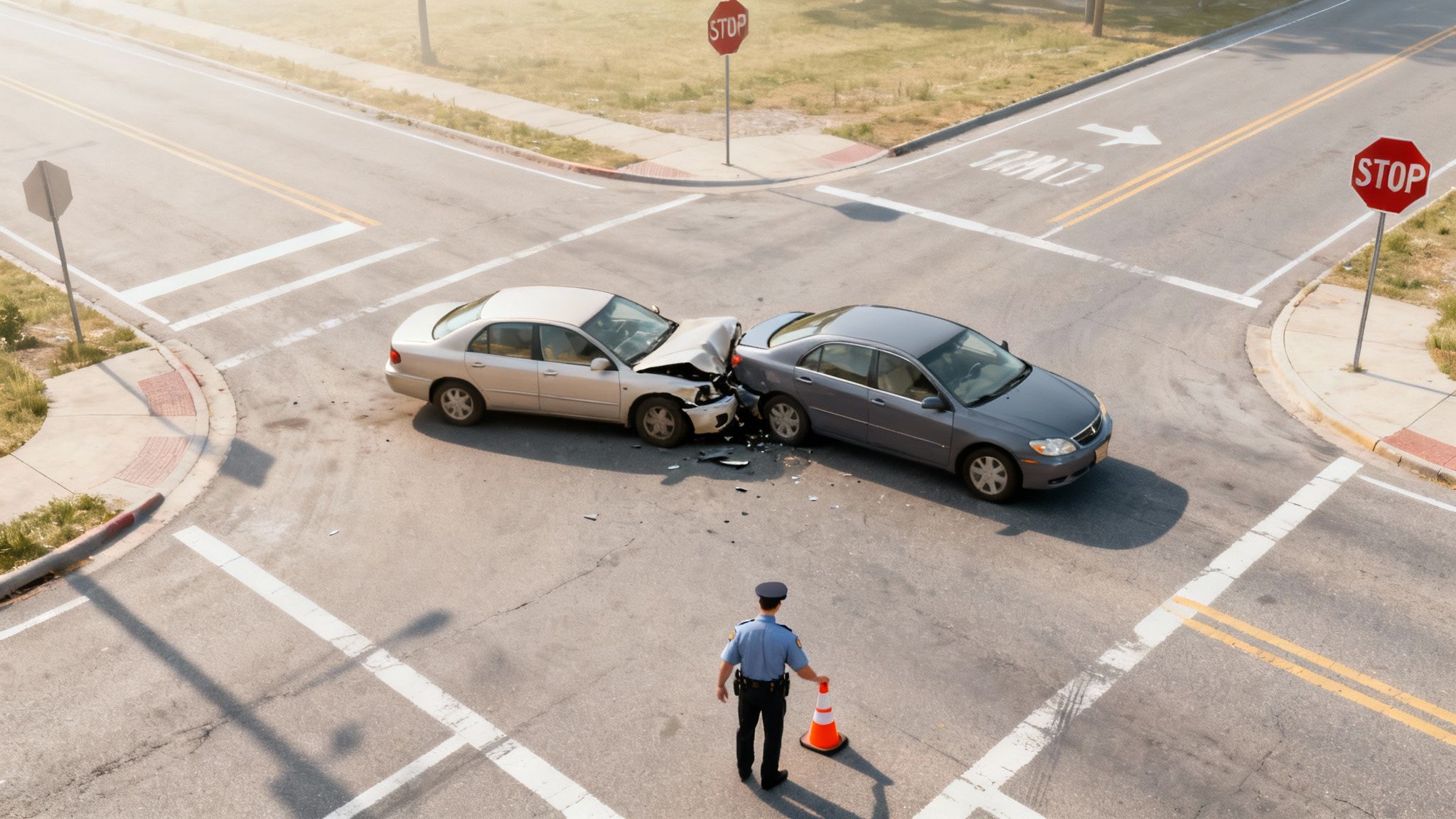
After the chaos of a crash at a busy intersection, figuring out who pays can seem complicated. But the legal process is actually pretty methodical. It all starts by proving which driver was negligent.
Think of it this way: every driver on the road has a fundamental duty to operate their vehicle safely and obey the rules. When someone breaches that duty by running a red light, making a risky turn, or blowing through a stop sign, they’ve acted negligently. If that action causes a collision, they are considered at fault. This isn’t about “he said, she said”; it’s about finding clear proof of that failure to drive safely.
The Role of Traffic Laws in Proving Negligence
Pennsylvania’s traffic laws aren’t just suggestions—they are the rulebook for the road. They spell out exactly what a driver is supposed to do in any given situation.
When a driver breaks one of these rules, like failing to yield the right-of-way, it creates a powerful argument that they were at fault. After all, these laws exist specifically to prevent these kinds of accidents.
Intersection crashes are a serious problem across the state, and the numbers are getting worse. According to the latest PennDOT crash data, fatalities in intersection accidents climbed to 321 from 301 the year before—a 6.6% increase. The situation is particularly bad at intersections with stop signs, where fatal crashes jumped from 98 to 111, a shocking 13.3% rise. You can explore more insights on Pennsylvania’s crash statistics from PennDOT for a deeper look at the data.
Common Intersection Accidents and Typical Fault
To see how these principles play out in the real world, let’s look at some of the most common types of intersection accidents. While every crash has its own unique details, clear patterns of fault tend to emerge based on the rules of the road.
This table breaks down some frequent scenarios and shows who is generally held responsible.
Common Intersection Accidents and Typical Fault
| Accident Type | Typically At-Fault Driver | Key Reason for Fault |
|---|---|---|
| Left-Turn Collision | The driver turning left | Failing to yield to oncoming traffic, which has the right-of-way. |
| Red Light Violation | The driver who ran the red light | Disregarding a clear traffic control signal, violating a direct safety law. |
| Stop Sign Violation | The driver who ran the stop sign | Failing to come to a complete stop and yield to cross-traffic. |
| Rear-End at an Intersection | The driver in the back | Following too closely or failing to stop in time for traffic ahead. |
Understanding these basic scenarios is the first step, but remember that proving fault requires solid evidence to back up your claim.
How Pennsylvania’s Comparative Negligence Rule Works
When it comes to figuring out who’s at fault in a Pennsylvania intersection crash, the answer is almost never black and white. It’s rarely a simple case of one driver being 100% wrong and the other being completely innocent. The law gets this, which is why the state uses a rule called modified comparative negligence.
Think of it like this: after a crash, a jury or an insurance company will look at all the evidence and assign a percentage of the blame to everyone involved. Your ability to get paid for your medical bills, lost wages, and other damages is tied directly to your percentage of fault.
This concept is the bedrock of nearly every car accident claim in Pennsylvania. Getting a handle on how it works is crucial if you want to protect your right to fair compensation.
The Critical 51 Percent Rule
Pennsylvania’s system has a very strict cutoff. If there’s one thing to take away from this section, it’s this: if you are found to be 51% or more responsible for causing the accident, you are completely barred from recovering any money from the other driver. It doesn’t matter how severe your injuries are; if your share of the blame hits that 51% mark, you get nothing.
On the other hand, if your fault is determined to be 50% or less, you can still get compensation. Your final payout is just reduced by whatever your percentage of fault is. So, if you have $100,000 in damages but are found to be 20% at fault, your recovery is cut by 20%, and you’d receive $80,000. For a deeper dive, check out our guide on what comparative negligence is in Pennsylvania law.
Example in Action:
Let’s say a driver is flying through an intersection, going 15 mph over the speed limit. At that same moment, another driver coming from the opposite direction makes a left turn, misjudging how fast the first car is approaching, and they collide. A jury might find that the turning driver shoulders most of the blame—say, 70%—for failing to yield. But they could also assign 30% of the fault to the other driver because their speeding clearly contributed to the crash.
In this case, the speeding driver (30% at fault) can recover 70% of their total damages. The turning driver (70% at fault) gets nothing because their blame is over the 51% threshold.
Using Traffic Violations to Prove Fault
So, how do you prove the other driver’s percentage of fault? Often, the most direct way is to show they broke a traffic law. This is where a powerful legal tool called negligence per se comes into play.
“Negligence per se” is a Latin phrase that means an action is automatically considered negligent just because it violates a law. When it comes to intersection accidents, if you can prove the other driver broke a rule of the road—one designed to prevent the very type of crash they caused—their carelessness is essentially proven.
- Running a Stop Sign: A driver who blows through a stop sign has violated a clear safety law. That act alone can establish their negligence.
- Illegal Left Turn: Turning left without yielding to oncoming traffic is a direct violation of the vehicle code.
- Red Light Violations: This is a textbook example of negligence per se. Driving through a red light is an obvious and dangerous breach of the law.
Relying on this principle really simplifies things. Instead of getting into a long debate about what a “reasonable person” would have done, you can point directly to the law they broke. This shifts the focus of the argument to proving that their specific violation is what caused your injuries, putting you in a much stronger position when it’s time to assign those all-important fault percentages.
Common Scenarios in Intersection Crashes
It’s one thing to talk about legal theories like negligence, but it’s another to see how they play out on the road. The concepts really click when you look at actual crash scenarios. Certain types of intersection accidents are far more common than others, and each one has a familiar pattern when it comes to figuring out who’s at fault under Pennsylvania law.
By breaking down these common situations, you can see exactly how a driver’s decision—or lack of one—translates into legal responsibility for the crash. This is where the rubber meets the road, both literally and legally.
Left-Turn Collisions
Left-turn accidents are one of the most frequent—and most straightforward—types of intersection crashes. The law here is crystal clear: a driver making a left turn has a duty to yield the right-of-way to any oncoming traffic that’s close enough to be a hazard.
Plain and simple, the turning driver has to wait for a safe gap. Trying to “beat” oncoming traffic or misjudging another car’s speed is a direct violation of that duty. Because of this, the driver making the left turn is found at fault in the overwhelming majority of these collisions. You can explore more about fault in Pennsylvania left-turn accidents in our detailed guide.
Of course, there are exceptions. If the driver coming straight was speeding excessively or blew through a red light, they might share some or even all of the blame. But the initial burden always falls on the turning driver to make sure the coast is clear.
Red Light and Stop Sign Violations
When a driver ignores a red light or a stop sign, assigning fault gets a whole lot easier. These traffic signals exist for a single purpose: to keep traffic flowing safely and prevent crashes.
Blowing through a red light or stop sign is a textbook example of negligence per se. By breaking a clear safety law, that driver is automatically presumed to have acted negligently. Barring some very unusual circumstances, the driver who illegally entered the intersection will almost always be held 100% at fault.
Key Takeaway: A traffic ticket from the police for running a red light or stop sign is a powerful piece of evidence. While it’s not an automatic win for your civil case, it creates a strong presumption of fault that insurance companies find very hard to argue against.
These violations aren’t just common; they’re getting deadlier. Statewide data shows that intersection collisions in Pennsylvania are becoming more severe. Between 2019 and 2023, Pennsylvania averaged about 1,172 roadway fatalities annually. While the overall number of fatalities has dipped slightly, PennDOT data shows intersection fatalities have bucked that trend, climbing from 301 to 321. Stop sign intersections have become particularly dangerous, with deaths at those locations jumping from 98 to 111.
This decision tree gives you a visual breakdown of how Pennsylvania’s comparative fault rule works, depending on the percentage of blame assigned to you.
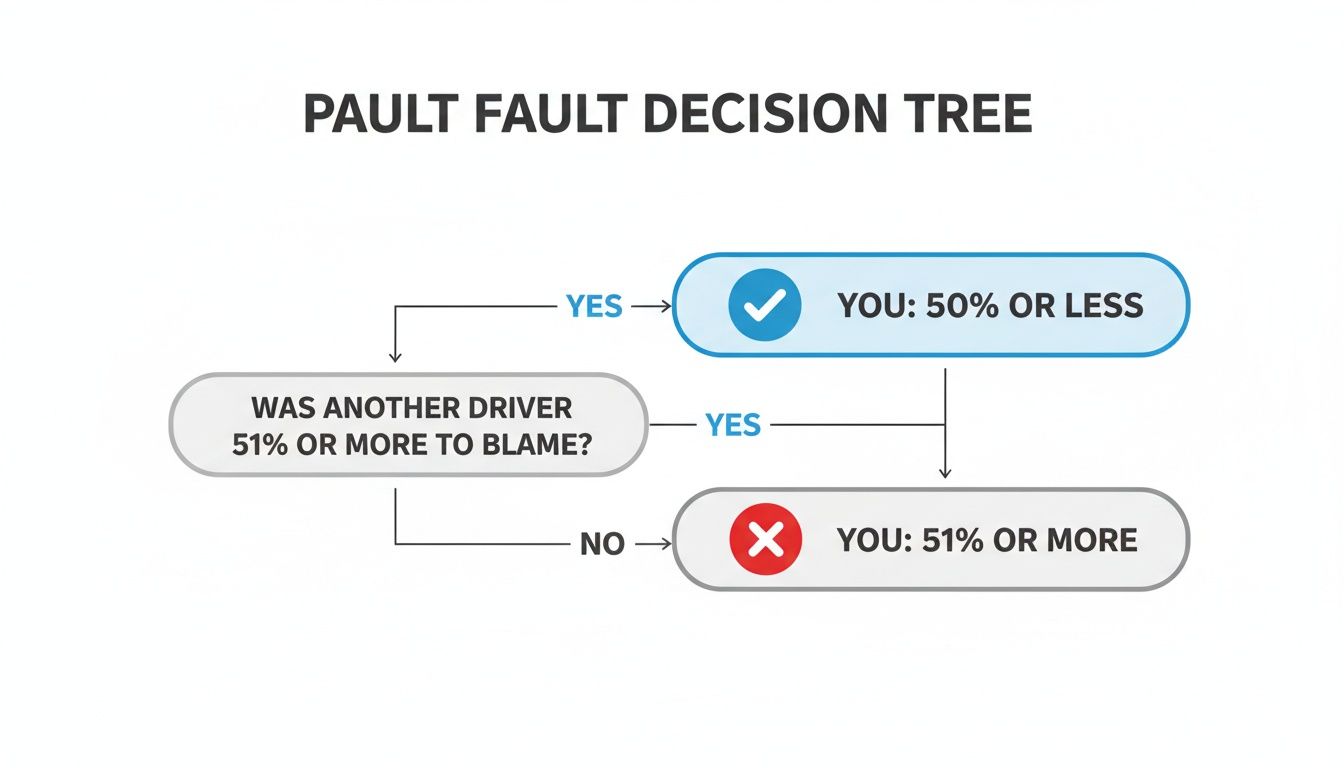
As the flowchart shows, that 51% mark is critical. If you are found to be 51% or more at fault, Pennsylvania law bars you from recovering any money for your damages.
T-Bone Crashes at Intersections
A “T-bone,” or side-impact crash, is exactly what it sounds like: the front of one car smashes into the side of another, usually at a 90-degree angle. These are incredibly common at intersections and often lead to devastating injuries.
Who is at fault in a T-bone crash comes down to one simple question: who had the right-of-way? It almost always boils down to one of these situations:
- Running a Red Light or Stop Sign: One driver ignored the signal and drove directly into the path of a vehicle that had the green light or a clear right-of-way.
- Failing to Yield on a Left Turn: A driver turns left in front of an oncoming car, causing the other car to slam into their side.
- Uncontrolled Intersections: At intersections with no signs or signals, the rule is that the driver on the left must yield to the driver on the right. A T-bone here usually means the driver on the left is to blame.
The central challenge in these cases is proving who had the right-of-way. This is where evidence like witness accounts, traffic camera footage, and even the location of the vehicle damage becomes absolutely essential to piece together what happened and establish fault.
The Evidence That Proves Fault in Your Claim
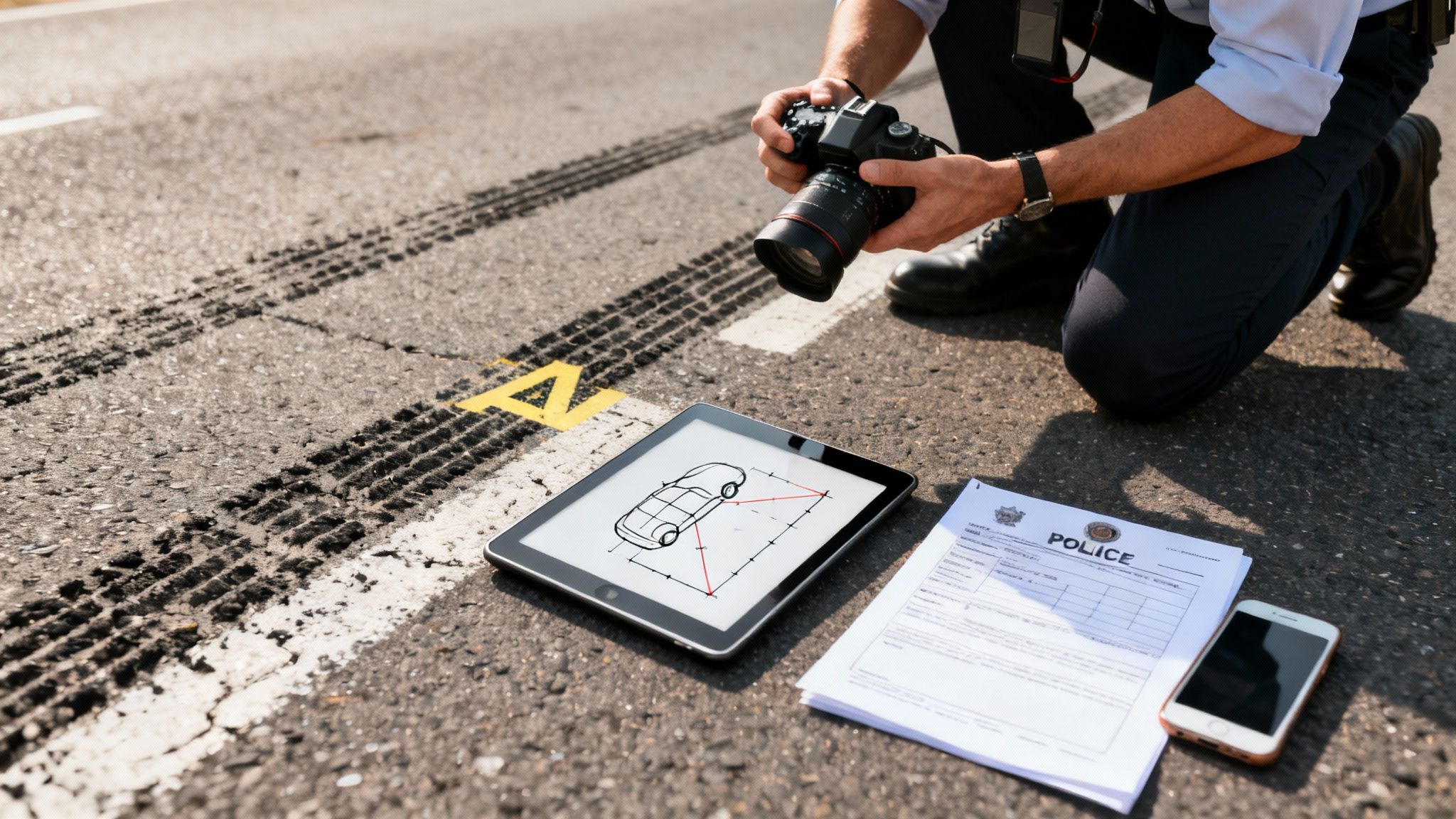
Winning an intersection accident claim isn’t about telling the most believable story—it’s about proving it with hard facts. To establish fault in Pennsylvania, you need objective evidence that clearly shows the other driver was negligent.
Think of it like building a house. Each piece of evidence is a brick. Without a solid foundation of proof, your entire case can crumble under pressure from the insurance company. An experienced law firm knows exactly what evidence to gather to build an unshakable claim.
Foundational Evidence Gathered Immediately
The first few hours and days after a crash are absolutely critical for collecting evidence. This is when the proof is freshest, before memories start to fade or physical evidence gets cleaned up or disappears.
- The Official Police Report: This is your starting point. It contains the responding officer’s initial thoughts, a diagram of the scene, witness contact information, and—most importantly—any traffic tickets they issued. A citation for failure to yield is a powerful piece of evidence.
- Photos and Videos from the Scene: A picture is worth a thousand words, and in a car accident case, it can be worth thousands of dollars. Photos of the vehicle damage, where the cars ended up, skid marks, road debris, and the traffic signals can paint a clear picture of what went wrong.
- Statements from Independent Witnesses: A neutral third party who saw what happened can be your strongest asset. Their unbiased account can back up your version of events and shut down any attempt by the other driver to change their story later.
This initial evidence sets the stage, but for a tough, disputed case, you often have to dig a lot deeper.
Advanced and Expert-Level Evidence
When the other driver refuses to accept responsibility, you need to bring in the heavy hitters. This is where a skilled legal team’s investigative resources become priceless, uncovering details that can completely turn a case around.
For example, collecting dash cam footage can provide undeniable proof of how the collision happened, instantly ending a “he said, she said” debate. It’s the kind of objective evidence that leaves little room for argument.
Key Insight: The success of an injury claim often hinges not just on the evidence you have, but on the evidence you prevent the other side from destroying. preservation letters must be sent immediately to secure things like vehicle black box data or surveillance footage before it’s overwritten.
Other types of advanced evidence include:
- Vehicle “Black Box” Data: Most modern cars have Event Data Recorders (EDRs) that capture key information in the seconds before a crash—things like speed, braking, and steering. This data can prove whether a driver was speeding or didn’t even try to brake.
- Cell Phone Records: If you suspect the other driver was distracted, their phone records can be a goldmine. We can obtain these records through legal channels to show if they were texting, talking, or using an app at the exact moment of impact.
- Red-Light Camera Footage: Many city intersections are equipped with cameras that provide indisputable proof of which driver ran the light and had the right-of-way.
In Philadelphia, for instance, crashes are concentrated in specific areas. City data reveals that just 12% of streets are the site of 80% of all serious accidents. When a crash happens at one of these known hotspots, a sharp attorney will investigate the intersection’s history, pulling signal timing plans and past accident reports to see if poor design played a role.
To give you a better idea of what we look for, here’s a table summarizing the most crucial evidence in these cases.
Key Evidence for Proving Fault in an Intersection Accident
| Evidence Type | What It Proves | How to Obtain It |
|---|---|---|
| Police Accident Report | Officer’s initial assessment of fault, witness info, and citations. | Request from the police department that responded to the crash. |
| Photos & Videos | Vehicle positions, property damage, road conditions, traffic signals. | Taken by you at the scene; requested from witnesses. |
| Witness Statements | An unbiased, third-party account of the events leading to the crash. | Gather contact info at the scene; your attorney can follow up. |
| “Black Box” (EDR) Data | Pre-crash speed, braking, acceleration, and steering inputs. | Through a legal preservation letter and expert data retrieval. |
| Surveillance/Dash Cam | Unbiased visual proof of the entire incident as it unfolded. | Request from nearby businesses, residents, or through legal channels. |
| Expert Reconstruction | A scientific opinion on speed, impact angles, and driver actions. | Your attorney will hire a qualified expert to analyze all evidence. |
Gathering a mix of these evidence types creates a powerful, multi-layered argument that is difficult for any insurance company to deny.
The Role of Accident Reconstruction Experts
When the physical evidence is complicated or the sequence of events is unclear, we bring in an accident reconstruction expert. These specialists are like forensic scientists for car crashes.
They use physics, engineering, and meticulous analysis to scientifically recreate what happened. By examining everything from skid marks to crush damage, they can provide an authoritative opinion on vehicle speeds, angles of impact, and what each driver did (or failed to do).
In a hotly contested case, an expert’s testimony can be the single most persuasive piece of evidence, dismantling the other driver’s story and clearly proving their fault. Our detailed guide explains what evidence you need to win a Pennsylvania car accident claim, giving you an even more in-depth checklist.
Why You Need an Attorney for Your Accident Claim
After an intersection accident, you might think that if the other driver was obviously at fault, getting a fair payout will be straightforward. I’ve seen it time and time again—it’s almost never that simple. The moment that crash gets reported, the other driver’s insurance company gets to work protecting its bottom line, not you.
Their primary goal is to pay out as little as they possibly can. Insurance adjusters are trained negotiators, skilled at twisting the facts to shift blame, downplay your injuries, and pressure you into a quick, lowball settlement before you even know the true value of your claim.
The Insurance Company Is Not on Your Side
Adjusters love to use Pennsylvania’s comparative negligence rule as their main weapon. They will pick apart every single detail of the crash, searching for any excuse to assign you a percentage of the fault. Even sticking you with just 10% or 20% of the blame can slash thousands of dollars from your settlement.
They might twist your words from a recorded statement or misinterpret the evidence to argue you were distracted, speeding, or could have somehow avoided the crash. It’s a brutally effective strategy. If they can convince a jury that you were 51% or more at fault, they walk away without paying you a dime.
Crucial Insight: An insurance adjuster’s job is to minimize their company’s payout. They are not neutral parties. Anything you say can and will be used against you to reduce the value of your claim.
Trying to fight these tactics on your own is a huge risk. If you’re already running into problems with an insurer’s decision, knowing how to dispute an insurance claim is a vital first step, but an experienced attorney can take that entire burden off your shoulders.
How a Skilled Trial Attorney Fights for You
Bringing in an experienced personal injury attorney completely levels the playing field. While you focus on getting better, your lawyer goes on the offensive, building a rock-solid case designed to shut down the insurance company’s arguments.
A dedicated legal team takes immediate, decisive action to protect your rights. Here’s what that looks like:
- Conducting a Rigorous Investigation: We don’t just take the police report at face value. We move fast to secure all available evidence—surveillance footage from nearby businesses, witness statements, and data from the vehicle’s “black box”—often before it disappears for good.
- Hiring the Right Experts: For complex cases, we bring in accident reconstruction experts who can provide a scientific breakdown of exactly how the crash happened. We also consult with medical specialists to document the full impact of your injuries and what you’ll need for future care.
- Negotiating from a Position of Strength: We take over all communications with the insurance company. Armed with compelling evidence, we can tear down their lowball offers and fight aggressively for the full and fair compensation you are actually owed.
- Preparing Every Case for Trial: Insurance companies are savvy. They know which law firms will settle for less to avoid court and which ones are ready to go all the way. We prepare every single case for trial from day one. That sends a powerful message: we won’t back down.
Trying to handle a serious injury claim yourself puts you at a massive disadvantage. An attorney is your advocate, investigator, and negotiator, making sure your rights are protected at every turn while fighting to secure the maximum compensation you deserve.
Common Questions After an Intersection Crash
After a serious intersection accident, your head is spinning with questions. Even after you understand the basics of Pennsylvania’s fault laws, the “what ifs” and “what nows” can feel overwhelming. I get it. Below, I’ve answered some of the most pressing questions I hear from clients every day, using straightforward language to give you the clarity you need.
How Long Do I Have to File a Lawsuit in Pennsylvania?
This is a big one, and the clock is ticking. Pennsylvania law gives you a strict deadline, known as the statute of limitations, to file a personal injury lawsuit. For most intersection accidents, you have just two years from the date of the crash.
If you miss that two-year window, your claim is almost certainly gone for good. It doesn’t matter how badly you were hurt or how clearly the other driver was at fault. The court will bar you from ever seeking compensation. There are very few exceptions to this rule, which is why it’s critical to talk to an attorney well before the deadline approaches.
What Steps Should I Take at the Scene to Protect My Claim?
The aftermath of a crash is pure chaos, but what you do in those first few minutes can make or break your case. Your number one priority is always safety.
First, check on everyone involved and call 911 for police and paramedics. If you’re able to move around safely, start documenting everything with your phone.
- Take Photos and Videos: Get pictures of the vehicle damage, where the cars ended up, skid marks, broken glass on the road, and any traffic lights or signs nearby.
- Exchange Information: Swap names, contact info, driver’s license numbers, and insurance details with the other driver. Stick to the facts—don’t get into an argument about who’s to blame.
- Talk to Witnesses: If anyone saw what happened, get their name and number. An independent witness statement is often incredibly persuasive.
- Don’t Admit Fault: It’s natural to want to say “I’m sorry,” but those words can be twisted by an insurance adjuster later. Never admit fault to anyone—not the other driver, not their insurer, not even the police.
Lastly, get checked out by a doctor as soon as you can, even if you think you’re okay. Adrenaline is a powerful painkiller, and a medical report is the best way to connect your injuries directly to the crash.
The Other Driver Got a Ticket, So They’re 100% at Fault, Right?
Not automatically, but it’s incredibly strong evidence for your case. When a police officer issues a ticket for running a red light or blowing through a stop sign, it establishes a powerful starting point that the ticketed driver was negligent. It makes it much tougher for their insurance company to deny the claim outright.
However, that won’t stop the insurer from trying to pin some of the blame on you to lower their payout. They might argue you were speeding or looking at your phone, even if their driver was the one who caused the collision. A good lawyer will use that traffic ticket as the foundation of your claim while shutting down any attempts to unfairly shift fault back onto you.
What if the Insurance Company Says I’m Partly at Fault?
This is a classic insurance adjuster tactic, and it’s all about saving their company money. Remember Pennsylvania’s modified comparative negligence rule? Your final compensation gets cut by whatever percentage of fault they can assign to you. If they can convince you that you were 20% responsible for a $100,000 claim, they just saved their company $20,000.
Crucial Reminder: The adjuster’s ultimate goal is to push your share of the blame past the tipping point. If they can successfully argue you were 51% or more at fault, Pennsylvania law says you get nothing. Zero.
Never, ever accept an insurance company’s determination of fault without speaking to your own attorney first. The adjuster works for them, not for you. Their job is to minimize payouts. We gather the evidence needed to push back, protect your rights, and prove the other driver was the one primarily responsible for your injuries.
If you or a loved one was hurt in an intersection accident, you don’t have to take on the insurance companies by yourself. At Mattiacci Law, we dig deep, investigate every detail, and prepare every case as if it’s going to trial. That’s how we fight for the full compensation you deserve. Contact us today for a free, no-obligation consultation to understand your rights and options. Visit us at https://jminjurylawyer.com to learn more.