

Author: John Mattiacci | Owner Mattiacci Law
Published January 16, 2026
When a merging accident happens in Pennsylvania, the first assumption is often that the driver entering the new lane is at fault. After all, they have a duty to yield. But the real answer is rarely that simple. Fault can be shared if the other driver was speeding, distracted, or actively blocking a safe merge.
Unpacking Initial Fault in a Pennsylvania Merging Accident
After a crash, figuring out who's at fault in a merging accident in Pennsylvania boils down to one core question: who broke the rules of the road? While the driver merging has a clear legal duty to yield to existing traffic, that doesn't give the other driver a free pass to drive recklessly. Investigators and insurance companies will immediately dig into what both drivers were doing in the moments before impact.
Think of highway traffic as a flowing river. The merging car is like a boater trying to join the current—they're responsible for finding a safe gap without disrupting the flow. If they pull out abruptly and cause a collision, they're almost always seen as the primary cause.
But the analysis doesn't stop there. What if a driver already in the "river" of traffic suddenly sped up to close a gap? Or what if they were texting and didn't see the merging car? In those situations, the responsibility starts to shift.
Key Factors That Determine Blame
Several critical factors come into play when assigning responsibility for a merge-related crash. Insurance adjusters and attorneys will scrutinize the evidence to get the full story, not just the final impact. These initial considerations often include:
- Failure to Yield: Did the merging driver actually wait for a safe and adequate opening in traffic before moving over?
- Speeding: Was the driver in the through-lane going well over the speed limit, making it impossible for the other car to judge the gap correctly?
- Distracted Driving: Was either driver on their phone, messing with the radio, or otherwise not paying full attention to the road?
- Aggressive Driving: Did the driver in the through-lane intentionally block the merge or show other signs of road rage?
To break it down, here’s a look at the basic duties and common mistakes each driver makes that can lead to a crash.
Initial Fault Indicators in a Merging Crash
| Driver Role | Primary Responsibility | Common Actions Leading to Fault |
|---|---|---|
| Merging Driver | To yield the right-of-way and only enter the lane when it is safe to do so. | Merging too slowly, not using a turn signal, misjudging the speed of traffic, cutting someone off. |
| Through-Traffic Driver | To maintain a safe speed, remain aware of surroundings, and not impede other drivers unnecessarily. | Speeding, distracted driving (e.g., texting), intentionally speeding up to "close the gap," making an unsafe lane change to avoid the merging car. |
Ultimately, just because one driver has the primary duty doesn't mean the other driver is free from all responsibility.
This decision tree helps visualize how fault can be assigned based on the actions of both the merging driver and the driver already in the lane.
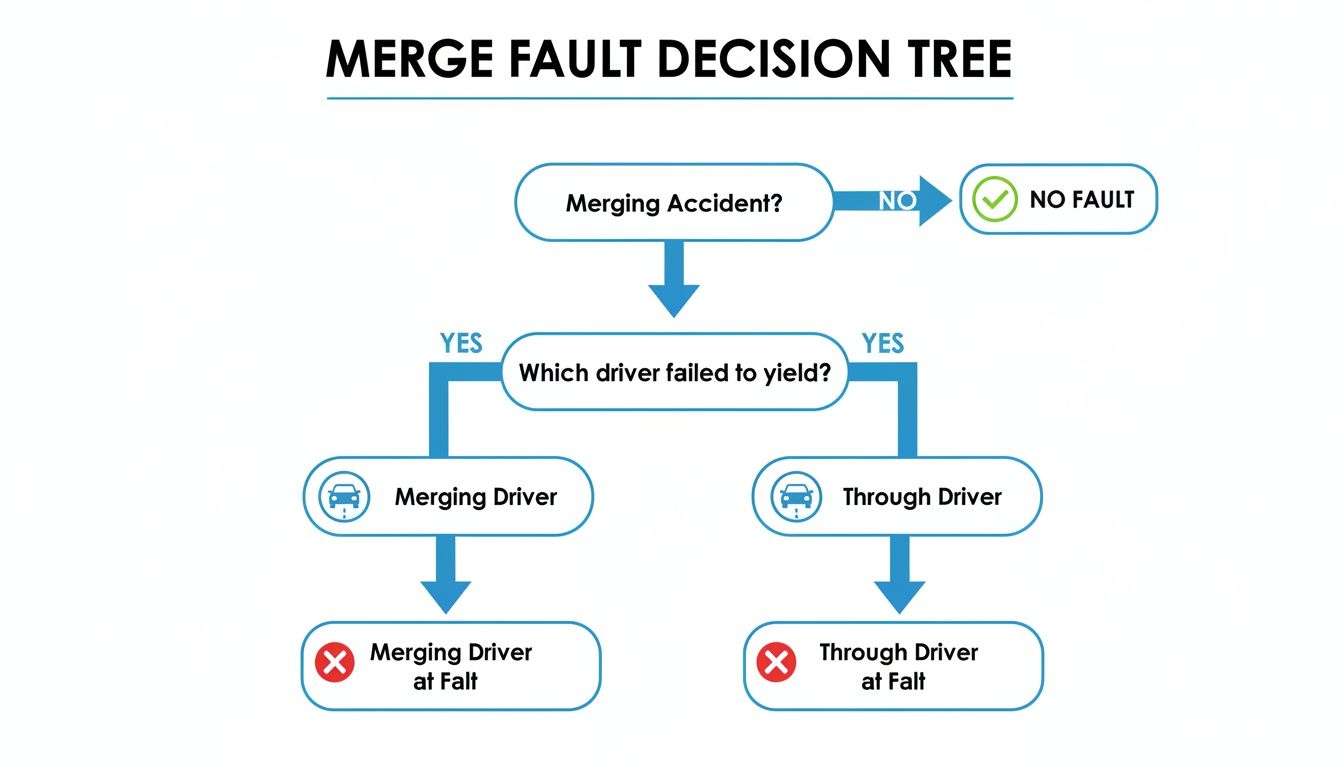
As the chart shows, the merging driver’s duty to yield is the starting point, but negligence from the through-driver can introduce shared fault, which can completely change the outcome of a claim.
Understanding Pennsylvania's Right-of-Way Merging Laws
To figure out who’s at fault in a merging accident in Pennsylvania, we first have to look at the rules of the road. These aren't just polite suggestions; they're legal duties spelled out in state law, mainly under Pennsylvania Statutes Title 75. While the legal text can be a bit dense, the main idea is actually pretty simple.
Think of highway traffic as a powerful, fast-moving river. If you’re on an on-ramp or in a lane that’s about to end, you’re like a boater trying to join that current. It's on you to get up to speed, find a safe opening, and slide into the flow without making a mess or forcing someone to slam on their brakes.
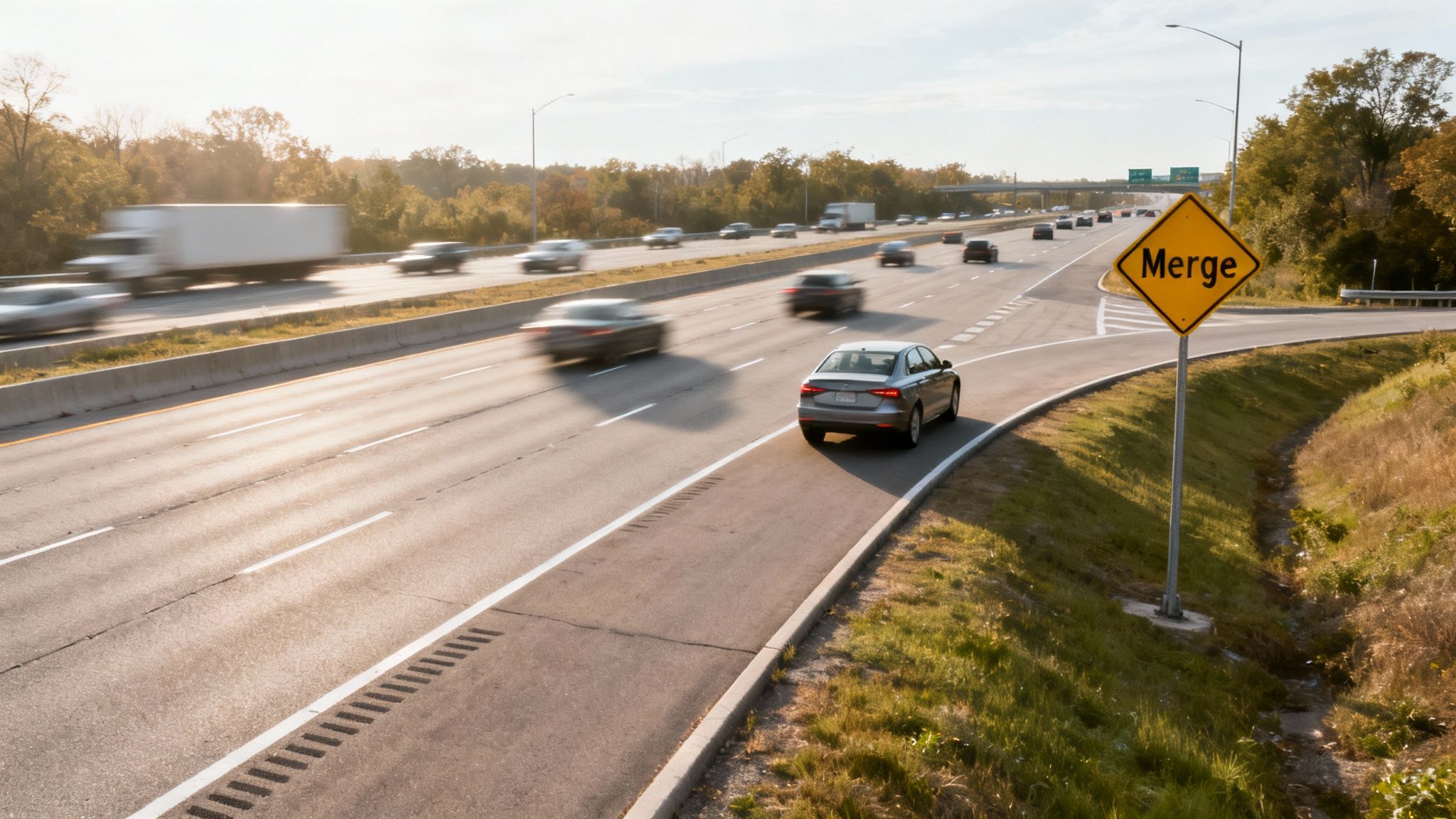
The law is crystal clear on this: the vehicle entering a new lane must yield to the cars already there. A "failure to yield" is one of the biggest causes of merging accidents, and it’s why the initial finger of blame almost always points at the merging driver.
The Merging Driver's Legal Duty
Under Pennsylvania law, the person doing the merging has a very specific job to do. Getting these steps right is key to merging safely and, just as importantly, avoiding liability if a crash happens.
A driver entering traffic has to:
- Yield to Through Traffic: This is the golden rule. You can’t just force your way in. The cars already on the highway have the right-of-way, period.
- Use the Acceleration Lane Properly: That lane exists for a reason—to get you up to the same speed as the traffic you’re joining. Merging too slowly can be just as dangerous as going too fast.
- Signal Your Intentions: Your turn signal is your only way to talk to other drivers. Flip it on early to let people know what you’re planning to do so they have time to react.
- Find a Safe Gap: This takes good judgment. You have to accurately size up the speed and distance of the cars coming up behind you before you make your move.
Key Takeaway: The responsibility for a safe merge falls squarely on the merging driver. The very act of merging means you are the one joining an established flow of traffic, and you have to do it without causing a hazard.
This concept is so fundamental that the crash itself can sometimes be seen as proof that the merging driver failed to yield. But that's not the whole story. The driver already in the lane of traffic has responsibilities, too.
What About the Driver in the Through Lane?
While the merging car has the duty to yield, drivers already on the highway can’t just ignore them. Everyone has a general duty to be careful and avoid accidents when they can. This means that, in certain situations, they can absolutely share the blame for a merging accident.
Here are some common ways a through-traffic driver can be found partially at fault:
- Aggressive Driving: Intentionally speeding up to block someone from merging isn't just rude; it’s a negligent act that can cause a serious collision.
- Distracted Driving: If a driver is texting, on the phone, or just not paying attention, they might not even see the merging vehicle until it’s too late.
- Unsafe Lane Changes: Suddenly swerving into the lane a car is trying to merge into, or changing lanes without checking their blind spot, is a recipe for disaster.
- Excessive Speed: Flying down the highway well over the speed limit makes it nearly impossible for a merging driver to judge a safe gap.
Put it this way: the merging driver has to ask for permission to enter the lane, but the through-traffic driver has a duty not to unreasonably slam the door or create a dangerous situation. The rules can get complicated, and you can learn more by reading our guide on who is at fault in a failure to yield accident in Pennsylvania. At the end of the day, the law expects everyone to cooperate. When someone drops the ball, figuring out who is at fault means looking closely at what each person did—or failed to do—in the moments before the crash.
How Pennsylvania's Negligence Rule Affects Your Claim
Figuring out who broke a traffic law is just the starting point in a Pennsylvania merging accident. The next, and often more critical, question is how the blame gets divided. This is where things can get complicated, and it directly controls whether you can recover money for your injuries.
Pennsylvania follows a legal doctrine called "modified comparative negligence." It's a system for assigning fault, but it comes with a strict, all-or-nothing cutoff.
The 51% Bar to Recovery
Think of it like this: as long as you are 50% or less to blame for the crash, you can seek compensation from the other driver. But if a judge or jury decides you were 51% or more responsible, you get nothing. Your ability to recover damages is completely barred.
The Critical Takeaway: Even if the other driver was clearly doing something wrong, if you're found to be just slightly more at fault than they were, your claim is worth zero. This rule makes fighting any unfair blame an absolute necessity.
Insurance adjusters are masters at using this rule to their advantage. Their job is to minimize payouts, and their best strategy is to shift as much of the fault as possible onto you. If they can push your share of the blame to that 51% mark, they owe you nothing.
How Comparative Negligence Plays Out in a Real-World Scenario
Let's walk through a common merging accident to see how this works.
Imagine you're merging onto a busy highway. You signal, check your mirrors, and see a car in the through lane, but it seems far enough away to merge safely. As you move into the lane, that car slams into your rear quarter panel.
At first glance, it seems the other driver is at fault. They were clearly driving too fast or weren't paying attention, right? But what if an investigation uncovers a few more details?
- Your Action: You merged while going a bit slower than the flow of highway traffic.
- Their Action: The other driver was going 15 mph over the speed limit.
Here, both drivers made a mistake that contributed to the crash. A claims adjuster or a jury might split the fault this way:
- The Merging Driver (You): 30% at fault for not matching the speed of traffic.
- The Through-Traffic Driver: 70% at fault for excessive speeding and failing to avoid the collision.
Now, let's say your total damages—for medical bills, lost income, and pain and suffering—add up to $100,000. Because you were found 30% responsible, your total award is reduced by that percentage.
- $100,000 (Total Damages) – $30,000 (Your 30% Fault) = $70,000 (Your Final Recovery)
As you can see, even a minority share of the blame takes a significant bite out of your compensation. And if the fault had been flipped—if you were found to be 51% at fault—that $70,000 recovery would instantly become zero.
This is why understanding this system is so important. To protect your right to fair compensation, you need to be prepared to challenge how fault is assigned. You can learn more about how comparative negligence works in Pennsylvania law and see how it’s applied in all sorts of personal injury cases.
Common Scenarios Where Fault Gets Complicated
Traffic laws give us a starting point, but the real world of merging is messy. Accidents on the road are rarely a simple, open-and-shut case. The moments leading up to a crash involve two drivers, and the actions of both can create a gray area where assigning blame becomes a real fight.
This is exactly where insurance companies dig in. They know these situations are complex, and they’ll use that ambiguity to try and shift the blame, ultimately reducing what they have to pay. Let's walk through some of the most common and tricky merging accident scenarios I see all the time.
The Aggressive Blocker
We’ve all seen this one. You put on your blinker, spot a perfectly safe gap, and start to ease over. But then, out of nowhere, the driver in the lane you’re entering stomps on the gas, deliberately closing the space to keep you out. The crash happens, and the first words out of their mouth are, "You cut me off!"
Technically, the merging driver has to yield. But when the other driver intentionally speeds up to block you, they’ve just introduced a massive dose of their own negligence into the equation. That wasn't a defensive move; it was an aggressive one that directly helped cause the collision. Proving this often comes down to a good witness or, even better, dashcam footage that clearly shows they had plenty of time to let you in but chose to speed up instead.
The Distracted Driver in the Through Lane
In this scenario, you do everything right. You judge the speed of the approaching car, see you have plenty of room, and begin your merge. The problem is, the other driver never even sees you. They're on their phone, fiddling with the radio, or just not paying attention. They don't make the slightest adjustment to their speed and plow right into you.
Of course, their story will be that you failed to yield. But here's the thing: every single driver on the road has a fundamental duty to stay aware and avoid a crash if they can. Their distraction made it impossible to react to a completely normal traffic situation. Evidence like cell phone records, statements from other drivers who saw them looking down, or even a lack of skid marks (showing they never hit the brakes) can be powerful in proving their inattention was the real cause.
In Pennsylvania, lane departure crashes—a category that frequently includes merging accidents—were a leading cause of fatalities in 2023, resulting in 606 deaths. When you consider that speeding was a factor in over 23,000 crashes and that Philadelphia’s busy merge points have the highest crash rates in the state, it's clear that the actions of through-traffic drivers are under a microscope. An experienced attorney knows how to use this context to show that another driver's negligence, whether it's distraction or excessive speed, makes them liable—even when you were the one changing lanes. You can find more details in recent Pennsylvania crash data reports.
The "Phantom Vehicle" Chain Reaction
Sometimes, the driver who actually causes the accident is never even touched. Picture this: a "phantom vehicle" suddenly cuts you off as you're trying to merge, forcing you to swerve violently into the next lane to avoid getting hit. In doing so, you sideswipe a car that was already there, driving perfectly legally.
The phantom driver who started it all just keeps going, leaving you and the other driver to figure out what just happened. The person you sideswiped is going to blame you for an unsafe lane change. You, on the other hand, can argue that you were forced into an emergency maneuver by someone else's recklessness. This is a tough spot. Without an independent witness or dashcam video that caught the phantom vehicle's license plate, proving you weren't at fault can be an uphill battle.
Sideswipes and Big Trucks
Commercial trucks are surrounded by enormous blind spots—the "No-Zones"—on all four sides. A classic accident scenario plays out when a trucker starts to change lanes, completely unaware that a passenger car is driving right alongside them in that blind spot.
Even if you were just holding your lane and speed, the truck driver might try to claim you were trying to pass unsafely or were "lingering" where you shouldn't have been. But the law holds commercial drivers to a much higher standard of care. They have a professional duty to be extra cautious and to know what’s in their blind spots before making a move. Evidence from the truck’s event data recorder (its "black box"), driver logs, and a crash reconstruction expert can often prove the truck driver simply failed to look, making them liable for the crash.
Gathering the Right Evidence to Prove Your Case
When it comes to a merging accident in Pennsylvania, figuring out who’s at fault isn't about what you think happened—it's about what you can prove. Trust me, after a crash, the other driver's story can change in a heartbeat, and their insurance company will be looking for any crack in your story to deny or lowball your claim. A strong case is built on a foundation of solid, undeniable evidence.
Think of it like building a house. Your word is the starting point, but without a sturdy frame of hard evidence, the whole thing can collapse under pressure. Every piece of proof—from the police report to a witness's account—is a support beam that makes your claim stronger and more likely to stand up to scrutiny.
The Official Police Report
The single most important document you'll have from the scene is the official police report. It's not always the final say on who’s at fault, but you can bet it's the first thing an insurance adjuster is going to read.
Why is it so valuable? Because it’s an objective account from a neutral party. The report usually includes:
- A diagram of the crash, showing where the cars ended up.
- A note of any traffic tickets issued, like one for failure to yield.
- Statements from you, the other driver, and anyone who saw it happen.
- The officer's own initial thoughts on what caused the crash.
If the other driver gets a ticket for an illegal merge or speeding, that’s a powerful piece of evidence that can immediately tilt the scales of liability in your favor.
Eyewitness and Video Evidence
What other people saw can be just as important as the physical evidence left at the scene. Independent witnesses don’t have a horse in the race, which makes their testimony incredibly credible to both insurers and juries. If someone stops to help, make sure you get their name and number before they leave.
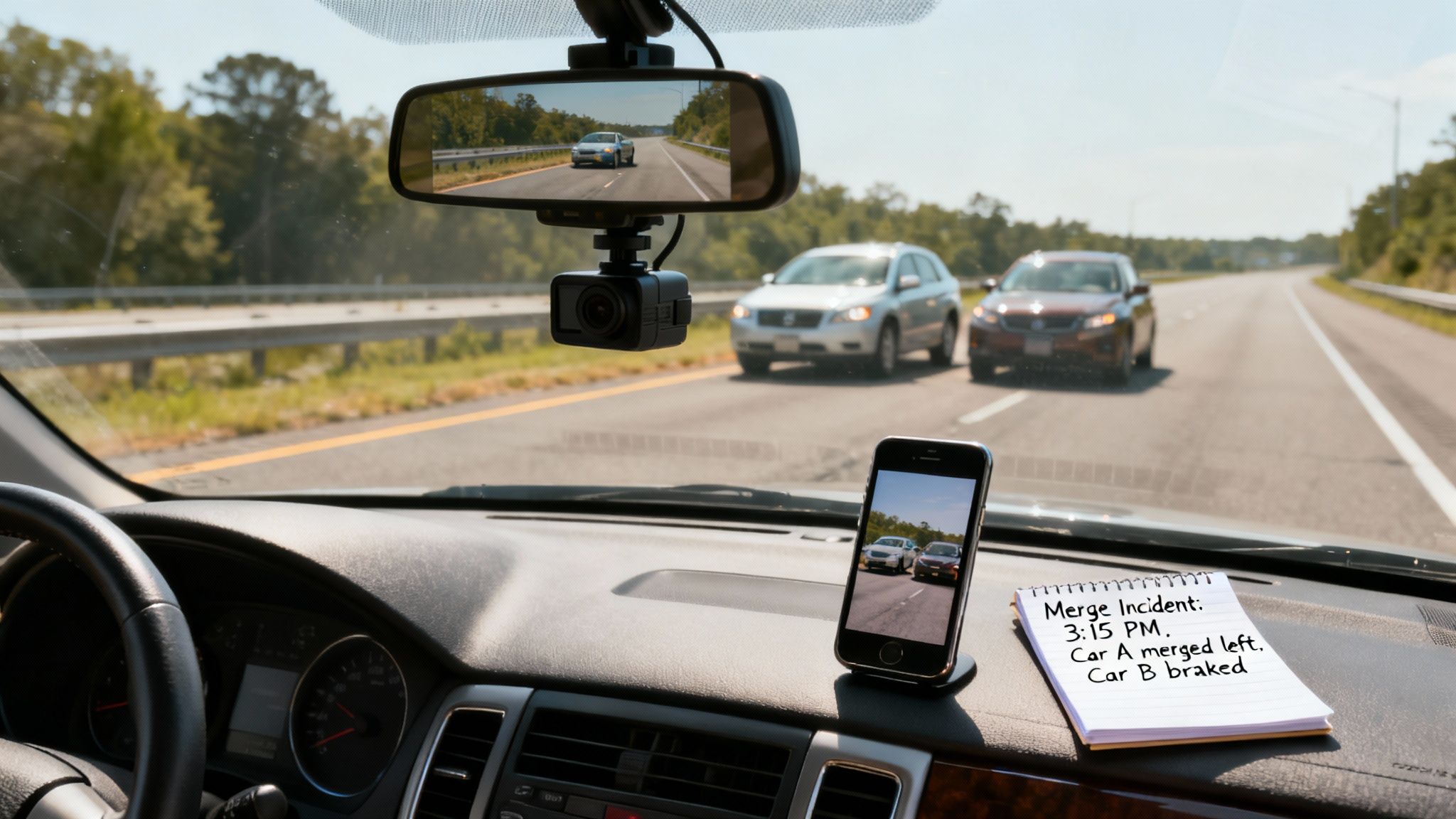
Even better? Video footage. In a classic "he said, she said" situation, a video is the ultimate tiebreaker.
Key Takeaway: Footage from a dashcam or a nearby business's security camera can end a dispute over fault almost instantly. It can show if the other driver was texting, speeding, or aggressively trying to block you, turning a tough case into a straightforward one.
It’s just very hard for an insurance company to argue with what's on video, making it one of the best assets you can have for your claim.
Documenting the Scene and Damages
The evidence you collect yourself right after the crash is also crucial. Your smartphone is your best tool here, allowing you to create a detailed visual record of what happened. For a more in-depth checklist, check out our guide on how to document evidence after a car accident.
You'll want to take pictures of everything:
- Vehicle Damage: Get photos of both cars from every angle, paying close attention to the points of impact.
- Skid Marks and Debris: These little details can help experts figure out speeds and the sequence of events later on.
- Road Conditions and Signs: Was there a yield sign the other driver ignored? Was the on-ramp designed poorly?
- Visible Injuries: Snap a picture of any cuts or bruises right away.
This on-the-spot documentation preserves the scene exactly as it was, providing a clear snapshot before things get cleaned up or memories fade. As you move forward, you might have to give a deposition, and a solid resource like this ultimate deposition preparation checklist can be a huge help in getting you ready.
The Role of Accident Reconstruction Experts
When fault is seriously in dispute, bringing in an accident reconstruction expert can be a complete game-changer. Think of these professionals as forensic scientists for car crashes. They use physics, engineering, and all the available evidence to scientifically piece together exactly how the accident unfolded.
By analyzing everything from the vehicle’s “black box” data recorder to the skid marks and crush damage, they can calculate speeds, impact angles, and what each driver was doing in the seconds before impact. Their expert report can provide the objective, scientific proof needed to cut through the noise, counter the other driver's story, and establish who was truly at fault.
Why You Need a Pennsylvania Car Accident Lawyer on Your Side
Right after a merging accident, your world can feel chaotic. You're dealing with injuries, your car is a mess, and before you know it, the phone starts ringing. It’s almost always an insurance adjuster on the other end.
While you’re just trying to figure out your next move, their goal is simple: to minimize what their company has to pay. This is the moment when having an experienced attorney in your corner isn't just a good idea—it's essential for protecting your future.
A good lawyer immediately steps in to become your shield. They handle all the calls and paperwork from the insurance companies, which is a bigger deal than it sounds. It stops you from accidentally saying something that could hurt your claim, like casually saying "I'm fine" when you're still in pain. That single phrase can be twisted and used against you later.
Don't Let the Clock Run Out: Pennsylvania's Statute of Limitations
In Pennsylvania, the law gives you a strict deadline to take legal action after an accident. It’s called the statute of limitations, and for most personal injury cases, it’s just two years from the date of the crash.
Two years can fly by, especially when you're recovering. Building a solid case takes time, and evidence has a nasty habit of disappearing.
- Witnesses forget: The details a witness remembers a week after the crash can be gone a year later.
- Video footage vanishes: That crucial gas station or traffic cam footage is often recorded over in just a few days or weeks.
- The deadline is absolute: If you miss that two-year window, you lose your right to sue for compensation. It doesn’t matter how clear the other driver’s fault was or how serious your injuries are.
Getting a legal team involved quickly means they can start preserving that critical evidence right away. This is how you build a powerful foundation for proving fault in a merging accident.
Leveling the Playing Field Against Insurance Companies
Let's be clear: insurance companies are not on your side. They are businesses with teams of professional adjusters and lawyers whose entire job is to pay out as little as possible on claims. Going up against them alone is like stepping into a professional boxing ring without any training.
An attorney’s job is to even the odds. They know the tactics insurers use and they know how to fight back. They launch their own investigation, gather all the necessary evidence, and negotiate aggressively to make sure you're treated fairly.
Your lawyer understands the real, long-term cost of an accident—from future medical bills and lost wages to the pain and suffering that doesn't show up on a receipt. They prepare every case as if it's going to trial, and that readiness is what often convinces an insurance company to offer a settlement that truly covers your losses.
Frequently Asked Questions About Merging Accidents
After the chaos of a merging accident, it's completely normal for your head to be spinning with questions. Who was at fault? What do I do now? Getting clear answers is the first step toward putting things right. Here are some of the most common questions we hear from people in your situation.
What Happens If Both Drivers Blame Each Other?
It's one of the most frustrating scenarios: a classic "he said, she said" standoff. When both drivers point the finger at each other, the case hinges entirely on the evidence that can be gathered. Insurance adjusters and legal teams have to play detective, piecing together the story from the clues left behind.
This is where objective proof is worth its weight in gold. Eyewitness testimony, the official police report, and especially video from a dashcam or a nearby security camera can completely change the game. Without that kind of clear-cut evidence, experts will look at the physical aftermath—things like the location of the vehicle damage, skid marks on the pavement, and the debris field—to reconstruct the accident and figure out what most likely happened.
Can I Get Compensation If I Was Partly At Fault?
Yes, you absolutely can. Pennsylvania follows a rule called modified comparative negligence, sometimes known as the 51% bar. It's a system designed to be fair when fault isn't a simple 100/0 split.
The rule says you can still recover damages as long as you are found to be 50% or less responsible for the crash. Your final compensation will simply be reduced by your percentage of fault.
Think of it this way: If a jury awards you $100,000 but decides you were 20% to blame for the merge, you would receive $80,000 ($100,000 minus 20%). This is exactly why it's so important to fight back against any unfair blame the other driver's insurance company tries to place on you.
But be aware, if you're found to be 51% or more at fault, you are completely barred from recovering anything. That one percentage point makes all the difference.
How Long Do I Have To File a Merging Accident Lawsuit?
In Pennsylvania, the law gives you a firm deadline to file a personal injury lawsuit. This is called the statute of limitations. For nearly all car accident cases, you have exactly two years from the date of the crash to take formal legal action.
Two years might sound like a lot of time, but it can fly by when you're dealing with doctor's appointments, physical therapy, and just trying to get your life back on track. Acting quickly is crucial, and not just because of the deadline.
- Evidence vanishes. Security camera footage is often recorded over, and evidence from the crash scene is cleaned up within hours.
- Memories get fuzzy. Witnesses forget key details over time, making their testimony less powerful.
- A strong case takes time. A thorough investigation needs to happen right away to lock down evidence and build a solid claim.
If you wait too long, you risk losing the very proof you need to show what really happened and get the compensation you deserve for your injuries.
If you have more questions or were injured in a merging accident and need help now, the experienced team at Mattiacci Law is ready to listen. We offer a free consultation to hear your story and explain your options. Contact us 24/7 to get the guidance you need by visiting https://jminjurylawyer.com.