

Author: John Mattiacci | Owner Mattiacci Law
Published April 26, 2026

You’ve just dealt with the crash itself. Your hands are still shaking, your car may be on a tow truck, and now your phone lights up with an insurance call. The person on the other end sounds polite. They may even sound helpful. That doesn’t mean the conversation is harmless.
In Philadelphia, a car accident claim starts taking shape almost immediately. What you say in the first call can affect fault, treatment disputes, and the value of your case long before you’ve seen the full medical picture. If you’re searching for What to Say to Insurance After Accident in Philly, the safest approach is simple: report the crash, protect your rights, and don’t give the adjuster language they can use against you later.
The First Phone Call After a Philly Accident
You are leaving the crash scene on Roosevelt Boulevard or I-76, your car is damaged, adrenaline is high, and your phone rings before you have even had a real chance to process what happened. The caller sounds calm. The questions sound routine. That first call still deserves caution.

In Philadelphia, early claim handling moves fast. Adjusters see heavy crash volume, and Pennsylvania law gives them real room to argue over fault, injury thresholds, and what benefits apply. If you chose limited tort, or if the insurer plans to argue you were partly responsible, a casual answer in the first call can create problems long before your treatment is finished. A trial-ready firm looks at that call for what it is: the beginning of the evidence record.
What the adjuster is trying to get
The first call usually serves a few practical purposes for the insurance company:
- Open the claim: They want the date, location, vehicles, and names involved.
- Lock in your first account: They prefer to hear your version before you have reviewed the police report, photos, or witness information.
- Test your injury position: If you say you feel fine, they may point back to that later.
- Look for admissions: Words like “maybe,” “I guess,” or “I didn’t see them” can be used to reduce or deny value.
That does not mean every adjuster is acting in bad faith. It means their job is to evaluate exposure early, and your job is to avoid giving them more than they need.
How to approach the call
Keep the conversation short, factual, and controlled. Confirm basic identifying information. Confirm that a crash occurred. If you do not know an answer, say you do not know yet. If you are still being checked by a doctor, say that. Do not guess about speed, distance, fault, or the extent of your injuries.
I tell clients to treat this like the first page of a file that may someday be read by a defense lawyer or a Philadelphia jury. That mindset helps. It keeps you from filling silence with explanations that feel harmless in the moment but read badly later.
A safe approach is simple: report the collision, state that medical evaluation is ongoing if that is true, and decline to give detailed analysis on the spot.
Why this matters more in Pennsylvania
Pennsylvania is not a pure no-fault state in the way many drivers assume. PIP benefits, tort election, and modified comparative negligence can all affect what happens next. If the insurer can frame you as partly at fault early, that issue can follow the claim from the first call through settlement talks and trial preparation.
That is why being polite is fine, but being loose with details is not.
If you want a broader checklist before speaking with any insurer, review these steps to take after a crash in Philadelphia.
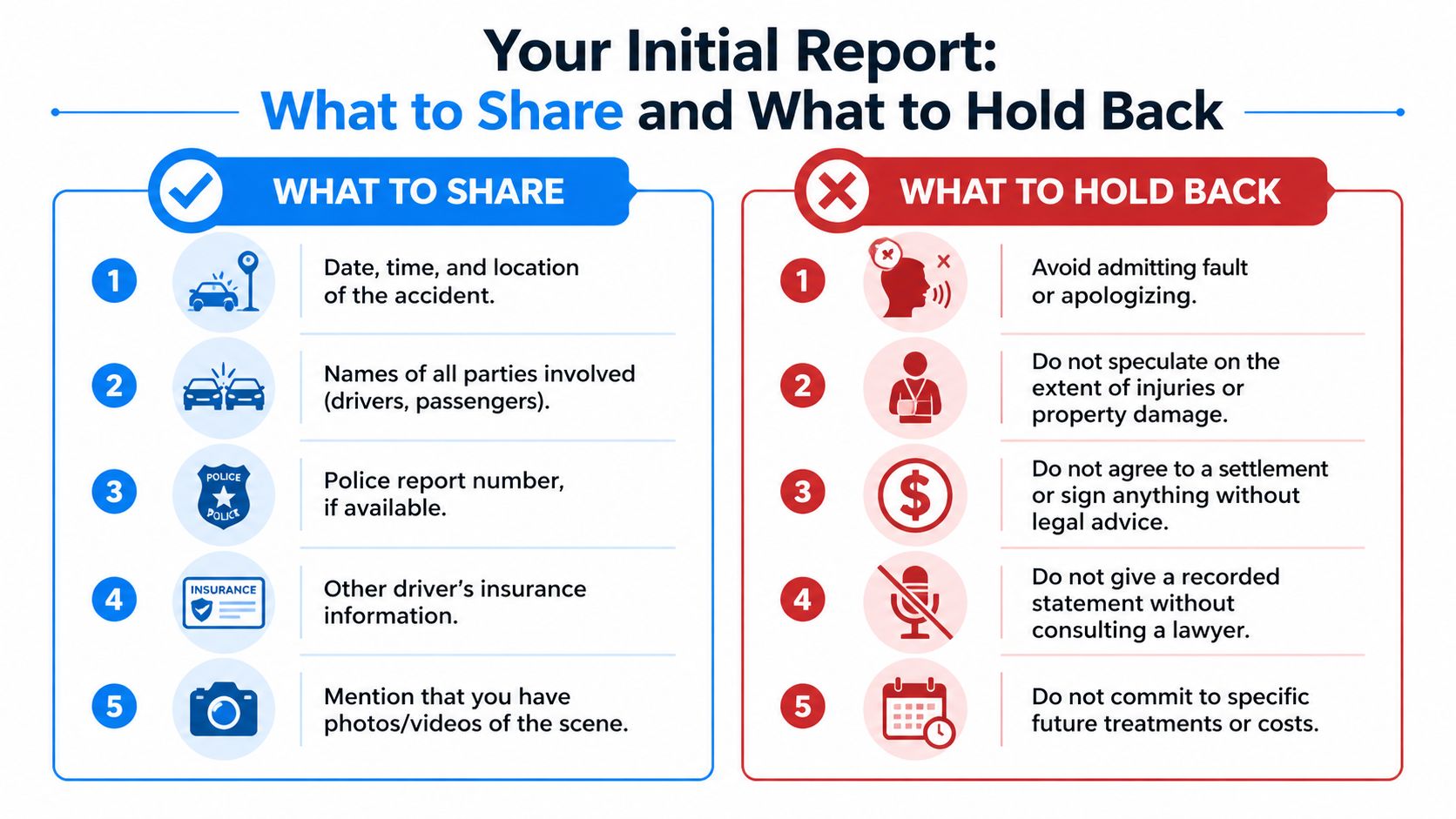
Your Initial Report What to Share and What to Hold Back
The first report should do one job. Open the claim without handing the insurer extra material to use against you later.
In Philadelphia crashes, that matters more than many drivers realize. A few loose words about fault or injury can become part of the insurer’s story from day one, and in Pennsylvania, fault allocation can directly affect what you recover.
A safe script for the first report
A short opening report can sound like this:
“There was a collision on [date] at [location]. The vehicles involved were [basic identifying information]. Police responded, and the report number is [number] if available. My vehicle is [drivable/not drivable]. I am being medically evaluated or receiving treatment.”
That is usually enough.
The adjuster needs the basic facts to set up the file. The adjuster does not need your reconstruction of the crash, your opinion about blame, or your guess about how badly you are hurt.
What to share
Keep your report limited to concrete facts you know firsthand:
- Date and time: Give the day and approximate time of the crash.
- Location: Identify the street, intersection, highway, or nearby landmark.
- People involved: Name the drivers and, if asked, the passengers.
- Vehicle details: Provide basic vehicle information and where the car can be inspected.
- Police involvement: Give the report number if you have it.
- Medical status: Say you are being evaluated or are in treatment, if that is true.
- Preserved evidence: You can say you took photos or have witness contact information.
If you want examples of how to respond once the adjuster starts pressing for details, review this guide on how to answer insurance claim questions.
What to hold back
The first call is not the place for analysis. It is not the place for reassurance either.
Do not volunteer these subjects:
- Fault opinions: Do not say you caused the crash, may have caused it, or “could have avoided it.”
- Guesses: Do not estimate speed, stopping distance, signal timing, or what another driver “must have been doing.”
- Injury conclusions: Do not say you are fine, uninjured, or only a little sore.
- Damage estimates: Do not guess at repair costs or whether the vehicle is totaled.
- Settlement talk: Do not discuss money, releases, or quick payment.
- Future treatment predictions: Do not predict how long recovery will take or whether you will need more care.
I give clients one practical rule. If you did not personally confirm it, or if a doctor has not evaluated it, do not state it as fact.
The phrase that causes trouble fastest
The sentence I correct most often is, “I’m okay.”
People say it to be polite. Adjusters may later treat it as a statement that you were not hurt. That creates problems when pain worsens that night, a concussion is diagnosed two days later, or neck and back symptoms show up after the adrenaline wears off.
A better answer is simple: “I am still being evaluated.” That is accurate, careful, and hard to mischaracterize.
In Pennsylvania, those early word choices can matter well beyond the intake call. If the insurer is building a comparative negligence argument or looking for a reason to question damages under your tort election, your first statements become part of that effort. Keep the report short. Keep it factual. Let the medical records and investigation fill in the rest.
Can We Get a Recorded Statement How to Respond
Soon after the initial report, many adjusters ask for a recorded statement. They may frame it as standard procedure. They may say it will help move the claim along. They may imply that only uncooperative people decline.
You should hear that request for what it is. A recorded statement locks you into language while you are still recovering, still investigating, and often still confused about what happened in the seconds before impact.

Why insurers want it
The insurer benefits from a statement taken early. If you misspeak, minimize your symptoms, or make an uncertain comment about fault, they now have your own words to compare against every later medical record, demand letter, and deposition.
That risk is not theoretical. Data shows that 45% of personal injury claims are reduced in value because recorded statements include inadvertent admissions of partial fault, as discussed in this recorded-statement analysis. A sentence like “I only glanced away for a second” may sound minor to you and major to the adjuster.
Polite ways to say no
You don’t need to be hostile. You need to be clear.
Try one of these responses:
- Simple refusal: “I’m not prepared to provide a recorded statement at this time.”
- Medical uncertainty: “I’m still being evaluated and don’t want to make incomplete statements.”
- Counsel-first response: “I’ll have my attorney handle any further communication.”
- Facts-only response: “I’ve reported the basic facts. I’m not giving a recorded statement.”
If the adjuster pushes, repeat the same point. Don’t start defending your refusal. The more you explain, the more room you create for follow-up questions.
What not to say while declining
People often decline the recording, then accidentally give a statement anyway. They say something like, “I’d rather not record it, but basically I was heading through the intersection and maybe didn’t see him until late.”
That defeats the purpose.
Use this quick comparison:
| Response type | Safer approach | Riskier approach |
|---|---|---|
| Declining | “I’m not giving a recorded statement.” | “I’m not giving one, but here’s roughly what happened.” |
| Injury status | “I’m still being evaluated.” | “I feel mostly fine.” |
| Fault questions | “I’m not discussing fault.” | “I may have been a little distracted.” |
A recorded statement rarely helps an injured claimant with the other driver’s insurer. It often helps the insurer test your claim before your evidence is complete.
When your own insurer asks
The analysis is a little different with your own carrier because your policy may require cooperation. Even then, brief and careful is still the rule. If the crash involved injuries, disputed fault, or significant losses, get legal advice before you agree to anything formal. The right response may be coordination through counsel rather than an open-ended interview.
Why Your Words Matter PAs Insurance Rules Explained
A single careless sentence can change the value of a Philadelphia injury claim.
Pennsylvania insurance rules give adjusters room to argue about fault, causation, and what your case is worth. In a city with heavy traffic, disputed intersections, and frequent chain-reaction crashes, that matters from the first conversation. I tell clients the same thing every day: speak as if your words may be read back to a jury later, because they might.
Modified comparative negligence
Pennsylvania follows modified comparative negligence. That rule allows recovery only if you are 50% or less at fault, as explained in this Pennsylvania car accident claim overview. If the insurer can push your share of fault above that line, your recovery can be reduced or cut off.
That is why casual language is dangerous. Statements like “I was probably going a little fast,” “I should have seen him sooner,” or “maybe I could have stopped” are not harmless conversation. They are admissions the adjuster can use to assign you a bigger share of blame.
A trial-ready law firm listens for that risk immediately. The issue is not whether your comment sounds polite or honest. The issue is how the defense will frame it if settlement talks fail.
No-fault benefits and liability claims
Pennsylvania also uses a no-fault system for first-party medical benefits. Your own policy often includes $5,000 in PIP coverage for medical bills regardless of fault. That point confuses many injured drivers, especially after a stressful crash in Philadelphia. They assume fault does not matter early because some bills are paid through their own coverage.
Fault still matters. A lot.
PIP is only the starting point. Once injuries are serious, treatment continues, or wage loss and pain claims grow, the dispute usually shifts to the liability side of the case. That is where insurers examine your words closely. They look for anything they can use to argue you caused the crash, your injuries are minor, or your medical problems came from something else.
Limited tort and full tort
Pennsylvania’s limited tort and full tort election also affects what your claim may include. Full tort usually preserves broader rights to seek pain and suffering damages. Limited tort can restrict that part of the case unless an exception applies or the injury qualifies as serious.
That choice is a real trade-off:
- Full tort: Higher premiums in many cases, but broader access to non-economic damages
- Limited tort: Lower premiums in many cases, but tighter limits on pain and suffering claims
If you do not know which option applies, check your declarations page. Do not guess on a recorded line, and do not let an adjuster define your policy for you before your lawyer reviews it.
Why process matters too
Good claim handling is legal strategy plus discipline. Insurers move files through intake systems, notes, and evaluation protocols. If you want a broader look at that operational side, you can discover claims processing benefits. For an injury case, the practical point is simple: clear records help your claim, and loose language gives the insurer something to work with.
Pennsylvania law rewards precision. In Philadelphia accident cases, the safer course is short, factual communication that does not guess, volunteer fault, or minimize injury.
Building Your Case Before You Even Make the Call
A strong claim starts before the adjuster hears your voice. It starts with evidence.
If your account is short but your documentation is solid, you are in a much better position than someone who talks freely but preserves nothing. Insurance companies evaluate what can be proven. That means your photos, records, names, bills, and timeline matter as much as any phone script.

What to gather right away
Build a file from day one. Digital is fine. Paper is fine. Both is better.
- Scene photos: Take wide shots of the intersection or roadway, traffic controls, vehicle positions, debris, skid marks, and visible injuries.
- Vehicle images: Photograph every side of every involved vehicle if possible, not just the impact point.
- Witness contacts: Get names, phone numbers, and short notes about what each person saw.
- Police information: Save the report number, officer name, and responding agency details.
- Insurance details: Keep photos of insurance cards, registration, and claim numbers.
- Medical records: Save discharge papers, visit summaries, prescriptions, imaging instructions, and referrals.
Keep a running damages file
Many claims lose value because people remember the crash but fail to document the aftermath.
Track these categories as they happen:
- Medical expenses: Bills, copays, medication receipts, braces, and therapy charges.
- Work loss: Missed time, reduced hours, employer notes, and pay records.
- Out-of-pocket costs: Parking, transportation, towing, storage, and rental expenses.
- Daily limitations: Pain, sleep disruption, missed family events, and tasks you now need help completing.
A short daily journal helps. Keep it plain. Note what hurts, what treatment you had, what activities you missed, and how your symptoms affected work or home life. Honest detail is more persuasive than dramatic language.
Prepare before you speak
Before returning an insurer call, review your own materials first.
Create a simple pre-call checklist:
- Confirm the basics: Date, location, vehicles, and report number.
- Review your photos: Refresh your memory so you don’t guess.
- Check your treatment status: Know whether you were evaluated and what follow-up is scheduled.
- Write down your boundaries: No fault discussion, no injury conclusions, no recorded statement.
That preparation changes the tone of the call. You stop reacting and start controlling the information flow.
Knowing When to Call a Philadelphia Accident Attorney
Some claims can stay straightforward for a short time. Many do not.
The moment there’s an injury, disputed fault, pressure for a recorded statement, or uncertainty about coverage, the risk goes up quickly. At that point, the issue is no longer just what to say. The issue becomes who should be speaking for you.
Clear signs it’s time to get counsel
Call a Philadelphia accident attorney if any of these apply:
- You’re hurt: Even if the injury seems moderate at first.
- The adjuster wants a recorded statement: Especially from the other driver’s insurer.
- Fault is being disputed: Or you suspect the other side is changing the story.
- You have a limited tort policy: Because the legal analysis gets more technical.
- A quick settlement is offered: Before treatment is complete.
- You feel overwhelmed: That alone is a valid reason to get help.
If you’re weighing that decision, this guide on whether to get a lawyer after a Philadelphia accident lays out the practical considerations.
What a trial-ready approach changes
A trial-ready law firm doesn’t treat the insurance claim as a paperwork exercise. It treats the file as a case that may need to be proved. That affects what evidence gets preserved, how medical records are framed, how witness statements are gathered, and when negotiations begin.
That approach also changes how insurers evaluate the risk of underpaying the case. If they know the file has been built carefully and can be presented in litigation, the conversation changes.
One final instruction
If you remember only one thing, remember this: your first job is to protect your claim, not to satisfy the adjuster’s curiosity.
Say enough to report the crash. Don’t guess. Don’t minimize injuries. Don’t discuss fault. Don’t give a recorded statement just because someone asked nicely. And when the case starts to feel bigger than a simple car repair issue, put counsel between you and the insurer.
If you were injured in a Philadelphia crash and don’t want to risk saying the wrong thing to an adjuster, Mattiacci Law can step in, review the facts, handle insurer communication, and help protect the value of your claim while you focus on treatment and recovery.