


Author: John Mattiacci | Owner Mattiacci Law
Published February 10, 2026

When a child gets hurt, a parent’s world stops. The last thing on your mind is a legal deadline, but it’s one of the most important factors in protecting your child’s future.
Fortunately, Pennsylvania law understands this. It provides special rules for injured kids that are very different from the rules for adults.
Why the Clock Works Differently for Children
For most adults in Pennsylvania, the rule is brutally simple: you have two years from the date you were injured to file a lawsuit. Miss that window, and your chance to get compensation is gone forever. It’s a strict, unforgiving deadline.
But for a child under 18, the system hits the pause button. This legal protection is called tolling.
Think of it like this: the standard two-year legal clock is supposed to start ticking on the day of the accident. For a minor, however, the law keeps that clock frozen. It doesn’t start until the child’s 18th birthday.
Once they become a legal adult, the two-year countdown finally begins. This means an injured minor generally has until their 20th birthday to file a personal injury claim.
This timeline gives you a clear picture of how this protective rule works in practice.
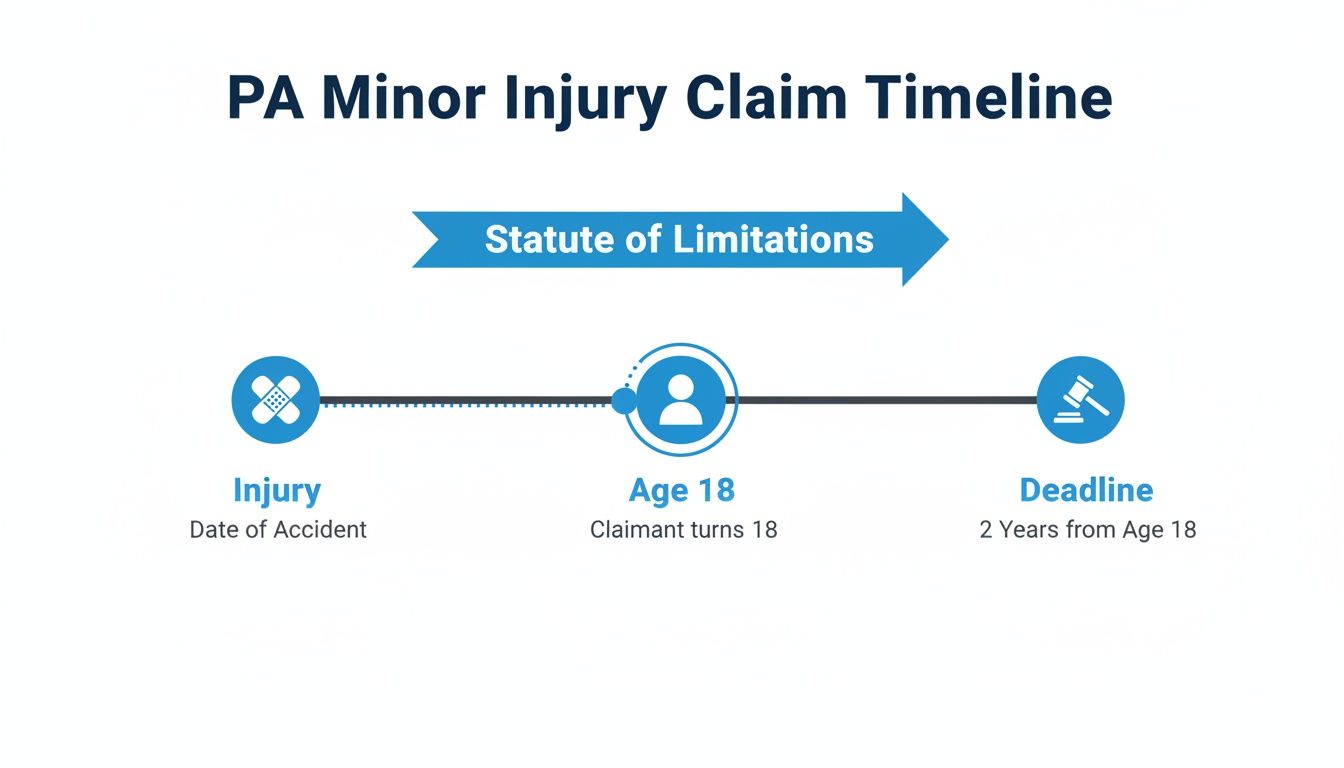
As you can see, the law essentially grants a long “pause” that only ends once the child reaches the age of majority.
The Real-World Reason for This Extra Time
This isn’t just a legal technicality; it’s a critical safeguard built on common sense and experience.
Injuries in children can be incredibly complex. The full impact of an accident might not show up for years. A concussion in a five-year-old could lead to learning disabilities that only become obvious in middle school. A joint injury might seem to heal perfectly, only to cause severe arthritis in their late teens.
The minor tolling rule exists for one simple reason: to prevent a child’s right to justice from expiring before anyone truly understands the lifelong consequences of their injury.
It gives families the breathing room needed to see how an injury will affect a child’s development, education, and future opportunities.
The difference this makes is profound. Let’s look at the deadlines side-by-side to see just how significant this legal protection is.
Pennsylvania Statute of Limitations Adult vs Minor Injury Claims
This table highlights the stark contrast between the deadlines for an adult and a minor who suffer the same type of injury on the same day.
| Claimant | Standard Time Limit | When the Clock Starts | Final Deadline |
|---|---|---|---|
| Adult | 2 Years | On the Date of Injury | 2 Years After Injury |
| Minor | 2 Years | On the Child’s 18th Birthday | On the Child’s 20th Birthday |
As you can see, the law provides a crucial buffer for children, prioritizing their long-term well-being over a rigid, one-size-fits-all deadline. To understand how this fits into the bigger picture, you can learn more by reading our complete guide on the Pennsylvania personal injury statute of limitations.
How Pennsylvania’s Minor Tolling Rule Protects Your Child
Pennsylvania law operates on a simple, yet profound, truth: children aren’t just small adults. They don’t have the legal standing to hire a lawyer, the perspective to grasp the long-term effects of an injury, or the experience to navigate the complexities of our justice system. This is precisely why the minor tolling rule exists—it’s a critical legal shield for your child’s future.
Think of the statute of limitations like a ticking clock. For an adult who gets hurt, that clock starts immediately and runs out in just two years. But for a child, the law hits the pause button. The clock is “tolled,” or frozen, until their 18th birthday. Only then does the two-year countdown officially begin, giving them until their 20th birthday to file a claim.

This rule, laid out in 42 Pa.C.S. § 5533(b), is incredibly practical. The full impact of an injury from childhood often takes years to surface. A bump on the head as a toddler could reveal itself as a learning disability in second grade. A playground fracture might develop into chronic arthritis, jeopardizing a young athlete’s future. The tolling rule ensures the complete story of the injury can be told.
Why This Protection Is So Crucial
The minor tolling rule is far more than a legal formality. It’s a direct acknowledgment of a child’s vulnerability and their developmental journey. It serves a few essential purposes that can make all the difference for your family.
First and foremost, it preserves the child’s own legal rights until they are mature enough to have a say in decisions that will impact their entire life.
Second, it allows everyone—doctors, parents, and legal experts—to get a much more accurate picture of the total damages. By allowing time to pass, it becomes clearer what future surgeries, physical therapy, specialized equipment, or educational support will be needed. This is how we ensure a settlement or verdict truly covers the lifelong costs of a serious injury.
Imagine a 10-year-old in Philadelphia is hit by a delivery truck and suffers a traumatic brain injury. While an adult would have a strict two-year deadline, the clock for the child won’t start until he turns 18. This gives him and his family until he is 20 years old to file a lawsuit, recognizing that the true scope of his cognitive challenges and lost earning potential may not be known for years.
The Role of Parents and Guardians
Just because the law pauses the clock for the child doesn’t mean you, as the parent or guardian, should wait. You have the authority—and I’d argue, the responsibility—to act on your child’s behalf well before they turn 18. In nearly every case, taking action sooner is the smarter move.
The minor tolling rule is a safety net, not a reason to delay. The best time to preserve evidence, interview witnesses, and build a strong case is immediately after the injury occurs.
Waiting for years is a huge gamble. Evidence disappears, witness memories fade, and the people or companies responsible can become impossible to find. By acting promptly, you give your child the best possible chance at securing their future. While Pennsylvania’s law provides this specific protection, it’s part of a broader legal framework that values the vital role of guardians in safeguarding minors.
This protection is a cornerstone of how Pennsylvania delivers justice for its youngest citizens. To better understand the exact moment these legal timelines are set in motion, you can learn more about when does the statute of limitations start in a pa injury case.
How Different Types of Injuries Change the Filing Clock
While Pennsylvania’s tolling rule for minors is a fantastic safety net, it’s not a simple, one-size-fits-all rule. The specific details of how your child was injured can dramatically change how these deadlines work, creating legal traps for families who assume the rules are the same across the board. Getting these distinctions right is absolutely critical to protecting your child’s future.
The basic idea is simple enough: for most personal injury claims, the clock stops ticking until your child turns 18. This covers a huge range of incidents, from a fall on a poorly maintained playground to an injury caused by a defective toy. But once you step into more complex cases, you’ll find unique timelines and exceptions every parent needs to understand.
Medical Malpractice Claims Involving Children
This is where the tolling rule for minors often becomes most important. Think about it: an injury that happens at birth or during a childhood surgery might not show itself for years. A child might start missing developmental milestones, slowly revealing a hidden brain injury. Or a surgical mistake could cause problems that don’t surface until a teenage growth spurt.
In these tough situations, the law gives families two layers of protection:
- Tolling for Minors: The statute of limitations is paused until your child’s 18th birthday, giving them until they turn 20 to file their claim.
- The Discovery Rule: This common-sense rule says the two-year clock doesn’t start running until the injury is discovered, or reasonably should have been discovered. For a child, this works hand-in-hand with tolling to ensure fairness when the harm isn’t obvious right away.
This combination is a powerful tool. Pennsylvania’s law really shines in medical malpractice cases, protecting children whose injuries—like birth trauma or surgical errors—take time to fully emerge. For a deeper dive, you can read our detailed guide to the medical malpractice statute of limitations in Pennsylvania.
The Critical Exception: Wrongful Death Claims
This is the most dangerous exception for families dealing with an unimaginable loss. If an injury tragically leads to a child’s death, the tolling rule does not apply to the family’s wrongful death claim. The statute of limitations is a strict two years from the date of death, no matter the age of the surviving family members.
This is a hard and fast rule. A personal injury claim for the child’s pain and suffering before they passed (called a survival action) might still be tolled. But the family’s separate wrongful death claim is not. Waiting past that two-year mark means losing the right to seek justice for your loss forever.
The rules around wrongful death claims are complex and can feel unfair. While a personal injury claim tolls for the child, a death claim starts immediately and doesn’t pause for anyone. Sadly, this misunderstanding is common. It’s estimated that 40% of such claims are dismissed when guardians wait too long, a heartbreaking statistic backed by court decisions. You can find more insights on this from legal analyses like those on statutes of limitations for minors on mwke.com.
How Other Common Injury Claims Are Affected
Beyond malpractice and wrongful death, other types of claims have their own practical considerations. The general tolling rule usually applies, but the evidence you need to prove your case can disappear fast, making a long wait a very risky strategy.
Here’s a quick summary to help you see how the timelines apply to different kinds of claims involving children.
Claim Timelines for Minors by Injury Type in Pennsylvania
| Claim Type | General Rule for Minors | Key Exceptions or Considerations |
|---|---|---|
| Product Liability | Tolled until age 20. | The defective product is your most important piece of evidence. If you wait, you risk it being lost, thrown away, or destroyed. |
| Premises Liability | Tolled until age 20. | Proving a dangerous condition (like a wet floor or broken stair) existed requires immediate investigation, photos, and witness interviews. |
| Car Accidents | Tolled until age 20. | Skid marks vanish, accident scenes are cleared in hours, and witness memories fade surprisingly quickly. The evidence doesn’t wait. |
The key takeaway is this: while the law gives your child extra time to file a lawsuit, the evidence needed to actually win their case has a much, much shorter shelf life.
The Parent’s Claim: A Separate and Much Shorter Deadline
While Pennsylvania law rightly gives your child extra time to file their injury claim, there’s a critical detail that trips up far too many families: the extended deadline for your child does not apply to your own claims as a parent. Your right to recover your own financial losses is governed by a separate, and much shorter, deadline you absolutely cannot afford to miss.
When your child gets hurt, the financial burden often falls squarely on your shoulders. You have a legal right to get that money back—for the medical bills, co-pays, and prescriptions you paid out-of-pocket. You can also seek compensation for the wages you lost taking time off work to care for them or shuttle them to countless doctor’s appointments.
This is what lawyers call a derivative claim. You can think of it as a claim that branches off from your child’s primary injury case. But legally speaking, it stands on its own and is subject to its own unforgiving timeline.

Understanding Your Two-Year Window
For your derivative claim as a parent, the standard two-year statute of limitations applies. That clock starts ticking on the day of your child’s accident and it runs out exactly two years later. There is no tolling, and there is no extension until your child turns 18.
It’s an easy and devastating mistake to make. A family, understandably focused on their child’s recovery and long-term future, might think they have years to act. By waiting, they might secure a strong settlement for their child’s future pain and suffering, but unknowingly give up the right to be reimbursed for tens or even hundreds of thousands of dollars in medical expenses they’ve already paid.
Your child’s claim and your financial claim are on two completely different clocks. Believing one deadline covers both is one of the most financially damaging assumptions a parent can make after an accident.
This dual-deadline system creates a real sense of urgency. To protect all of your family’s financial rights, you have to act quickly.
The Real-World Cost of Missing the Parent’s Deadline
The financial stakes are incredibly high. The costs tied to a serious childhood injury can snowball, from the initial ER visit to years of specialized therapy, rehabilitation, and medical equipment.
If you miss your two-year deadline, you could lose the right to recover money for:
- Medical Bill Reimbursement: Every dollar you paid for doctors, hospital stays, surgeries, and medications.
- Lost Wage Compensation: The income you lost from having to miss work to care for your child.
- Related Expenses: Costs for traveling to specialists or even modifying your home to be accessible.
The courts are strict about these rules. For instance, in a premises liability case where a child was hurt, the parents’ claim for medical costs had to be filed within two years of the fall. In one such case, the parents’ timely action led to a $1.1 million recovery that covered years of therapy—funds that would have been completely lost had they waited.
Wrongful death claims are another area with no exceptions for minor beneficiaries; in recent years, a staggering 22% of these cases were dismissed simply for missing the strict two-year filing deadline. You can read more about how these deadlines are applied in Pennsylvania wrongful death claims on brandonjbroderick.com.
The bottom line is simple: while the law protects your child’s right to compensation for the long haul, it expects you to act on your own financial claims right away. Speaking with an attorney early on is the only way to ensure both sets of rights are fully preserved.
When your child gets hurt, it’s easy to feel overwhelmed. Your world shrinks down to one thing: making sure they’re okay. But in the middle of the chaos, a few key actions can safeguard their future, even with Pennsylvania’s extended deadlines for minors.
Think of it this way: the sooner you act, the stronger your foundation for a potential legal claim. Time can unfortunately work against you, as evidence disappears and memories fade.
Get Medical Care Immediately and Consistently
First things first: get your child to a doctor. This is non-negotiable for their health, but it also serves a critical legal purpose. Every visit creates a paper trail that officially documents the injuries and connects them directly to the incident.
Make sure you follow through on everything the doctors recommend, whether it’s seeing a specialist, going to physical therapy, or attending follow-up appointments. Any gaps in treatment can give an insurance company an opening to argue the injuries weren’t that serious.
Your child’s complete, uninterrupted medical record is often the most persuasive piece of evidence you can have. It tells the story of what they’ve been through in a way nothing else can.
Document Everything You Can
Evidence has a short shelf life. Accident scenes get cleaned up, skid marks wash away, and people’s recollections of an event can get fuzzy surprisingly fast. You need to capture as much as you can, right away.
Here’s a quick checklist of what to focus on:
- Photos and Videos: Use your phone to take pictures of everything—the location of the accident, your child’s injuries, and any damaged property like a bicycle or torn clothing. Get shots from different angles.
- Witness Details: If anyone saw what happened, get their name and phone number. A third-party account can be incredibly powerful down the road.
- Official Reports: Always request a copy of any police report or official incident report that was filed.
Be Smart When the Insurance Adjuster Calls
You can bet that an insurance adjuster for the at-fault party will call you, probably sooner than you expect. Be extremely careful. Their goal is simple: to pay out as little money as possible.
Never, ever give a recorded statement without talking to a lawyer first. These adjusters are skilled at asking leading questions designed to get you to inadvertently downplay the injury or accept partial blame. Whatever you say can be twisted and used against your child’s claim later.
Your best response is polite but firm. Simply tell them you aren’t ready to discuss the matter and that your attorney will be in touch. That single sentence protects your child’s rights and prevents you from making a mistake that could cost your family dearly.
Why Early Legal Action Is Critical for Your Claim
Even though Pennsylvania law gives an injured minor extra time to file a claim, waiting is one of the biggest gambles a family can take. The law might offer a long timeline, but the evidence you need to actually win that claim has a much shorter shelf life. Delaying an investigation can cripple a future case, making it much harder to prove what happened and secure the full compensation your child deserves.
Think of it like building a puzzle. The sooner you start collecting the pieces, the more likely you are to see the whole picture. If you wait years, those crucial pieces start to go missing.

The Disappearing Evidence Problem
Evidence is the bedrock of any successful personal injury claim, and it’s almost never permanent. Acting quickly gives an attorney the chance to lock down critical information that could otherwise be lost forever.
As time passes, a number of things can happen that directly threaten your ability to build a strong case:
- Witnesses Move or Forget: Human memory is not a perfect recording. A witness with a crystal-clear memory of the incident today might struggle to recall key details five years from now. Worse, they might move without a forwarding address, making them impossible to find.
- Physical Evidence Is Destroyed: Accident scenes get cleaned up. Defective products are discarded. Most importantly, security camera footage is often recorded over in a matter of days or weeks. Without someone stepping in to preserve it, that proof simply vanishes.
- Companies Dissolve or Restructure: The business responsible for your child’s harm could go bankrupt, get sold, or merge with another entity. Years down the line, it can become a legal nightmare trying to track down and hold the right party accountable.
The minor tolling rule gives your child time to file a lawsuit, but it does not stop the clock on the decay of evidence. Early legal action isn’t about rushing to court; it’s about preserving the proof you’ll need to win later.
The Immediate Value of an Attorney
Bringing in an experienced personal injury lawyer right away gives you an immediate strategic advantage. They can launch a full-scale investigation while the evidence is fresh and everyone involved is still available.
From day one, an attorney can take vital steps to protect your child’s rights:
- Preserve Key Evidence: They will immediately send legal notices—often called spoliation letters—that legally require defendants to preserve crucial evidence like video footage, vehicle black box data, or internal maintenance records.
- Interview Witnesses: A legal team can track down witnesses and secure sworn statements while their memories are still sharp and reliable.
- Hire Necessary Experts: For more complex cases, an attorney can engage accident reconstruction specialists, medical experts, or engineers to analyze the facts and start building a powerful, evidence-based argument right from the beginning.
Ultimately, acting quickly is the single most important thing you can do to protect your child’s future. It ensures that when the time is right to file a claim, you’re negotiating from a position of strength, armed with the best possible evidence to win your case.
Frequently Asked Questions About Minor Injury Claims
When your child gets hurt, the legal side of things can feel overwhelming. The rules for kids’ injury claims in Pennsylvania are tricky, so it’s completely normal to have questions and feel a bit lost. We’ve put together some straightforward answers to the questions we hear most often from parents.
What Happens If My Child Was Partially at Fault?
This is a big worry for many parents, especially when an injury happens on a playground or in a traffic accident. Pennsylvania uses a rule called modified comparative negligence. What this means in plain English is that your child can still recover money for their injuries, as long as they weren’t 51% or more responsible for what happened.
The catch is that whatever compensation they are awarded gets reduced by their percentage of fault. So, if a jury decides your child was 10% to blame, the final award would be cut by that 10%. Insurance companies love to pin as much blame on children as they can, which is precisely why you need a sharp attorney to fight back against any unfair blame-shifting.
Can My Child’s Case Be Settled Without a Trial?
Absolutely. In fact, most personal injury cases never see the inside of a courtroom; they’re resolved through a settlement. But when a child is the injured party, there’s an important safety net built into the system. In Pennsylvania, any settlement involving a minor must be approved by a judge.
This step is designed to make sure the settlement is fair and serves the child’s best interests. During this court review, often called a “minor’s compromise,” a judge looks at everything: the settlement amount, the lawyer’s fees, and how the money will be managed until the child turns 18. Usually, the funds are put into a protected account or trust to keep them safe for your child’s future. Your lawyer handles this entire court approval process from start to finish.
What if a Government Agency Caused the Injury?
This is where things get really time-sensitive. If you believe a government body—like a public school, a city-run park, or a state agency—is responsible for the injury, the rules change dramatically. These cases operate on a much shorter, stricter timeline. You are required to give the government agency formal written notice of your claim within just six months of the injury.
This six-month notice requirement is a critical deadline that can completely bar your claim if missed, regardless of the minor tolling rule. It is one of the most dangerous legal traps for families.
Frankly, this is the single most urgent reason to call an attorney the moment you suspect a government entity might be at fault.
Does the Tolling Rule Apply to an Emancipated Minor?
No, it doesn’t. An “emancipated minor” is a legal term for a person under 18 who has been declared an adult by the court. This can happen if they get married, join the armed forces, or can prove to a judge that they are financially independent.
Once a minor is legally emancipated, they are treated as an adult in the eyes of the law. That means the special tolling rule that protects children no longer applies. Their deadline to file an injury claim is the standard two years from the date of the accident, just like it is for anyone over 18. It’s not a common situation, but it’s a critical exception to remember.
Getting a handle on these details is the first step toward protecting your child’s rights. When you’re dealing with the aftermath of an injury, you shouldn’t have to go it alone. The dedicated team at Mattiacci Law is here to answer your questions and provide the expert guidance you need. For a free, no-obligation consultation to discuss your case, contact us today.