


Author: John Mattiacci | Owner Mattiacci Law
Published February 6, 2026

In Pennsylvania, you generally have two years from the date of your slip-and-fall accident to file a lawsuit. This isn’t just a suggestion—it’s a strict, legally enforced deadline that can make or break your case.
Your Two-Year Deadline for Pennsylvania Slip and Fall Claims
Think of the moment you slip and fall as the start of a legal countdown timer. In Pennsylvania, that timer is set for exactly two years. Once it runs out, your right to seek financial compensation for your injuries is almost always gone for good, no matter how strong your case might have been.
This rule is called the statute of limitations. Its purpose is to make sure legal claims are brought forward while evidence is still available and memories are reliable. It protects property owners from facing indefinite legal threats and pushes for timely resolutions. But for you, the injured person, it means the clock is always ticking against you.
Understanding the Legal Framework
The law is specific and unforgiving. Pennsylvania’s statute of limitations for slip and fall claims is set at two years from the accident date, as spelled out in 42 Pa.C.S. § 5524(2). For example, if you were hurt in a fall at a Philadelphia grocery store on March 10, 2024, you must file your lawsuit no later than March 10, 2026.
If you miss that deadline, the property owner’s legal team can simply ask the court to dismiss your case. And in nearly every situation, the judge will grant that request.
Here’s a quick summary of what you need to know:
Pennsylvania’s Two-Year Slip and Fall Deadline At a Glance
| Legal Concept | What It Means for Your Claim |
|---|---|
| Statute of Limitations | The legal time limit you have to file a lawsuit. |
| The Deadline | Two years from the date of the slip-and-fall incident. |
| Start of the Clock | The countdown begins on the exact day your injury occurred. |
| The Consequence | If you miss the deadline, your case will almost certainly be dismissed. |
This table highlights the urgency. The two-year window is absolute, making prompt action essential.
Key Takeaway: The two-year deadline is a hard stop. Waiting too long to contact an attorney can torpedo your entire claim because building a solid case takes a lot of time. Procrastination is the single biggest threat to your right to compensation.
Why Acting Quickly Matters
Meeting the deadline isn’t just about getting paperwork filed on time. It’s about giving your legal team the runway they need to build a powerful case. A thorough investigation can’t be rushed and involves several critical steps:
- Gathering Evidence: Securing photos, incident reports, and surveillance footage before it gets deleted or lost.
- Interviewing Witnesses: Speaking with people who saw what happened while their memories are still sharp and accurate.
- Hiring Experts: Bringing in professionals to analyze the dangerous condition and the extent of your injuries.
- Negotiating with Insurers: Dealing with insurance companies from a position of strength, not desperation.
Each of these steps takes time. The sooner you start the process, the stronger your position will be to recover the full compensation you deserve for your medical bills, lost income, and pain and suffering. To get a wider perspective, you might find our guide on Pennsylvania’s personal injury statute of limitations helpful.
When Does the Countdown Clock Actually Start?
Knowing you have a two-year deadline is the first step, but the real question is, when does that legal countdown actually begin? It’s not always as simple as you might think.
For most slip-and-fall cases, the answer is pretty straightforward. The clock starts ticking on the exact date the accident happened. If you slipped on an icy patch of sidewalk on January 15th, your two-year window to file a lawsuit starts right then and there.
But what about injuries that don’t show up right away? Sometimes, the true damage from a fall is hidden, only revealing itself weeks or months down the line. This is where a critical legal concept called the Discovery Rule can change everything.
The Discovery Rule Explained
Think of the Discovery Rule as a fairness doctrine. The law recognizes that you can’t sue for an injury you don’t even know you have.
Under this exception, the two-year clock doesn’t start on the day you fell. Instead, it begins on the date you discovered your injury, or the date you reasonably should have discovered it had you been paying proper attention to your health.
Let’s say you take a tumble in a grocery store. You feel a bit sore and bruised, but you shake it off. Six months later, you’re experiencing debilitating back pain, and a doctor’s MRI finally connects it to a herniated disc from that fall. With the Discovery Rule, a court could decide your two-year clock didn’t start until you received that diagnosis, not on the day you initially fell.
This flowchart maps out the basic timeline questions you’ll face.
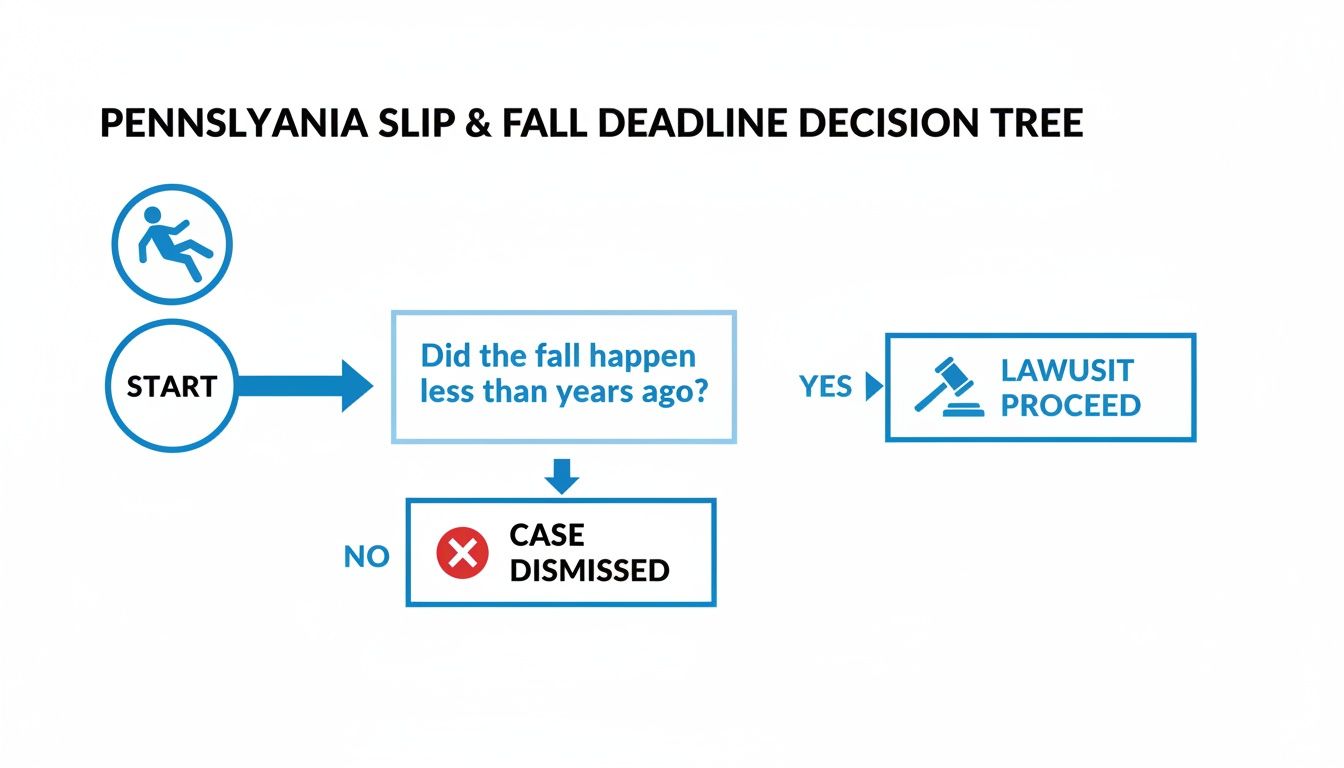
As you can see, falling outside that two-year window is usually the end of the road for a claim, unless you can prove one of these specific exceptions applies.
Heads Up: The Discovery Rule isn’t a get-out-of-jail-free card. The responsibility falls on you—the injured person—to convince the court that you couldn’t have possibly known about your injury any sooner. This often means presenting a rock-solid case backed by clear medical evidence.
Why Proving a Delayed Injury Is a Tough Fight
Successfully arguing for the Discovery Rule is an uphill battle. You can bet the property owner’s insurance company will push back hard, claiming you should have known about your injury much earlier. To win this argument, you need to be prepared.
Your case will hinge on a few key things:
- Solid Medical Records: You need clear, detailed documentation from your doctors showing exactly when the injury was diagnosed and how it connects back to the original fall.
- Expert Medical Opinions: Often, you’ll need a medical expert to testify and explain to the court why an injury like yours could have a delayed onset and wouldn’t have been obvious right after the accident.
Because the stakes are so high and the proof required is so specific, trying to handle a Discovery Rule case on your own is extremely risky. A seasoned personal injury lawyer will know exactly what’s needed to build a convincing case and argue it effectively. For a deeper dive into this nuanced topic, you can learn more about when the statute of limitations starts in a PA injury case on our blog.
How Key Exceptions Can Change Your Filing Deadline
While that two-year deadline for a slip and fall claim in Pennsylvania feels pretty rigid, it’s not set in stone. The law understands that life is complicated. Certain situations can legally hit the pause button on that countdown, a concept lawyers call “tolling.”
Think of it like a stopwatch. Normally, it starts ticking the moment you fall. But under specific circumstances, the law allows you to stop the clock and restart it later. Understanding these exceptions is crucial because they can sometimes rescue a claim that appears to be too late.
When the Injured Person Is a Child
The most common and clear-cut exception involves injuries to children. The legal system recognizes that a minor—anyone under the age of 18—can’t be expected to hire a lawyer and file a lawsuit on their own behalf.
So, when a child is hurt in a slip and fall, the two-year clock does not start on the day of their accident. Instead, the statute of limitations is “tolled,” or paused, until the day they turn 18. This gives them until their 20th birthday to file their claim, ensuring they have the chance to pursue justice as a legal adult.
Other Scenarios That Can Pause the Clock
Beyond injuries to minors, a few other rare situations can extend the filing deadline. These exceptions are really about fairness, preventing a negligent person from hiding or running away until your time to sue has expired.
These special circumstances include:
- Fraudulent Concealment: This is more than just someone being quiet. It means the at-fault party actively tried to hide their identity or cover up key facts about the accident, making it impossible for you to know who was responsible.
- Defendant Leaves the State: If the person who caused your fall moves out of Pennsylvania specifically to avoid being served with a lawsuit, the clock can be paused for the time they are gone.
It’s important to realize these exceptions aren’t automatic. You can’t just claim one applies and move forward.
A key takeaway is that you must formally ask the court to apply an exception. A judge will then decide if your situation meets the very strict legal requirements for tolling the statute of limitations.
This process isn’t simple. It requires a strong legal argument backed by solid proof. For example, proving someone intentionally fled the state just to dodge your lawsuit is a tough thing to do.
Because these scenarios are so complex—and you can bet the insurance company will fight them tooth and nail—trying to handle them on your own is incredibly risky. An experienced personal injury attorney can evaluate your situation, determine if an exception might apply, and build the compelling case needed to convince the court.
Filing a Claim Against a Government Agency

If your slip and fall happened on public property—like a cracked city sidewalk, a wet floor in a state-run building, or an icy staircase at a public school—the rules change dramatically. Suing a government entity in Pennsylvania isn’t as straightforward as suing a private business. You’re dealing with a completely different set of deadlines that are much shorter and far more rigid than the standard two-year window.
Think of it like this: before you can even file your actual lawsuit, you have to complete a mandatory first step. It’s a formal Notice of Claim, and it has its own unforgiving deadline.
The Six-Month Notice of Claim Deadline
When your claim is against a Commonwealth or local government agency here in Pennsylvania, you must provide them with written notice of your intent to sue within just six months of the accident. This isn’t a suggestion; it’s an absolute legal requirement.
This notice has to be sent to the correct government body and must include specific details about your accident:
- Your name and address
- The date, time, and location of the fall
- A short, clear description of what happened
- The name and address of the doctor who treated you, if applicable
This six-month deadline is, without a doubt, the biggest trap for people injured on public property. So many assume they have the usual two years and are devastated to find out their right to sue evaporated before they ever spoke to a lawyer.
A Critical Warning: Missing this six-month notice deadline is almost always fatal to your case. The court has the power to block you from ever filing a lawsuit, and it usually will—no matter how severe your injuries are or how obvious the government’s fault was.
Why Does This Extra Step Exist?
The official reason for this early notice requirement is to give the government agency a fair chance to investigate the incident while evidence is still available and witness memories are fresh. It also lets them evaluate their potential liability and maybe even settle the claim before it turns into a full-blown lawsuit.
From the perspective of the injured person, however, it’s a major legal hurdle that you have to clear very, very quickly. It’s incredibly easy to make a mistake. That’s why getting legal advice immediately after an accident on public property is so important.
If you want to dive deeper into this topic, you can learn more about government injury claims and special deadlines in Pennsylvania in our detailed guide. Speaking with an attorney right away is the best way to ensure you meet this critical first deadline and protect your right to seek compensation.
What Happens If You Miss the Filing Deadline?
When it comes to Pennsylvania’s slip and fall statute of limitations, think of it less as a friendly suggestion and more as a concrete wall. Missing this deadline is, without a doubt, the single biggest mistake you can make for your injury claim.
Put simply, if you don’t file your lawsuit within that two-year window, you almost certainly lose your right to recover a single penny for your injuries. It doesn’t matter how obvious the property owner’s fault was or how life-altering your injuries are. Once that clock runs out, the courthouse doors are shut for good.
Your Case Will Be Dismissed
So, what does this look like in practice? If you file a lawsuit even one day late, the outcome is swift and predictable. The property owner’s lawyer will immediately file what’s called a motion to dismiss. Their entire argument will be that your claim is “time-barred”—a legal term for “too late.”
A judge has almost no choice but to agree and throw out your case. There’s no room for sympathy or second chances just because your story is compelling or your evidence is strong. The law on this is crystal clear and absolute.
The result is a total and permanent end to your legal claim. You can’t refile. You lose all power to negotiate with the insurance company, because they now have zero reason to offer you anything.
This outcome is especially brutal when you think about what you’re losing. While every case is different, Pennsylvania statistics show that slip and fall settlements can often range from $15,000 to $45,000, and sometimes much more for severe injuries. The two-year deadline in 42 Pa.C.S. § 5524(2) is the only key that unlocks the door to that potential compensation. Pennsylvania courts are notoriously strict on this, consistently dismissing late cases, which you can see in more detail by reviewing average Pennsylvania slip and fall settlements on jminjurylawyer.com.
Don’t Let the Clock Run Out on Your Claim
Waiting to get legal advice is the most dangerous gamble you can take with your financial recovery. Putting together a solid personal injury case isn’t an overnight job. It involves investigating the scene, gathering evidence before it disappears, and carefully reviewing all your medical records.
Every day you delay puts a tighter squeeze on this critical timeline, jeopardizing your entire claim. The best way—the only way—to protect your rights is to act quickly. It’s your one shot to hold a negligent property owner accountable for the harm you’ve suffered.
Protecting Your Rights After a Slip and Fall Accident

It’s easy to feel disoriented and overwhelmed in the moments after a slip and fall. But what you do right then and there can be absolutely critical to protecting your legal rights down the road. You have to think like an investigator, because the evidence you gather at the scene can make or break your case.
Building a strong claim begins the second you’re injured. While the slip and fall statute of limitations in Pennsylvania gives you a two-year deadline to file a lawsuit, the proof you need to win that lawsuit can vanish in a matter of minutes. Being deliberate and methodical can preserve your chance to get the compensation you deserve.
Create an Immediate Action Plan
Your health is always priority number one. But if you’re physically able, a few simple steps can make all the difference for your future claim. Every photo you take and every name you get is a puzzle piece your attorney can later use to show what happened and why the property owner should be held responsible.
Here’s a quick checklist of what to do on the scene:
- Seek Medical Attention Immediately: Before anything else, take care of yourself. Seeing a doctor not only gets you the treatment you need but also creates a crucial medical record linking your injuries directly to the fall.
- Report the Incident On-Site: Find the manager, landlord, or whoever is in charge and tell them exactly what happened. Always ask for a copy of the incident report they fill out. This creates an official, time-stamped record of the event.
- Document the Scene Thoroughly: Pull out your phone and start taking pictures and videos. Get shots of the exact spot where you fell from every possible angle. Make sure you capture the hazard—the wet floor, the icy patch, the broken stair—before anyone has a chance to clean it up or fix it.
- Gather Witness Information: If anyone saw you fall, politely ask for their name and phone number. A statement from an unbiased third party can be incredibly powerful evidence.
Don’t Delay Your Next Steps: The clock is ticking. A property owner will want to fix the hazard immediately, and witnesses can become impossible to track down later. The more evidence you can lock down right away, the stronger your position will be.
Even if you think your injuries are minor, it’s vital to go through these motions. Some serious injuries, like concussions or back problems, don’t show their full extent for days or even weeks. By taking these immediate, decisive actions, you are protecting your future. The sooner you speak with an attorney, the sooner you’ll have a professional in your corner, working to preserve your claim long before the statute of limitations ever becomes an issue.
Common Questions About Slip and Fall Deadlines in Pennsylvania
After a sudden fall, you’re bound to have questions. When it comes to the statute of limitations for a slip and fall in Pennsylvania, getting clear, direct answers isn’t just helpful—it’s essential for protecting your right to compensation.
Here are some of the most common questions we hear from clients and the straightforward answers you need to know.
Does Talking to an Insurance Adjuster Pause the Deadline?
Absolutely not. This is a critical point that trips up many people. Negotiating with an insurance company has zero impact on the two-year statute of limitations. The clock keeps ticking no matter how friendly or productive your conversations might feel.
Insurance adjusters know this deadline inside and out. Some might even use delay tactics, stringing you along with promises of a settlement until it’s too late. Once that deadline passes, their legal obligation to pay you anything vanishes. You have to file a lawsuit before that two-year mark, even if you’re still in the middle of negotiations.
What if My Fall Happened at a Friend or Family Member’s House?
The two-year deadline applies everywhere, from a big-box store to a friend’s back porch. It can feel incredibly awkward to think about filing a claim against someone you care about, but it’s important to understand how these cases really work.
You aren’t going after their personal savings. The claim is made against their homeowner’s insurance policy—that’s precisely why they pay for that coverage. Hesitating out of concern for the relationship could leave you on the hook for all your medical bills, forcing you to carry a financial burden that isn’t yours to bear.
Key takeaway: A premises liability claim is a formal request for an insurance company to cover damages caused by a policyholder’s negligence. It’s not a personal attack; it’s the proper, necessary way to get financial help after an injury.
Can I File a Claim if My Injuries Get Worse After the Deadline?
In most cases, the answer is no. Once the statute of limitations expires, you lose your right to file a claim related to that incident, even if your condition takes a turn for the worse. The law expects you to bring all potential claims from that single event within the time limit.
This is exactly why getting a full medical workup and speaking with a lawyer before the deadline is so important. While a narrow exception called the “Discovery Rule” exists for injuries that couldn’t have been discovered earlier, it’s very difficult to apply to a known injury that simply worsened over time.
Is the Deadline Different in a Neighboring State Like New Jersey?
Yes, the rules can and do change from state to state. While both Pennsylvania and New Jersey happen to have a two-year statute of limitations for most personal injury claims, the fine print—the exceptions, the rules for suing the government—are not the same.
The law that matters is the law of the state where the injury happened. If you fell in a store in New Jersey, you have to follow New Jersey’s laws, period. This is why it’s so important to work with a law firm that is licensed and experienced in the state where your accident occurred.
Navigating the deadlines and details of a slip and fall claim takes experience and a firm commitment to protecting your rights. The legal team at Mattiacci Law is here to give you the clear guidance needed to meet every deadline and fight for the full compensation you deserve. Contact us today for a free, no-obligation consultation to discuss your case. Learn more about how we can help at https://jminjurylawyer.com.