


Author: John Mattiacci | Owner Mattiacci Law
Published July 31, 2026

The hard truth is that medical malpractice cases are brutally hard to win without counsel. One Nolo review found that only 12% of its readers got any payout, a separate review of 2015 malpractice claims found only 25% ended in payment, and in a 6,779-claim study of adult emergency department and urgent care cases, just 23.4% produced a payout while 0.6% ended in a verdict for the injured claimant, with two-thirds dismissed without settlement or trial. Even more damaging for self-filed cases, that same source reported that only 10% of claimants without a lawyer received a payout, while hiring an attorney nearly doubled the chances of a settlement or verdict and more than tripled success when the claimant sent a demand letter, filed suit, or both. Nolo's malpractice payout review
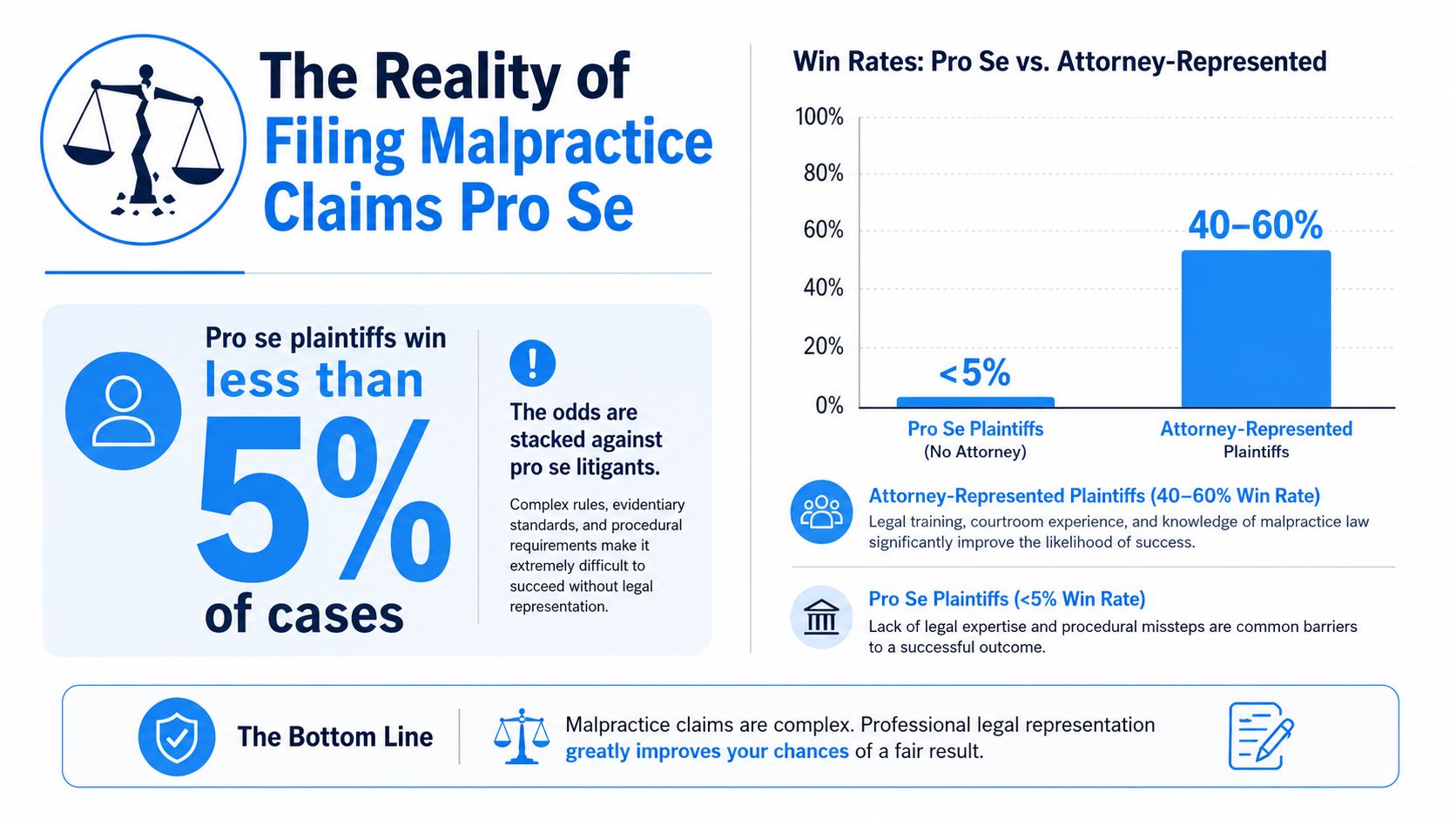
The Reality of Filing Malpractice Claims Pro Se
Many people think the challenge is writing the complaint. It isn't. The challenge is surviving the procedural gauntlet long enough for a judge or jury to ever look at the merits.
The odds are the first warning sign
Malpractice litigation is not a normal injury claim. It sits at the intersection of medicine and law, which means the plaintiff has to prove what happened, explain why it violated the standard of care, and connect that breach to actual harm. The historical record in the verified data shows exactly why self-represented plaintiffs get crushed early, because many claims die before they ever reach payment, let alone trial. Nolo's malpractice payout review
That is why I tell people to stop thinking in terms of “Can I file?” and start thinking in terms of “Can I build a case that survives dismissal, expert review, and service?” If the answer is no, the complaint is just paperwork. It does not become a case until the court can hear it.
Practical rule: if you do not already have records, a credible expert screening opinion, and a clean deadline calendar, you're not ready to file.
What separates the rare successful pro se case
The cases that have any real chance without a lawyer usually share the same traits. Liability is clear, the medical records tell a coherent story, the injury is well documented, and an expert is willing to review the file and support the claim. Without that structure, the case turns into a guessing game, and judges do not guess for you.
The historical pattern matters here because it shows where pro se cases fail. They do not usually collapse because the complaint was badly worded. They collapse because the filer missed a deadline, could not get an expert, served the wrong party, or could not prove causation once the defense started pushing back. That is the core baseline if you are trying to figure out how to file a medical malpractice lawsuit without a lawyer.
Evaluating Your Claim and Meeting Pre-Filing Requirements
Before you draft a single page, check the deadline. Then check it again. In malpractice, a valid claim can still be dead if you missed the filing window or skipped a pre-suit notice requirement.
Start with the deadline, not the complaint
State rules vary sharply, and that is where a lot of self-filed cases go off the rails. California requires suit by the earlier of 1 year after discovery of the injury or 3 years from the injury date, plus at least 90 days' written notice before suing a healthcare provider, while many states use filing windows somewhere between 1 and 3 years from the error. California self-help guidance
If you're in Pennsylvania, don't guess. Use a jurisdiction-specific statute-of-limitations guide like this Pennsylvania malpractice deadline resource and verify whether your facts trigger a discovery rule issue, a notice requirement, or a special tolling problem. The rule is simple, even if the law is not. Deadlines come first.
Confirm the expert requirement before you spend money
Many states require a certificate of merit or similar expert review before filing. That means a qualified clinician has to review the records and be willing to say the provider likely deviated from the standard of care. If you cannot get that opinion, filing anyway is often just an expensive way to invite dismissal. Nolo's filing guidance
Finding an expert is not a casual favor. You need someone with the right specialty, a clean conflict check, and enough confidence to stand behind the opinion if the defense challenges it later. That review can take time, and if you wait until the last minute, you'll put yourself in a bind where the deadline is running but the file is still incomplete.
Use a blunt viability checklist
- Statute verified: confirm the exact deadline in your state and any discovery-rule wrinkle.
- Notice sent: if your state requires pre-suit notice, send it the way the statute demands.
- Expert secured: get a written screening opinion before filing if your state requires one.
- Damages documented: make sure your injury, treatment, and losses are real, not speculative.
- Court identified: file in the proper trial court, not a court that lacks jurisdiction.
A malpractice case should only move forward if the claim can survive both legal and medical scrutiny. If you're still trying to figure out whether your facts can clear the threshold, the next move is to read the record like a defense lawyer would, not like an injured patient hoping for fairness.
Gathering Medical Records and Building Your Evidence
Medical records are the spine of the case. If they're incomplete, disorganized, or missing key entries, the defense will use that against you immediately. A neat complaint cannot fix a weak file.
Request the full record set, not a summary
Ask for the complete chart from every facility involved. That should include operative notes, nursing charts, medication administration records, imaging studies, discharge summaries, lab reports, consultation notes, and billing records. A treatment summary is not enough, because malpractice cases are built page by page, and the defense will look for every gap.
Get the records directly from the hospital or provider's medical records department using the authorization form they require. Keep copies of everything you send and everything you receive. If one provider treated you after the original event, their records matter too, because causation often turns on the chain between the first mistake and the later damage.
Plain truth: if you can't show the sequence of care in writing, you'll struggle to prove what went wrong.
Build a timeline the way a trial lawyer would
Put the records into chronological order and mark the events that matter. Date of first complaint. Diagnostic test. Procedure. Medication change. Worsening symptoms. Follow-up visit. New specialist. That timeline is how an expert reviewer sees the case, and it is how you keep your own story straight under pressure.
You should also assemble a damages file with medical bills, wage loss proof, out-of-pocket costs, and notes about how the injury changed daily life. If the injury is affecting your mental health, don't pretend it doesn't matter. Get support and keep your head clear while you work the case, because a serious malpractice claim can become emotionally draining fast. If you need a local counseling resource while dealing with the stress, Vernon mental health support is one place to start.
For a deeper look at proving the underlying negligence, review this negligence guide before you file. The point is not to decorate the file. It is to make the proof obvious.
Drafting and Filing the Complaint
The complaint has one job, to put the right people in the right court with the right theory. If it's vague, sloppy, or missing a required piece, the defendant will attack it before the merits ever get discussed.
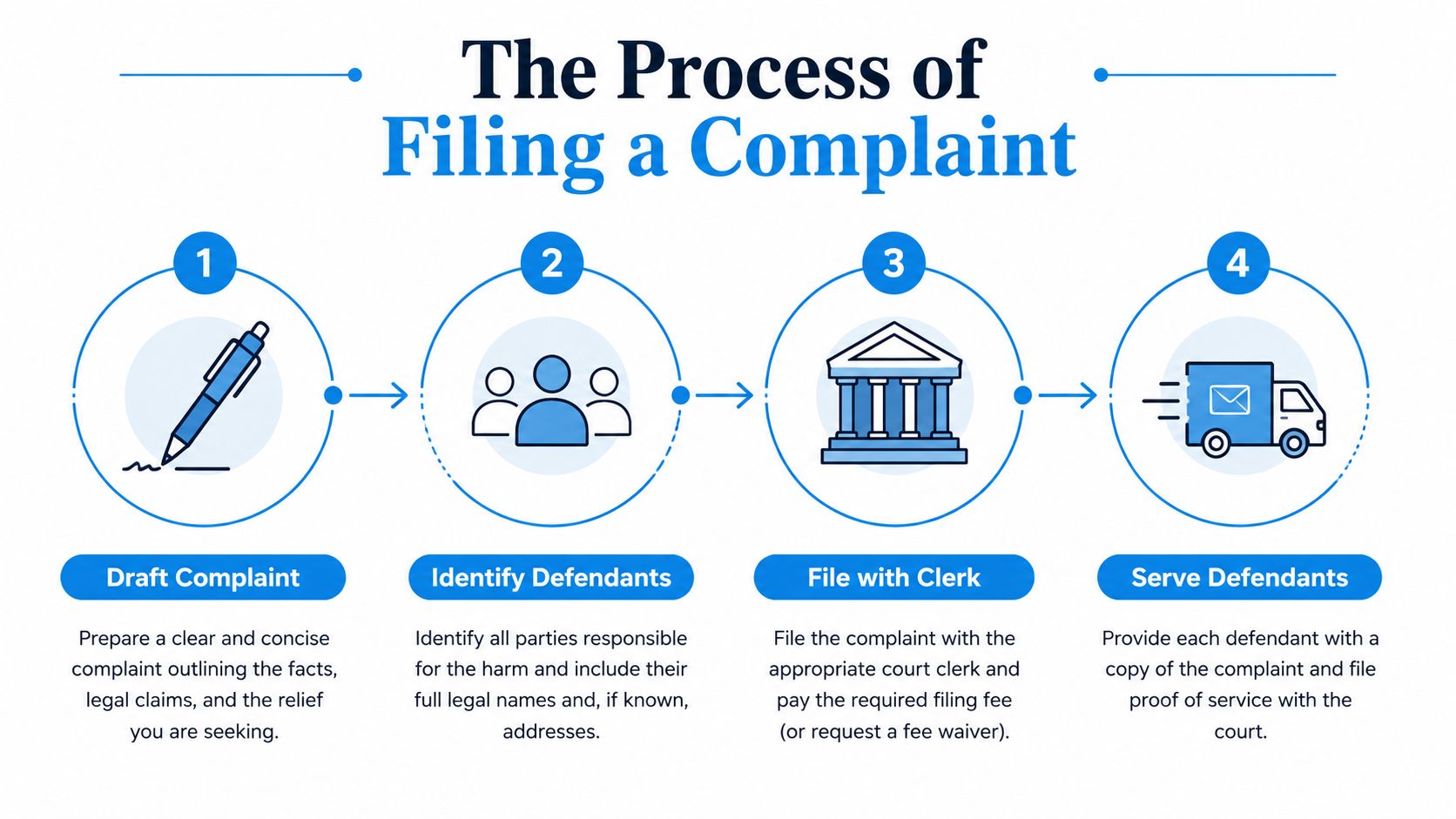
Draft for facts, not emotion
A proper malpractice complaint should identify each defendant, describe the duty of care, state the specific breach, explain causation, and itemize damages. Do not write general accusations like “they were negligent” and expect the court to fill in the blanks. Pleading in malpractice is detail-heavy for a reason, and bare conclusions invite dismissal.
Use the records to name the right entities. That may include the doctor, the hospital, a practice group, or a corporate healthcare owner. Misidentifying the defendant is a classic self-filed mistake because the caption looks harmless until the service deadline passes and you realize the wrong party was sued.
File in the correct court and serve fast
Nolo's filing guidance says many states require the complaint to be filed in the main trial court, usually with a filing fee of about $150 to $300, and then served on each defendant within roughly 30 to 90 days after filing. Nolo's filing guidance The fee itself is not the hard part. The hard part is making sure the summons, complaint, and service all match what your state requires.
Do this immediately after filing: get a summons for each defendant, use a legally valid server, and track every service deadline on a calendar you actually check.
If your state requires a certificate of merit, file it the way the rule demands. Do not assume the court will excuse a missing expert document because the story sounds sympathetic. Judges dismiss cases for technical defects all the time, and a defective filing can end the case before discovery even begins.
Navigating Discovery and Expert Testimony
A filed complaint is not a finished case. It is a starting gun. Once the defendant answers, the fight begins, and that is where pro se malpractice cases usually unravel.
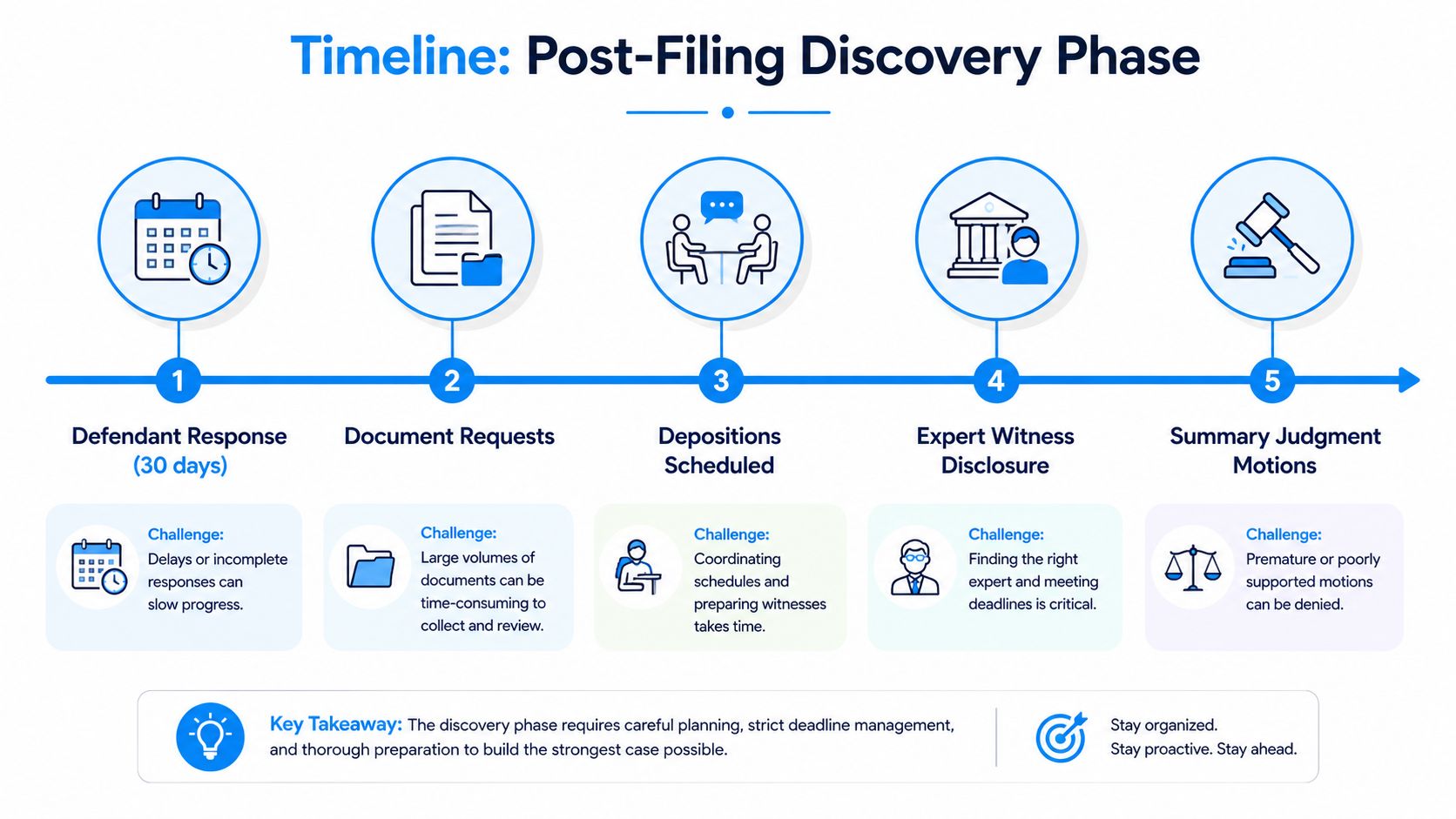
Discovery is where the case gets tested
Discovery means interrogatories, requests for production, depositions, and sometimes independent medical examinations. It is the formal exchange of information that lets each side test the other's story, and it is technical enough to punish mistakes. One step-by-step guide estimates discovery alone can run 12 to 18 months, with the full process often extending far beyond a year before trial. Charter Chambers guide
That time matters because delays create pressure, and pressure makes self-represented plaintiffs settle badly or miss deadlines. Defense lawyers handle these motions and discovery fights every day. You do not get points for sincerity when you miss a response deadline or produce a messy document dump.
Expert testimony is not optional in practice
Malpractice cases usually turn on what a competent clinician should have done, and jurors generally cannot evaluate that without expert proof. That means your expert has to be lined up, ready to testify, and prepared to survive deposition or a summary judgment attack. If you wait until late in the case to find that witness, you're already behind.
The practical work is heavy. You need records organized for review, a clear damages summary, and an expert who can explain the standard of care in plain English without getting lost in medical jargon. If the expert won't stand firm, the case won't stand firm either.
Settlement leverage depends on proof
The defense will not pay much for a file that looks incomplete. The strongest advantage comes from clean records, credible expert support, and a case theory that can survive summary judgment. Without those pieces, settlement talks become positional, and the other side knows it.
If you insist on going pro se, treat discovery like the heart of the case, because that is what it is. The complaint opened the door. Discovery decides whether you get to stay in the room.
Realistic Alternatives to Going It Alone
Self-representation is not the only path, and in malpractice it usually isn't the best one. The smarter choice is often the one that puts expert handling and cost control in the same package.
Compare the practical options
| Option | Upfront Cost | Risk to You | Best For |
|---|---|---|---|
| Contingency-fee lawyer | Usually none upfront | Low, because the lawyer fronts the case costs | Strong claims with meaningful damages |
| Legal aid or clinic help | Usually low or none | Medium, because scope may be limited | People who need targeted help |
| Limited-scope representation | Lower than full representation | Medium, because you still handle part of the case | Filers who can manage some tasks themselves |
| Pro se | Filing fees and expert costs come out of pocket | High, because every deadline is on you | Rare cases with simple facts and strong documentation |
Contingency representation is the cleanest answer for most injured patients because the lawyer fronts the litigation costs and only gets paid if there is a recovery. That structure removes the immediate financial barrier that pushes many people toward self-filing in the first place.
Don't overlook targeted help
A lawyer does not always have to take the whole case to make a difference. Some firms will help with complaint drafting, records review, expert coordination, or disclosures. That kind of limited-scope help can keep a self-represented case from dying over a technical defect.
There are also review panels, referral services, and specialty resources that can point you to counsel with real malpractice experience. If the injury involves disputed medical findings after death, a private autopsy and negligence analysis may help sharpen the proof before any filing decision gets made.
For finding counsel, use this malpractice attorney selection guide to focus on trial experience, expert access, and willingness to screen the case. You want someone who can tell you no when the file is weak and move fast when the file is strong.
Making Your Final Decision
If the deadline is close, do not spend weeks debating philosophy. Protect the claim first. The statute does not pause while you decide whether you feel ready.
Use a hard yes-or-no test
Proceeding without a lawyer makes the most sense only when the facts are clear, the records are complete, the expert issue is already under control, and the damages are not so large or complex that the case will require heavy litigation muscle. If any of those pieces is missing, the risk climbs fast.
Hire counsel if the case involves multiple defendants, disputed causation, catastrophic injury, a death claim, or any situation where expert proof will be contested. Those are not DIY cases. They are litigation cases, and litigation rewards preparation, strength, and experience.
If your case needs a battle over records, experts, and deadlines, the smartest move is to get help before you file, not after the first dismissal motion lands.
The honest answer is this. You can file without a lawyer, but filing is the easy part. Winning is the hard part, and in malpractice, the hidden traps are usually procedural, not dramatic.
If you're trying to decide whether your case is strong enough to move forward, Mattiacci Law can give you a direct, trial-tested evaluation and tell you where the procedural traps are before they cost you the case. Visit Mattiacci Law to discuss your medical malpractice claim and get practical guidance on your next step.