


Author: John Mattiacci | Owner Mattiacci Law
Published April 10, 2026
The call comes after a rough week. Your back locked up lifting, twisting, climbing down from equipment, or getting hit by something that should have been secured. Since then, you have gone from trying to “walk it off” to doctor visits, restrictions, missed paychecks, and a stack of forms that all seem designed to make a simple injury feel complicated.
What most injured workers want is clear. They want stability. They want treatment approved, wage checks to arrive, and a fair number when the time comes to talk settlement.
A workmans comp settlement for back injury is supposed to do exactly that. It is not a random payout. It is a negotiated resolution built around specific losses tied to your injury, your treatment, your work restrictions, and what your doctors say you will need going forward.
That matters because back claims rarely stay simple. A “strain” can turn into months of therapy, imaging, injections, work restrictions, and arguments over whether you can return to the same job. Back injuries are also common. Boohoff Law reports that back injuries are the second most frequent workplace injury in the U.S., and Washington alone recorded 11,358 accepted claims in a year with total payments exceeding $115 million.
If you are trying to figure out whether to settle, when to settle, or what your case may be worth in Pennsylvania or New Jersey, the details matter more than broad internet averages. So does the timing. So do the medical records. So does the form of settlement you choose.
Your Back Injury and The Path to a Settlement
The early stage of a back claim often feels upside down. You are in pain, but the paperwork keeps moving. You are told to attend appointments, report restrictions, follow treatment, and wait while the insurance carrier decides what it believes.

For a lot of workers, the primary fear is not just the injury. It is the gap between what life costs and what they can now do. Rent or mortgage payments keep coming. So do utility bills, prescriptions, and family obligations.
What a settlement really does
A settlement is a way to close out some or all of the claim in exchange for money. In a strong case, it gives you certainty after months of uncertainty. In a rushed case, it can leave you carrying future medical costs that should have stayed with the carrier.
That is why the number itself is only part of the story. A solid settlement has to match the precise shape of the injury.
For many injured workers, that means looking beyond the first diagnosis. A low back strain may still involve imaging, physical restrictions, and a long rehab course. If you are using outside providers for recovery support, practical resources like Workers Comp treatment information can help you understand how coordinated care fits into the larger claim.
Why back claims need careful handling
Back injuries create disputes because symptoms do not always show up neatly on one document. Some workers have obvious trauma. Others develop disc problems, nerve symptoms, or chronic pain over time.
Insurers often focus on what they can minimize:
- The diagnosis label: They may call it a simple strain when the treatment history suggests something more serious.
- The work impact: They may argue you can go back sooner, or into a job that does not exist for you.
- The future care question: They may resist valuing injections, surgery, or long-term restrictions until the record is impossible to ignore.
A back claim usually gets stronger when the medical record tells a clear story from the first report through the final restrictions.
The path to settlement gets easier when you understand the choice in front of you, what goes into value, and where Pennsylvania and New Jersey rules can change the outcome.
Two Roads to Settlement Compromise & Release vs Open Medicals
Once your case reaches the point where settlement is realistic, the first major question is not “how much?” It is “what kind of settlement am I accepting?”
Those are two different questions. A worker can accept a decent number and still make the wrong deal if the structure does not fit the injury.
The practical difference
Consider it this way: One option is a clean sale. The other is a partial deal where you take money now but keep an important protection in place.
A Compromise & Release is the full buyout model. You receive a lump sum, and in exchange you usually close the case for good, including future medical rights related to the work injury.
A Stipulation with Request for Award, often described as an open-medicals structure, resolves the disability portion but leaves future treatment rights open for care connected to the accepted injury.
Compromise & Release vs Stipulated Award A Snapshot
| Feature | Compromise & Release (Lump Sum) | Stipulation with Request for Award (Open Medicals) |
|---|---|---|
| Finality | Usually full and final | Partial resolution |
| Medical care | Future medical rights are usually closed | Future medical treatment remains available for the accepted injury |
| Upfront money | Usually larger because more rights are being closed | Often more limited because medical exposure stays open |
| Risk to worker | You carry future treatment risk after settlement | Carrier continues carrying covered future treatment risk |
| Best fit | When future treatment is limited or fully valued | When future care is uncertain, expensive, or likely ongoing |
When a lump sum makes sense
A full buyout can work well when the medical picture is stable and the future is reasonably predictable.
That often applies when:
- Treatment has plateaued: Your doctors do not expect major future procedures.
- You want closure: You do not want to keep dealing with utilization review, denials, or carrier oversight.
- The settlement fully prices in future care: The number reflects the cost of closing medical rights.
The danger is obvious. If you settle too early and later need surgery, injections, or long-term pain management, you may be paying for that out of your own pocket.
When open medicals make more sense
Open medicals can protect workers whose back injuries still carry uncertainty.
That can matter when:
- Surgery is still on the table
- You have recurring flare-ups or radicular symptoms
- Your doctor expects future therapy, injections, or specialist care
- You may need treatment years after settlement
This option can feel less satisfying in the short term because it may not produce the same immediate check. But it can be the safer outcome if your back has not definitively declared itself.
Timing matters more than most workers realize
A lot of bad settlements happen because the worker reaches agreement before the medical evidence is mature enough. If you have not reached maximum medical improvement, the case value can still be moving.
If you are unsure what that term means, this explanation of MMI in workers comp gives useful context. The short version is simple. You should know as much as possible about your long-term condition before you sign away long-term rights.
If your back injury still has unresolved treatment questions, finality is not always your friend.
In practice, the right road depends on future care, job prospects, restrictions, and whether the settlement number compensates you for what you are giving up.
What Drives Your Back Injury Settlement Value
A worker hurts his low back lifting at a warehouse in Bucks County. The first MRI shows a disc problem. Months later, he is still on restrictions, still treating, and still cannot do the job that paid his bills. That claim will not be valued like a strain that resolved after a few therapy visits. In Pennsylvania and New Jersey, settlement value rises or falls on what the medical file proves, how the injury affects your ability to work, and how the local comp rules apply to your case.
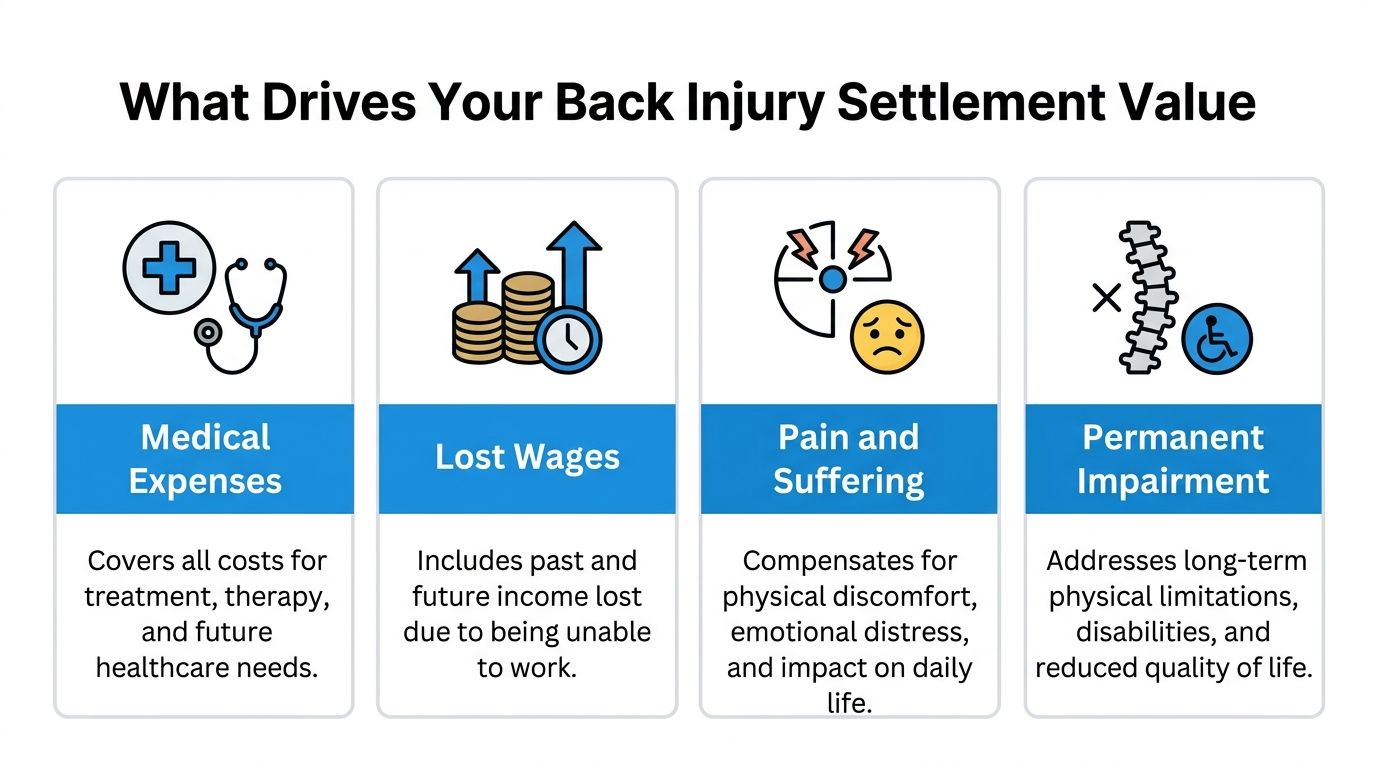
Medical treatment already received
Start with the care you have needed. Office visits, MRIs, prescriptions, physical therapy, pain management, injections, specialist evaluations, and hospital treatment all help show how serious the injury became.
The records matter as much as the treatment. Adjusters look for objective findings, repeat complaints, referral patterns, and whether you followed through with care. A thin chart gives the insurer room to argue that your symptoms were temporary or overstated.
For lower-level cases, the valuation issues look different than they do in a surgical claim. This breakdown of a soft tissue back injury settlement in Pennsylvania shows why diagnosis and treatment intensity matter so much.
Future medical needs
Future care often drives the hardest settlement fights. A back injury may look stable for a few months, then turn into a repeat-injection case, a surgical recommendation, or chronic pain treatment that lasts for years.
That matters even more in Pennsylvania and New Jersey because the settlement structure can affect whether future treatment stays open or gets bought out. If your doctor expects more imaging, specialist follow-up, medication management, therapy, or surgery, those projected costs belong in the discussion before any final number is accepted.
Workers also need a realistic view of recovery outside the legal file. Resources on physiotherapy and rehabilitation support can help you understand what extended rehab may involve after a significant back injury.
Lost wages and reduced earning ability
Past wage loss is only part of the picture. Settlement analysis also considers whether your back injury has reduced your future earning ability, especially if you cannot return to heavy labor, overtime work, or the trade you worked in before the injury.
I see this issue missed all the time. A worker returns to a job, but only in a lighter role, with fewer hours, lower pay, or permanent restrictions. On paper, the carrier says the worker is back. In reality, the injury has cut into long-term earning power, and that should affect settlement value.
This point often carries extra weight in regional industries like construction, logistics, delivery, manufacturing, and healthcare support. If your old job required lifting, bending, climbing, or constant driving, a permanent back restriction can narrow your labor market fast.
Permanent impairment and permanency evidence
Permanent partial disability is one of the most misunderstood parts of a back injury claim. The label matters less than the proof behind it. What moves value is a clear medical opinion that your condition has stabilized and left lasting impairment, restrictions, or both.
Pennsylvania and New Jersey handle permanency differently, and that difference can shape strategy. Pennsylvania cases often turn on wage-loss exposure, medical exposure, and the strength of the evidence supporting ongoing disability. New Jersey places more formal weight on permanency findings in many claims. National articles usually blur that distinction. Local settlement analysis cannot.
A strong permanency opinion usually comes from the full record. MRI findings, surgical history, radiculopathy, failed conservative care, and documented work restrictions all matter.
Severity changes the range, but proof controls the category
Severity still matters. A resolved lumbar strain is generally valued far differently than a herniated disc with nerve symptoms, work restrictions, and a recommendation for surgery. But labels alone do not increase value.
Insurers pay attention to what they can verify. If the imaging is mild, treatment was brief, and you returned to unrestricted work, the claim will usually be treated as a lower-value case. If diagnostics confirm structural damage, treatment stays active, and your doctor documents lasting limits, the carrier has fewer ways to minimize the file.
The best way to raise settlement value is to build a record that matches the seriousness of the injury.
The records that usually matter most
A few parts of the file tend to drive negotiations more than anything else:
- Imaging and specialist opinions: MRIs, EMG studies, orthopedic evaluations, neurosurgical opinions, and pain management records often carry more weight than generalized complaints alone.
- Work restrictions over time: Disability slips and return-to-work notes show whether your limitations were short-term or persistent.
- Treatment consistency: Gaps in care can reduce value unless there is a clear reason, such as denied treatment or financial barriers.
- Final medical opinions: The doctor who addresses permanency, future care, and functional limits often shapes the settlement discussion.
Workers' comp settlements are not built like personal injury cases. The value usually comes from medical exposure, wage-loss exposure, permanency, and how credible the records are under Pennsylvania or New Jersey rules. If you want a better number, build a better file.
Typical Settlement Amounts for Back Injuries
A forklift driver in Allentown throws out his back lifting a pallet, does physical therapy for six weeks, and gets back to full duty. A union laborer in Camden has a lumbar surgery, cannot return to heavy work, and still needs pain management months later. Both have a workers' comp back claim. Their settlement values are nowhere close.
That is why the phrase “average settlement” causes trouble. It gives injured workers a number without giving them the category, the state-specific rules, or the medical facts that control the result.
National averages are a rough reference point
Bruscato Law reports that Martindale-Nolo research places the average workers’ compensation settlement for a back injury in the $20,000 to $25,000 range. The same source states that NCCI data puts average insurer costs for low back injuries at about $37,000, and OSHA estimates total employer costs can reach $80,000 per claim.
Use those figures carefully. National averages blend minor strains, disc cases, surgeries, and severe spinal injuries into one bucket. They also do not account for the very different settlement rules in Pennsylvania and New Jersey. A number that sounds realistic in one state can be misleading in the other.
The range depends on the kind of back case you have
A short-term strain with conservative treatment usually settles at the lower end, if it settles at all. Many of those claims involve limited wage loss, modest medical exposure, and a full return to work.
Disc injuries without surgery often draw more serious offers because the file usually contains MRI findings, longer treatment, and work restrictions that affect earning power. If your injury falls into that category, this guide on a soft tissue back injury settlement in Pennsylvania helps explain how lower-level and moderate Pennsylvania back claims are often evaluated.
Surgical cases are different. A discectomy, laminectomy, or fusion usually increases settlement value because the carrier is looking at larger medical exposure, more time out of work, and a stronger argument for permanent limitations. Catastrophic spinal injuries sit in their own category. Those claims are often driven by long-term disability, future care, and whether the worker can return to any meaningful employment.
Pennsylvania and New Jersey workers should be careful with generic comparisons
I tell clients this all the time. Do not compare your Pennsylvania or New Jersey back case to a national article unless you know how that case was settled and under what law.
In Pennsylvania, a Compromise and Release often reflects what the carrier is trying to close out on wage loss and future medical exposure under Pennsylvania practice. In New Jersey, the posture of the case can look different because permanency findings and formal awards play a larger role in settlement value. Recent reforms and local court handling also affect timing and pressure points in ways national guides usually miss.
A better way to judge your own case
Ask which of these descriptions fits your file:
- Resolved strain: brief treatment, little lost time, return to regular duty
- Disc injury without surgery: ongoing symptoms, imaging support, restrictions, disputed work capacity
- Surgical back case: operation, rehabilitation, continuing limits, likely future treatment
- Severe permanent injury: major loss of function, chronic pain care, inability to return to prior work
That comparison is more useful than chasing one average number.
The right question is simple. Where does your case fall on the severity scale under Pennsylvania or New Jersey rules, and what evidence makes that position hard for the insurance company to deny?
Pennsylvania and New Jersey Settlement Rules You Must Know
Generic national advice breaks down in Pennsylvania and New Jersey. The legal structure matters. So do recent state-level changes that affect what a back claim is worth and how it should be negotiated.

Pennsylvania issues that affect negotiating power
Pennsylvania workers know the carrier watches disability status, work restrictions, and medical opinions. One recurring issue in serious back cases is the fight over whether the worker remains disabled in a practical employment sense.
Another issue is the use of impairment evidence to limit exposure. If the carrier can frame your condition as stable, limited, and manageable, it gains a stronger negotiating position. If your medical proof shows ongoing restrictions, loss of earning power, and likely future treatment, your negotiating power improves.
That is one reason local handling matters. The file must address not just diagnosis, but employability, restrictions, and future care in a way that fits Pennsylvania practice.
New Jersey permanency issues
New Jersey back cases focus on permanency. The central fight is often not whether you got hurt, but how much lasting functional loss the injury created.
For a worker with a lumbar injury, the difference between a modest permanency position and a stronger one can change the outcome in a meaningful way. Objective support matters. So does a medical expert who can tie your current limits to the work event instead of to age, wear and tear, or prior complaints.
The 2025 reforms matter
The strongest reason not to rely on old national articles is that recent state-specific changes can alter value.
According to Sink Law, Pennsylvania’s Act 71 (2025) expanded vocational rehabilitation and increased settlements by an average of 15 to 20 percent for claims involving lost earning capacity. The same source reports that a 2025 New Jersey amendment requiring coverage for therapies such as spinal cord stimulators increased lower back claim payouts by roughly 25 percent.
Those are not small changes. They affect the way future earning loss and advanced treatment should be considered in settlement discussions.
What that means for injured workers in practice
If you work in construction, delivery, warehousing, manufacturing, or another physically demanding field, these reforms can matter because back injuries often create the exact long-term vocational issues they address.
A few practical takeaways:
- Do not negotiate from outdated averages: A national article written before these reforms may undervalue a current PA or NJ claim.
- Do not minimize vocational loss: If you cannot return to the same type of work, the loss is not just medical.
- Do not treat future treatment as speculative: In New Jersey, emerging therapy coverage may now be part of the value picture.
- Do not assume the insurer will apply these changes generously: It usually takes pressure, documentation, and local knowledge.
In Pennsylvania and New Jersey, the rules around disability status, permanency, and future care often matter as much as the diagnosis itself.
A back injury settlement in this region should be evaluated through the state system you are in, not by generic online content that applies to everyone but no specific situation.
Your Step-by-Step Guide to the Settlement Process
Settlement usually happens after the claim has matured enough for both sides to evaluate it. If you try to force that process early, you often leave money on the table or close medical rights before you understand what they are worth.
Step 1 Reach a reliable medical stopping point
This does not mean you are pain free. It means your doctors have enough information to say where you are likely to end up.
For many workers, this is tied to a maximum medical improvement finding, final restrictions, and a clearer opinion about future care. If your case is still bouncing between possible surgery and conservative treatment, you may not be ready.
Step 2 Gather the proof that moves value
At this stage, many claims either sharpen or stall. The right records usually include imaging, treatment notes, work status slips, billing records, and final medical opinions on permanency.
If earning power is an issue, vocational evidence can become critical. If the insurer has sent you to its own doctors, your side may need a stronger independent evaluation to answer that report.
Step 3 Put a number together that can be defended
A serious demand is not a wish list. It is a supported valuation built from the medical file, wage history, restrictions, permanency, and future exposure.
That is also why impairment ratings matter. Bentley More notes that moving from a 12% rating to a 20% rating in a scheduled system can increase the permanent partial disability portion of the case by more than $19,000.
Step 4 Negotiate with the adjuster, not with their framing
Adjusters usually start by shrinking one of four things: the diagnosis, the duration, the restrictions, or the future care.
For this reason, workers benefit from understanding common workers comp adjuster tricks. The practical point is not to become suspicious of everything. It is to recognize when a “reasonable offer” is built on an unreasonable assumption.
Step 5 Review the settlement terms before you sign
At this point, the biggest mistakes are usually structural.
Before signing, confirm:
- What exactly is being closed: Wage loss only, or wage loss plus medical.
- Whether future treatment rights survive: This is often the most important term in a back case.
- Whether there are offsets or outside consequences: A settlement can affect other benefits.
- Whether the medical assumptions are final enough: If your condition changes next month, can you reopen the case or not.
Step 6 Final approval and payment
Workers’ comp settlements often require formal approval. That process is meant to confirm that you understand what rights you are giving up and what you are receiving in return.
The strongest settlements usually come after the worker has stopped reacting to the case and started documenting it.
A careful process does not guarantee the perfect result. It does make a costly mistake much less likely.
Common Questions About Workers Comp Back Injury Settlements
A lot of the most important settlement questions show up late. By then, the offer is on the table and the pressure to decide is real. These are the issues workers often need answered before signing.
Is workers’ comp pain and suffering included in the settlement
Usually, no. Workers’ compensation is generally built around medical care, wage loss, and disability benefits. It does not function like a third-party personal injury case.
That distinction matters in back claims because workers often feel that the daily pain and lifestyle disruption should carry separate value. In the workers’ comp system, those effects usually influence medical and disability analysis rather than appearing as a standalone line item.
Can I reopen my case after I settle
Sometimes yes, sometimes no. It depends largely on the settlement structure and the law that applies in your state.
A full buyout usually aims for finality. Once approved, reopening can be difficult or impossible except in limited circumstances. A structure that leaves medical rights open gives you more protection if treatment continues.
This is why workers should pay close attention to the difference between getting a bigger check now and keeping a safety net for later.
Will a settlement affect Social Security Disability or other benefits
It can. The interaction between workers’ comp and disability benefits can create offset issues, and the wording of settlement documents can matter.
This is not something to guess about. If you are receiving or expect to apply for disability benefits, the settlement should be reviewed with that in mind before anything is signed.
Should I accept the first offer if I need money now
Needing money is real. It also makes workers vulnerable to a bad resolution.
The first offer is often built around the insurer’s best version of your case, not yours. If treatment is ongoing, future restrictions are unresolved, or your doctor has not addressed permanency, the first number may reflect an early discount rather than fair value.
What usually helps a back case most
No single trick changes a case. The basics do.
- Consistent treatment: Follow the plan unless a doctor changes it.
- Clear reporting: Tell your providers exactly what hurts, what triggers it, and what you cannot do.
- Strong medical proof: Imaging, specialist opinions, and final restrictions carry weight.
- Patience at the right time: Settling before the medical picture is clear often helps the insurer more than the worker.
What usually hurts a back case most
These problems come up often:
- Gaps in care without explanation
- Returning to heavy work too soon and aggravating the record
- Minimizing symptoms to doctors
- Assuming a common injury means a low-value case
- Signing final papers without understanding future medical consequences
A back claim is rarely won by one dramatic moment. It is usually won by a record that stays consistent from day one to settlement.
If you are weighing an offer in Pennsylvania or New Jersey, local legal strategy matters because the rules, procedures, and current reforms can change what a fair result looks like.
If you are dealing with a back injury claim in Pennsylvania or New Jersey and need clear guidance on settlement value, medical rights, and the best way to protect your future, contact Mattiacci Law. The firm serves injured workers across the Philadelphia area and can help you evaluate whether a proposed settlement accurately reflects the value of your case.