

Author: John Mattiacci | Owner Mattiacci Law
Published January 13, 2026
Figuring out who’s at fault in a stop sign crash almost always comes down to one thing: which driver broke the rules of the road?
Pennsylvania Stop Sign Laws and The Rules of Right-of-Way
When a collision happens at a stop sign, the first question everyone asks is, "Whose turn was it to go?" The answer is buried in Pennsylvania's traffic laws, and understanding them is the first step in figuring out fault. The driver who ignored these rules is almost always the one considered negligent—and therefore responsible for the crash.
These laws aren't just polite suggestions. They're legally binding duties that create a predictable, safe flow of traffic. Think of it like a conversation at an intersection; one driver has to yield, or wait for the other to "finish," before it's their turn to speak. When a driver interrupts that conversation by barging through, the result is often a serious accident.
What a Full Stop Really Means
In Pennsylvania, a stop sign means more than just tapping your brakes or doing a "rolling stop." The law is crystal clear: you have a duty to come to a complete cessation of movement. You must stop at the designated white line.
No line? You stop before the crosswalk. No line or crosswalk? You stop before entering the intersection itself, at a point where you have a clear view of any approaching traffic.
Blowing through this step is a direct violation of the law and is usually the number one factor in establishing who’s at fault. It's the most basic and critical part of navigating a stop sign safely.
Understanding the Hierarchy of Right-of-Way
Once you’ve made that complete stop, the concept of right-of-way takes over. This isn't a free-for-all where whoever gets there first just goes. Pennsylvania law lays out a clear hierarchy to prevent crashes. The rules change a bit depending on what kind of intersection you’re at.
This decision tree gives you a quick visual on how the right-of-way hierarchy works at a typical stop sign.
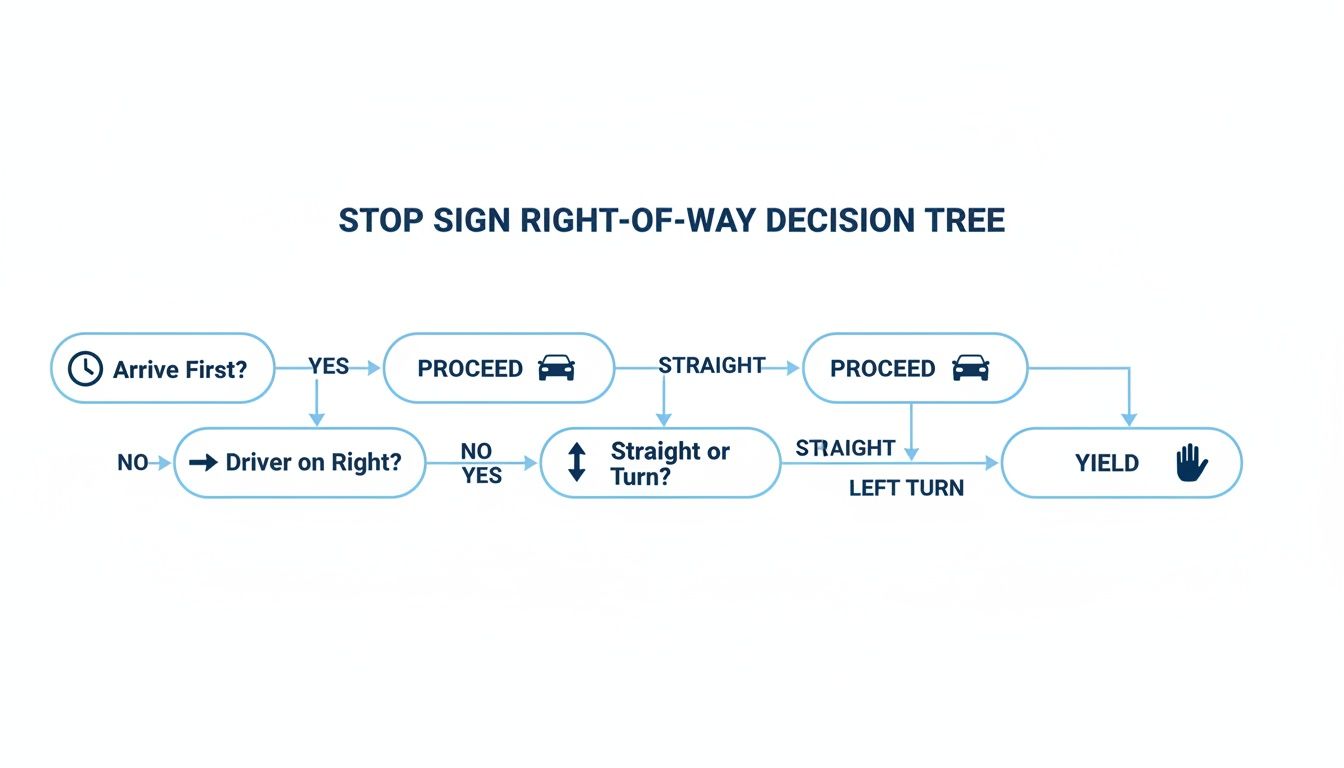
As the chart shows, arriving first, being on the right, or going straight are the main factors that determine who has the legal priority to proceed.
To make it even simpler, here's a quick-reference table that breaks down the most common scenarios you'll encounter on the road.
Pennsylvania Stop Sign Right-of-Way Scenarios
| Intersection Type | Who Must Yield | Who Has the Right-of-Way |
|---|---|---|
| Two-Way Stop | The driver at the stop sign. | All traffic on the through street (the road without a stop sign). |
| Four-Way / All-Way Stop | The driver who arrives second. If arriving at the same time, the driver on the left yields. | The first driver to arrive and make a complete stop. If arriving at the same time, the driver on the right proceeds. |
| T-Intersection | The driver on the road that ends. | All traffic on the continuous, through road. |
This table covers the basics, but remember that every accident has its own unique facts. A driver with the technical right-of-way could still be found partially at fault if they were speeding or distracted.
A failure to yield right-of-way is one of the most common causes of intersection accidents. It’s a clear breach of a driver’s duty of care, making it a powerful piece of evidence in a personal injury claim.
The consequences of ignoring these simple rules can be tragic. In Pennsylvania, stop sign accidents have shown a troubling rise in fatalities, jumping from 98 deaths in 2023 to 111 in 2024, according to PennDOT's latest traffic data. This 13.3% increase highlights how these seemingly routine intersections can turn deadly, often due to drivers failing their basic duty to stop and yield. You can find more details about these traffic fatality trends by exploring PennDOT's recent data reports on Times Leader.
How Shared Fault Impacts Your Accident Claim
When you're in a stop sign crash, it’s easy to think in black-and-white terms: one person was 100% wrong, and the other was 100% right. But Pennsylvania law doesn't always see it that way. Fault isn't an all-or-nothing game; it's often more like a pie, where slices of blame get assigned to everyone involved.
This whole concept is wrapped up in a legal rule called modified comparative negligence. It’s a mouthful, but it directly controls how much money you can actually get for your injuries, medical bills, and time off work. It’s a system designed to divide up responsibility based on each driver’s role in causing the collision.
Let's play this out. Imagine someone blows through a stop sign and T-bones you. They're clearly at fault. But what if you were going just five miles per hour over the speed limit? An insurance adjuster, or even a jury, might decide your extra speed made the crash just a little bit worse.
How Percentages of Fault Reduce Your Compensation
In that scenario, a court could say the other driver was 90% at fault for ignoring the stop sign, but you were 10% at fault for speeding. That small percentage has a huge impact on your bottom line.
If your total damages—everything from medical bills to lost income to pain and suffering—add up to $100,000, your 10% share of the blame will reduce your final payout by that much.
- Total Damages: $100,000
- Your Assigned Fault: 10% ($10,000)
- Final Award: $90,000
This reduction happens because Pennsylvania law says you're responsible for the portion of damages your own actions caused. Insurance companies are masters at digging for any little thing you did—or didn't do—to argue your percentage of fault should be higher, shrinking what they have to pay. You can get a deeper look by exploring our detailed guide on what is comparative negligence in Pennsylvania law.
The Critical 51 Percent Bar to Recovery
Here's where Pennsylvania's system gets really tough. There's a strict, unforgiving cutoff point, which is what makes it a "modified" comparative negligence state.
Under Pennsylvania law (42 Pa. C.S.A. § 7102), you are completely barred from recovering any compensation if your share of the fault is determined to be 51% or greater.
This is the infamous 51% rule, and it's the most important piece of the shared-fault puzzle. If you are found to be even slightly more than half responsible for the crash, you get zero. It doesn’t matter how bad your injuries are or how high your medical bills have climbed.
Think back to our example. If the insurance company successfully argues that you were not only speeding but also distracted by changing the radio, a jury might pin 51% of the blame on you. At that moment, your potential recovery drops from $49,000 (if you were 50% at fault) straight down to $0.
This rule is exactly why insurance companies fight tooth and nail to shift blame onto accident victims. Pushing your fault percentage over that 50% line saves them from paying a single dime. It's also why having an experienced attorney in your corner—someone who knows how to fight back against these unfair blame games—is absolutely crucial to protecting your right to compensation after a stop sign accident.
Analyzing Common Stop Sign Collision Scenarios
Knowing the traffic laws and fault rules is one thing, but seeing how they play out in the real world is another. At the scene of a crash, who’s at fault isn't always as cut-and-dried as it seems. Let's walk through a few common stop sign collision scenarios to see how investigators figure out what really happened.
Think of an investigation like piecing together a puzzle. Every crash tells a story, and investigators are the ones who have to read the clues—the vehicle damage, the skid marks on the road, what witnesses saw—to reconstruct the moments right before impact.
The Classic T-Bone or “Rolling Stop” Crash
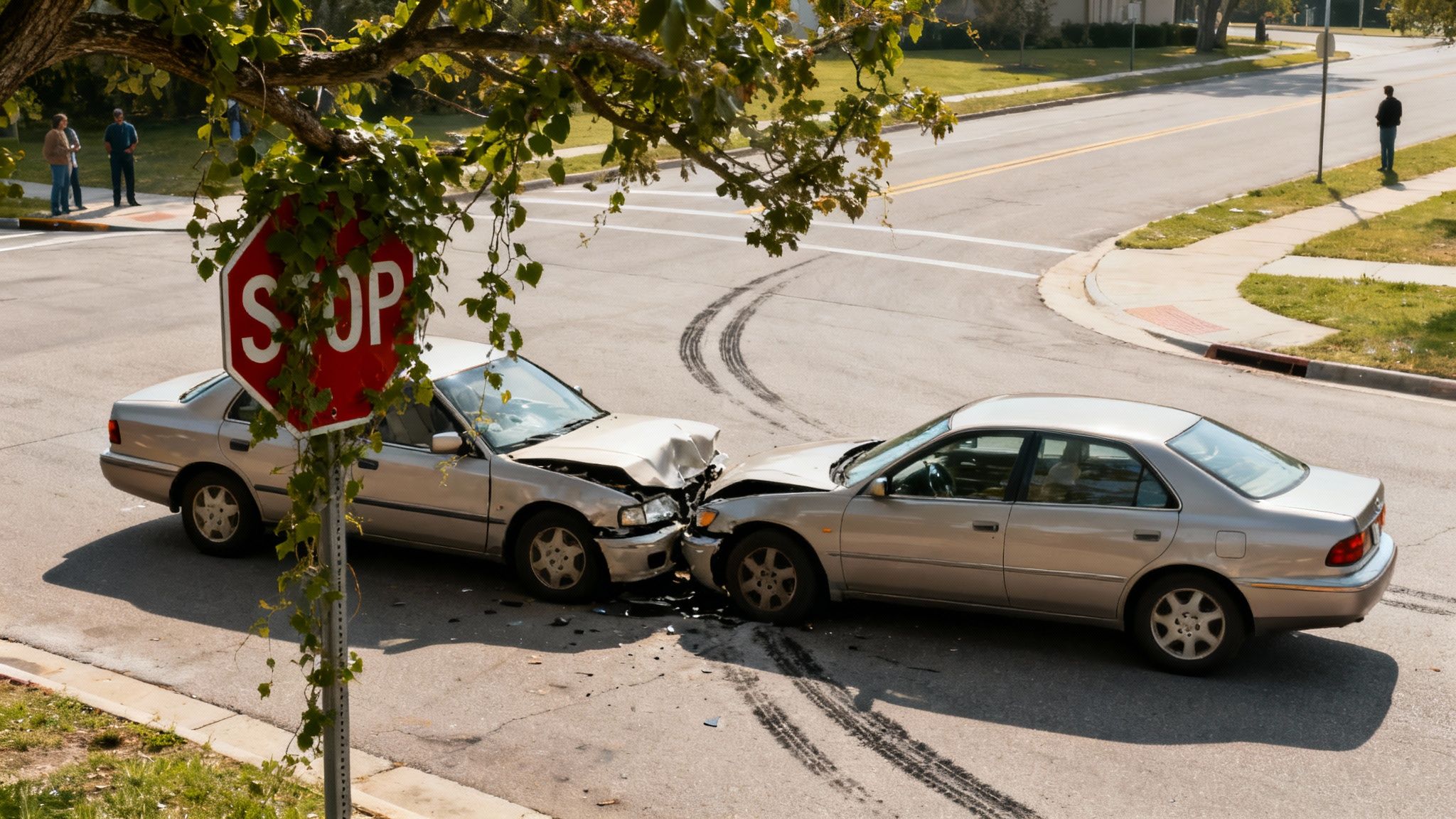
This is the one we see most often. A driver on a smaller road with a stop sign pulls out in front of a car on the main road, which has no stop sign. The car on the main road smashes into the side of the other vehicle, creating a "T" shape.
In almost all of these cases, the driver who ran the stop sign is going to be found at fault. It comes down to two simple duties they ignored:
- Failure to Stop: They probably did a "rolling stop" or didn't stop at the white line at all. That split-second decision meant they couldn't properly judge how fast the other car was coming.
- Failure to Yield: Even if they did stop, they pulled out anyway. They failed to give the right-of-way to the traffic that had the legal green light to keep moving.
Ultimately, figuring out fault in a Pennsylvania stop sign crash often comes down to who had the right-of-way. In 2023, Pennsylvania saw 110,382 total crashes. And while that number is down, fatalities have climbed to 1,209—a 2.5% jump from 2022—which tells us that intersection crashes are getting more dangerous. You can dig deeper into the numbers by checking out the latest Pennsylvania crash statistics and accident trends on Kalraylaw.com.
Confusion at a Four-Way Stop
Four-way stops are supposed to be simple, but they're a common source of confusion and collisions. The typical crash happens when two drivers get there around the same time, and one of them gets impatient or confused and goes out of turn.
To sort out the blame, investigators will ask three key questions:
- Who Arrived First? The first car to come to a full stop gets to go first. Simple as that.
- Who Was on the Right? If two cars stop at the same time, the driver on the right has the right-of-way. The driver on the left has to wait.
- Who Was Turning Left? If you're turning left, you always have to yield to someone going straight through the intersection from the opposite direction.
The driver who broke this sequence is the one who will likely be found at fault. In these "he said, she said" situations, eyewitnesses can be incredibly important for confirming who got there first.
The Hidden or Obstructed Stop Sign
Now for a tricky one. What if a driver blows through a stop sign they literally couldn't see? Maybe it was completely blocked by an overgrown tree branch or a giant delivery truck parked on the corner. Here, the blame gets a little more complicated.
In cases involving an obstructed stop sign, fault can be divided. The driver who failed to stop may bear some responsibility, but the government entity (like a township or PennDOT) responsible for maintaining clear sightlines could also be held negligent.
While the driver did technically fail to stop, it's not entirely their fault. The city, township, or state agency responsible for road maintenance might share the blame.
To make that stick, you have to prove the government agency knew (or should have known) about the hazard and didn't do anything about it. This means digging for things like maintenance records or complaints from other residents about that same blind spot. The driver might still be found partially at fault for not being more cautious at an intersection, but the government’s negligence could be the main reason the crash happened in the first place.
Gathering Evidence to Build a Winning Claim
Just because you know the other driver blew through that stop sign doesn't mean their insurance company is going to take your word for it. Not by a long shot. To get the compensation you deserve, you have to prove it with hard evidence.
Think of yourself as a detective. The minutes, hours, and days right after the crash are your only real shot to gather the clues that will build an undeniable case.
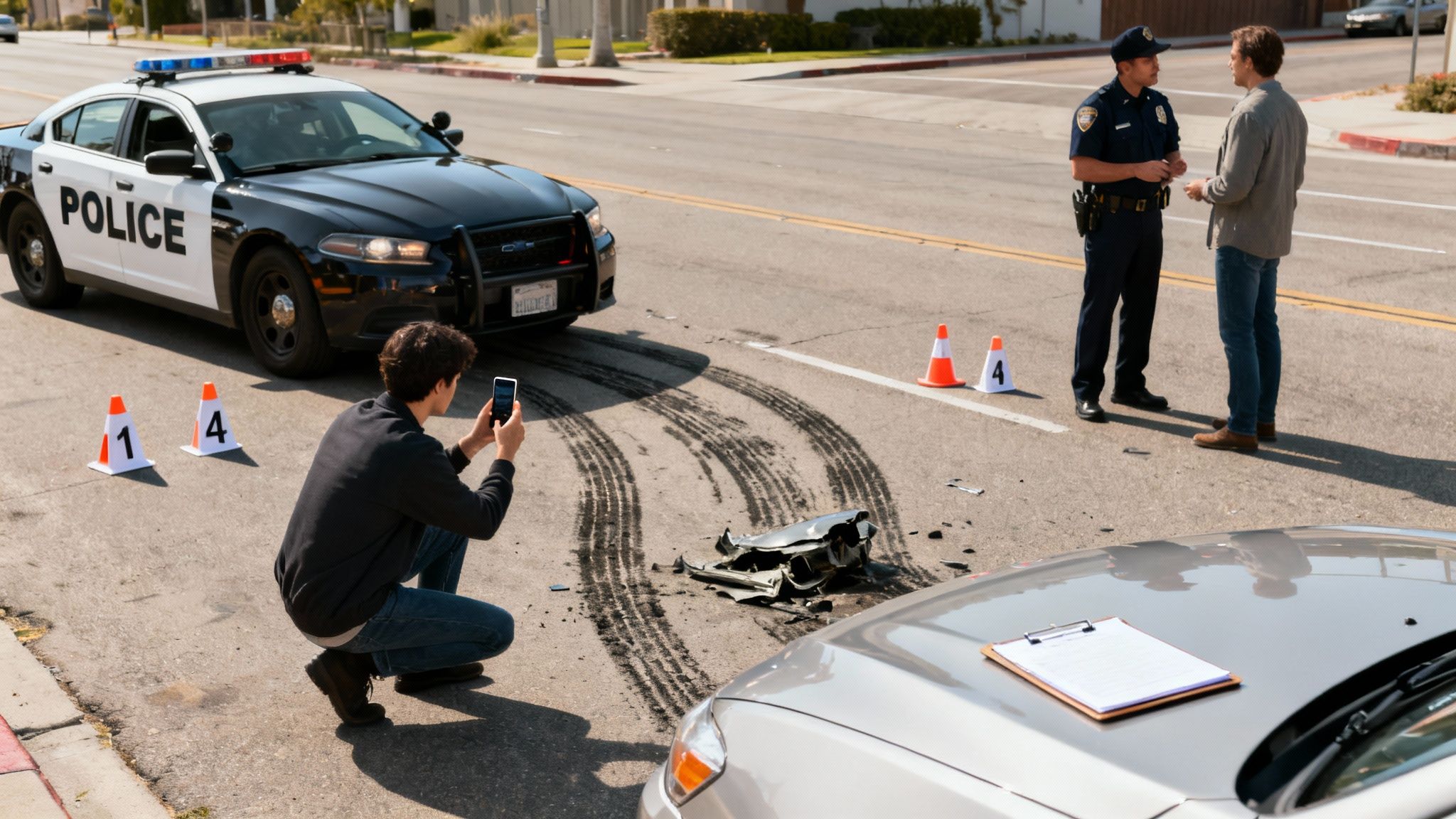
This initial evidence gathering is the bedrock of your entire claim. Without solid proof from the very beginning, you give the insurance company all the room they need to argue, delay, and deny what you're rightfully owed.
Your Action Plan at the Scene
What you do immediately after the accident can make or break your case. Of course, safety and medical care come first. But if you're able to, taking these steps is absolutely critical for locking down evidence:
- Photograph Everything: Use your phone and take pictures from every conceivable angle. Get shots of where the cars ended up, the damage to both vehicles, any skid marks on the road, the stop sign itself, and the entire intersection. You can't have too many photos.
- Get Witness Information: If anyone saw what happened, get their name and phone number. An independent witness who can back up your story is incredibly powerful, especially when it’s your word against the other driver’s.
- File a Police Report: Always call 911 and have an officer come to the scene. The official police report will include the officer's initial thoughts on fault, statements from everyone involved, and a diagram of the accident.
This on-the-spot documentation freezes the moment in time before memories get fuzzy or the scene gets cleared away. The details you capture right then and there are often the most powerful.
Securing Key Documents After the Crash
The work isn't over once you leave the scene. In the following days, you or your attorney need to get your hands on the official records that give your claim authority. The single most important document is the police report. You can usually get a copy from the police department that handled the crash a few days later.
This report is typically the very first thing an insurance adjuster will ask to see. While the officer's opinion on who's at fault isn't the final word in court, it carries a lot of weight and sets the tone for the whole negotiation.
Key Takeaway: A police report that doesn't go your way is not the end of the road. It’s just one piece of the puzzle. A good lawyer can often find other proof, like surveillance video, that tells a completely different story from the officer's initial report.
From there, a good attorney will dig even deeper. This often means sending out formal requests, called spoliation letters, to nearby homes or businesses, telling them they must preserve any security camera footage that might have caught the accident. That video can be the smoking gun that proves the other driver never even touched their brakes.
How an Attorney Elevates Your Evidence
The evidence you collect is a great start, but a skilled trial attorney knows how to take it to the next level. They know what evidence you need to win a Pennsylvania car accident claim and have the resources to find facts you could never get on your own.
An attorney can:
- Subpoena Cell Phone Records: This can prove the at-fault driver was texting, scrolling, or talking on the phone at the exact moment of impact.
- Hire Accident Reconstruction Experts: These are specialists who use physics and engineering to analyze skid marks, vehicle damage, and other physical clues to scientifically prove what really happened.
- Obtain Vehicle "Black Box" Data: An Event Data Recorder (EDR) can reveal a car's speed, braking, and steering in the seconds right before the crash.
When putting together a strong case, having precise records of what was said in depositions or recorded statements is vital. Services that provide legal court transcription are instrumental in creating these exact written accounts. By combining the evidence from the scene with this kind of expert analysis, your lawyer builds a powerful, fact-based story that leaves the insurance company with nowhere to hide.
Why a Trial Attorney Is Your Strongest Ally
After a stop sign accident, you might think the person who hit you is your biggest problem. The reality? Your real opponent is their insurance company. These are massive, multi-billion-dollar corporations, and their business model is simple: protect profits by paying out as little as possible on claims.
Their number one strategy is to turn Pennsylvania’s shared fault rules against you. An insurance adjuster's whole job is to dig for any reason—no matter how small—to pin some of the blame on you. They'll pick apart every detail, hoping to push your percentage of fault over that critical 51% line. If they succeed, they legally owe you nothing.
The Insurance Company's Playbook
Insurance adjusters are professional negotiators who see hundreds of claims just like yours every single year. They know exactly what to say to get you to accidentally admit you were partially at fault. They might ask tricky, leading questions or twist your words to suggest you were speeding, distracted, or just not paying enough attention.
Their goal is always the same: reduce or deny what you're rightfully owed. This is where an experienced trial attorney becomes your most powerful asset.
An attorney who prepares every single case for trial sends a powerful message to the insurance company: You are not an easy target, and their lowball offers will be rejected. That readiness to go to court is often what forces them to the negotiating table in good faith.
A real trial lawyer does a lot more than just file paperwork and make phone calls. They immediately level the playing field by launching their own investigation to dismantle the insurer's story before it even gets off the ground.
How a Trial Lawyer Fights Back
A true trial attorney doesn't just react to what the insurance company does; they go on the offensive. From day one, they are building an ironclad case designed to win in a courtroom, even while they're pushing for a fair settlement. This aggressive preparation is what forces insurers to sit up and take your claim seriously.
Here’s how they do it:
- Independent Investigation: They’ll get out to the scene themselves, hire private investigators if needed, and uncover evidence the police might have missed. Think surveillance footage from a nearby storefront that clearly shows the other driver blowing right through the stop sign.
- Expert Consultation: They bring in the heavy hitters—accident reconstruction experts who use physics and engineering to prove exactly how the crash happened. These experts can pinpoint the other driver's actions with scientific certainty, making it almost impossible for the insurer to argue.
- Aggressive Negotiation: Armed with indisputable facts, your attorney negotiates from a position of strength. They can systematically take apart the insurer's attempts to shift blame and show them the true value of your claim, which includes not just medical bills and lost wages, but your pain and suffering too.
This isn't just for show; it's a strategic necessity. The sad reality is that stop sign accidents remain a persistent danger on Pennsylvania roads. Historical trends show 111 fatalities from stop sign accidents in 2024, a notable spike from 98 deaths in 2023, underscoring the lethal consequences of driver error. For more details on these statistics, you can explore the latest Pennsylvania traffic fatality report from the Duffy Firm.
Ultimately, deciding to hire a lawyer can be one of the most important moves you make. To get a better sense of the support a lawyer provides, you can learn more about the benefits of hiring a personal injury lawyer in our detailed guide. An attorney ensures your rights are protected against powerful insurance companies, giving you the best chance to get the full compensation you need to recover and move on with your life.
Common Questions We Hear After a Stop Sign Crash
Even when you know the rules of the road, the reality of a crash is a mess of confusion and stress. In those first few moments, practical questions pop up fast. Knowing your rights is key. Let’s tackle some of the most common questions we get from clients after a Pennsylvania stop sign collision to help clear things up.
What If the Other Driver Ran the Stop Sign, but I Was Speeding?
This is probably one of the most common "what if" scenarios we see, and it’s a perfect real-world example of how Pennsylvania’s comparative negligence rule actually works. The short answer is yes, you can almost certainly still recover money. But the final amount you get will probably be reduced by your share of the blame.
Think of fault as a pie that has to be divided up. The other driver’s failure to stop is a huge slice of that pie, but your speeding might be seen as a smaller slice that contributed to the crash or made it worse.
A jury would be asked to look at what each driver did and assign a percentage of fault. For example, they might decide the driver who blew the stop sign was 80% at fault, but find you 20% at fault for speeding. If your total damages were calculated at $100,000, your final award would be cut by your 20% fault, so you'd receive $80,000. The most important thing to remember is that as long as your share of the blame is under 51%, you have a right to financial recovery.
The Police Report Blames Me. Is My Case Over?
Absolutely not. This is a huge and dangerous myth. Believing the police report is the final word on fault is a mistake. While it’s an important piece of evidence, it is not legally binding. A police officer’s conclusion is just their opinion, often formed in the chaos right after a crash with very limited information.
Officers do their best, but they aren't investigators with unlimited time. They don't always get it right. They might not have seen a crucial piece of evidence, or one driver might have just been more convincing with their story at the scene.
A good personal injury lawyer can—and often does—successfully challenge a bad police report. We do this by launching our own deep, independent investigation to find the facts the officer missed. An attorney can:
- Find surveillance video from a nearby doorbell camera or business that proves the other driver never even slowed down.
- Track down independent witnesses who saw what happened but left before the police arrived.
- Hire an accident reconstruction expert who can use science to analyze the crash dynamics and show that the officer's initial conclusion was wrong.
Plenty of winning personal injury claims started with an unfavorable police report. Don't let it stop you.
How Long Do I Have to File a Lawsuit for a Stop Sign Accident?
In Pennsylvania, the law puts a strict timer on your right to file a personal injury lawsuit. This is called the statute of limitations. For the vast majority of car accident cases, you have two years from the date of the collision to file a lawsuit.
This isn't a suggestion—it's a hard deadline. If you miss that two-year window, you are permanently blocked from getting any compensation for your injuries, no matter how badly you were hurt or how obvious it is that the other driver was at fault.
You need to contact an attorney long before this deadline gets close. Building a strong case takes time. Evidence like security camera footage gets deleted, witnesses move away or their memories fade, and experts need time to do a thorough analysis. The sooner you act, the better you protect your rights.
What if There Were No Witnesses to the Crash?
An independent witness is great, but you don't need one to win your case. A claim can be completely successful with no witnesses at all, because the physical evidence often tells a story that can't be denied.
Modern accident investigation is all about science and tech, which can be far more reliable than a person's memory. An accident reconstruction expert can look at the physical aftermath and scientifically figure out who was at fault. They’ll examine things like:
- The location and severity of the damage on both cars.
- The length and direction of any skid marks left on the road.
- Where the cars ended up after the impact.
Better yet, most newer cars have an Event Data Recorder (EDR)—the "black box." This little device captures critical data from the few seconds before a collision, like speed, braking, and steering. This electronic data can prove without a doubt that the other driver never hit the brakes for that stop sign, making it one of the most powerful tools we have.
If you've been injured in a stop sign accident, you don't have to face the insurance companies alone. The dedicated trial attorneys at Mattiacci Law are ready to fight for you. We prepare every case for trial to ensure you are taken seriously and receive the full compensation you deserve. Contact us today for a free, no-obligation consultation to discuss your case by visiting jminjurylawyer.com.