

Author: John Mattiacci | Owner Mattiacci Law
Published January 9, 2026
When you get into a rear-end accident in Pennsylvania, it’s easy to assume the person who hit you from behind is automatically at fault. But that’s one of the biggest—and most dangerous—myths out there. The truth is, figuring out who pays depends on the specific actions of both drivers.
Forget "Automatic Fault"—It Doesn't Exist in PA
So many people believe a rear-end collision is an open-and-shut case. They think the trailing driver is always handed 100% of the blame. This is a huge oversimplification that ignores the legal standard governing every single personal injury claim in our state: modified comparative negligence.
Think of fault less like a switch and more like a pie that has to be divided. A judge or jury looks at what happened and assigns each driver a slice of that "fault pie" based on what they did or didn't do. That percentage is everything—it determines if you can get paid, and how much.
The 51% Rule: Pennsylvania's Strict Cutoff
The whole system hinges on what’s called the 51% Bar Rule. Under Pennsylvania law, you can only recover money for your injuries and other damages if your share of the fault is 50% or less.
If you are found to be 51% or more responsible for causing the crash, you are legally barred from recovering a single penny from the other driver. It’s a harsh cutoff, and it makes every detail of what happened critically important.
This rule is exactly why insurance companies will fight tooth and nail over what might seem like minor details. Shifting just a few percentage points of blame can be the difference between a fair settlement that covers your bills and walking away with absolutely nothing. You can learn more about how rear-end accident laws are applied from legal experts in Pennsylvania.
To make it crystal clear, we've put together a simple table breaking down how this negligence rule really works in the context of a rear-end accident claim.
How Pennsylvania's Negligence Rule Works
| Concept | What It Means for You | Real-World Impact on Your Claim |
|---|---|---|
| Modified Comparative Negligence | Fault is shared. Your ability to recover money depends on being less at fault than the other parties involved. | The insurance adjuster will look for any reason to assign blame to you, even if you were hit from behind. |
| The 51% Bar Rule | If your assigned fault is 51% or higher, you get $0. Period. No exceptions. | Even if your damages are severe, being found mostly at fault means you bear the full financial burden yourself. |
| Reduced Compensation | If you're found partially at fault (but 50% or less), your total compensation is reduced by your percentage of blame. | A $100,000 claim becomes $80,000 if you're found 20% at fault. |
This isn't just legal theory; it has a direct and significant impact on the money you can actually put in your pocket after an accident.
How This Rule Hits Your Wallet
Let’s run through a few quick examples. Say your total damages—medical bills, lost paychecks, pain and suffering—add up to $100,000.
Here’s how Pennsylvania’s rule would play out:
- You are found 10% at fault: You can recover $90,000 of your total damages.
- You are found 50% at fault: You can still recover $50,000.
- You are found 51% at fault: You recover $0.
Grasping this concept is the first and most important step toward protecting your rights. It’s not just about proving the other driver made a mistake; it’s about proving they were more responsible for the accident than you were.
Navigating Pennsylvania’s Comparative Negligence Law
Before we can figure out who’s at fault in a rear-end collision, we need to talk about the legal rule that powers every single personal injury claim in Pennsylvania: modified comparative negligence. This isn't just some legal jargon to skim over; it’s the system that decides if you get paid and, if so, how much.
Think of it like this: after an accident, a judge or jury takes a "fault pie" and carves it up, assigning a percentage slice to each driver based on their actions. The amount of money you can recover is directly tied to the size of your slice. Proving the other driver was careless isn't enough—you have to prove they were more careless than you were.
How Your Percentage of Fault Impacts Your Claim
Let's see how this works in the real world. Imagine you've been rear-ended, and your total damages—medical bills, lost wages, pain and suffering—add up to $50,000.
- You are found 10% at fault: You can walk away with $45,000 (your $50,000 award minus your 10% share).
- You are found 50% at fault: You can still collect $25,000, which is half of your total damages.
- You are found 51% at fault: You get $0. Nothing.
That last part is the harsh reality of Pennsylvania's 51% bar. The moment your share of the blame crosses that halfway mark, you are legally blocked from getting a dime from the other driver. This is exactly why insurance adjusters will fight tooth and nail over what seem like tiny details. They know that shifting just a few percentage points of fault their way can save their company a fortune.
To get a better handle on how liability works here, it helps to understand the bigger picture of Pennsylvania's legal framework, which sets the stage for every claim.
This simple chart breaks down how Pennsylvania’s fault rules play out and determine whether you can recover money after a crash.
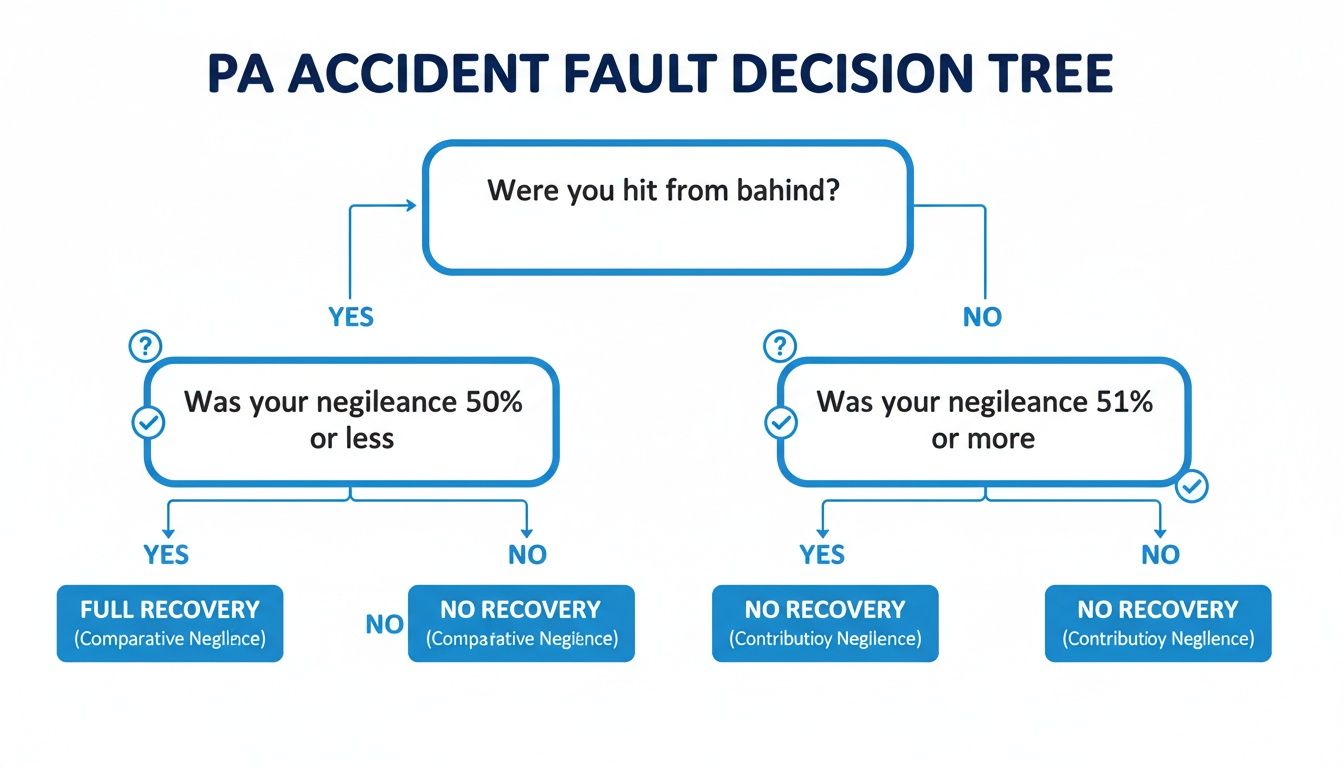
The main takeaway here is simple: your ability to get compensation depends on keeping your own negligence at 50% or less. If your actions are deemed to have contributed more than half to the accident, your path to recovery is completely shut down.
The Financial Stakes of Every Percentage Point
Now, let's raise the stakes. Say we're talking about a catastrophic injury case where the damages are valued at $1 million. If the injured driver is found 40% responsible for suddenly slamming on their brakes for no good reason, their potential payout drops to $600,000.
But if that fault percentage inches up to 51%, the recovery plummets to zero. That single percentage point just cost them $600,000.
Because the financial stakes are so massive, every shred of evidence—from a witness's offhand comment to the condition of the road—gets put under a microscope. It’s all ammunition to assign those critical percentages. Understanding this from the start is the first step toward building a case that can stand up to that kind of scrutiny. To learn more, check out our deeper explanation of what comparative negligence in Pennsylvania law means and how it will shape your claim.
When the Front Driver Is Held Responsible
While most people assume the rear driver is always to blame, that's a myth. It’s far from an absolute rule. The "assured clear distance ahead" rule has its limits, and there are plenty of situations where the actions of the lead driver can flip the script entirely.
Understanding these exceptions is critical. The law doesn’t give the front driver a free pass to drive recklessly. If their negligent or dangerous actions create a hazard that another driver can’t reasonably avoid, they can be held partially or even entirely responsible for the crash.
Common Scenarios Where the Lead Driver Shares Fault
Think of it this way: every driver has a duty to operate their vehicle safely. When a lead driver's actions violate that duty, they contribute to what I call the "fault pie." Let's walk through a few real-world examples of how this plays out.
- Malfunctioning Brake Lights: Imagine you're driving at night and the car ahead stops, but their brake lights are out. You react as soon as you realize they're slowing, but it's too late. Here, the lead driver’s failure to maintain their vehicle directly contributed to the crash.
- Sudden Reversing: You're stopped at a red light. Without warning, the driver in front of you throws their car into reverse—maybe they overshot the stop line. Before you can even honk, they back right into your front bumper. In this case, their unexpected and unsafe maneuver is the clear cause.
- Cutting Off Another Vehicle: You’re driving along when another car suddenly swerves into your lane right in front of you and immediately slams on its brakes. You had zero time to establish a safe following distance. That driver’s aggressive lane change created an unavoidable hazard.
A key legal question is whether the front driver's actions were sudden, unexpected, and unforeseeable. If a reasonably attentive driver would not have had time to react safely, a strong argument can be made that the lead driver bears significant responsibility.
Brake Checking and Creating Hazards
One of the most clear-cut examples is "brake checking." This is when a lead driver intentionally slams on their brakes to intimidate or retaliate against someone they think is tailgating. This isn't just reckless; it's an aggressive act that can easily cause a serious collision.
Beyond intentional acts, a lead driver can also be liable for stopping in a travel lane for no good reason. Stopping in the middle of a highway to answer a text or grab something that fell on the floor creates an extreme and unexpected danger for everyone behind them.
Complexities in Chain-Reaction Pile-Ups
Chain-reaction accidents add a whole other layer of complexity. Let’s say you have a three-car pile-up: Vehicle C hits Vehicle B, pushing it into Vehicle A. At first glance, the fault seems to lie with the driver of Vehicle C.
But what if the driver of Vehicle B was tailgating Vehicle A and would have hit them anyway, even without the push from behind?
In these multi-vehicle crashes, a thorough investigation is needed to figure out the sequence and force of each impact. It’s entirely possible for multiple drivers to share the blame. For example, the driver who caused the first hit and a second driver who was following too closely could both be assigned a percentage of fault under Pennsylvania’s comparative negligence rules. Unraveling these scenarios requires careful analysis to make sure liability is assigned correctly.
The Critical Evidence That Proves Your Case
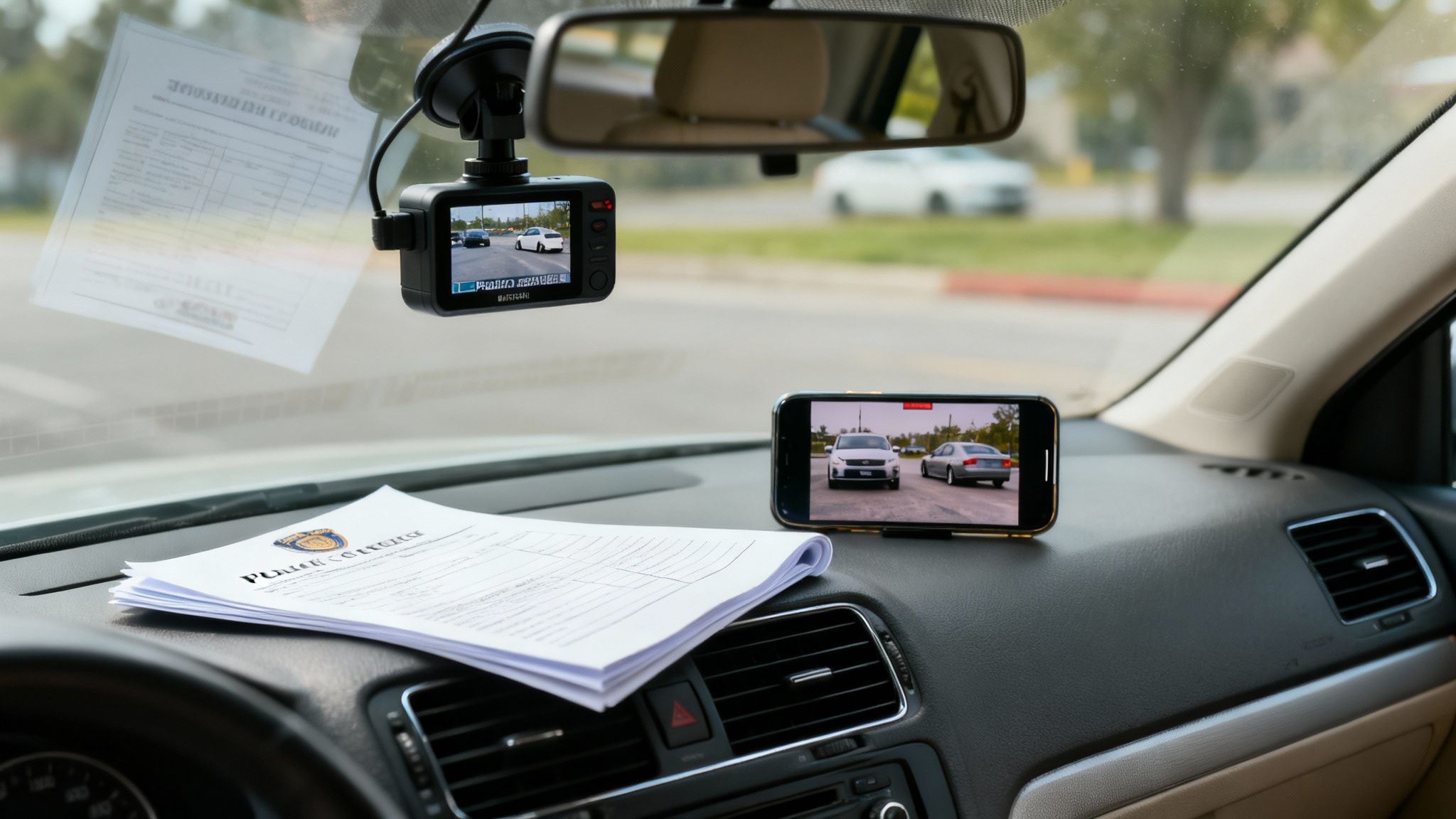
After a crash, what happened isn't just a story—it's a collection of facts. Winning your claim doesn't come down to who tells the most convincing tale; it's about who has the hard evidence to back it up. Understanding what kind of proof is powerful is the first step toward building a case that can stand up to insurance adjusters.
Simply put, you need proof. Without it, you’re stuck in a "he said, she said" scenario, and that’s a game the insurance company is happy to play. Each piece of evidence helps paint a clear picture of the other driver’s negligence and dismantles any attempt they make to shift the blame.
The Foundational Pieces of Evidence
Think of building your case like putting together a puzzle. You have to start with the corner pieces to create a solid frame. For a rear-end accident, a few pieces of evidence are absolutely non-negotiable.
- The Official Police Report: This is almost always the first document an insurance adjuster looks at. It contains the officer's initial take, contact info for drivers and witnesses, a diagram of the scene, and, most importantly, any citations issued. A ticket for "following too closely" is a massive point in your favor.
- Photographs and Videos: Pictures you take right after the crash are priceless. They freeze the scene in time—capturing vehicle positions, the extent of the damage, skid marks, and even the weather. This kind of visual proof can instantly shut down a false story from the other driver.
- Witness Statements: A neutral third party who saw what happened can be your most powerful asset. Their testimony provides an unbiased account, confirming critical details like a sudden lane change or a driver who was clearly looking down at their phone.
These initial pieces set the stage for your entire claim. Our guide on how to document evidence after a car accident gives you a practical checklist to make sure you don't miss a thing in those chaotic first few moments.
Advanced and Digital Evidence
In today's world, the most compelling evidence is often digital. Dashcams and nearby surveillance footage can offer an irrefutable, second-by-second replay of the accident, leaving zero room for debate.
Key Takeaway: Unbiased video evidence can single-handedly dismantle the other driver's defense. It can show a driver looking at their phone, swerving erratically, or brake-checking, turning a difficult case into a clear-cut one.
Beyond video, we can sometimes pull data from a vehicle's Event Data Recorder (EDR), or "black box." This device can reveal crucial information like speed, braking, and steering inputs right before impact. Accident reconstruction experts often use this technical data to create a scientific model of the collision.
The Role of Expert Testimony
When the stakes are high or the facts get complicated, we bring in an accident reconstruction expert. These professionals use physics and engineering to analyze all the evidence and determine exactly how the crash happened. Their scientific analysis can be the final word in proving the other driver’s actions made the accident unavoidable for you.
Medical experts are just as crucial. They connect your specific injuries directly to the force of the collision, showing how the impact caused the harm you've suffered. It’s vital that all medical evidence adheres to proper Medical Record Documentation Standards, as this impacts its power and admissibility in your case.
This level of detail is especially important in high-traffic areas. In 2021, Philadelphia County alone recorded 10,417 crashes—the highest in the state. Behaviors like aggressive driving and distraction are common factors that solid evidence is needed to prove.
How Road Conditions and Other Factors Can Shift Fault
When a rear-end collision happens, it’s easy to point the finger at the driver in the back. But the real story behind the crash often involves more than just the two drivers. External factors can throw a major curveball, creating unavoidable hazards that Pennsylvania law recognizes can shift who’s actually at fault.
Think about it this way: following another car on a dry, sunny day is one thing. Doing the exact same thing on a dark road covered in black ice is a completely different ballgame. A careful driver has plenty of time to react in the first scenario. In the second, even the most cautious driver might not be able to stop a crash. This is where outside conditions come into play.
When the Road Itself Is the Hazard
Sometimes, the road is the real villain. Government bodies are responsible for keeping public roads reasonably safe. When they drop the ball on that duty through negligence, they can be held at least partially responsible for accidents that happen as a result.
Here’s how that can happen:
- Poor Road Maintenance: We’re talking about massive, unmarked potholes, sudden pavement drop-offs, or super uneven surfaces that force a driver to slam on their brakes out of nowhere.
- Obscured or Missing Signage: A stop sign hidden by a tree branch, a broken traffic light, or a lack of warning for a sharp curve can cause a driver to stop suddenly, making a rear-end collision almost guaranteed.
- Poor Road Design: Some roads are just built badly. Dangerously sharp turns, blind hills, or intersections with terrible visibility create conditions that practically invite a crash.
It's not just about the drivers; it's about the environment they are forced to operate in. If a hazardous road condition was a substantial factor in causing the collision, the government body responsible for that road could share in the fault.
Treacherous Weather and Its Legal Impact
Weather is another huge factor that can totally change the game and shift legal fault. Sure, drivers are expected to slow down for bad conditions, but some weather events create dangers that are nearly impossible to handle. Heavy fog can cut visibility down to almost nothing, while a sudden downpour can cause a car to hydroplane in an instant.
Pennsylvania gets more than its fair share of nasty driving weather. In 2023, PennDOT tracked 24,698 crashes during ugly weather like rain, snow, or sleet. Rain was a factor in a whopping 14,486 crashes, while snow and ice played a part in 4,049 collisions. Conditions like these dramatically increase how long it takes to stop and can give an insurance company a solid argument that even a safe driver couldn't have prevented the impact. You can see more car accident statistics and what they mean on the Edgar Snyder & Associates website.
The table below breaks down some of the most common factors that can be used to argue that fault should be shared.
Factors That Can Influence Fault in a Rear-End Crash
| Factor Category | Specific Examples | Potential Impact on Fault |
|---|---|---|
| Environmental Conditions | Black ice, heavy fog, sun glare, torrential rain | Can argue the trailing driver couldn't see or stop in time despite being cautious. |
| Road Hazards | Large potholes, missing stop signs, non-working traffic signals | Suggests a government entity's negligence contributed to the crash. |
| Lead Driver's Actions | Brake checking, sudden lane changes without signaling, broken brake lights | Shifts blame to the front driver for creating an unexpected, dangerous situation. |
| Mechanical Failures | Sudden brake failure (trailing car), engine seizure (lead car) | Fault could lie with a manufacturer or mechanic, not the driver. |
| Third-Party Actions | A pedestrian darting into the road, another vehicle cutting someone off | Shows an outside actor created the emergency that forced a sudden stop. |
As you can see, a rear-end collision is rarely a simple, open-and-shut case. Multiple things can contribute to a crash, and a good investigation will uncover all of them.
Sudden Mechanical Failures
This one is less common, but it’s a big deal when it happens. If the trailing driver's brakes suddenly fail without any warning because of a manufacturing defect, the fault might not be on the driver at all—it could be on the car company or parts maker. Likewise, if the lead driver’s car has a catastrophic engine failure and lurches to a dead stop in a 65-mph lane, their abrupt stop may be seen as completely unavoidable.
Proving any of these external factors takes a serious, in-depth investigation. It means digging up weather reports, municipal maintenance records, vehicle service histories, and often bringing in engineering experts to testify. A full analysis is the only way to make sure fault is assigned correctly when outside forces are part of the story.
Protecting Your Rights After a Rear-End Crash
Knowing the legal theories is one thing, but knowing what to do in the chaotic minutes, days, and weeks after a rear-end collision is what really protects your rights. The steps you take from the very beginning can make the difference between a fair recovery and a claim that gets unfairly denied. Think of this as your practical roadmap to taking control of the situation.
Your absolute top priority is your health. Even if you feel fine right after the crash, you must seek a medical evaluation as soon as you can. The adrenaline coursing through your system can easily mask serious injuries like whiplash or even concussions. If you delay seeing a doctor, you’re giving the insurance company an easy opening to argue that your injuries aren’t that bad or didn't come from the crash at all.
Your Immediate Action Plan
If you're able to, start gathering information right at the scene. The documentation you collect in these first few moments becomes the foundation of your entire claim.
- Call 911: Always report the accident to the police. A police report creates an official, unbiased record of what happened.
- Take Photos: Use your phone to snap pictures of everything. Get shots of the damage to both cars, their positions on the road, any skid marks, and the surrounding intersection or roadway.
- Exchange Information: Make sure you get the other driver's name, phone number, and insurance information.
- Talk to Witnesses: Did anyone see it happen? Get their name and number. An independent witness can be an incredibly powerful voice in your corner.
Once you leave the scene, you'll soon be dealing with insurance adjusters. These are trained professionals whose entire job is to minimize how much money their company pays out. Be polite, but stick to the basic facts. Avoid giving a recorded statement until you've spoken with a lawyer, and never, ever admit fault or say you feel "fine."
Crucial Reminder: A simple, courteous apology like "I'm so sorry" can be twisted by an adjuster and used against you as an admission of fault. Let the evidence and the investigation determine who was liable.
It’s also critical to remember that the clock is ticking. In Pennsylvania, you generally have just two years from the date of the accident to file a personal injury lawsuit. This deadline is called the statute of limitations. If you miss it, you lose your right to seek compensation forever.
Insurance companies know this deadline exists and sometimes use delay tactics, hoping you'll run out of time. This is why it’s so important to act quickly to protect your legal options. Having a clear idea of what to expect financially can also help you plan your next moves; our firm offers resources to help you understand the average payout for a rear-end collision to give you a better picture.
Ultimately, the actions you take immediately after a rear-end crash are critical. By getting medical care, documenting the scene, and being careful in your communications, you create the strongest possible foundation for your claim. When the other driver’s insurer refuses to offer a fair settlement, having this solid groundwork in place empowers you to seek professional legal guidance and fight for the full compensation you deserve.
Frequently Asked Questions About Pennsylvania Rear-End Accidents
When you're trying to pick up the pieces after a crash, you’re bound to have a lot of questions. Below are some straight-up answers to the most common things people worry about after a Pennsylvania rear-end accident.
What Happens If My Brake Lights Weren’t Working?
This is a tricky one. If your brake lights were out, you can bet the other driver's insurance company will jump on that, arguing you share the blame. In Pennsylvania, every driver has a legal duty to keep their vehicle safe and in good working order.
Even though the driver behind you is still supposed to keep a safe distance, your broken lights become a major factor in the accident. A jury could easily decide you were partially at fault, which would directly reduce your payout under Pennsylvania's comparative negligence rule.
For example, if you’re found 20% at fault, your total compensation gets cut by 20%. It’s a perfect example of why every little detail matters and needs a proper investigation.
How Does No-Fault Insurance Affect My Claim?
Pennsylvania’s "choice no-fault" system trips a lot of people up. Here’s the simple version: the "no-fault" part just means your own Personal Injury Protection (PIP) insurance is the first to pay for your medical bills, no matter who caused the crash.
But that’s where "no-fault" ends. Fault is still absolutely critical for two huge reasons:
- Vehicle Damage: Your PIP doesn't cover your car repairs. For that, you have to file a claim against the at-fault driver's property damage liability insurance.
- Pain and Suffering: To sue the other driver for non-economic damages—things like pain, suffering, and emotional distress—your injuries have to be serious enough to meet a legal threshold.
Proving the other driver was more than 50% to blame is non-negotiable if you want to recover any money beyond what your own PIP policy covers.
How Long Do I Have to File a Rear-End Accident Lawsuit?
In Pennsylvania, you generally have two years from the date of the crash to file a personal injury lawsuit. This is known as the statute of limitations.
This is a hard deadline. If you miss it, the court will almost certainly throw out your case, and you’ll lose your right to seek compensation forever.
Insurance adjusters know this deadline all too well. They might drag their feet during negotiations, hoping you'll run out of time and lose your leverage. That’s why it’s so important to talk to an attorney well before that two-year clock runs out to make sure your rights are protected.
If you were hurt in a rear-end collision, figuring out who was at fault is the first critical step toward getting the compensation you need to move forward. The experienced attorneys at Mattiacci Law are ready to dig into your case, take on the insurance companies, and fight for you. Contact us today for a free, no-strings-attached consultation to learn about your legal options. Find out more by visiting us at https://jminjurylawyer.com.