

Author: John Mattiacci | Owner Mattiacci Law
Published January 16, 2026

In a failure-to-yield accident in Pennsylvania, figuring out who’s at fault usually starts with one simple question: Who had the right-of-way? More often than not, the driver who broke the rules and failed to yield is the one held responsible.
It’s helpful to think of right-of-way not as something you have, but as something you give. It’s a set of rules designed to keep traffic moving safely and predictably. When someone ignores those rules, the law generally points the finger at them for the crash that follows.
Determining Responsibility in Pennsylvania Wrecks
After a crash, you might feel certain the other driver was in the wrong, but proving it legally is a different battle. At its core, any injury claim comes down to proving the other driver was negligent. That means showing they had a duty to drive safely, they failed, and their failure caused your injuries.
Luckily, Pennsylvania’s vehicle code lays out the rules of the road in black and white. These laws aren’t just friendly suggestions; they establish the legal standard for every driver. When a driver violates a specific traffic law—like blowing through a stop sign or making an unsafe left turn—it can be considered negligence per se. This legal shortcut makes proving fault much more direct.
The Complexity of Shared Fault
But here’s where things get tricky. Determining fault isn't always a clean, 100/0 split. Insurance companies are notorious for trying to shift at least some of the blame onto the injured person. Why? To reduce how much they have to pay out.
This is where understanding Pennsylvania’s laws becomes absolutely critical. Our state operates under a modified comparative negligence rule, and it has a huge impact on your ability to get paid for your injuries.
Under Pennsylvania's modified comparative negligence statute (42 Pa. C.S. § 7102), you can recover damages even if you were partly to blame, but only as long as your share of the fault is 50% or less.
This means fault can be—and often is—divided between drivers. Let’s say an investigation finds you were 10% responsible for the crash. Your final compensation award would be cut by that 10%. But if you're found to be 51% or more at fault, you get nothing. Zero.
Because of this harsh cutoff, the fight over percentages is often the main event. Even a tiny shift in blame can make or break your case, which is why having a thorough investigation backed by solid evidence is the only way to protect your rights.
Understanding Right-of-Way as the Foundation of Fault
To figure out who’s at fault in a failure-to-yield accident, you first have to get a handle on the concept of "right-of-way." Forget the dense legal jargon for a second. It's much simpler to think of it as a set of traffic etiquette rules everyone is supposed to follow. These rules tell us whose turn it is to go, creating a predictable, safe flow of traffic.
When a driver ignores those rules, they shatter that predictability, and the results can be devastating. That’s why Pennsylvania’s Vehicle Code spells these duties out so clearly. Determining fault isn't a guessing game; it's a logical process of figuring out who broke the fundamental rules of the road.
Core Right-of-Way Rules in Pennsylvania
Most failure-to-yield crashes happen in a handful of common situations, each governed by specific right-of-way laws. If you understand these, you're already halfway to pinpointing who was negligent.
- Uncontrolled Intersections: You pull up to an intersection with no stop signs or traffic lights at the same time as another car. What now? The rule is simple: the driver on the left has to wait for the driver on the right.
- Left Turns: Making a left turn puts the responsibility squarely on your shoulders. You must yield to any oncoming traffic close enough to be a hazard. It’s on you to find a safe gap before you go.
- Stop and Yield Signs: A stop sign isn’t a suggestion—it means coming to a complete stop before the line and only moving when the coast is clear. A yield sign means you slow down and prepare to stop, giving way to any traffic already in or heading into the intersection.
These are the big ones. Violating any of these rules creates a strong presumption that the driver who didn't yield is the one at fault. The consequences are far from minor. In Pennsylvania, failing to yield is a leading cause of serious intersection crashes. Recent PennDOT crash data shows that deaths in intersection accidents climbed to 321 in the most recent year reported—a 6.6% increase from the year before. The trend is even worse at stop signs, where fatal crashes jumped from 98 to 111, a staggering 13.3% spike. It’s grim proof that ignoring these rules is a deadly mistake.
Why These Rules Are Not Suggestions
Here’s a critical point many drivers get wrong: right-of-way isn't something you have, it's something you give. No driver ever has the absolute right to just plow ahead into the path of another vehicle, even if they technically have the right-of-way.
The law grants the right-of-way to a driver in a specific situation to prevent a collision. A driver who has the right-of-way is legally permitted to proceed, while the other driver is legally obligated to wait. Ignoring this obligation is a direct violation of traffic law and a clear indicator of negligence.
This concept is especially vital at four-way stops, which seem to confuse a surprising number of drivers. The law provides a clear, predictable sequence for who goes and when. For a deeper look at that specific scenario, you can check out our guide on who has the right-of-way in a four-way stop accident in PA.
At the end of the day, fault follows the rules. The driver who breaks the established right-of-way protocol is almost always the one held responsible for the crash.
Common Scenarios Where Failure-to-Yield Causes Accidents
The legal rules around “right-of-way” can feel a little abstract. That is, until you see them play out on the road. A failure-to-yield accident isn’t just a technical traffic violation; it’s a real-world event with devastating consequences. Knowing the most common scenarios helps clear up exactly who is at fault when these preventable crashes happen.
From busy city intersections to highway on-ramps, these situations demand clear judgment and a healthy respect for traffic laws. When one driver ignores their duty to yield, the results can be catastrophic, especially for the most vulnerable people sharing the road.
The Treacherous Left-Hand Turn
One of the most frequent—and dangerous—failure-to-yield scenarios involves a driver making a left turn across oncoming traffic. Under Pennsylvania law, the driver turning left has a clear-cut duty to yield to all vehicles coming from the opposite direction.
The responsibility is simple: the turning driver must wait for a safe gap before they go. In T-bone or head-on collisions caused by left turns, fault is almost always assigned to the driver who was turning. They were the one obligated to wait. An insurance adjuster will look for any evidence that the driver misjudged the speed or distance of the oncoming car, which is a common and costly mistake.
Merging Onto Highways and Major Roads
Safely merging into fast-moving traffic takes both patience and awareness. Whether you’re entering a highway from an on-ramp or pulling out from a side street, the law puts the burden of yielding squarely on the merging driver.
You must yield the right-of-way to vehicles already on the main road. Any driver who tries to force their way into a lane or pulls out without leaving an adequate gap is acting negligently. If a sideswipe or rear-end collision happens because someone failed to yield while merging, they will almost certainly be found at fault.
The infographic below breaks down the core right-of-way rules for these and other common traffic situations.
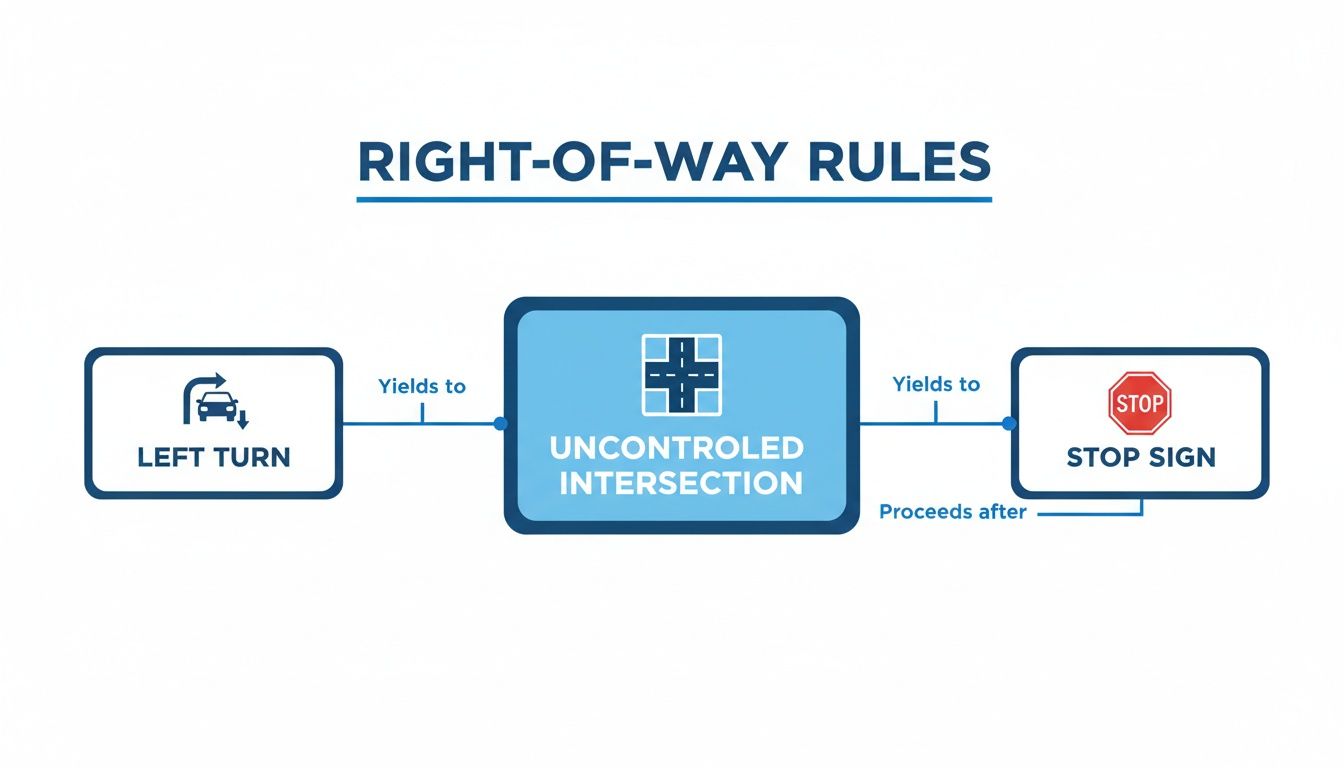
This visual guide is a good reminder that the duty to yield isn’t a suggestion—it's a legal requirement designed to keep everyone safe.
Confusion at Four-Way Stops
Four-way stops are supposed to create an orderly flow of traffic, but they often become hotbeds of confusion and crashes. The rules are actually pretty straightforward:
- First to Arrive, First to Go: The first vehicle to come to a complete stop at the intersection has the right-of-way.
- Yield to the Right: If two vehicles show up at the same time, the driver on the left has to yield to the driver on their right.
A failure-to-yield accident here usually happens when a driver misjudges who got there first or simply forgets to yield to the car on the right. Proving who stopped first can be a challenge, often coming down to witness statements or video footage to sort out who was at fault.
The Danger to Pedestrians in Crosswalks
Nowhere is the duty to yield more critical than when it comes to pedestrians. Pennsylvania law is crystal clear: drivers must yield to pedestrians in both marked and unmarked crosswalks. And yes, an unmarked crosswalk exists at any intersection as the logical extension of the sidewalk across the street.
This duty is absolute. A driver can’t just claim they didn’t see the pedestrian or that the person wasn’t directly in their path. The law recognizes the incredible vulnerability of a person on foot compared to a multi-ton vehicle and places the highest level of responsibility on the driver.
A failure-to-yield accident involving a pedestrian almost always results in the driver being held responsible for the crash. The legal and moral obligation to protect those on foot is a cornerstone of traffic safety.
The statistics paint a grim picture of this danger. According to 2023 data from PennDOT, there were 186 pedestrian fatalities and 3,145 injuries across the state. In Philadelphia alone, 57 of the city's 126 traffic fatalities were pedestrians, a stark reminder of the amplified risks in urban areas. You can learn more about these pedestrian accident findings and their legal implications.
In every one of these scenarios, figuring out who is at fault starts with identifying which driver broke their legal duty. While the rules seem clear, proving what actually happened requires a careful investigation into the specific facts of the crash.
How Fault Is Officially Determined and Proven

After a failure-to-yield accident, fault isn't just an opinion—it's a conclusion built on hard evidence. Insurance companies don’t simply take drivers at their word. Instead, they kick off a detailed investigation to piece together exactly what happened in the moments leading up to the collision. This process is all about moving from he-said-she-said to legal fact.
Think of the investigation like assembling a puzzle. Every piece of evidence helps create a clearer picture of who followed the rules of the road and who failed to yield the right-of-way. Acting fast to preserve this evidence is often the single most important step you can take to protect your claim.
The Role of the Police Report and Citations
The first official record of the accident is almost always the police report. This document is a cornerstone piece of evidence because it gives an objective, on-the-scene account from a law enforcement officer. It’s packed with crucial details that can shape the entire direction of a claim.
The report typically includes:
- A diagram of the crash scene showing where the vehicles ended up.
- Statements from both drivers and any witnesses who stuck around.
- The officer’s notes on weather, road conditions, and visible vehicle damage.
Most importantly, the report will note if any traffic citations were issued. If the other driver got a ticket for something like "Failure to Yield Right of Way" (PA Title 75, Section 3323), that becomes powerful proof of their negligence. While a ticket alone doesn't automatically make the other driver 100% at fault, it creates a strong legal presumption that they broke the law and caused the crash.
Gathering Critical Physical and Digital Evidence
Beyond the police report, a strong case is built with a mix of other evidence. These are the building blocks that support your version of events and push back against any attempts by the other driver's insurer to shift the blame onto you.
Key pieces of evidence include:
- Photographs and Videos: Pictures of vehicle damage, skid marks on the road, traffic signs, and your injuries provide visual proof that’s tough to argue with. Video from nearby security cameras or a dashcam can be a game-changer, often capturing the entire incident as it happened.
- Witness Statements: Independent witnesses who have no stake in the outcome can offer unbiased accounts that back up your story. Their testimony is invaluable, especially when the drivers are telling two completely different stories.
- Vehicle "Black Box" Data: Most modern cars have an Event Data Recorder (EDR). This "black box" records critical data like speed, braking, and steering input in the seconds right before a collision, offering a scientific look at a driver's actions.
The sheer number of these crashes is staggering. In 2023, failure-to-yield was a factor in a huge portion of Pennsylvania's 110,382 reportable traffic accidents. These violations led to thousands of crashes at intersections and during turns, highlighting just how common and dangerous they are. You can dig into the numbers yourself in PennDOT’s comprehensive 2023 report.
The Power of Accident Reconstruction
So, what happens when the evidence is a mess or the drivers' stories are polar opposites? In complex cases, we often turn to accident reconstruction experts. These specialists are engineers who use science to figure out how and why a crash really happened.
An accident reconstructionist can analyze physical evidence like skid marks and vehicle crush damage, combine it with black box data and witness statements, and use sophisticated software to create a scientific model of the collision. This analysis can definitively prove things like vehicle speeds, impact angles, and who truly had the right-of-way.
This kind of expert analysis can be the deciding factor, transforming a disputed claim into a clear-cut case of negligence and proving who is really at fault in a Pennsylvania failure-to-yield accident.
Pennsylvania's Comparative Negligence Rule and Your Compensation
Figuring out who was at fault in a failure-to-yield accident is just the first hurdle. The next, and equally important, question is: how does fault actually affect the money you can recover for your injuries? In Pennsylvania, the answer comes down to a legal rule called modified comparative negligence.
This is the system used to sort out compensation when more than one person shares the blame for a crash. It’s also a concept insurance companies love to use to reduce or even completely deny a claim.
How Comparative Negligence Works
Think of your potential compensation as a whole pie. If an investigation finds you were partially responsible for the accident, a slice of that pie gets taken away—a slice that matches your percentage of fault. This system recognizes that accidents aren't always black and white. Sometimes, mistakes made by both drivers contribute to a collision.
The most critical part of this rule is the 51% bar.
Under Pennsylvania law (42 Pa. C.S. § 7102), you can recover damages from another driver only as long as your share of the fault is 50% or less. If you are found to be 51% or more responsible, you are barred from recovering a single penny.
This creates a harsh, all-or-nothing threshold that has a massive impact on injury claims. An insurance adjuster's main goal is often to push just enough blame onto you to get over that 50% line, which lets their company walk away without paying anything.
Real-World Examples of Shared Fault
Let's see how this plays out in a common failure-to-yield scenario. Imagine a driver turns left right in front of you, violating your right-of-way. They are clearly the one who caused the crash. Even so, their insurance company will look for any way to argue that you were also negligent.
Here are a few classic arguments they use to shift some of the fault to you:
- Speeding: They might claim you were driving just a few miles over the speed limit, which cut down your reaction time.
- Distraction: They could suggest you were glancing at your phone or changing the radio and didn't see the turning car as quickly as you should have.
- Failure to Take Evasive Action: They'll often argue that a "reasonably prudent" driver would have been able to swerve or brake hard enough to avoid the crash entirely.
Even if these arguments feel minor or unfair, they can have a huge financial impact on your case.
Calculating Your Reduced Compensation
The math behind comparative negligence is pretty simple. Your final compensation award is reduced by your exact percentage of fault.
Let's apply this to a few examples:
- Case A: You are awarded $100,000 in damages, but it’s determined you were 10% at fault for being briefly distracted. Your recovery is cut by 10% ($10,000), meaning you walk away with $90,000.
- Case B: You are awarded $200,000, but the other driver convinces a jury you were 40% at fault for speeding. Your award is slashed by $80,000, leaving you with $120,000.
- Case C: The jury decides you were 51% responsible for the crash. Because you crossed that 50% line, your recovery is $0. It doesn’t matter how severe your injuries are.
This is exactly why the fight over fault in a failure-to-yield accident is so intense. For a deeper look into this law, we’ve put together a full guide on what is comparative negligence in Pennsylvania law. Every single percentage point matters, which makes a detailed investigation and strong legal arguments essential to protecting your right to fair compensation.
What to Do After a Failure-to-Yield Accident
The moments after a crash are a blur of adrenaline and confusion. It’s stressful, but what you do next can make a huge difference for your health and your potential legal claim. Knowing the right steps will help protect you and lay the groundwork for a successful recovery.
Your first thought should always be safety. If you can, move your car out of the flow of traffic to avoid a second collision. Check on yourself and anyone in your car, then see if the people in the other vehicle are okay. It’s tough, but try to stay as calm as possible.
Your Priorities at the Scene
Once everyone is safe from immediate danger, it’s time to shift your focus to documenting what happened. The steps you take here create the official record that will be crucial later.
- Call 911 Immediately: Get the police on their way, and ask for an ambulance if anyone might be hurt. A police report is one of the most important pieces of evidence you can have. It documents the scene, includes initial statements from everyone involved, and often gives a preliminary take on who was at fault.
- Gather Evidence on Your Phone: If you’re able to, start taking pictures of everything. Get photos of the damage to both cars, the license plates, any skid marks on the pavement, and the intersection itself, including traffic signs and signals. Make sure to get the other driver’s name, phone number, and their insurance information.
- Talk to Witnesses: Independent witnesses are gold. If anyone stopped and saw the accident, politely ask for their name and number. Their unbiased story can shut down any attempts by the other driver to change their story later.
Feeling overwhelmed is normal. For a more detailed checklist, check out our guide on what you should do immediately after a car accident in Pennsylvania.
Protecting Your Health and Your Claim
What you do in the hours and days after the crash is just as important as what you do at the scene. These actions protect both your physical well-being and your right to get fair compensation.
Get Checked Out by a Doctor—No Matter What. Even if you feel perfectly fine, go see a doctor. The adrenaline pumping through your body can easily mask serious injuries like whiplash or internal bleeding that might not show symptoms for hours or even days. A medical record creates a clear, undeniable link between the crash and your injuries.
You'll need to report the accident to your own insurance company pretty quickly. But be careful when you talk to the other driver's insurance adjuster. They will almost certainly ask you for a recorded statement. It's always a good idea to politely decline until you've spoken with a lawyer. They are skilled at asking questions designed to get you to say something they can use to pin some of the blame on you.
Finally, don't ignore the emotional side of things. A car accident can be a traumatic event. For anyone struggling with the mental impact, there are effective strategies to overcome the fear of driving after an accident. Your recovery is about your whole self—not just your physical injuries.
Answers to Common Failure-to-Yield Accident Questions
After a crash, it feels like you're hit with a hundred questions at once. It's confusing and overwhelming. Below, we've tackled some of the most pressing concerns we hear from clients after a failure-to-yield accident in Pennsylvania, giving you the straightforward answers you need.
If the Other Driver Got a Ticket, Does That Mean They’re 100% at Fault?
Not necessarily, but it’s a huge piece of the puzzle. A traffic ticket for failing to yield is powerful evidence that the other driver was careless, but it doesn't automatically slam the door on the case.
The other driver’s insurance company can—and often will—try to poke holes in your story to shift some of the blame your way. For instance, they might claim you were going a few miles over the speed limit or were distracted for a split second. Under Pennsylvania's comparative negligence rule, if they succeed in pinning even a tiny percentage of fault on you, your final compensation gets reduced by that same percentage. So, while that ticket is a major win, it’s not a guarantee of a 100% fault finding.
What if Nobody Else Saw My Accident?
Don't panic. While a good witness is always a bonus, you can absolutely build a strong case without one. Many failure-to-yield cases come down to the physical and digital evidence that paints a clear picture of what really happened.
An experienced lawyer knows exactly where to look for proof, including:
- Vehicle Damage: The location and severity of the damage on both cars can tell a compelling story about the angle of impact and who really hit whom.
- The Scene Itself: Skid marks, shattered glass, and debris fields are like a roadmap of the collision's final moments. An expert can read those signs.
- Digital Footprints: We can often uncover footage from nearby traffic cameras, security cameras from businesses, or even data from a vehicle’s own “black box” to get an objective look at what happened.
A skilled legal team, sometimes with the help of an accident reconstruction expert, can use this type of evidence to scientifically prove how the crash occurred and who was truly at fault.
How Long Do I Have to File an Injury Claim in Pennsylvania?
This is one deadline you absolutely cannot miss. In Pennsylvania, the statute of limitations for filing a personal injury lawsuit is generally two years from the date of the accident.
If you miss that two-year window, the court will almost certainly throw out your case forever, and you will lose your right to seek any compensation. It's critical to act quickly to make sure your rights are protected.
If you were injured when another driver failed to yield, you don't have to take on the insurance companies by yourself. The legal team at Mattiacci Law has the experience to investigate your case, stand up for your rights, and fight for every dollar you deserve. Contact us for a free, no-obligation consultation to discuss your case by visiting https://jminjurylawyer.com.