

Author: John Mattiacci | Owner Mattiacci Law
Published February 15, 2026

In Pennsylvania, “negligence” isn’t about someone intentionally trying to hurt you. It’s about carelessness—someone failing to act with reasonable caution, and that failure causing you harm.
To win a negligence case, you have to prove four specific things. Think of them as four legs of a table; if even one is missing, the whole thing collapses. You must show that the person who hurt you owed you a duty, that they breached that duty, that their breach directly caused your injuries, and that you suffered real damages because of it.
The Four Essential Elements of a Negligence Claim

Let’s dig into what each of these four elements really means in practice. Successfully proving all four is the foundation of every single personal injury claim in Pennsylvania. Without them, there’s simply no case.
1. Duty of Care
First, you have to establish that the other person had a duty of care. This is a legal obligation to act in a way that doesn’t put others in unreasonable danger. Most of the time, the law judges this based on the “reasonable person” standard. It’s a simple but powerful question: What would a sensible, careful person have done in the same situation?
Here are a few real-world examples:
- Every driver has a duty to follow traffic laws and keep their eyes on the road.
- A business owner has a duty to make sure their property is safe for customers, like mopping up a spill.
- A doctor has a professional duty to provide medical treatment that meets the accepted standards of their field.
This duty is the starting point for responsibility. In some cases, the duty is very specific, such as the legal liabilities for non-disclosure of a known hazard.
2. Breach of Duty
Once you’ve shown a duty existed, you have to prove the person breached it. A breach is simply the failure to live up to that duty of care. It’s the careless act—or the failure to act—that put you in harm’s way.
Think about it this way:
- A driver looking down at their phone instead of the road has breached their duty to drive safely.
- A store manager who sees a puddle on the floor but walks away without putting up a “wet floor” sign has breached their duty.
- A surgeon who accidentally leaves a surgical sponge inside a patient has severely breached their professional duty.
A breach is the specific action—or inaction—that violates the legal obligation to act reasonably. It is the moment where carelessness translates into a dangerous situation for others.
3. Causation
It’s not enough to show someone was careless. You must also prove that their carelessness directly caused your injuries. This is a critical link in the chain. In Pennsylvania, causation has two parts, and you need to prove both.
-
Actual Cause (or “Cause-in-Fact”): This is the “but-for” test. The question is, “Would the injury have happened but for the defendant’s action?” If a driver runs a stop sign and hits your car, it’s clear the accident would not have happened but for them breaking the law.
-
Proximate Cause (or “Legal Cause”): This part deals with foreseeability. Was your injury a predictable result of the other person’s carelessness? If someone is speeding in a residential area and hits a child chasing a ball, that terrible outcome is a foreseeable result of their speeding.
The breach must be both the direct and the legally recognized cause of the harm you suffered.
4. Damages
Finally, you must prove you suffered actual damages—real, measurable losses. Even if someone was incredibly negligent, if you weren’t harmed, there is no personal injury case.
Damages are generally broken down into two categories:
- Economic Damages: These are the straightforward financial losses you can add up with a calculator. Think medical bills, lost income from being out of work, the cost to repair your car, and any future medical care you might need.
- Non-Economic Damages: These are just as real but harder to put a number on. They compensate you for the human cost of your injuries, like physical pain, emotional trauma, scarring, and the loss of your ability to enjoy your life and hobbies.
To give you a clearer picture, this table breaks down how the four elements work together.
The Four Core Elements of Negligence at a Glance
| Element | What It Means | Example |
|---|---|---|
| Duty of Care | The legal obligation to act with reasonable caution to avoid harming others. | A truck driver has a duty to follow traffic laws and conduct safety checks on their vehicle. |
| Breach of Duty | Failing to meet the required standard of care through action or inaction. | The truck driver texts while driving, violating their duty to pay attention to the road. |
| Causation | The breach of duty must be the direct and foreseeable cause of the victim’s injuries. | Because the driver was texting, they didn’t see a car stop and caused a rear-end collision. |
| Damages | The victim must have suffered actual, legally recognized harm (financial or personal). | The driver of the other car suffers a whiplash injury, incurs medical bills, and misses work. |
Understanding these four components is the first step in figuring out if you have a valid claim. Each piece must be carefully investigated and proven with solid evidence for your case to succeed.
How Pennsylvania’s Comparative Fault Rule Impacts Your Case
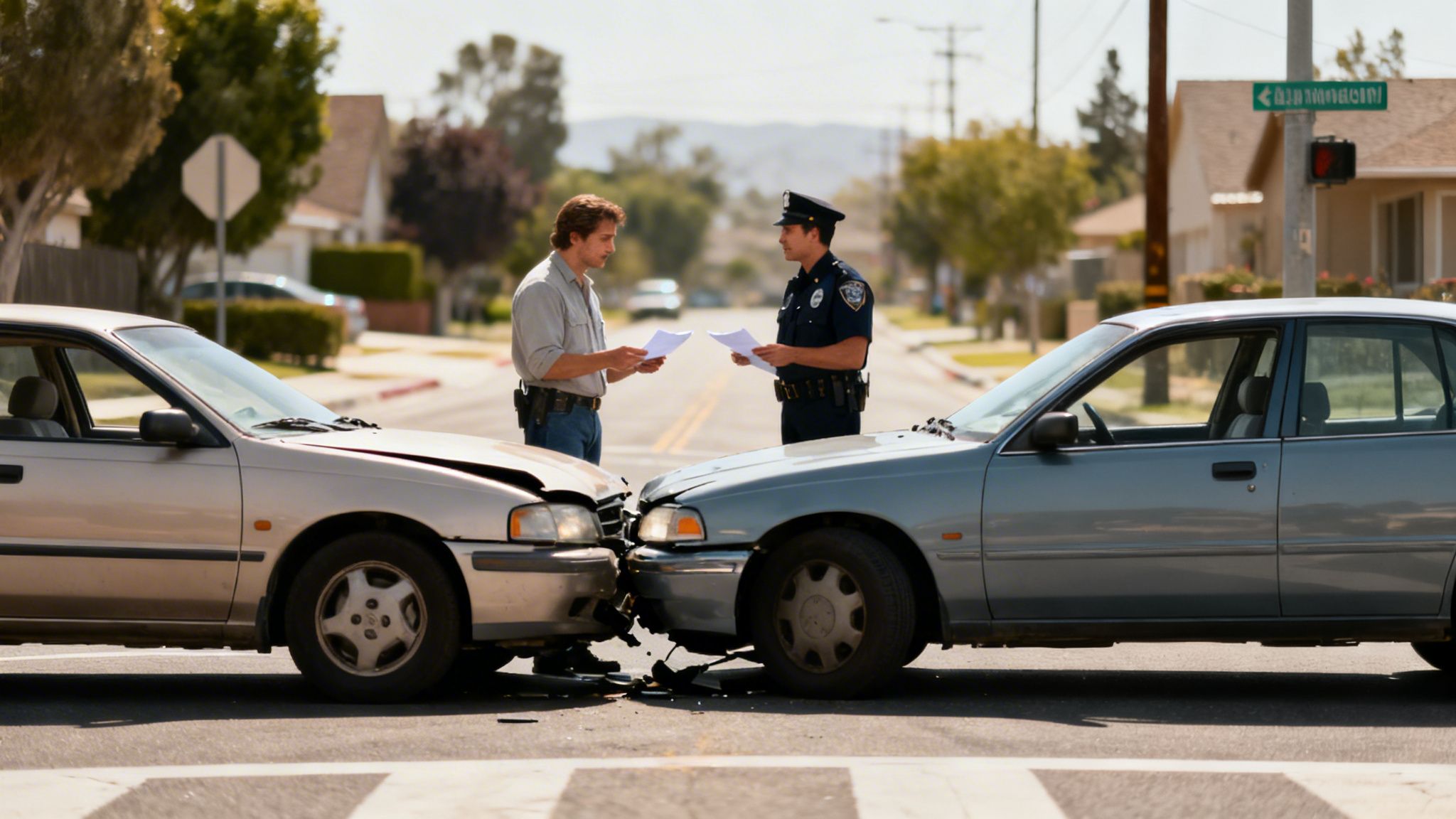
After an accident, one of the first questions people ask is, “What if I was partly to blame?” It’s a natural concern, and thankfully, it doesn’t automatically mean you can’t get compensation. Pennsylvania law handles these shared-blame situations with a system known as modified comparative negligence.
This rule is a really important piece of the puzzle when we talk about what qualifies as negligence in Pennsylvania. It’s not an all-or-nothing game. Instead, the law allows a judge or jury to look at the evidence and assign a percentage of fault to everyone involved.
This approach is much fairer than older, harsher rules that would block you from recovering anything if you were even 1% at fault.
The 51% Bar Rule Explained
Pennsylvania’s system has a critical cut-off point called the 51% bar. The rule is simple but has a massive impact on your case: you can recover damages as long as your share of the fault is 50% or less.
If you are found to be 51% or more responsible for the accident, you are legally barred from recovering a single penny. It’s a cliff. Being 50% at fault means you can still get a settlement, but being just one percentage point over—at 51%—means you get nothing.
You can bet that this makes the assignment of fault the main battleground in most personal injury claims. Insurance companies know this rule inside and out and will do everything they can to push as much blame as possible onto you, hoping to get you over that 51% threshold.
How Your Compensation Is Calculated
If you’re found to be 50% or less at fault, you can still get paid, but your final award is reduced by your exact percentage of responsibility.
Let’s walk through a common example to see how this plays out:
- The Accident: You’re driving 10 miles over the speed limit. At the same time, another driver swerves into your lane without signaling, cutting you off and causing a crash.
- The Damages: Your injuries lead to $100,000 in total damages, which includes your medical bills, lost income, and pain and suffering.
- The Fault Allocation: A jury decides that while the other driver was the main cause of the accident, your speeding made the crash worse. They assign 70% of the fault to the other driver and 30% to you.
Because your share of the fault (30%) is under the 51% bar, you can still recover money. Your final award is simply reduced by your 30% share.
Calculation: $100,000 (Total Damages) – 30% ($30,000) = $70,000 (Your Final Award)
This shows why every single percentage point is crucial. If the jury had found you 50% at fault, you’d get $50,000. But if they’d decided you were 51% at fault, your award would drop to zero. You can get a more detailed breakdown by learning about how Pennsylvania’s 50 percent rule affects car accident claims.
This rule, formally established under 42 Pa.C.S. § 7102, is a cornerstone of our state’s personal injury law. It directly ties your level of fault to your financial recovery.
With the stakes this high, you can’t afford to go it alone. An experienced attorney is vital. We know how to gather the right evidence, work with accident reconstruction experts, and build a powerful argument to minimize your assigned fault and protect your right to fair compensation.
Negligence in Action: Real-World Examples

The legal theory is one thing, but seeing how negligence plays out in real life is what makes it all click. Those four elements—duty, breach, causation, and damages—aren’t just textbook terms; they’re the building blocks of every single personal injury claim, from a minor fender bender to a devastating construction accident.
Let’s walk through a few common situations. By looking at these examples, you can see exactly how a moment of carelessness can spiral into a legitimate legal case and truly understand what qualifies as negligence under Pennsylvania law.
Car Accidents: Distracted and Reckless Driving
Car crashes are, without a doubt, one of the most common sources of negligence claims here in Pennsylvania. It makes sense when you think about it: every single person behind the wheel has a fundamental duty to drive safely and obey the rules of the road.
Imagine a driver approaching an intersection while texting. It’s a scene we see far too often. Here’s how the negligence framework applies:
- Duty of Care: That driver has a clear legal duty to pay attention and safely control their vehicle for the sake of everyone else on the road—other drivers, cyclists, and pedestrians.
- Breach of Duty: By looking at a phone instead of the road, the driver breached that duty. A reasonable person simply wouldn’t do that while operating a multi-ton vehicle.
- Causation: Because they were distracted, they blow through a red light and T-bone another car. The distraction directly caused the crash and the injuries that followed.
- Damages: The person in the other car ends up with a broken arm and severe whiplash. Now they’re facing medical bills, lost income from missing work, and a lot of pain. These are very real, calculable damages.
In a situation like this, all four pillars of negligence are standing strong, which is what creates a solid personal injury case. Speeding, drunk driving, or failing to yield are other classic examples of a driver breaching their duty of care.
Premises Liability: The Hidden Hazard
Property owners, whether it’s a small shop or a huge corporation, have a legal responsibility to keep their spaces reasonably safe for people they invite in. This is the core of “premises liability,” which covers everything from slip-and-fall incidents to injuries from poor security or building code violations.
Picture a shopper in a grocery store who slips and falls hard on a freshly mopped floor with no warning sign.
The heart of a premises liability case is this: did the property owner know, or should they have known, about a dangerous condition and fail to either fix it or warn people about it?
Let’s break it down:
- Duty: The grocery store owes its customers a duty to provide a safe shopping environment, free of unexpected dangers.
- Breach: The store’s employees failed in that duty by not putting up a “Wet Floor” sign. They created a hidden hazard.
- Causation: The shopper’s fall and resulting hip fracture were a direct consequence of that unmarked, slippery floor. If the sign had been there, the injury likely wouldn’t have happened.
- Damages: Now, that shopper is looking at surgery, a long and painful recovery, and an inability to go about their daily life. The economic and non-economic damages are significant.
This same logic applies to injuries from a broken handrail on a staircase, dim lighting in a parking garage, or merchandise falling from a high shelf. It all comes back to the owner’s failure to act reasonably to protect their visitors.
Construction and Workplace Incidents
By their very nature, construction sites are filled with hazards. That’s precisely why there are strict federal and state safety regulations in place. When those rules get bent or broken, the results are often catastrophic, leading to clear-cut cases of negligence.
Think about a general contractor who, trying to rush a job, pressures a crane operator to lift a load that’s heavier than the crane’s official weight limit. The cable snaps, the load plummets, and a worker below is struck.
Let’s trace the negligence:
- Duty: The general contractor has a powerful duty to maintain a safe worksite for every single person there, including subcontractors. This means enforcing safety rules and ensuring equipment is used properly.
- Breach: Pushing the operator to knowingly overload the crane is a shocking breach of that duty and a direct violation of safety standards.
- Causation: The overloaded cable snapping was the direct cause of the load falling and seriously injuring the worker.
- Damages: The injured worker suffers a traumatic brain injury, leading to a lifetime of medical care, permanent disability, and the loss of their ability to ever work again. The damages are immense.
As you can see, negligence isn’t some fuzzy, abstract concept. It’s a practical tool used to hold people and companies accountable for the very real harm they cause when they fail to act with reasonable care. Learning to spot these patterns is the first step in protecting your rights after you’ve been injured.
Building Your Case: What Evidence You Need to Prove Negligence

Successfully proving what qualifies as negligence under Pennsylvania law isn’t about just telling a compelling story. It’s about building an airtight case with solid, credible evidence. You can be sure the other side’s insurance company will poke holes in any weakness, so your claim needs to rest on a strong foundation of proof.
Think of it like building a house. Each piece of evidence is a brick. Without enough of them placed just right, your case can easily crumble under pressure. That’s why collecting and preserving the right evidence from the very beginning is one of the most important things you can do to protect your right to compensation.
The Foundational Evidence for Any Claim
Certain types of evidence are essential in almost any personal injury case. These are the documents and records that create an objective picture of what happened, who was involved, and what the immediate aftermath looked like.
Be sure to track down these key items:
- Official Reports: For a car crash, this is the police report. For a workplace injury, it’s the official incident report you file with your employer. These documents provide an official, third-party account of the event.
- Photos and Videos: Nothing tells the story quite like a picture. Photos of the accident scene, damage to vehicles, the slick floor that caused your fall, and your visible injuries are incredibly powerful.
- Witness Information: Get the names and phone numbers of anyone who saw what happened. An independent witness can be a game-changer, especially if the at-fault party tries to change their story later.
These initial pieces establish the basic facts, creating a framework for your entire claim. Without them, you can find yourself in a messy “he said, she said” situation. You can learn more about the strategic process and how to prove negligence in your PA personal injury claim in our detailed guide.
Documenting Your Damages Thoroughly
The fourth element of negligence—damages—requires more than just saying you were hurt. It demands meticulous documentation of every single loss, both financial and personal. The centerpiece of this evidence is your medical journey.
Your medical records are the official narrative of your injuries. They connect the negligent act to the physical harm you suffered, detailing your diagnosis, treatment, and prognosis from a medical professional’s perspective.
Start a folder and keep absolutely everything organized. This includes:
- All Medical Bills: Every single invoice from hospitals, doctors, physical therapists, pharmacies, and even for medical equipment like crutches or a brace.
- Proof of Lost Income: Gather your pay stubs and ask for a letter from your employer confirming the dates you missed work and the wages you lost as a direct result of your injuries.
- Personal Journals: It might sound simple, but keeping a daily log describing your pain levels, physical limitations, and how the injuries impact your day-to-day life is crucial. This helps document non-economic damages, like pain and suffering.
The Role of Expert Testimony
In more complicated cases, proving negligence often requires specialized knowledge that goes far beyond what an average person understands. This is where expert witnesses become invaluable. Their testimony can break down technical details for a jury and draw authoritative conclusions that connect all the dots of your case.
When you’re trying to prove negligence, the credibility of an expert is everything, which is why they are often bound by strict professional guidelines like an Expert Witness Code of Conduct. These experts can include:
- Accident Reconstructionists: They can analyze skid marks, vehicle damage, and other physical evidence to scientifically explain how a crash occurred and who was really at fault.
- Medical Experts: A doctor can testify about the severity of your injuries, the necessity of your treatment, and your long-term prognosis, including any future medical care you’ll need.
- Engineers: In a slip-and-fall case, an engineer might testify that a collapsed staircase failed to meet building code safety standards, making it dangerously defective.
Expert testimony elevates a claim from a simple argument to a well-supported, professional case. A skilled attorney knows exactly which experts to bring in and how to present their findings to build the strongest argument possible on your behalf.
Understanding Common Defenses to Negligence Claims
Even if your case seems like a slam dunk, don’t expect the other side to simply roll over and write a check. The defendant’s insurance company and their lawyers have a playbook of legal strategies designed to poke holes in your claim, pay you less than you deserve, or avoid paying you anything at all.
Knowing what arguments they’re likely to use is half the battle. When we anticipate their moves, we can build a much stronger case from the very beginning by gathering the right evidence to shut those arguments down.
Assumption of Risk
One of the first defenses they often try is assumption of risk. The argument goes something like this: you knew there was a clear and obvious danger, but you went ahead and did it anyway, so you accepted the consequences. This comes up a lot in cases involving sports, recreational activities, or properties with big, bold warning signs.
Think about getting hit by a foul ball at a Phillies game. The defense would argue that’s a well-known risk of being at a ballpark. But this defense isn’t a silver bullet for them. It generally doesn’t work if the danger was hidden, unexpected, or not a normal part of the activity.
Pre-Existing Conditions and Causation Attacks
Another go-to tactic is to attack causation by digging into your medical past. They’ll comb through your records looking for any old injury or pre-existing condition they can use as a scapegoat for your current pain. Their goal is to create doubt and suggest their client’s actions aren’t what really hurt you.
You might hear arguments like:
- “Her back pain isn’t from the car accident; it’s from the degenerative disc disease she’s had for a decade.”
- “His knee problems are just a flare-up of old football injuries, not because he slipped in our store.”
We fight this by working with medical experts who can clearly explain how the accident caused a new injury or, just as importantly, aggravated a dormant condition. Pennsylvania law is clear: if someone’s negligence makes an old, underlying condition worse, they are responsible for that harm.
In legal terms, this is often called the “eggshell skull” rule. It means a defendant must take their victim as they find them. They can’t escape responsibility just because the person they injured was more fragile or susceptible to harm than someone else.
Shifting Blame with Comparative Negligence
We’ve already touched on it, but Pennsylvania’s modified comparative negligence rule is where the biggest fights often happen. The defense knows the magic number: if they can convince a jury that you were 51% or more at fault, you get nothing. Zero.
Because of this, they will put your actions under a microscope, trying to shift as much blame onto your shoulders as possible. They’ll seize on anything—maybe you glanced at your phone for a second, or you weren’t wearing the “right” shoes for the weather. It’s a strategy of a thousand cuts, all designed to push your percentage of fault over that critical 51% line.
Countering this requires a detailed investigation to prove, with hard evidence, who was truly responsible. For a deeper understanding of these strategies, you can read more about affirmative defenses in a Pennsylvania personal injury case.
Your Top Questions About Pennsylvania Negligence Law, Answered
When you’re injured, the last thing you want is a lecture full of confusing legal jargon. You just want straight answers. We get it. Here are clear, direct responses to the most pressing questions we hear from people just like you.
How Long Do I Have to File an Injury Lawsuit in Pennsylvania?
You have two years. In Pennsylvania, the clock starts ticking from the moment you get hurt. This deadline is called the statute of limitations, and it’s incredibly strict.
If you miss that two-year window, you almost always lose the right to seek compensation for good. It doesn’t matter how clear-cut the other person’s fault was. This is why acting fast is so critical. Evidence—like witness memories, security camera footage, or even skid marks on the road—can disappear in a matter of days or weeks, let alone years.
Is there a rare exception? Yes, it’s called the “discovery rule.” It applies when an injury isn’t immediately obvious, like in some medical malpractice cases where a surgical error is found years later. In that situation, the two-year clock might start when you discover the injury. But banking on this exception is a huge gamble. The safest move is always to talk to an attorney right away to protect your rights.
What Is Negligence Per Se and How Does It Help My Case?
Think of negligence per se as a legal shortcut. It comes into play when the person who hurt you was also breaking a safety law at the time of the incident.
Normally, we have to prove that the other person failed to act like a “reasonable person” would have. But if they violated a law meant to prevent the very kind of harm you suffered, the court automatically considers their actions negligent. Their lawbreaking is the proof of their carelessness.
A classic example is a drunk driver. DUI laws exist to keep people safe on the road. If someone under the influence runs a red light and T-bones your car, their violation of the DUI law is negligence per se. It simplifies a huge part of your case and gets you one step closer to proving they’re responsible.
What’s the Difference Between Negligence and Malpractice?
While malpractice is a form of negligence, it’s a special category that’s much harder to prove. The biggest difference comes down to the standard of care we have to show was violated.
- Ordinary Negligence: This is what applies to most everyday situations, like a car crash or a slip and fall in a grocery store. We judge the at-fault person’s actions against what a sensible, average person would have done.
- Professional Malpractice: This is reserved for licensed professionals like doctors, surgeons, lawyers, or architects. They aren’t held to the “reasonable person” standard. Instead, they must meet the accepted standard of care for a competent professional in their specific field.
Proving malpractice almost always requires testimony from another expert in that same profession. A qualified doctor, for instance, would need to review your case and explain exactly how your doctor’s care fell below the accepted medical standard, causing you harm. These cases are complex and require a law firm with deep experience in this specific area.
How Can a Lawyer Actually Help Me Prove My Case?
Proving negligence isn’t just about telling your side of the story; it’s about building a fortress of evidence that can withstand an insurance company’s attacks. A skilled personal injury attorney takes that entire burden off your shoulders so you can focus on getting better.
An experienced attorney does more than just file paperwork; they build a strategic, evidence-based case designed to stand up to aggressive insurance company tactics and, if necessary, win in court.
Here’s what a dedicated legal team does behind the scenes:
- They Dig for Evidence: They immediately work to gather police reports, track down and secure surveillance footage, interview witnesses before their memories fade, and preserve physical evidence.
- They Bring in the Experts: They connect with accident reconstructionists, medical specialists, and financial experts who can provide powerful testimony linking the defendant’s actions to your injuries and financial losses.
- They Handle the Insurance Companies: They take over all communications with insurance adjusters, shielding you from their tactics and fighting back against lowball settlement offers.
- They Prepare for a Fight: From day one, they prepare your case as if it’s going to trial. This shows the insurance company you mean business and puts you in the strongest possible position to get the full compensation you deserve.
If you or a loved one has been injured because someone else was careless in Pennsylvania, you don’t have to navigate this process alone. At Mattiacci Law, our entire practice is dedicated to fighting for the injured. We meticulously prepare every single case for trial to give our clients the leverage they need to secure justice.
For a free, no-obligation consultation to discuss your case, visit us at https://jminjurylawyer.com.