


Author: John Mattiacci | Owner Mattiacci Law
Published July 14, 2026
In the United States, the right to physically defend yourself against a police officer is extremely limited, and by 2012 only 14 states explicitly allowed resistance to an unlawful arrest. In practice, physical resistance almost always creates greater danger and greater legal exposure, so the safest path is usually to survive the encounter, comply as safely as you can, and immediately start protecting the evidence.
If you're reading this after a traffic stop, an arrest, a protest, or a street encounter that went bad fast, you're probably not asking an abstract legal question. You're asking whether the law expects you to just take it if an officer uses force on you.
That question deserves a straight answer. Sometimes the law does recognize self-defense against police force. But the legal window is narrow, the facts must be extreme, and the decision about whether the officer used excessive force usually isn't made on the street. It's made later, by prosecutors, judges, and juries. By then, if you fought back, you may already be charged with resisting arrest, assault on an officer, or related offenses.
The better question is usually not, "Can I win the fight?" It's, "How do I get out alive and prove what happened?"
That is where many individuals lose valuable ground. They focus on the instant of force and miss the next hour, the next night, and the next morning. Those are the moments that often determine whether you can defend yourself in court, challenge criminal charges, and build a civil case that survives scrutiny.
The Difficult Answer to a Frightening Question
A routine encounter can turn ugly in seconds. An officer orders you out of the car. You hesitate because you don't understand why. Hands grab you, you hit the pavement, and suddenly your instincts are louder than your judgment. In that moment, individuals aren't thinking like lawyers. They're thinking like human beings.
The law, unfortunately, doesn't grade these situations on instinct. It grades them after the fact, under rules that are harsh, technical, and often unforgiving.
What the law usually rewards
The central reality is this. Even when an officer's conduct later looks wrong, fighting back usually makes your position worse. A widely cited legal overview explains that the right to resist police force in the United States is exceptionally narrow, varies by state, and has been shrinking for decades under the influence of the Model Penal Code. It notes that by 2012 only 14 states explicitly allowed citizens to resist an unlawful arrest, and even then any self-defense claim generally depends on a later finding that the officer's force was legally excessive. California, for example, criminalizes resisting an officer's duties and limits any defensive force to what is necessary to stop an ongoing assault, not to punish or retaliate. Texas is described as a place where self-defense against police is "virtually never legal" except in a very narrow imminent-danger scenario. The practical lesson from that analysis is blunt. The smarter response is usually evidence preservation and civil recourse, not street-level force (Police1 discussion of civilian self-defense versus police excessive force).
Practical rule: If you can get through the encounter without escalating it, you've usually protected both your body and your legal case.
That doesn't mean silence equals surrender. It means choosing the battlefield. Street confrontations favor whoever has legal authority, backup, and the first draft of the report. Courtrooms favor documentation, disciplined statements, medical records, and credible witnesses.
What works and what doesn't
What works is controlled language. "I am not resisting." "I want a lawyer." "I am invoking my right to remain silent." Short, clear, respectful.
What doesn't work is arguing the Constitution in the middle of force. What doesn't work is trying to teach the officer the law. What doesn't work is striking back because you know you're right.
On the question of whether if a police officer assaults you can you defend yourself, the legal answer is "rarely, and only in very narrow circumstances." The practical answer is more useful. Protect yourself first. Then protect the proof.
The Narrow Legal Path to Justified Self-Defense
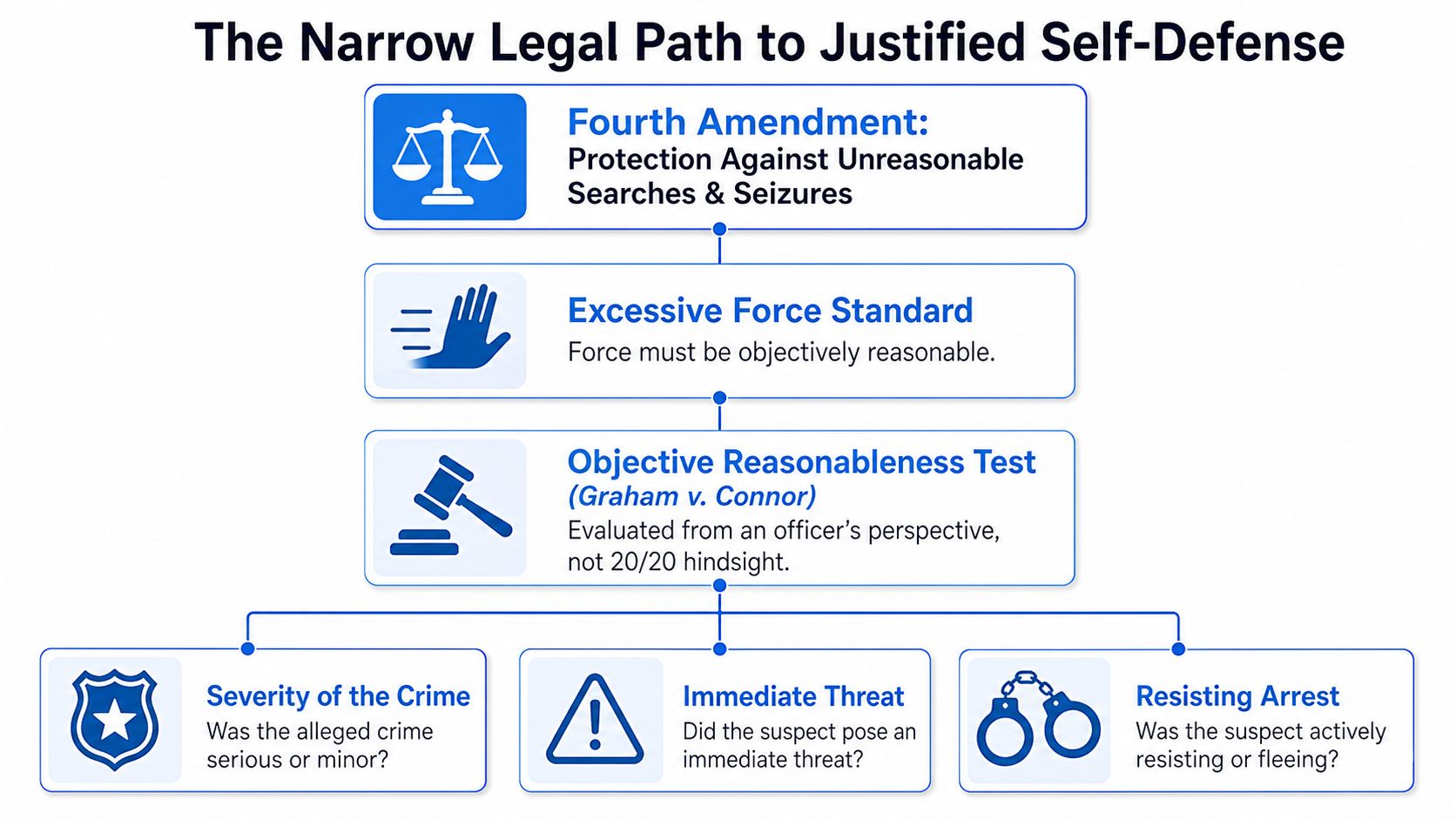
The legal system doesn't ask whether you felt terrified. It asks whether the officer's force crossed a very high line, and whether your response was necessary in that exact moment.
Why the standard is so hard to meet
Courts generally evaluate police force through an objective reasonableness lens. In plain English, that means the question isn't whether things look bad in hindsight. It's whether the force appeared reasonable from the perspective of an officer confronting a fast-moving scene.
The situation can be likened to a referee making a call in real time. The replay may look different later, but the legal system often gives weight to what the official perceived in the split second. That is one reason these cases are so difficult. A jury may dislike what happened and still conclude the force wasn't legally excessive under the governing standard.
A defense-oriented legal analysis of this issue puts the problem starkly. In the United States, the right to defend yourself against a police officer is exceptionally narrow, generally limited to situations involving actual and imminent danger of serious bodily injury from excessive force. The same discussion notes that defense attorneys report a kind of practical rule in the trenches: many defendants don't get meaningful traction on a self-defense claim against police unless the facts approach a de facto threshold of catastrophic harm (analysis of when force against a police officer may be legally recognized).
The line between defense and retaliation
That distinction matters. The law is more open to force used to stop an immediate unlawful beating than force used out of anger after the danger has already passed.
A jury may ask questions like these:
- Was the danger immediate or had the contact already ended?
- Was the force limited to escape or shield yourself, or did it continue after the threat changed?
- Did you know it was an officer or did you reasonably believe you were being attacked by someone else?
- Can the facts be proved with video, injuries, witness accounts, and timing?
The defense doesn't succeed because the officer was rude, rough, or unfair. It succeeds, if at all, because the force was unlawfully excessive and the response was strictly necessary in that moment.
Why people misread the legal risk
Many people hear that self-defense is "allowed" in some circumstances and assume that means they can safely act on it. That is a dangerous misunderstanding.
A legal right that exists only after a jury reconstructs the scene isn't much protection in the moment. You can still be arrested. You can still be charged. You can still be injured. And if the evidence is unclear, the system often focuses first on your resistance, not the officer's conduct.
That is why the narrow legal path matters less, in practical terms, than your immediate decisions after the incident.
Resisting Arrest Laws in Pennsylvania and New Jersey
Pennsylvania and New Jersey both treat resistance to police as a separate legal problem from whether the officer's conduct was proper. That's the part people often miss. Even if the arrest or force is later challenged, the act of resisting can still produce its own criminal exposure.
The issue in both states
In both states, courts and prosecutors typically separate two questions.
First, did the officer act lawfully?
Second, did the civilian resist in a way the criminal law prohibits?
Those aren't the same issue. You don't erase a resistance charge by only showing the encounter was unfair. In real cases, the prosecution often leads with the resistance and pushes the misconduct dispute into a separate lane.
Resisting arrest standards in PA vs. NJ
| Legal Aspect | Pennsylvania | New Jersey |
|---|---|---|
| Core rule | Resisting arrest is a separate criminal offense under state law. | Resisting arrest is also a separate criminal offense under state law. |
| Practical effect | Even if the arrest is later disputed, physical resistance can still trigger prosecution. | Even if the stop or arrest is later attacked, resistance often remains its own charge. |
| Self-defense reality | Any claim of justified force faces a very high factual burden and is risky to raise without strong evidence. | Any claim that force was defensive rather than resistant faces the same practical difficulty. |
| Street-level advice | Comply verbally, don't struggle, preserve evidence immediately afterward. | Comply verbally, don't struggle, preserve evidence immediately afterward. |
| Best strategy | Shift the fight from the street to the courtroom. | Shift the fight from the street to the courtroom. |
What that means for a defendant
In Pennsylvania practice, a resistance case often turns on how the officer describes your body movements, your tone, and whether the encounter became harder to control because of what the officer calls "active resistance." In New Jersey, the same practical problem shows up. The officer's version often starts with command noncompliance and ends with a use-of-force justification.
That doesn't mean you're powerless. It means your strongest tools are usually not physical.
Use words that help later:
- State compliance clearly: "I'm not resisting."
- Do not argue facts on scene: save details for counsel.
- Notice identifiers: badges, patrol car number, names, location, time.
- Watch for witnesses: bystanders matter.
A bad arrest and a resistance charge can exist in the same case. That's why people need to stop thinking in either-or terms.
The trial-lawyer view
From a courtroom perspective, jurors care about sequence. Who did what first. Whether commands were clear. Whether the civilian's movements looked defensive, confused, panicked, or aggressive. Whether the force kept going after control was established.
If you've been through this in Pennsylvania or New Jersey, assume two battles may follow. One is criminal. The other is civil. The evidence you preserve in the first hours can affect both.
The Overwhelming Risks of Fighting Back
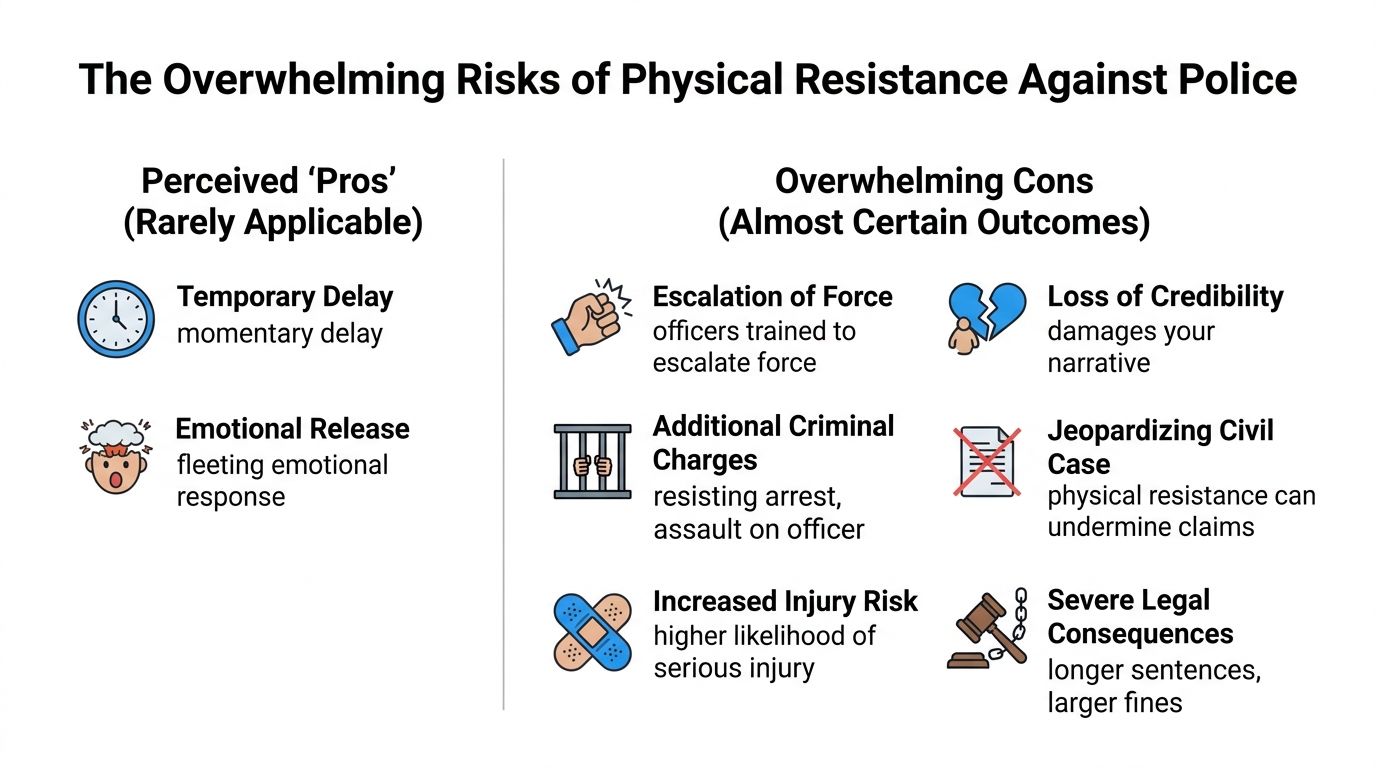
The worst mistake I see in these cases is treating physical resistance as a clean moral response. It may feel justified. It rarely stays contained.
Why encounters escalate so fast
Police are trained to interpret sudden movement, grabbing, and struggle as danger. Institutions then evaluate those incidents through that same lens. That matters because once a confrontation becomes a struggle, the legal and physical stakes jump immediately.
A government report on assaults against police in England and Wales recorded over 30,000 assaults on officers in 2019/20, including 20,269 crimes of assault without injury and 10,410 offenses of assault with injury. The same body of data notes that when an officer is disarmed during a struggle, the odds of the assault resulting in fatality more than double, with an odds ratio of 2.24. Firearm assaults raise the risk further, while body armor reduces fatality risk. Those figures help explain why legal systems react so aggressively to physical resistance and why prosecutors frame struggles as dangerous events, not isolated acts of self-protection (official report on police officers assaulted in England and Wales and related fatality-risk data).
The practical costs to you
Physical resistance can produce consequences that outlast the incident itself:
- More force on the scene: once officers describe you as resisting, more force often follows.
- More charges: resisting arrest is usually only the beginning.
- Worse optics: jurors may focus on your movement instead of the officer's misconduct.
- A weaker civil case: defense lawyers for the municipality will argue you caused the escalation.
- A damaged record: the incident report may harden against you before your lawyer ever sees it.
You don't need to prove courage in the moment. You need to avoid giving the other side a better story than the truth.
What people regret later
Clients rarely regret staying as calm as they could. They often regret one shove, one swing, one jerk of the arm, one angry sentence caught on body cam at the worst possible second.
That doesn't excuse police misconduct. It recognizes how the system processes it. Once a case becomes "civilian fought the police," the original abuse can get buried under the language of officer safety, compliance, and threat assessment.
If the goal is accountability, fighting back usually gives away the ground you need most.
Your Immediate Post-Incident Safety and Evidence Plan
After the encounter ends, the clock starts. During this period, many strong claims are lost and many weak claims become provable.
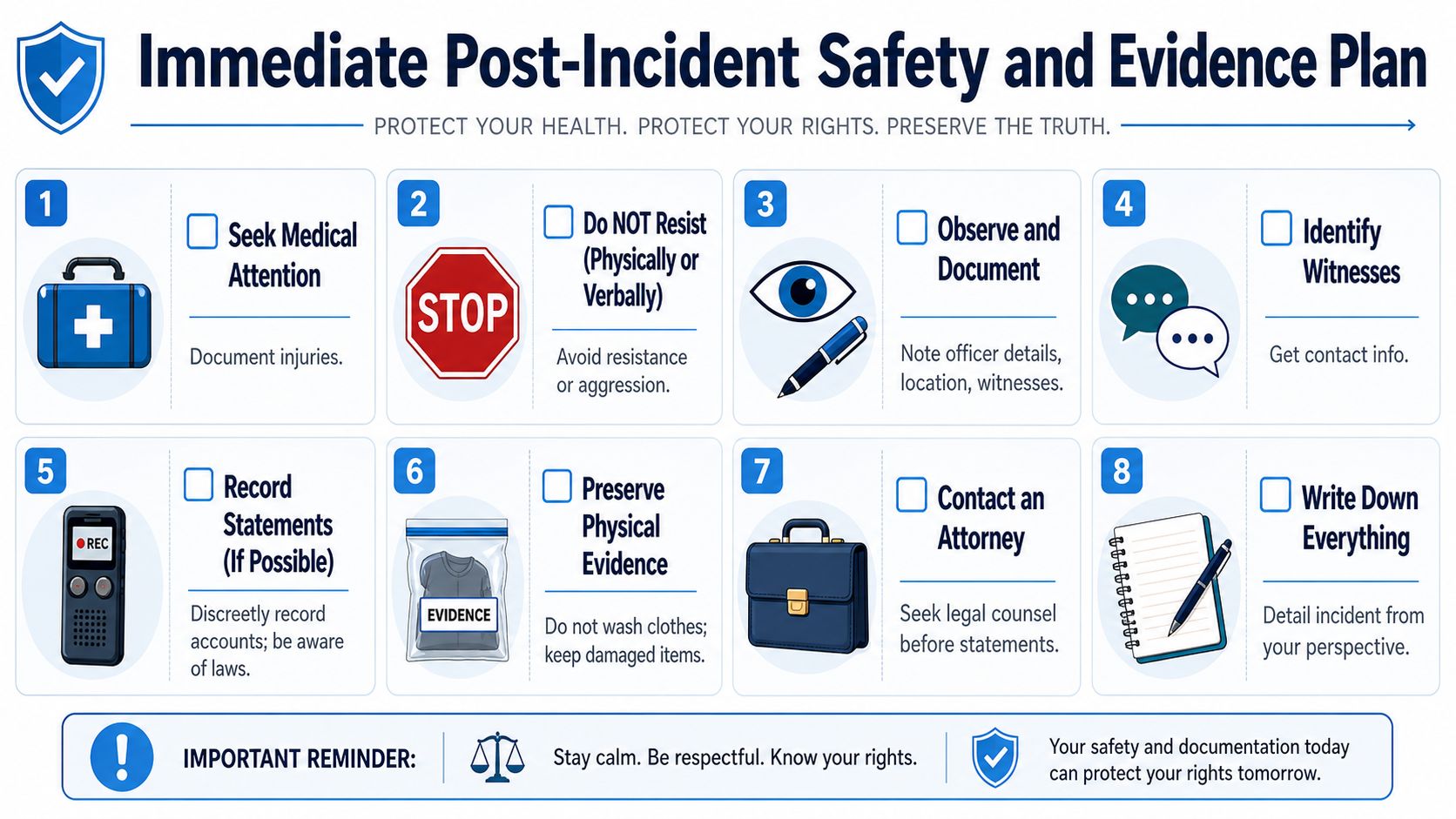
A legal guidance source addressing this issue directly states that the prevailing strategy across major markets is to comply and document rather than resist. It recommends invoking the right to remain silent, preserving video evidence, and seeking immediate medical care to create a forensic record of injuries, because physical resistance usually triggers additional charges regardless of the officer's initial misconduct (guidance on whether you can hit police in self-defense and why professionals advise comply and document).
What to do in the first hours
Use this as a working checklist.
Say less
Once you're safe enough to do so, invoke your right to remain silent and ask for a lawyer. Don't try to explain, persuade, or debate. People often talk themselves into trouble while they're still in pain and adrenaline is high.
Get medical care
Go to the ER, urgent care, or another qualified medical provider as soon as possible. Even injuries that seem minor can become important later. Medical records often become the most trusted timeline of force.
Photograph everything
Take clear photos of bruises, cuts, swelling, torn clothing, broken glasses, damaged phones, and the area where the incident occurred if you can do so safely.
Preserve physical items
Don't wash bloodied clothing. Don't throw away torn garments. Don't repair damaged property.
What to capture before memory fades
Memory starts changing fast after trauma. Write down facts while they're still sharp.
- Officer details: names, badge numbers, agency, patrol vehicle markings
- Scene details: exact location, lighting, weather, who was present
- Witness information: names, phone numbers, social accounts if needed
- Video sources: bystanders, nearby homes, stores, dash cams, transit cameras
If an official report gets basic facts wrong, correcting the record matters. A practical starting point is understanding how to fix a wrong police report in Pennsylvania, because small errors in the first report can snowball into larger credibility fights later.
What not to do
Stop speaking about the incident until counsel is involved.
Don't post your narrative online. Don't text your version to ten people. Don't edit videos. Don't crop images. Don't speculate. Don't exaggerate. A good case can be badly damaged by one inconsistent retelling.
What wins later is disciplined preservation. Not outrage. Not volume. Not a perfect memory. Just a clean record built before the facts scatter.
How to Build a Civil Rights Case Against Police Misconduct
A civil rights case isn't built on indignation. It's built on records, timing, and proof that can survive attack.

The claim is only as strong as the evidence trail
A practitioner-focused discussion of police brutality evidence makes an important point that many public guides skip. The success of an excessive force claim often depends on time-sensitive evidence gathering, especially immediate medical treatment to create professional medical records, plus prompt photos of injuries and property damage, and a disciplined decision to stop talking until a lawyer is present (guidance on preserving evidence after unlawful police force).
That aligns with what trial lawyers see in real litigation. The plaintiff with a coherent evidence trail starts from strength. The plaintiff with gaps, missing images, altered files, and inconsistent statements starts behind.
What usually forms the backbone of the case
Civil claims involving police misconduct often include federal constitutional claims and, depending on the facts and jurisdiction, state-law claims such as assault or battery. But the legal theory matters less at the start than the proof.
Build the file around:
- Medical records: ER intake, imaging, discharge papers, follow-up care
- Scene evidence: photos, videos, timestamps, location data
- Witness accounts: collected early, before memories converge
- Official records: arrest paperwork, charging documents, dispatch logs when available
- Complaint records: internal complaints or agency reports
- Damages proof: lost work, treatment needs, pain-related limitations
If you're preserving video, chain of custody matters. A practical tool for organizing that record is this authenticity verification template, which helps document when a file was obtained, who handled it, and whether it was altered. That kind of discipline becomes important when the other side tries to attack authenticity.
Deadlines can damage a good case
Claims involving government actors often move under special procedural rules. Waiting can hurt you even when liability is strong. In Pennsylvania, that includes issues tied to notice requirements and timing, which is why it's useful to understand government injury claims and special deadlines in Pennsylvania early rather than after evidence has gone stale.
The fight happens in documents first, depositions second, and trial last. If the documents are weak, everything downstream gets harder.
What a strong file looks like
A strong file tells one consistent story. The body-camera timestamp lines up with the dispatch record. The hospital chart matches the photos. The witness statement matches the injuries. The property damage matches the force described.
That is how you turn "something bad happened" into a case that can survive a motion to dismiss, pressure a meaningful settlement discussion, or persuade a jury.
Why You Must Contact an Attorney Immediately
Police misconduct cases often involve two tracks at once. One is defense against criminal allegations such as resisting arrest or assault on an officer. The other is pursuing a civil claim for the injuries and rights violations you suffered.
Those tracks can collide. Statements that seem helpful to you may be damaging in the criminal case. Delay can also cost you surveillance footage, witness cooperation, and procedural rights. That is why the first serious legal mistake many people make is talking too much before counsel gets involved.
An attorney steps in to do several things fast. They protect you from making admissions that prosecutors can use. They preserve evidence before it disappears. They identify witnesses, send preservation letters, obtain records, and frame the case around facts that matter under the law instead of emotion that won't carry the day in court.
If you're unsure whether you need counsel, the practical answer is yes. Cases involving force by police aren't ordinary injury claims. They are document-heavy, defense-driven, and aggressively contested. If you want a realistic sense of timing, exposure, and next steps, start with the question of whether you need a personal injury attorney, then get case-specific advice immediately.
The strongest response to police misconduct usually isn't force. It's fast, disciplined legal action backed by evidence.
If you were injured during an encounter with police and need clear guidance on what to do next, Mattiacci Law can evaluate the facts, help preserve critical evidence, and explain your options under Pennsylvania and New Jersey law. In high-stakes cases, early legal strategy matters. A prompt consultation can help protect both your defense and any civil claim you may have.