


Author: John Mattiacci | Owner Mattiacci Law
Published July 22, 2026

You just got home, you're shaken, and you keep replaying the same question. If you were assaulted, can you sue, and if so, how much can you sue someone for assault? The short answer is that civil assault claims are built around your real losses, not a preset price tag, so the value depends on the injuries, the evidence, and the state where you file.
That's why two people with similar incidents can end up in very different places. One may recover only enough to cover a short medical visit and missed work, while another may have a claim that includes lasting emotional harm, future treatment, and possibly punitive damages if the conduct was extreme. If you're in Pennsylvania, you'll also want to understand your rights under a civil assault claim in the context of local practice, which is why many readers start with a Philadelphia assault and battery lawyer overview like this one.
Introduction to Civil Assault Claims
A civil assault claim usually starts in the middle of a bad moment, after the police report, after the ER visit, after the adrenaline wears off. You may still be dealing with bruising, anxiety, or the kind of fear that makes it hard to sleep, and now you're wondering whether the law can make the person who hurt you pay for it. The civil system exists for that purpose, compensation, not punishment.
That distinction matters because criminal charges and civil claims are separate. A prosecutor can pursue a criminal case, while you can still bring a civil claim for your own losses, even if the criminal case goes nowhere. The two paths answer different questions, one asks whether the government can punish the conduct, the other asks what money is needed to make you whole.
Practical rule: if the incident caused medical costs, missed work, or emotional harm, don't assume the case has no value just because the criminal side is slow or uncertain.
The rest of this guide walks through the value question in plain English, starting with what a civil assault claim requires, then moving into the damage categories courts use, the settlement ranges people commonly see, and the state rules that can change the answer in Pennsylvania and New Jersey.
Understanding the Key Concepts
Civil assault and battery can sound like the same thing, but courts and insurers often treat them as related but distinct ideas. Assault usually involves placing someone in reasonable fear of imminent harm, while battery involves harmful or offensive contact. In everyday terms, assault is the threat that makes your body tense up, battery is the contact that follows or occurs alongside it.
What you have to prove
To recover money, you usually need evidence that the other person caused your harm and that your losses are real. The process is similar to asking someone to reimburse a broken phone. You need to show what happened, what got damaged, and what it cost to fix it, only here the “damage” can include physical injury, fear, and emotional fallout.
The important part is that you don't need catastrophic injuries for a claim to exist. Minor physical harm can still support a lawsuit, especially when the incident left you with treatment costs or persistent distress. The legal focus is less on the label “assault” and more on the chain between the incident and the losses you can document.
Who can file
Usually, the injured person is the one who brings the civil claim. If the event involved a child, a dependent adult, or an estate claim after a fatal attack, the right plaintiff may be different, but the basic idea stays the same, the person seeking payment has to connect the harm to the defendant's conduct.
A civil claim is not a moral judgment. It's a financial proof exercise, and the proof has to match the loss.
That's why early records matter. Photos, witness statements, medical notes, and any message threads that show threats or admissions can all help establish what happened. If the evidence is thin, even a serious story can be hard to value because insurers price cases on documentation, not sympathy.
Types of Damages and Calculation Factors
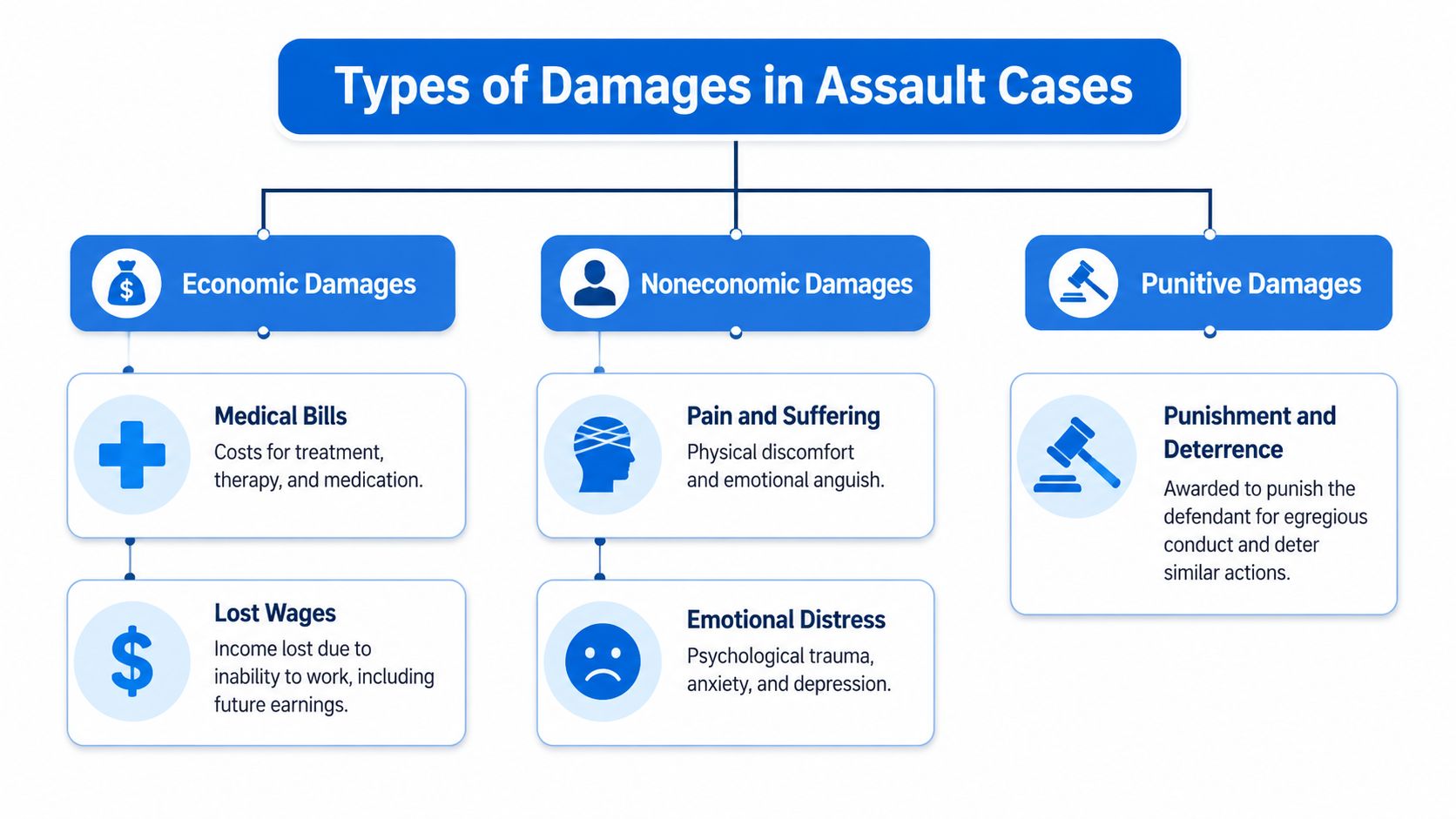
The easiest way to understand claim value is to separate the money into three buckets. One bucket pays for out-of-pocket losses, one tries to put a number on human suffering, and one is reserved for especially bad conduct. Courts and insurers may disagree on the exact dollar amount, but they usually think in those same categories.
Economic damages
Economic damages are the bills you can count. That includes emergency care, follow-up appointments, medication, therapy, and lost income when the attack kept you from working. If your injuries affect your ability to earn in the future, that can also matter, because the loss isn't just about one missed paycheck.
A broken nose that needs urgent treatment might create a clear paper trail. So might counseling after the attack, especially when anxiety, panic, or trauma interferes with daily life. When a claim is strong, the numbers in this bucket are easy to explain because they're tied to records.
Noneconomic damages
Noneconomic damages are the hardest part for injured people to understand because they don't come with receipts. They cover pain and suffering, emotional distress, fear, sleep problems, humiliation, and other harms that show up in your life rather than on a bill. In assault cases, this bucket can matter as much as the medical expenses, sometimes more.
That's where emotional evidence becomes important. A journal describing panic attacks, a therapist's notes, or a family member's observations can make the impact visible. If you're trying to learn how much can you sue someone for assault, this category is often the hidden driver of value because it reflects how the event changed your day-to-day life.
Punitive damages and the state cap problem
Punitive damages are different. They're meant to punish conduct that is especially outrageous and deter similar behavior. They aren't automatic, and their availability depends heavily on the state law and the facts of the case.
Jurisdiction plays a critical role in determining potential recovery. A national review of damage caps explains that some states limit recovery in ways that affect noneconomic damages, including one cap that allows the greater of two times economic damages plus noneconomic damages up to $750,000, or $200,000; by contrast, claims in states without those caps can reach far higher amounts in severe cases, sometimes $2 million+ according to the same review of published settlement surveys and state rules. TLR Foundation's 2024 damage cap review
That same state-by-state variation is why readers often get misled by national averages. A claim that looks modest on paper can grow if the injury is permanent, if the emotional trauma is well documented, or if the defendant's conduct supports punitive exposure. On the other hand, a case can shrink quickly if liability is disputed or if a state rule limits the categories of recovery.
For anyone who wants a practical way to think through the emotional side of the case, the free anxiety education hub from The Anxiety Checklist can help you recognize symptoms and describe them clearly, which can be useful when emotional distress becomes part of the claim.
Bottom line: the dollar value comes from the mix of bills, lost income, suffering, and state law limits, not from the word assault by itself.
Typical Settlement Ranges and Real Examples
Reported settlement ranges for assault claims are broad because injuries are broad. Some claims are resolved for amounts that look modest, while others climb much higher when the harm is serious or lasting. According to one published summary, reported settlements span from about $5,000 to more than $1,000,000, with minor injuries often settling between $5,000 and $25,000, moderate injuries between $25,000 and $100,000, and severe injuries reaching $100,000+. Nguyen Injury Law's assault settlement overview
Settlement range by injury severity
| Injury Severity | Typical Range |
|---|---|
| Minor injuries | $5,000 to $25,000 |
| Moderate injuries | $25,000 to $100,000 |
| Severe injuries | $100,000+ |
Those figures are not promises. They're a rough map of how cases tend to be priced when the evidence supports them. The actual settlement depends on what can be proved, how strong the liability evidence is, and whether there are long-term effects that push the case beyond the obvious medical bills.
A simple example helps. If someone is shoved, bruised, and treated once, the claim may sit in the lower range because the losses are narrow and documented. If the same assault leads to ongoing therapy, missed work, and visible lingering harm, the value can move upward because the case now includes more than the first clinic visit.
Another case can swing the other way. A person with a preexisting condition may still have a valid claim, but the insurer will often argue that only part of the current distress came from the assault. That doesn't erase the case, but it can make the proof fight harder because the valuation has to separate old problems from the new injury.
A final factor is permanence. Permanent disability, traumatic brain injury, or severe emotional harm can move a claim out of the middle range and into the top tier, especially when the state law allows those losses to be fully considered. That is why the same assault label can produce radically different outcomes in different files.
State Specific Rules in Pennsylvania and New Jersey
Pennsylvania and New Jersey both matter because the state line can change the answer faster than the facts do. Filing deadlines, court venue, and damage limits can all affect whether a claim survives and how much it's worth. For Pennsylvania timing rules, a good starting point is this statute of limitations resource.
Pennsylvania and New Jersey side by side
Pennsylvania personal injury practice is often discussed in terms of a two-year filing period, while New Jersey is commonly treated as having a longer civil window in many personal injury matters. For assault claims, that timing difference matters because waiting too long can end the case before the valuation question even starts. A jurisdictional comparison is one of the most overlooked parts of the process.
There are also court-path differences that can confuse people. California small claims can handle civil assault and battery claims up to $12,500, Tennessee generally has a one-year deadline and a $750,000 cap on non-economic damages in most personal injury cases, and those examples show how dramatically state rules can diverge. Public Interest Lawyers' assault claim FAQ
For legal research and deadline tracking, attorneys often rely on dedicated databases rather than memory alone. A tool such as legal research software can help sort through state rules, but the key point for an injured person is simpler, the rules in your state can change the case more than the headline facts do.
If you're in Pennsylvania or New Jersey, the first question isn't just what happened, it's where the case should be filed and how fast the clock is running.
Damage caps, notice requirements, and the proper court all affect advantage in settlement discussions. Even a strong fact pattern can lose value if the claim lands in the wrong place or misses a deadline. That's why local counsel matters, especially when the same conduct would be priced differently across state lines.
Gathering Evidence and Navigating the Civil Process
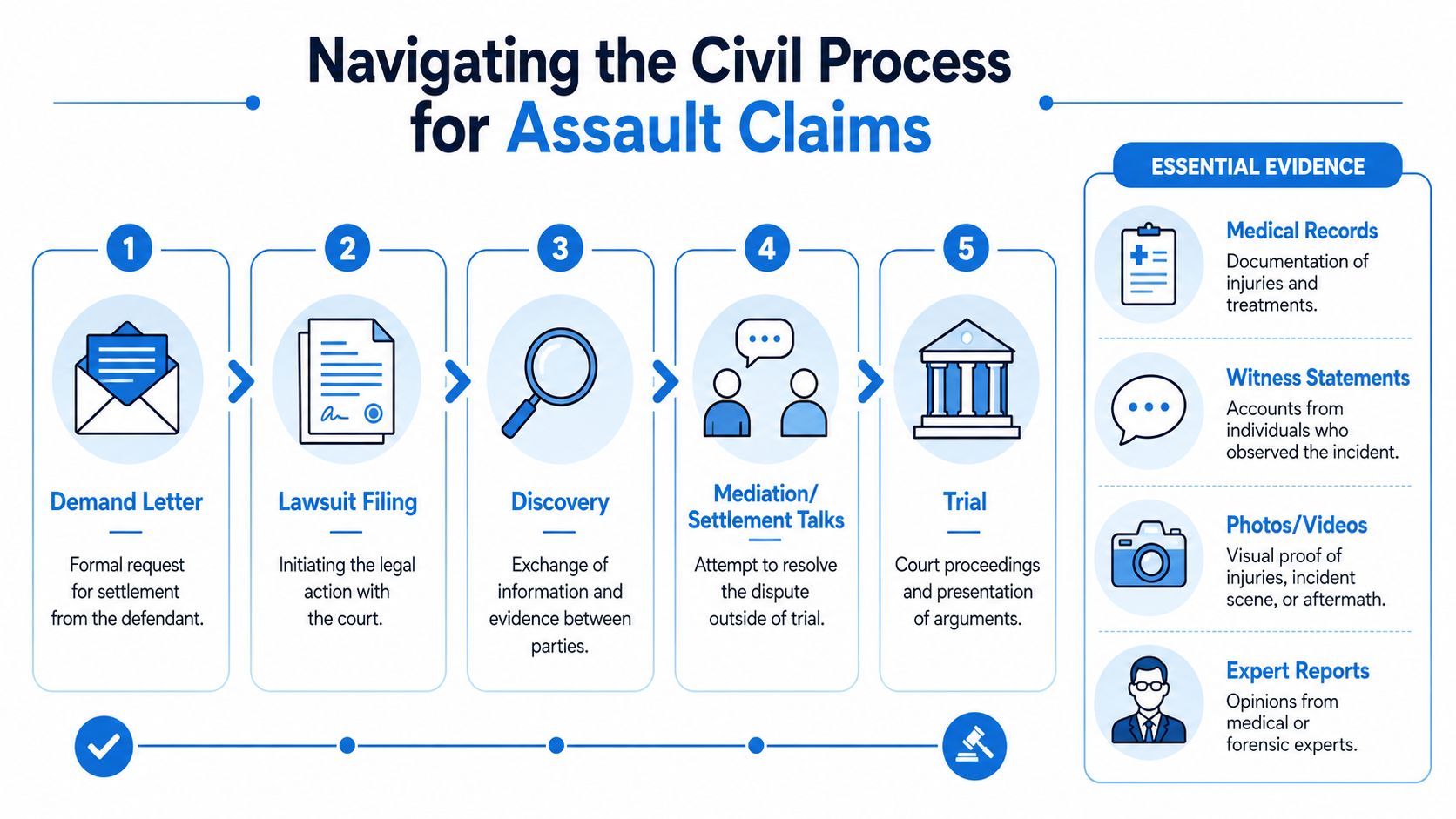
Civil assault claims usually move in stages, and each stage rewards the person who kept records. The process often begins with a demand letter, then turns into formal filing, evidence exchange, settlement talks, and, if needed, trial. The strongest cases are the ones where the paper trail matches the story from the very beginning.
What to gather first
Medical records show what happened to your body. Witness statements help confirm the sequence of events. Photos and videos can capture injuries, the scene, or the aftermath before time blurs the details.
The more specific the evidence, the better. A doctor's note that links the injury to the incident is more useful than a vague complaint, and a witness who saw the contact is stronger than someone repeating rumors later. If there was surveillance or phone video, that can often become the most persuasive piece in the file.
How the process usually unfolds
A demand letter puts the defendant on notice that the claim exists and gives the other side a chance to resolve it. If that goes nowhere, the lawsuit gets filed, and both sides move into discovery, where documents, statements, and other evidence are exchanged. Mediation often comes next because many cases settle once the facts are laid out clearly.
The final step is trial if settlement fails. That doesn't mean every case should be tried, but it does mean your evidence should be organized as if a jury might see it. Claims with clean records, steady treatment, and consistent witness accounts usually have a better negotiating position than claims assembled at the last minute.
For a plain-language overview of filing a personal injury case, this guide to filing a personal injury claim is a helpful reference point. The big lesson is simple, keep everything, write down what happened while it's fresh, and don't wait for the story to get fuzzy.
Next Steps and Conclusion
If you were assaulted, protect the claim like it matters, because it does. Get medical care, save every record, keep photos and messages, and calendar the deadline that applies in your state. In Pennsylvania and New Jersey, local rules can shape the value of the case just as much as the injury itself, especially when emotional harm or punitive exposure may be in play.
The fastest way to lose value is to wait too long or guess on the rules. The fastest way to protect it is to talk with a lawyer who handles assault claims in your state, reviews the evidence early, and tells you what the case may really be worth.
If you're ready to take the next step, contact Mattiacci Law for a focused review of your assault claim, your deadlines, and the damages you may be able to recover.