


Author: John Mattiacci | Owner Mattiacci Law
Published January 31, 2026

When you get hurt, a legal clock starts ticking immediately. In Pennsylvania, you generally have just two years from the date of your injury to file a personal injury lawsuit. Think of it less like a guideline and more like a hard deadline set by law.
Understanding Pennsylvania's Two-Year Filing Deadline
This two-year rule is known as the statute of limitations, and it’s probably the single most important deadline in any personal injury case. It’s a legal stopwatch that starts the second you’re injured. If you try to file a lawsuit after that two-year window slams shut, the courthouse doors are likely barred forever—no matter how strong your case is.
This isn't just a suggestion; it's a firm legal boundary. The whole point is to make sure claims are handled while evidence is still fresh and witness memories are clear. Waiting too long just complicates everything, which is why the state is so strict about this cutoff.
Common Cases Covered by the Two-Year Rule
This critical two-year window applies to the vast majority of personal injury incidents that happen every day across Pennsylvania. Knowing which situations fall under this rule helps you understand why acting fast is so important.
A few common examples include:
- Car, Truck, and Motorcycle Accidents: Any crash on I-95, the Schuylkill Expressway, or a local side street.
- Slip and Fall Incidents: Getting hurt on someone else’s property, like in a grocery store, a restaurant, or on an icy sidewalk.
- Premises Liability Claims: Any injury caused by unsafe conditions on another person's property.
- Dog Bites: Injuries caused by a dog or another domestic animal.
- Construction Site Accidents: Harm to workers or even passersby because of negligence on a job site.
For all these situations, the clock starts running on the date the incident happened. It’s a universal deadline that insurance companies know all too well, which is why moving quickly is your best defense.
The statute of limitations isn't just a procedural hurdle; it's an absolute bar to recovery. Miss the deadline by a single day, and a court is required to dismiss your case. You lose your right to seek compensation forever.
To give you a clearer picture, here's a quick summary of how this deadline applies to some of the most common injury claims.
Pennsylvania's Standard Two-Year Filing Deadline at a Glance
This table breaks down the standard two-year statute of limitations for various common personal injury cases in Pennsylvania. It's a helpful reference, but remember, there can be exceptions.
| Type of Personal Injury Case | Filing Deadline From Date of Incident |
|---|---|
| Car Accidents | Two Years |
| Truck Accidents | Two Years |
| Motorcycle Accidents | Two Years |
| Slip and Fall Incidents | Two Years |
| Premises Liability Claims | Two Years |
| Dog Bites | Two Years |
| Construction Accidents | Two Years |
As you can see, that two-year clock applies across the board for most standard injury cases. Don't let it run out on you.
The Law and Its Consequences
The official law is found in 42 Pa. Cons. Stat. § 5524(2), which strictly sets the statute of limitations for most personal injury claims at two years from the date of the injury. If your accident was on October 15, 2023, you must file your lawsuit by October 15, 2025.
The legal system offers very little wiggle room for missed deadlines. It’s up to you to know the timeline and act within it. This is why getting in touch with a legal professional early isn't just a good idea—it's a critical step in protecting your rights. You can learn more about the critical nature of Pennsylvania's injury claim deadlines and how they can impact your case.
When Does the Two-Year Clock Actually Start Ticking?
That two-year deadline sounds simple enough, but knowing exactly when the stopwatch starts is one of the most critical parts of a personal injury claim.
For many accidents, like a car crash or a slip and fall, the start date is straightforward—it’s the date the incident happened. If you were rear-ended on January 10th, your clock begins ticking that very day. Simple.
But life and injuries are often more complicated. What happens when the harm isn't immediately obvious? A construction worker might not realize they were exposed to a toxic chemical until years later when a serious illness develops. A surgical error might go completely unnoticed until a follow-up procedure reveals the mistake.
In these situations, Pennsylvania law recognizes it would be deeply unfair to start the clock on the date of the negligent act. This is where a crucial legal principle known as the discovery rule comes into play.
Understanding the Discovery Rule
Think of the discovery rule as a fairness doctrine. It basically pauses the statute of limitations clock until the date you knew, or reasonably should have known, that you were injured and that someone else’s conduct likely caused it.
It shifts the starting line from the date of the incident to the date of reasonable discovery.
This prevents a wrongdoer from getting off the hook just because the consequences of their actions took time to surface. The key phrase here is "reasonably should have known." This means the law expects you to be diligent. You can't just ignore obvious symptoms or clear signs that something is wrong. The clock starts ticking when a person paying reasonable attention would have connected their injury to a potential cause.
The discovery rule is there to protect victims of hidden injuries. It acknowledges that not all harm is visible on day one and provides a path to justice for those whose injuries show up later.
For instance, if a doctor leaves a surgical sponge inside a patient, the two-year clock doesn't start on the day of the surgery. It begins on the day the patient experiences severe pain and an X-ray finally reveals the foreign object. That’s the moment of reasonable discovery.
This flowchart gives you a quick visual on Pennsylvania's standard personal injury claim deadline.
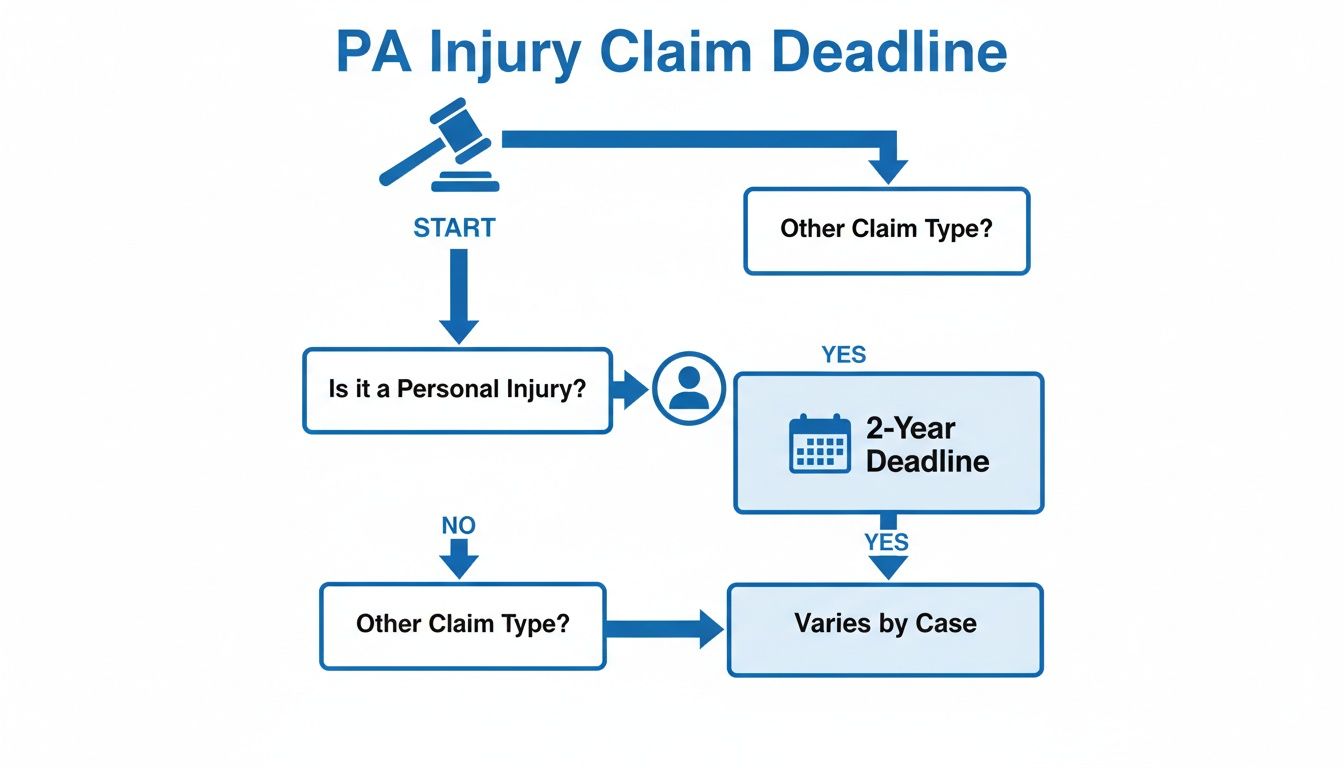
As you can see, the two-year deadline is the default rule, which really highlights why understanding exceptions like the discovery rule is so important.
How the Discovery Rule Applies in Real Cases
Applying the discovery rule isn't a blanket extension—it's a nuanced legal argument that depends entirely on the specific facts of each case.
Here are a few scenarios where it frequently comes up:
- Medical Malpractice: A misdiagnosis of cancer isn't found until the disease has progressed significantly, long after the initial incorrect diagnosis was made.
- Toxic Torts: An individual develops a lung disease years after being exposed to asbestos in their workplace without proper safety gear.
- Defective Medical Devices: A patient with a hip implant doesn't realize the device is failing and poisoning their bloodstream until they develop unexplainable symptoms years after the surgery.
In these cases, the discovery rule can be the only thing standing between a victim and the loss of their legal rights. The two-year period kicks in when you reasonably discover the injury. However, be aware that for medical malpractice, there's an outside limit; claims are typically capped at seven years from the date of the negligent act.
You can explore more about how the discovery rule impacts Pennsylvania injury cases to get a better handle on these complexities. The only way to know your exact deadline for sure is to have your case professionally evaluated.
What If the Deadline Needs to Be Paused? Critical Exceptions to the Rule
The two-year rule for filing a personal injury claim in Pennsylvania feels pretty final, but it’s not set in stone. The law gets that life is complicated, and sometimes things happen that make it impossible or just plain unfair for someone who’s been hurt to file a claim on time. In a few very specific situations, the statute of limitations clock can be “tolled”—which is just legal speak for hitting the pause button.
Think of it like a referee calling a timeout in a basketball game. The game clock stops, giving everyone a moment before it starts ticking again. Tolling works the same way for your legal deadline, providing a crucial pause when fairness demands it. These exceptions are powerful, but they don't apply to every case.
Figuring out if one of these exceptions fits your situation is a huge deal. It could be the difference between getting the compensation you deserve and walking away with nothing.
Protections for Injured Minors
When a child is the one who gets hurt, the rules change to make sure their rights are protected. A minor under the age of 18 can't legally file a lawsuit on their own. Because of this, Pennsylvania law pauses their two-year statute of limitations clock until the day they turn 18.
This means the two-year countdown doesn't even start until their 18th birthday. In practice, an injured minor generally has until their 20th birthday to file a personal injury lawsuit. This is a vital protection, especially when you consider the thousands of child injury cases in Pennsylvania each year from things like bike accidents, playground falls, or school bus crashes. You can find more details on how these exceptions protect young victims on RosenJustice.com.
Here’s how it works: Imagine a 15-year-old is hurt as a passenger in a car accident. The normal two-year clock doesn't start ticking on the crash date. Instead, it’s paused for three years. The moment they turn 18, the legal clock finally starts, giving them a full two years—until they're 20—to file their claim.
When a Person Is Incapacitated
Another key exception comes up when the injured person is legally incapacitated. This means they can't manage their own legal and personal affairs because of a mental or physical condition, like a severe traumatic brain injury from the accident itself or a pre-existing condition like advanced dementia.
If a court has declared someone legally incompetent, the statute of limitations is tolled. The clock stays paused for as long as they are incapacitated. If they ever regain their legal capacity, the two-year clock would then start running from that date. This makes sure that a person’s inability to understand or fight for their rights doesn’t stop them from getting justice later on.
The goal here is to protect the vulnerable. Tolling the deadline for minors and incapacitated people ensures their rights are safe until they, or someone acting for them, can take legal action.
When the At-Fault Party Hides the Truth (Fraudulent Concealment)
What if the person who caused your injury actively tries to hide what they did? This is where the fraudulent concealment exception comes into play. If a wrongdoer takes deliberate steps to deceive you or cover up their negligence, preventing you from figuring out what caused your injury, the law isn't going to reward them for their dishonesty.
In these cases, the statute of limitations is tolled until the date you discover—or reasonably should have discovered—the hidden information. It stops a negligent party from simply running out the clock by lying or burying the evidence.
To use this exception, a court would typically look for a few things:
- An Active Cover-Up: The defendant had to do something to actively hide the truth. Just staying quiet usually isn't enough.
- Intent to Deceive: Their actions had to be aimed at misleading you and stopping you from filing a timely lawsuit.
- You Did Your Part: You still have to show that you were being reasonably diligent in trying to find the cause of your injury.
If you can prove these points, the filing deadline can be extended, making sure justice isn’t defeated by deception.
Special Deadlines for Unique Injury Claims
That standard two-year rule covers a lot of accidents, but it's a huge mistake to assume it applies to every single case. Pennsylvania law actually carves out special timelines for certain types of injury claims. Ignoring these unique deadlines can permanently shut the door on your right to get compensated.
These special rules often come with much shorter timeframes and extra procedural hoops you have to jump through. They can easily trip up an otherwise solid claim before it even gets off the ground. Understanding these distinctions isn't just a good idea—it's essential for protecting your rights.

Claims Against Government Bodies
If your injury was caused by a state, city, or local government agency—think a SEPTA bus crash, a fall on a broken city sidewalk, or an injury in a government building—you’re up against one of the tightest deadlines in all of personal injury law.
Before you can even file a lawsuit, you must give the right government agency a formal written notice of your intent to sue within just six months of the date you were hurt.
This isn't a suggestion; it's a mandatory first step. This six-month notice requirement is a trap that unfortunately dooms many legitimate claims against government bodies like the City of Philadelphia. If you miss this deadline, you almost always lose your right to sue, no matter how badly you were injured.
Wrongful Death Actions
When an accident tragically leads to someone's death, the timeline for their family to seek justice is also different. The statute of limitations for a wrongful death claim is still two years, but the clock starts ticking at a different point.
Instead of starting on the date of the accident, the two-year countdown begins on the date of the person's death. This is a critical distinction. For example, if someone is hurt in a car wreck on May 1st but sadly passes away from those injuries on June 15th, their family has until June 15th two years later to file a wrongful death suit.
Medical Malpractice Claims
Medical malpractice cases are notoriously complicated, and their deadlines are no exception. While the standard two-year rule generally applies, the "discovery rule" is often front and center. This means the clock usually starts not on the date the medical error happened, but on the date you figured out (or reasonably should have figured out) that you were injured and what caused it.
But there's a catch. Pennsylvania also has a Statute of Repose, which is an absolute, final deadline. With very few exceptions, you cannot file a medical malpractice lawsuit more than seven years after the negligence occurred, even if you only discovered the harm after that seven-year window had already closed.
Product Liability Claims
If you're injured by a defective or dangerous product—like a faulty car part, contaminated food, or a malfunctioning tool—the standard two-year statute of limitations usually applies. The clock will almost always start ticking on the date the product injured you.
However, the discovery rule can come into play here, too. If the link between the product and your injury wasn't immediately obvious, your deadline might get extended. Figuring out the exact start date requires a careful look at when you first realized the product was the real cause of your harm. You can find more information in our guide on how long you have to file a pedestrian accident claim in Pennsylvania.
As you can see, these special deadlines are tricky. To make it a bit clearer, here’s a quick comparison of the timelines for these unique cases.
Comparing Filing Deadlines for Special Injury Cases in Pennsylvania
| Claim Type | Standard Deadline | Key Consideration |
|---|---|---|
| Claims Against Government | 6-Month Notice | You must provide written notice of intent to sue within 6 months before filing a lawsuit. |
| Wrongful Death | 2 Years | The clock starts on the date of death, not the date of the accident. |
| Medical Malpractice | 2 Years | The Discovery Rule often applies, but there is a final 7-year Statute of Repose. |
| Product Liability | 2 Years | The clock starts on the date of injury, but the Discovery Rule can sometimes apply. |
These special deadlines show exactly why you can never just assume you have two years. Each type of injury claim has its own set of rules, and a single miscalculation can have devastating results for your case.
Why Waiting to File Is a High-Stakes Gamble
It’s one of the most dangerous and costly assumptions you can make after an injury: thinking that talking with an insurance company somehow pauses your legal filing deadline. This is a myth, plain and simple. The statute of limitations clock doesn't stop for negotiations, friendly phone calls, or vague promises of a future settlement.
Think of the two-year deadline as a train leaving the station. It pulls out on a strict, legally mandated schedule, whether you and your claim are on board or not. Even if you're having productive conversations with an insurance adjuster, that train is still rolling toward its final departure.
Insurance adjusters are professionals who understand Pennsylvania’s legal deadlines inside and out. They are fully aware that once that two-year window slams shut, your legal leverage completely evaporates.
The Delay Tactic Trap
Some adjusters, whether intentionally or not, can use delay tactics. They might ask for endless streams of paperwork, promise to "look into" something, or offer just enough hope of a settlement to keep you from calling an attorney. All the while, the clock is ticking down.
This can create a dangerous false sense of security. You might feel like you're making progress, but in reality, your time to protect your legal rights is shrinking every single day. Waiting until the last minute puts your entire claim in a precarious position, forcing a rush that often leads to critical mistakes.
The consequences of missing the statute of limitations are not just serious; they are absolute. In almost every case, a missed deadline means your claim is permanently barred. You lose your right to seek any compensation through the court system, forever.
The Finality of a Missed Deadline
Once that deadline passes, it doesn't matter how severe your injuries are or how clear the other party's fault is. The courthouse doors are legally required to close on your claim. The other side’s attorney will simply file a motion to dismiss your case based on the expired statute of limitations, and the judge will almost certainly grant it.
This finality is why acting with urgency is your best defense. It's shocking, but a huge number of personal injury claims fail in the early stages. Many of these failures happen because people don't realize the deadline clock is running out while they’re still negotiating with an insurer. According to one report, as many as 75% of personal injury claims in Pennsylvania fail within the first 30 days, often because of poor documentation or claimants not realizing that legal deadlines never pause for insurance talks.
Preserving Your Rights Is Your Responsibility
Ultimately, the responsibility for filing a lawsuit within the legal timeframe rests with you, the injured person. The insurance company has no obligation to warn you that your deadline is getting close. Their primary duty is to their shareholders, not to you. By waiting, you’re gambling with your only chance to get compensation for your medical bills, lost income, and pain and suffering.
Taking decisive action early is the only way to make sure your rights are fully protected. While insurance companies have their own internal processes, you can read our guide on how long an insurance company has to investigate a claim to better understand their timelines. Just never confuse an insurer's internal timeline with the legally binding statute of limitations.
How an Experienced Attorney Protects Your Claim
Trying to navigate Pennsylvania’s legal deadlines on your own is a huge risk. After an injury, your focus should be on getting better, not trying to translate legal codes and court rules. This is where a dedicated personal injury attorney becomes your most important ally, stepping in immediately to protect your rights and level the playing field.
An experienced lawyer doesn’t just give advice; they take action from day one. Their first priority is to launch a thorough investigation to lock down critical evidence before it disappears. We’re talking about collecting police reports, photographing the scene, grabbing surveillance footage that might get erased, and interviewing witnesses while their memories are still fresh.

Taking Control and Calculating Deadlines
One of the most valuable things a lawyer does is figure out every single deadline that applies to your specific case. They don’t just look at the standard two-year statute of limitations. They identify any shorter notice periods, like the crucial six-month deadline for claims against government entities. Getting this right can single-handedly save a claim from being thrown out on a technicality.
At the same time, your attorney takes over all communication with the insurance companies. This shields you from adjusters who might try to get a recorded statement to hurt your case or push you into a lowball settlement that doesn't come close to covering your future needs. With a lawyer running interference, you avoid common traps and make sure your words aren’t twisted against you. You can find more details in our complete resource on filing a personal injury claim in Pennsylvania.
Having an attorney signals to the insurance company that you are serious. A trial-ready approach from the beginning demonstrates that you will not back down and are prepared to fight for the full value of your claim.
Building a Case for Full Compensation
A skilled attorney does a lot more than just file paperwork; they build a powerful case designed to get you maximum compensation. This involves:
- Working with Experts: Bringing in medical specialists to document the full extent of your injuries and accident reconstructionists to prove exactly who was at fault.
- Calculating Full Damages: Methodically adding up all your losses—not just current medical bills, but future ones, lost income, reduced earning capacity, and the very real impact of pain and suffering.
- Assertive Negotiation: Using the strength of the evidence to negotiate aggressively with the insurance company for a settlement that's actually fair.
By preparing every case as if it’s going to trial, your attorney sends a clear message. This strategy often leads to better settlement offers because insurers want to avoid the time and expense of a court battle they’re likely to lose. Legal guidance isn’t just helpful—it’s essential for protecting your future.
Answers to Your Questions About PA Injury Claim Deadlines
Legal deadlines can feel like a maze. To help you find your way, here are some straight answers to the questions we hear most often about filing a personal injury claim in Pennsylvania.
What Happens If I Miss the Filing Deadline?
If you miss the statute of limitations, your case is almost certainly over before it begins. The court will dismiss it, and that’s a hard and fast rule. You permanently lose your right to get compensation for your injuries, no matter how strong your case was.
Does Talking to an Insurance Company Pause the Clock?
No. This is a dangerous myth that costs people their claims. The two-year statute of limitations keeps ticking, no matter how many phone calls or emails you exchange with an insurance adjuster. Only filing a lawsuit officially stops the clock.
Can I Still File a Claim If My Injuries Showed Up Later?
Yes, this is often possible thanks to the discovery rule. If your injury wasn't obvious right away, the two-year clock might start from the day you found out about it—or reasonably should have found out about it—instead of the date of the accident itself.
It’s critical to understand that the discovery rule isn’t a free pass to wait. Evidence gets lost, memories fade, and legal exceptions have their limits. The safest move is always to act fast to protect your claim.
What if a Minor Was Injured?
Pennsylvania law has special protections for kids. The statute of limitations is paused, or "tolled," until the child turns 18. This means an injured minor generally has until their 20th birthday to file a personal injury lawsuit.
How Soon Do I Have to Notify My Own Insurance?
This is a totally separate deadline. Your own insurance policy is a contract with its own rules. Most policies demand you report an accident "promptly," which usually means within 24 to 72 hours. If you don't, you could lose your ability to use your own coverage, like your UM/UIM benefits.
Don't let a simple deadline stand between you and the compensation you deserve. The legal team at Mattiacci Law is ready to evaluate your case, calculate every critical deadline, and take decisive action to protect your rights. For a free, no-obligation consultation, contact us today through our website.