

Author: John Mattiacci | Owner Mattiacci Law
Published March 12, 2026
The moments after a delivery truck hits you are pure chaos. Your adrenaline is pumping, you’re probably in shock, and it’s tough to think straight. But what you do in these first few minutes is absolutely critical. It can make or break your ability to get fair compensation later on.
First things first: your safety. If you can move, get yourself out of the road and away from traffic. Then, call 911. This one call gets police and paramedics heading your way, and it’s the single most important step you can take. You need a police report, and you need to get checked out by a medical professional, even if you feel fine.
The First Steps After a Delivery Driver Hits You
It’s easy to feel overwhelmed, but your actions right after the crash lay the groundwork for your entire case. Let's walk through what you need to do to protect your health and your legal rights.
Document Everything (And I Mean Everything)
While you're waiting for the police, if you’re physically able, turn your smartphone into your best evidence-gathering tool. The scene of a crash changes fast. Cars get moved, debris gets cleared, and memories fade. Start taking photos and videos of everything.
Get pictures of:
- The positions of the vehicles before they are moved.
- The damage to your car, the delivery truck, and anything else that was hit. Get wide shots and close-ups.
- Any visible injuries you have, like cuts, scrapes, or bruises. These are powerful proof of the immediate impact.
- The surrounding area—things like skid marks, traffic lights or signs, weather conditions, and any potholes or road construction.
This protocol is simple but essential. Getting it right from the start makes a huge difference.

Following these three core actions—calling for help, documenting the scene, and swapping information—builds a solid foundation for your potential claim.
Dealing With the Driver and Witnesses
When you talk to the delivery driver, keep it calm and stick to the facts. Just exchange the basics: names, contact info, driver's license numbers, and insurance details. The key question you have to ask is: Who do you work for? Get the name of their employer—Amazon, FedEx, UPS, or a smaller third-party company—and be sure to snap a picture of the truck's license plate.
Key Takeaway: Do not apologize. Don't say "I'm sorry" or "I should have seen you." Insurance companies are experts at twisting a simple, polite apology into an admission of fault. It can seriously damage your case.
If anyone saw what happened, get their name and number. An independent witness who can back up your side of the story is worth their weight in gold, especially if the delivery driver's story suddenly changes later on. For a more detailed breakdown, you can also check out our general guide on https://jminjurylawyer.com/car-accidents/what-should-i-do-immediately-after-a-car-accident-in-pennsylvania/.
To give you a clear, scannable reference for those high-stress moments, here's a simple table outlining what to do.
Immediate Post-Accident Checklist
This table summarizes the most critical actions to take immediately following an accident with a delivery vehicle to protect your health and legal rights.
| Action Item | Why It's Critical |
|---|---|
| Move to Safety & Call 911 | Your health is the top priority. A 911 call summons medical help and police, creating an official report. |
| Seek Medical Attention | Adrenaline can mask serious injuries. A medical evaluation creates a record linking your injuries to the crash. |
| Document the Scene | Take extensive photos/videos of vehicle positions, damage, injuries, and the surrounding area before it's cleared. |
| Exchange Information | Get the driver's name, license, insurance, and employer's name. Get the truck's license plate. |
| Do Not Apologize | Saying "I'm sorry" can be used against you by insurance companies to argue you were at fault. |
| Get Witness Contacts | Independent witness testimony is incredibly valuable for proving what really happened. |
Having this checklist in mind can help you stay focused when it matters most.
With the explosion of e-commerce, our roads are flooded with delivery vans and trucks. It’s no surprise that accidents are on the rise. In fact, incidents involving these commercial vehicles have jumped by over 25% since 2021. PennDOT data from 2025 showed more than 3,200 truck-related crashes across the state. When you consider that some of these commercial trucks weigh up to 80,000 pounds, it's clear why the injuries are so often devastating.
Taking the right steps from the very beginning is vital. It's about more than just gathering evidence; you need to understand how to protect yourself legally and medically after a car accident to ensure you're not left to deal with the aftermath alone.
Is the Driver or the Company Liable for Your Injuries?
When you’re hit by a delivery driver, one of the first and most confusing questions is always: who pays? Is it the person behind the wheel, or the massive company they work for?
It’s a huge question, and the answer can make all the difference. It often comes down to a legal idea called vicarious liability. In simple terms, this means an employer can be held responsible for what their employee does on the job. But, as you can imagine, companies do everything they can to sidestep this.

Employees vs. Independent Contractors: The Critical Distinction
This is where things get tricky. The key to holding the company accountable often hinges on whether the driver is considered an employee or an independent contractor.
Employees: Think about a UPS driver. They're in a branded truck, wearing a uniform, and following a company-mandated schedule. In this kind of clear-cut case, UPS is almost always on the hook if their driver causes a crash while working. The company's business auto insurance policy, which has much higher limits than personal insurance, comes into play.
Independent Contractors: This is the model used by most "gig economy" services like Amazon Flex, DoorDash, or Uber Eats. They classify their drivers as independent contractors to try and wash their hands of responsibility when a crash happens.
But that label isn't the final word. Pennsylvania courts look past the title and focus on one thing: control. If the company dictates the driver's routes, sets strict delivery deadlines, and basically controls every part of the job, a good lawyer can argue they are, for all practical purposes, an employer.
A Real-World Scenario: Imagine you're hit by a driver in their own Toyota Camry, but it has an Amazon Flex magnet on the door. Amazon's first move will be to say, "Not our problem, they're an independent contractor." We would immediately dig into how much control Amazon really had, from the app's instructions to their performance metrics, to pull them into the claim.
When the Company Itself Is Directly Negligent
Sometimes, the company is at fault no matter what they call the driver. This is when their own carelessness, or direct negligence, contributes to the crash. It’s a completely separate way to hold them accountable.
We see this happen in a few common ways:
- Negligent Hiring: Did they even bother to run a background check? We’ve seen cases where companies hired drivers with a string of DUIs or a terrible driving record. That’s a ticking time bomb.
- Inadequate Training: A company has a responsibility to train its drivers, especially if they’re operating large cargo vans in busy places like Philly or Pittsburgh. Just handing someone the keys isn't enough.
- Failure to Maintain Vehicles: If the crash was caused by something like bad brakes or worn-out tires on a company-owned truck, that's on them. Vehicle maintenance is their job.
- Unrealistic Delivery Quotas: This is a big one. When companies push drivers with impossible deadlines, it directly encourages speeding, reckless driving, and skipping safety checks.
An experienced attorney knows the driver is only the starting point. We immediately start digging into the company's hiring files, training manuals, vehicle maintenance logs, and delivery schedules. This investigation often uncovers the proof needed to show the company is just as responsible—if not more so—for what happened to you.
Understanding Pennsylvania's Accident Laws and Deadlines
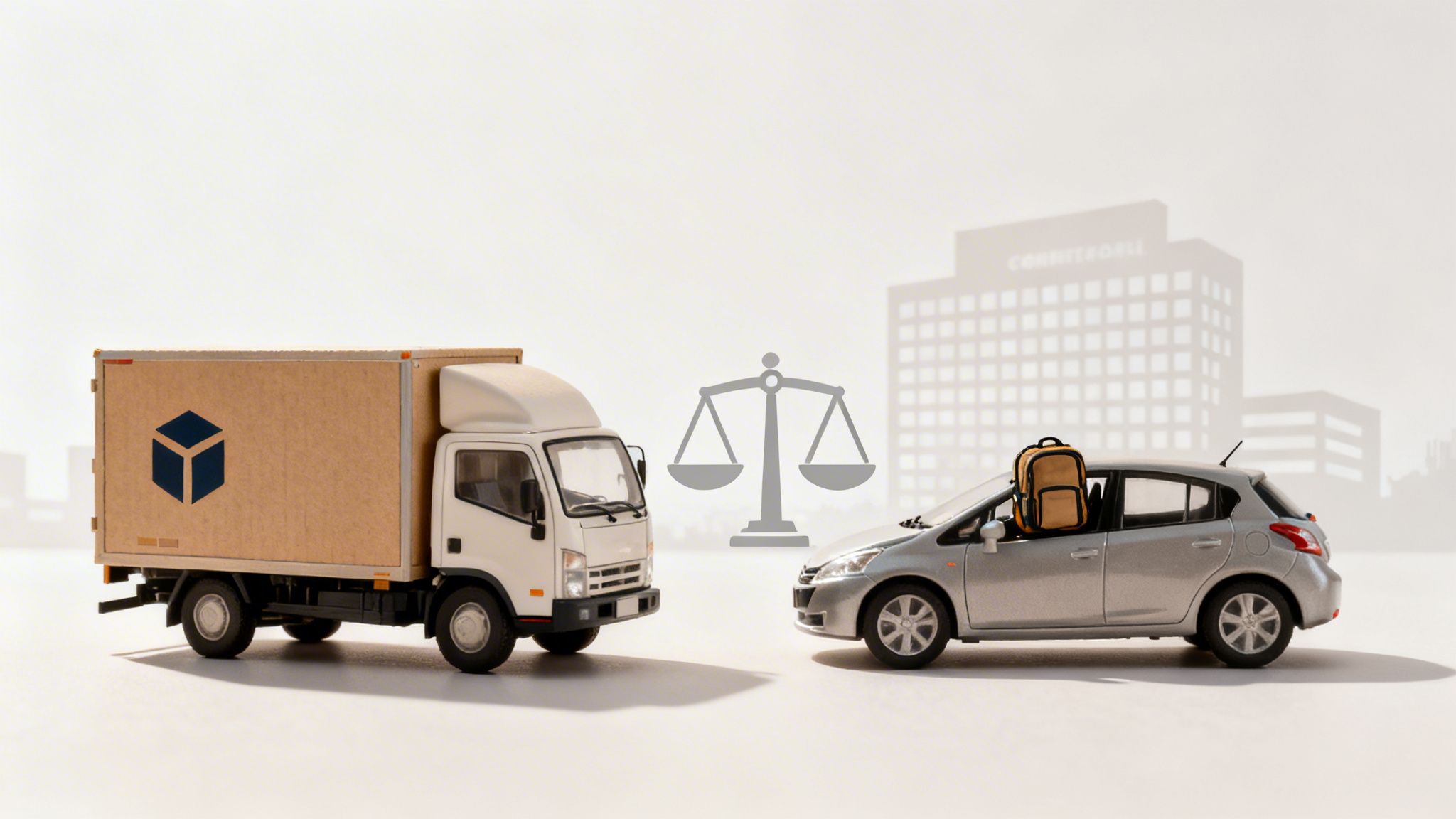
When you're hit by a delivery driver in Pennsylvania, you're not just dealing with your injuries and figuring out who's liable. You're also up against the legal system's strict timelines and specific rules—and these can absolutely make or break your case. Knowing these rules isn't just a good idea; it's critical to protecting your right to get paid.
Two state laws are especially important here: the statute of limitations and the modified comparative negligence rule. If you don't understand how these work, you could see your claim thrown out completely, no matter how strong your case is.
The Two-Year Countdown You Cannot Ignore
In Pennsylvania, a legal clock starts ticking the very moment the accident occurs. You have exactly two years from that date to file a lawsuit. This deadline is called the statute of limitations, and trust me, it’s set in stone.
Two years might sound like a long time, but it vanishes faster than you’d think. A proper investigation can’t be rushed. We need to gather police reports, subpoena records from the delivery company, track down and interview witnesses, and consult with medical experts to prove the full scope of your injuries.
Crucial Takeaway: If you miss this two-year deadline, you lose your right to seek compensation. Forever. The court will toss your case, and the insurance company will have zero reason to offer you a dime.
The delivery company's insurance adjuster knows this rule inside and out. They might try to string you along, making vague promises about a settlement while secretly letting that clock run down. This is exactly why you need to speak with an attorney long before the deadline gets close. You can learn more about the specifics of the Pennsylvania personal injury statute of limitations and how it affects different types of cases.
How Being "Partially At Fault" Can Cost You Everything
The other big legal hurdle is Pennsylvania's "modified comparative negligence" rule. This law comes into play when there's a question of whether both parties share some blame for the crash. It directly impacts how much money you can actually collect.
Here’s the bottom line: you can still recover money as long as you are found to be 50% or less at fault. But your total compensation will be reduced by your percentage of fault.
Let's see what that looks like in a real-world scenario.
Example of Comparative Negligence
Imagine a jury decides your total damages—for medical bills, lost income, and pain and suffering—come out to $100,000. The delivery company’s insurer, however, argues that you were partly to blame. Here's how the math breaks down:
| Your Percentage of Fault | Delivery Driver's Fault | Your Final Payout | Why It Matters |
|---|---|---|---|
| 10% | 90% | $90,000 | You receive most of your damages. |
| 50% | 50% | $50,000 | You still get paid, but your award is cut in half. |
| 51% | 49% | $0 | You get absolutely nothing. |
This is precisely why insurance adjusters fight so hard to shift blame onto you. If they can convince a jury you were just a little bit more at fault than their driver—even by 1%—they walk away paying nothing. They'll argue you were jaywalking, distracted by your phone, or made a sudden move. Anything to push your fault over that critical 50% line.
This is why having an experienced trial attorney is non-negotiable. We know these tactics are coming. From day one, we work to build a case that shuts down these arguments and proves the delivery driver was the one primarily responsible for your injuries.
Calculating the True Value of Your Accident Claim
After getting hit by a delivery driver, the first thing on your mind is getting through the immediate shock and pain. But soon enough, a very practical question starts to surface: what is my case actually worth?
It’s a common mistake to think the answer is just the total of your ER bills. The real value is so much more than that. It needs to account for every single way the accident has turned your life upside down—both now and for years to come.
To figure this out, we have to look at your losses in two different buckets: economic damages and non-economic damages. Both are absolutely critical to getting the full and fair compensation you need to truly get back on your feet.
Tallying the Tangible Costs or Economic Damages
Think of economic damages as anything you can track with a receipt, a bill, or a pay stub. These are the straightforward, black-and-white financial losses that piled up because of the accident.
But this isn't just about the first hospital bill. It's a much bigger picture that covers all your past and future expenses.
- All Medical Bills: This is everything—the ambulance ride, the emergency room, any surgeries, follow-up appointments, physical therapy, prescriptions, and even things like crutches or a wheelchair.
- Future Medical Care: A serious injury rarely ends when you leave the hospital. It often means a lifetime of care. We bring in medical experts to map out the real cost of future treatments, from ongoing rehab to chronic pain management.
- Lost Wages: This one's simple. It’s the money you didn’t earn because you were physically unable to work while recovering. We prove this with your pay stubs and work history.
- Loss of Future Earning Capacity: This can be one of the most devastating financial hits. If your injuries stop you from going back to your old job, or limit the kind of work you can do, you deserve to be compensated for the income you'll lose over the rest of your career.
While these costs are tangible, proving the future ones takes real expertise. We often work with economists and life care planners to create detailed reports that show a judge and jury exactly what financial support you’ll need to live.
Understanding the Intangible Losses or Non-Economic Damages
Economic damages cover your bank account, but non-economic damages are about the human cost. These are the very real, but hard-to-price, ways your life has changed for the worse. In many serious injury claims, non-economic damages actually make up the biggest part of the final settlement or verdict.
Think about a construction worker who can no longer lift his own child, or a passionate runner who now lives with chronic pain that keeps her off the trails. You can't put a price tag on that loss, but it's immense. This is what non-economic damages are for.
These losses don’t come with an invoice, but their impact is often what affects you the most.
Key Types of Non-Economic Damages
| Type of Damage | What It Covers |
|---|---|
| Pain and Suffering | This is for the physical pain, chronic discomfort, and overall suffering your injuries have forced you to endure. |
| Emotional Distress | This covers the psychological fallout—the anxiety, depression, fear, nightmares, or even PTSD that often follow a traumatic crash. |
| Loss of Enjoyment of Life | This addresses your inability to do the things you once loved, whether it's a hobby, playing with your kids, or just living without limitations. |
| Disfigurement & Scarring | This is compensation for permanent scars or physical changes that impact your appearance and your confidence. |
Proving these damages is about telling your story. We use personal journals, testimony from friends and family who've seen the change in you, and expert reports from mental health professionals to paint a full picture of what was taken from you. To get a better sense of this, you can learn more about how to value the loss of enjoyment of life in our detailed guide.
At the end of the day, calculating the true value of your claim is about so much more than adding up bills. It’s a careful, detailed process that ensures you have the resources not just to get by, but to truly rebuild your life.
Why You Need a Trial-Ready Attorney for a Commercial Claim
When you’re hit by a delivery driver from a company like Amazon, FedEx, or UPS, you need to understand one thing right away: this isn't a normal car accident claim. You're not just up against the driver. You're facing off against a massive corporation and its equally massive commercial insurance company.
It's a completely different league. These companies have a single goal: protect their bottom line. They have entire teams of adjusters and defense lawyers whose only job is to minimize, fight, and deny claims just like yours. They have a playbook, and they run it on repeat.
Understanding the Insurer's Playbook
From the moment the crash happens, the clock starts ticking—and the insurance company starts working against you. Their first move is almost always a phone call from a friendly-sounding adjuster. They'll seem concerned and sympathetic, but their true mission is to get you to settle fast and cheap.
That first offer is always a lowball. Always. It’s a calculated business move. They know you’re hurt, probably out of work, and stressed about medical bills. They dangle a quick check, hoping you’ll grab it before you realize the true, long-term cost of your injuries.
Crucial Warning: That early settlement offer will never cover future medical care, ongoing lost income, or the real value of your pain and suffering. Once you cash that check, you sign away your right to ever ask for another dime for this accident, no matter how bad your injuries turn out to be.
If their quick-and-cheap settlement trick doesn't work, they switch to more aggressive tactics. They'll argue your injuries aren't that serious. They will dig through your entire medical history to find some pre-existing condition to blame. They’ll even hire their own "experts" to claim the crash wasn't bad enough to cause your injuries. Their goal is to create doubt and wear you down until you accept an unfair offer out of sheer frustration.
The Power of Being Trial-Ready
This is exactly where having a trial-ready attorney flips the script. Lots of personal injury lawyers want to settle cases quickly. A true trial lawyer, on the other hand, prepares every single case from day one as if it’s headed for a jury.
This approach sends a loud and clear message to the commercial insurance company: we will not be intimidated, and your standard playbook won’t work here.
When an insurer sees your lawyer meticulously building a case for trial, they know the usual tricks—the lowball offers and delay tactics—are off the table. They know going to court is a huge expense, and a jury verdict could cost them far more than a fair settlement.
Suddenly, the playing field is level. Their risk calculation completely changes. The cost of paying you a fair settlement starts to look much better than the cost and uncertainty of facing a well-prepared trial attorney in court.
Building a Case the Insurance Company Can't Ignore
Getting a case ready for trial is an intense, front-loaded process. It’s way more than just writing a demand letter and hoping for the best. It’s about a proactive, deep-dive investigation aimed at building a case so solid that the corporate defense lawyers have nowhere to run.
A trial-ready attorney immediately takes critical steps to fortify your claim:
- Preserving Evidence: They fire off spoliation letters, legally demanding the delivery company preserve key evidence like the truck’s “black box” data, driver work logs, maintenance records, and GPS tracking. Without this, that evidence often "disappears."
- Hiring Top Experts: They bring in accident reconstruction specialists to scientifically prove what happened and who was at fault. They also work with medical and economic experts to create undeniable reports detailing the full, lifelong impact of your injuries.
- Conducting Depositions: They put the driver, company managers, and other key people under oath. This locks them into their story and often uncovers critical inconsistencies, rule-breaking, or straight-up negligence.
This isn't just for show. It’s about building a case so powerful that the insurance company has no good option but to come to the table and offer what your claim is actually worth. They know if they don't, they’ll have to explain their driver's and their company's actions to a jury—and that's a risk most of them aren't willing to take.
Answers to Your Pressing Questions After a Delivery Driver Accident

When you’ve just been in a crash with a delivery driver, your head is spinning with questions. It’s a confusing time, and you need straight answers. Let's tackle some of the biggest concerns we hear from clients every day.
What If the Driver Was an Independent Contractor?
This is one of the first things we look into, especially with gig-work drivers from places like DoorDash, Amazon Flex, or Uber Eats. These companies go out of their way to label their drivers as independent contractors, hoping it will shield them from any responsibility when a crash happens.
But here’s the thing: that label doesn’t mean a thing in court. What really matters is control. We dig into whether the company dictates the driver’s schedule, controls their route through an app, or penalizes them for not hitting certain targets. If so, we can argue they’re acting like an employer, and they should be held responsible.
Don't forget the insurance. These big companies have massive commercial insurance policies for accidents that happen on the job. But getting them to pay up? That almost always takes legal muscle. Their first move is to deny everything and point you back to the driver’s personal car insurance, which is never enough.
Should I Take the Quick Settlement Offer from Their Insurance Company?
Absolutely not. That first, fast offer from the adjuster is a trap. It’s a classic lowball tactic they use hoping you’re stressed, in pain, and desperate for cash.
That quick money won't even begin to cover the true cost of your accident. It doesn't account for future surgeries, lost earning potential, or the real-world impact of your pain and suffering. They’re just trying to make the claim go away for pennies on the dollar.
A WORD OF CAUTION: Once you sign that settlement release, your case is over. Forever. If you find out your injuries are more serious down the road, you can't go back and ask for more. Never sign anything or give a recorded statement until you’ve spoken with an experienced lawyer.
How Long Will This Whole Process Take?
There's no single answer, because every case is different. After you're hit by a delivery driver in Pennsylvania, the timeline really depends on the specifics of your situation.
A simple case with minor injuries and obvious fault might wrap up in a few months. But things get a lot more complicated—and take a lot longer—when the stakes are higher.
Cases that involve these factors tend to stretch out, often taking a year or two if a lawsuit is needed:
- Serious or permanent injuries that require detailed medical proof and expert testimony on future costs.
- Arguments over who was at fault, with the company blaming you or someone else.
- Multiple at-fault parties, like the driver, the delivery company, and maybe even a third-party logistics contractor.
A good attorney will keep the pressure on to move things along, but they won't rush the process at the expense of your compensation. Building a strong case takes time.
Can I Still Have a Claim if I Was Partly to Blame?
Yes, you can. Pennsylvania uses a legal rule called "modified comparative negligence." In plain English, it means you can still get paid as long as you are found to be 50% or less at fault for the accident.
But there’s a catch. Your final payout will be reduced by whatever percentage of fault is assigned to you. So, if a jury decides your damages are worth $100,000 but finds you were 20% at fault, you would receive $80,000.
Insurance companies are masters at twisting this rule. They will pick apart everything you did to try and shift more blame onto you. If they can convince a jury you were 51% or more responsible, they owe you nothing. This is exactly why you need a skilled lawyer fighting to protect your right to compensation.
If a delivery driver injured you, you shouldn't have to fight a massive company and its insurance carrier by yourself. At Mattiacci Law, we prepare every single case as if it's going to trial. This gives you the leverage needed to demand full and fair compensation. For a free, no-strings-attached consultation to go over your case, contact us today.