

Author: John Mattiacci | Owner Mattiacci Law
Published January 12, 2026
When the front of one car smashes into the side of another, it forms a “T” shape—what everyone calls a T-bone accident. It’s easy to assume the driver who did the hitting is automatically at fault, but that's not how Pennsylvania law sees it. Fault is all about who had the legal right-of-way, not just who hit whom.
Unpacking the T-Bone Collision
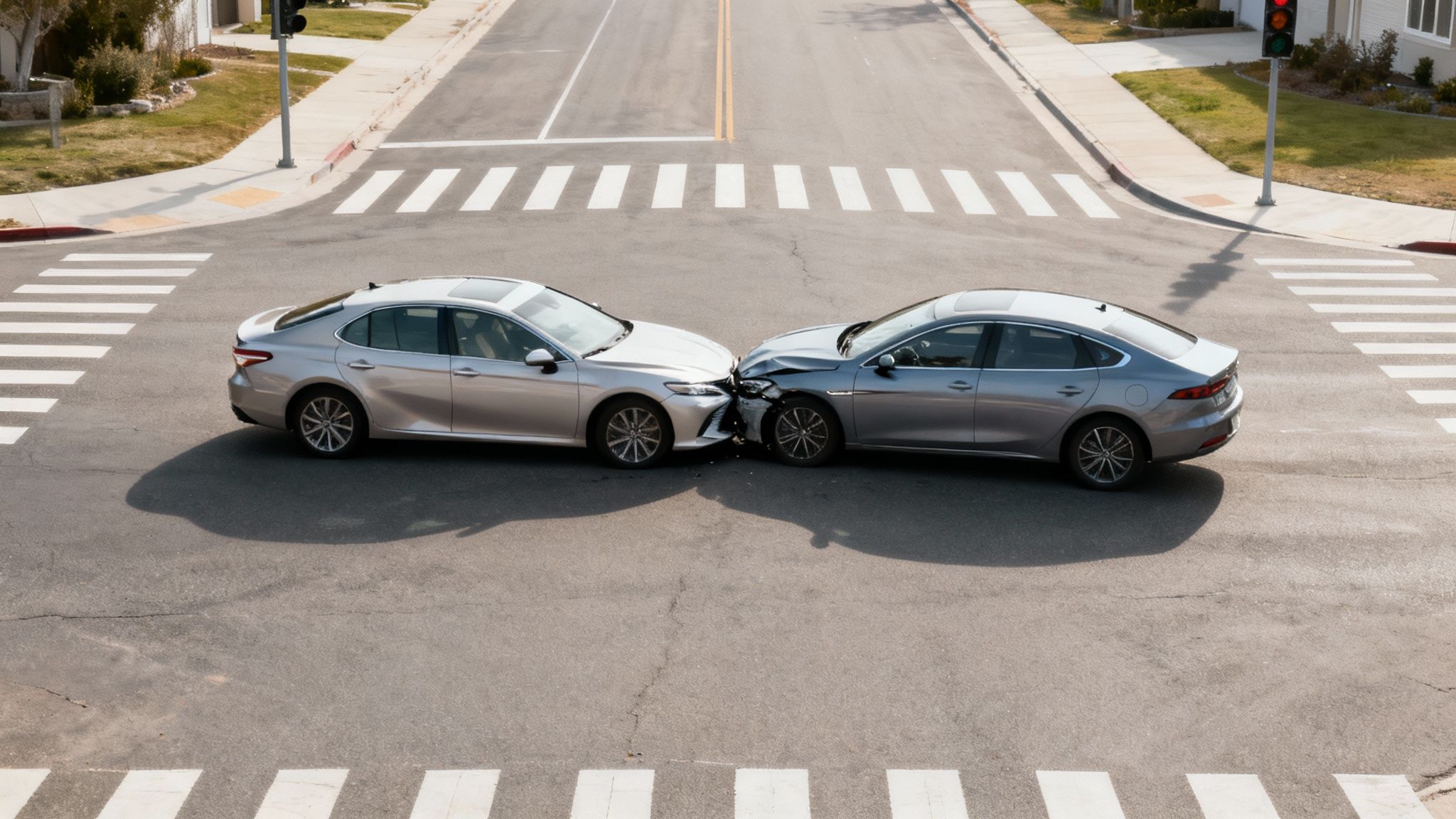
A T-bone crash, also known as a side-impact or angle collision, is one of the most dangerous wrecks you can be in. Think about it: the side of a car has very little to protect you. Unlike the front or back, there are no real crumple zones to absorb the force of the impact—just a door and a window.
These collisions are disturbingly common. T-bone accidents make up a huge percentage of serious crashes, and angled collisions are the single most frequent type of crash on state roads. According to the Pennsylvania Department of Transportation, they accounted for 29.8% of all collisions in the state. You can learn more about Pennsylvania crash statistics and see just how often this happens.
Why Intersections Are Hotspots
Intersections are the main stage for T-bone accidents. It’s where traffic paths are designed to cross, and one bad decision can lead to disaster. Figuring out who's at fault in a Pennsylvania T-bone crash means digging into what happened in those critical seconds before the cars met.
Here are a few of the most common ways these wrecks happen:
- Running a Red Light or Stop Sign: This is the classic scenario. One driver blows through a traffic signal and slams into a vehicle that had the green light and the right to be there.
- Failed Left Turn: A driver tries to turn left across oncoming traffic but completely misjudges the other car's speed or distance. It’s a gamble that often ends badly.
- Blocked Sightlines: Sometimes, it's not just about bad driving. Things like illegally parked trucks, overgrown bushes at a corner, or even big snowbanks can block a driver’s view of cross-traffic until it's far too late to react.
To help clarify who is usually found at fault, here is a quick guide to some of the most common situations we see.
Quick Guide to T-Bone Accident Fault in Common Scenarios
This table breaks down who is typically considered at fault in various T-bone accident situations under Pennsylvania law.
| Scenario | Typically At-Fault Driver | Reason Based on PA Law |
|---|---|---|
| Running a Red Light/Stop Sign | The driver who ignored the signal. | Failure to obey traffic control devices. The other driver had the established right-of-way. |
| Unprotected Left Turn | The driver making the left turn. | Obligation to yield to oncoming traffic. They must wait until it is safely clear to proceed. |
| Four-Way Stop | The driver who failed to yield. | The first vehicle to arrive has the right-of-way. If arriving simultaneously, the driver on the right goes first. |
| Exiting a Private Driveway | The driver pulling out of the driveway. | Must yield the right-of-way to all vehicles already on the public road. |
| Green Arrow Left Turn | The oncoming driver who ran a red light. | The turning driver has a protected turn, giving them the right-of-way. |
While these scenarios cover many cases, remember that every accident is unique. The specific details always matter when determining legal fault.
The Myth of Automatic Fault
It’s a huge misconception that the driver whose front end hits the other car's side is automatically on the hook. While the striking driver is often found liable for failing to yield, it's far from a guaranteed rule. Liability isn't based on the shape of the crash; it's based on who broke the traffic laws.
The core question is always: Who violated their duty to yield the right-of-way? Answering this takes more than a glance at the crumpled cars. It requires a deep dive into traffic signals, witness accounts, and the actions of both drivers leading up to the impact.
For example, if you legally enter an intersection on a green light and get T-boned by someone who blew through their red light, they are at fault. Period. The investigation has to focus on the rules of the road, not just where the cars ended up. This guide will break down those rules to show you how fault is really decided.
Understanding Pennsylvania Right-of-Way Rules at Intersections
When it comes to figuring out who’s at fault in a T-bone accident, almost everything boils down to one simple concept: the right-of-way. This isn't just about being polite on the road; it's a hard-and-fast set of legal rules that dictate who gets to go and who has to wait.
Think of these rules as the official playbook for intersections, which is exactly where most of these brutal crashes happen. Understanding who legally had the right to be there is the key to proving another driver was negligent. When someone breaks these rules, they’re almost always going to be held responsible for the crash that follows.
Let's break down exactly what the law expects from drivers at different types of intersections.
Intersections with Traffic Signals
Traffic lights seem pretty straightforward, right? Green means go, red means stop. But you’d be surprised how many crashes happen because someone misunderstands their duties. The rules are absolute.
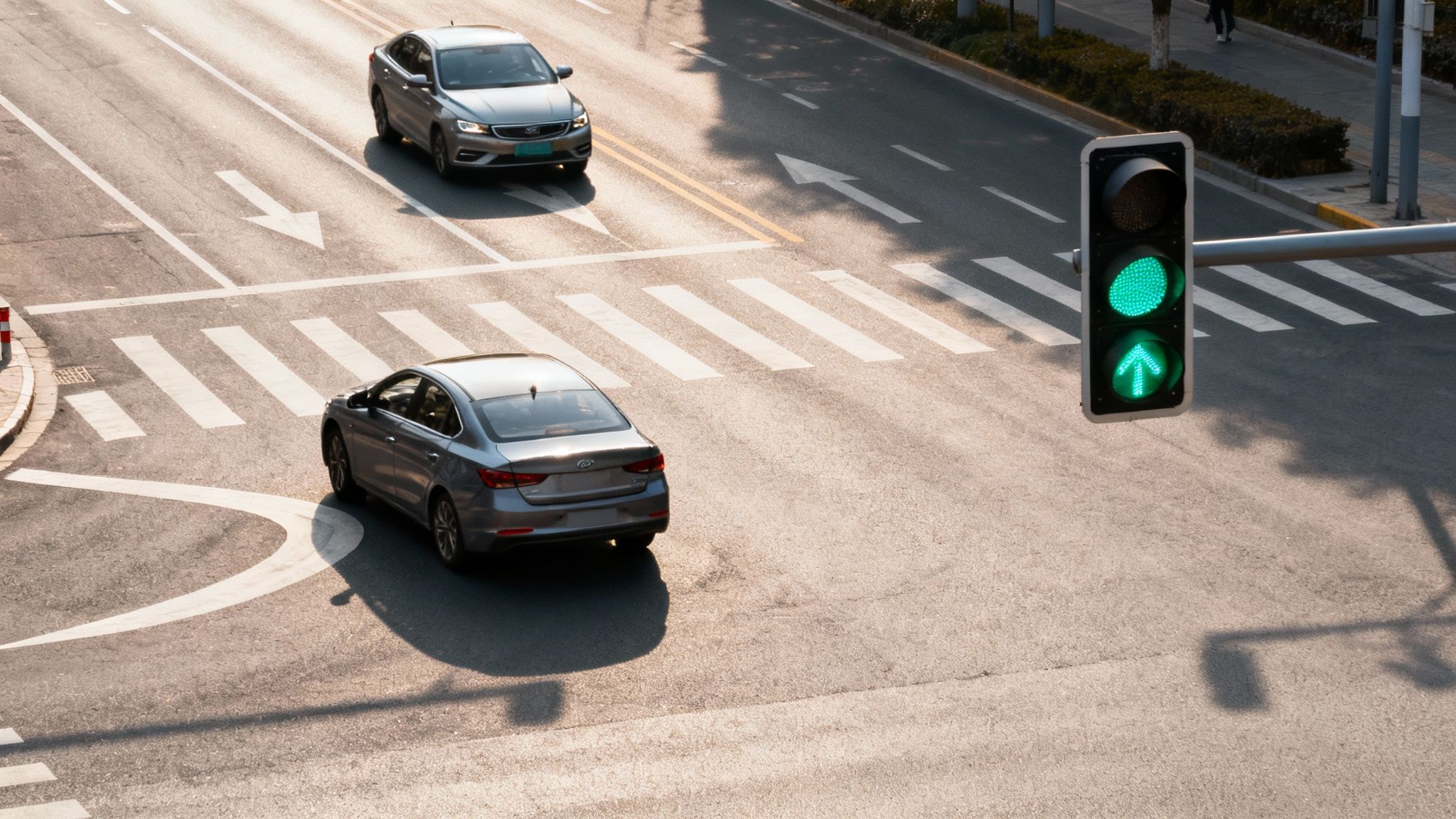
- Green Light: A green light gives you permission to go through the intersection, or turn right or left. But—and this is a big but—you still have to yield to any cars or people already legally in that intersection. It’s not a free-for-all.
- Yellow Light: A yellow light is a warning that the signal is about to turn red. You are not supposed to enter the intersection on a yellow unless you are so close that slamming on the brakes would be more dangerous than proceeding.
- Red Light: This one is simple. A solid red light means you stop. Period. You stop before the crosswalk or the painted line and you stay stopped until that light turns green.
Running a red light is one of the clearest traffic violations there is. If a driver blows through a red light and T-bones another car, there’s very little question about who is at fault.
Stop Signs Both Two-Way and Four-Way
Stop signs also spell out clear responsibilities for drivers. In a T-bone crash scenario, the driver who failed to stop or yield is the one who will almost certainly be held liable.
At a two-way stop—where you have a stop sign but the cross-traffic does not—your duty is to yield. You must wait for a safe gap in traffic before you even think about pulling out. Trying to dart out in front of an oncoming car is a direct violation of that duty.
At a four-way stop, the rules are a little more detailed:
- The first car to get to the intersection goes first.
- If two cars arrive at the same time, the driver on the right gets to go.
- A driver turning left has to yield to a driver going straight from the opposite direction.
Ignoring this sequence is a recipe for a T-bone crash.
The Special Danger of Left-Hand Turns
Statistically, making a left-hand turn is one of the riskiest things you can do behind the wheel, and it’s a leading cause of severe T-bone collisions. Pennsylvania law is crystal clear on this.
Under Pennsylvania motor vehicle statutes, a driver intending to turn left must yield the right-of-way to any vehicle approaching from the opposite direction that is close enough to constitute an immediate hazard.
What this means in plain English is that the driver turning left has the entire burden of making sure the coast is clear. Misjudging the speed of an oncoming car isn't an excuse. You have to wait until you can complete that turn safely, without forcing the other driver to slam on their brakes or swerve out of the way.
Because this duty is so strict, the driver making the unprotected left turn is presumed to be at fault in a T-bone wreck. While there are some rare exceptions—like if the oncoming driver was speeding excessively or ran a red light—the starting assumption is that the turning driver messed up. If you were hit in this situation, you can learn more about who is at fault in an intersection accident in Pennsylvania.
Uncontrolled Intersections
You don't see them as often, but uncontrolled intersections—the ones with no signs or signals at all—are just as dangerous. The rule here is simple: when two cars get to the intersection at about the same time, the driver on the left must yield to the driver on the right. This "yield to the right" rule is a fundamental way to prevent crashes where there are no other controls.
How Pennsylvania Comparative Negligence Law Impacts Your Claim
T-bone accidents are almost never clean-cut. While one driver’s mistake, like blowing through a red light, might be the main cause, what the other driver was doing matters, too. So, what happens when both drivers share some of the blame? This is where a critical Pennsylvania legal rule called modified comparative negligence comes into play.
Think of fault in a T-bone crash like a pie. After an accident, the insurance companies or a court will slice up that pie, assigning a percentage of responsibility to each driver based on their actions. Your ability to get paid for your injuries is directly tied to the size of your slice.
This system is designed to be fair. It recognizes that sometimes, an accident isn’t just one person’s fault. But Pennsylvania law draws a very firm line in the sand that determines whether you can collect a single dollar.
The Critical 51 Percent Bar
Under Pennsylvania's rule, you can recover money for your injuries as long as your percentage of fault is not greater than the fault of the other driver. In a two-car wreck, this means you can be found up to 50% responsible for the crash and still get paid.
But here’s the kicker: if you are found to be 51% or more at fault, you are completely barred from recovering anything. That's why it's called the "51% bar." It’s a strict cutoff that can make or break your entire case. One percentage point is the difference between getting a settlement and walking away with nothing.
Key Takeaway: In Pennsylvania, you can be partly at fault for a T-bone accident and still recover money. But if you're found to be even slightly more responsible than the other driver (51% or more), your right to compensation is gone.
This rule makes a thorough investigation absolutely essential. Even if the other driver was obviously negligent, you can bet their legal team will try to pin as much blame as possible on you to push you over that 51% threshold.
How Comparative Negligence Works in Practice
Let’s run through a quick example to see how this plays out in the real world.
Imagine a driver makes an illegal left turn right in front of you, and you T-bone their car. At first glance, they're clearly at fault for failing to yield. But what if you were driving 15 mph over the speed limit when it happened?
In this scenario, a court might divide the fault like this:
- The Left-Turning Driver: 80% at fault for the illegal turn.
- You (The Speeding Driver): 20% at fault because speeding reduced your ability to stop in time.
Let's say your total damages—medical bills, lost wages, and pain and suffering—add up to $100,000. Because you were 20% at fault, your final recovery would be reduced by that amount. You would receive $80,000 ($100,000 minus 20%).
Now, let's change the facts a bit. What if you were not only speeding but also distracted by your phone when the other driver turned? A jury might decide you were 60% at fault. In that case, because your share of the blame is over 50%, you would get $0.
As you can see, every little detail matters. To get a better handle on this, you can dig into a more detailed explanation of what comparative negligence is in Pennsylvania law and how it affects different types of accidents. Understanding this concept is vital to protecting your right to fair compensation after a serious T-bone collision.
Gathering Evidence to Prove Who Was At Fault
A personal injury claim is only as strong as the evidence backing it up. Figuring out who was at fault in a T-bone accident isn't a guessing game; it's a careful process of piecing together the facts to prove negligence. Simply saying "the other driver ran a red light" is a start, but it's not enough. You have to prove it.
This means gathering all kinds of information that, when put together, tells the real story of the collision. From the official police report to the high-tech data inside the cars themselves, every piece helps build a solid case.
The Foundational Pieces of Evidence
Right after a crash, the most important evidence is usually right there at the scene. This is the raw material that lawyers and experts will use to get a clear picture of what happened and build the framework for the entire investigation.
Here are the key items that need to be locked down:
- The Official Police Report: This document is the starting point. It includes the responding officer's initial thoughts, a sketch of the crash scene, contact info for drivers and witnesses, and any tickets that were issued. While it's not the final word on fault, it's a vital first piece of the puzzle.
- Witness Statements: Independent witnesses are gold. Their unbiased accounts can confirm who really had the right-of-way, describe what each driver was doing, and often break a "he said, she said" stalemate.
- Photos and Videos: Nothing tells a story like a picture. Photos of the vehicle damage, where the cars ended up, skid marks on the pavement, and the intersection itself can provide powerful, undeniable proof of how the crash went down.
Securing this initial evidence is just step one. To see how these pieces fit into a winning legal strategy, take a look at our detailed guide on what evidence you need to win a Pennsylvania car accident claim.
Digging Deeper with Expert Analysis
When the basic evidence is messy or the other driver is fighting the claim, the investigation has to go to the next level. This is where science and technology step in to provide objective, data-driven answers that are tough to argue with.
Two of the most powerful tools we use in serious T-bone cases are accident reconstruction and Event Data Recorders (EDRs).
An accident reconstruction expert is like a forensic detective for car crashes. These specialists, who usually have backgrounds in engineering and physics, go to the scene, analyze the vehicle damage, and use sophisticated software to recreate the crash, second by second. They can figure out:
- How fast the vehicles were going at impact
- The exact angle of the collision
- If a driver hit the brakes or the gas right before the crash
- Which car actually entered the intersection first
This kind of scientific breakdown can definitively prove a driver was speeding or blew a stop sign, turning a disputed claim into a clear-cut case of liability.
An Event Data Recorder (EDR) is another game-changer. Think of it as your car's "black box." In the critical moments before and during a collision, the EDR is busy recording key data points. This is unbiased, digital evidence that tells us exactly what the car was doing.
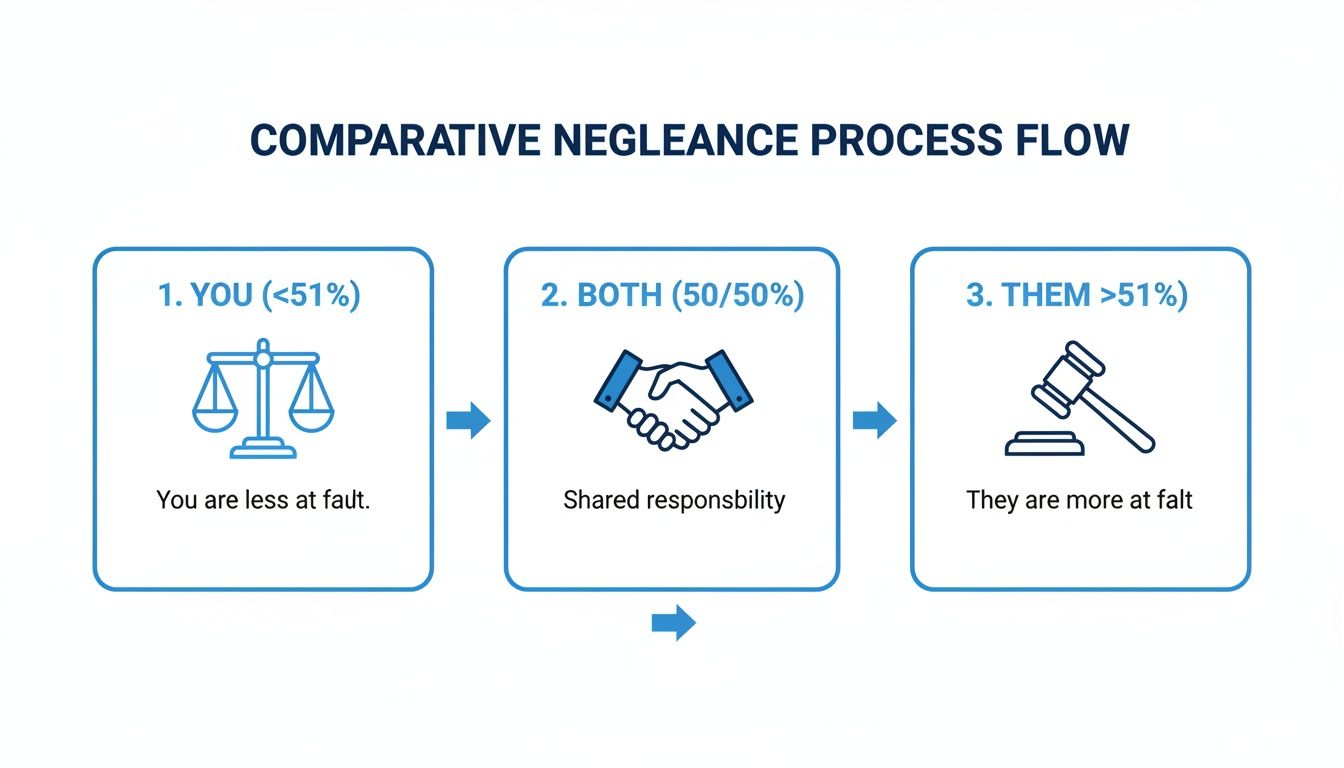
This chart breaks down Pennsylvania's 51% bar rule. If you are found to be 51% or more at fault for the accident, you are barred from recovering any money at all.
The Role of Legal and Technical Data
Beyond the physical evidence from the scene, a strong case has to be built on a solid legal foundation. This means digging into the specific traffic laws, past court decisions (known as precedents), and even local rules that apply to the intersection where the T-bone accident happened.
Putting together a winning case requires knowing the legal landscape just as well as the physical evidence. For a closer look at how the pros build their arguments from the ground up, check out this practical guide to legal research. At the end of the day, combining strong physical proof with solid legal work is the key to proving fault and getting the compensation you deserve.
What Can You Recover in a T-Bone Crash Claim?
Once we’ve established who was at fault for the T-bone accident, the conversation shifts to what you’ve lost—and what it takes to make things right. In legal terms, the money you can recover is called damages. It’s not just about paying off a few bills; it’s about compensating you for every single way the crash has impacted your life.
A lot of people mistakenly think a claim only covers the ER visit and the car repairs. But in reality, the law allows you to seek compensation for the full ripple effect of a serious collision. In Pennsylvania, these damages are broken down into two main buckets: economic and non-economic.
The Tangible Costs: Economic Damages
Economic damages are the straightforward, black-and-white financial losses you can prove with receipts, invoices, and pay stubs. These are the numbers we can add up, but it's critical to think about both the costs you have today and the ones you’ll face down the road.
Think of these as the direct, out-of-pocket expenses from the accident:
- Medical Treatment: This covers everything from the ambulance ride and hospital stay to surgeries, physical therapy, follow-up appointments, and prescriptions.
- Future Medical Needs: A serious injury doesn’t just go away. You may need future surgeries, ongoing rehabilitation, a wheelchair or other assistive devices, or even in-home nursing care for the rest of your life.
- Lost Wages: If you were out of work while recovering, you’re entitled to the income you missed out on. Simple as that.
- Loss of Future Earning Capacity: This is a big one. If the crash left you with a permanent disability that keeps you from returning to your old job—or from working at all—you can be compensated for the wages you would have earned over your entire career.
These damages are the financial foundation of your case. They ensure you aren't buried in debt because of someone else’s mistake at an intersection.
The Human Costs: Non-Economic Damages
Non-economic damages are just as real as the medical bills, but they are much harder to put a price tag on. This is compensation for the human toll of the crash—the pain, the trauma, and the life changes that don’t come with an itemized bill.
This category is meant to compensate you for things like:
- Pain and Suffering: The real, physical pain and agony your injuries have caused.
- Emotional Distress: The anxiety, depression, fear, and PTSD that often haunt people after a violent crash.
- Loss of Enjoyment of Life: This covers the inability to do the things you once loved, whether it’s playing with your kids, gardening, or going for a run.
- Disfigurement and Scarring: For permanent physical changes that impact your appearance and confidence.
Under Pennsylvania law, victims of T-bone accidents can pursue compensation for the full scope of their harm, including medical bills, lost wages, pain and suffering, and property damage. Thankfully, the state does not impose caps on these damages in most injury cases. You can learn more about Pennsylvania's approach to traffic safety and victim rights from official state resources.
Because there are no caps, it is absolutely essential to document every single way this accident has turned your world upside down. Every loss, whether it’s a receipt from the pharmacy or a journal entry about a sleepless night, helps build a stronger case for the full and fair compensation you deserve.
Why You Must Contact a Car Accident Lawyer Immediately
After a T-bone accident, you’re suddenly thrown into a world of physical pain, emotional shock, and medical bills that just keep showing up. The last thing you have the energy for is a complicated legal fight. This is the moment when an experienced car accident attorney becomes your most important call.
Waiting to get legal help is one of the biggest mistakes you can make. Pennsylvania has a strict deadline for filing a personal injury lawsuit, called the statute of limitations. In most cases, you have just two years from the date of the crash to file. That might sound like a long time, but crucial evidence can disappear in a matter of days.
Protecting Evidence Before It Vanishes
Your attorney needs to act fast to preserve the evidence that will prove your case. It’s a race against the clock. Things like security camera footage from a nearby gas station or convenience store are often taped over on a weekly, or even daily, loop. And as time passes, witnesses’ memories get fuzzy.
A good lawyer will immediately take these critical steps:
- Send Preservation Letters: These are legal demands telling trucking companies, businesses, and even the other driver to save essential evidence like dashcam videos and the car’s “black box” data (EDR).
- Canvass for Witnesses: We find and interview anyone who saw the crash before the details start to fade.
- Secure Official Records: This means getting the police report, 911 call logs, and other official documents that serve as the foundation of your claim.
Getting a jump on this ensures the facts are locked down while they're still fresh and available, putting you in a much stronger position right from the start.
Dealing with the Insurance Company
It won’t be long before you get a call from the other driver’s insurance adjuster. It is vital to understand their job isn't to help you—it's to protect their company's profits by paying you as little as possible. These are highly trained negotiators who know exactly how to use your own words against you to downplay your injuries or even deny your claim entirely.
An insurance adjuster may sound friendly and concerned, but their goal is to get a recorded statement where you might accidentally say something that hurts your case, like admitting partial fault or saying "I'm fine" when you're not. Once you hire a lawyer, all communication goes through them, shielding you from these tactics.
Your attorney takes over all the phone calls, handles the mountain of complicated paperwork, and negotiates for you. We build a powerful, evidence-based case that shows exactly who was at fault and the true extent of your damages. This lets you focus on what really matters: your recovery.
Don't face this fight alone. Contact Mattiacci Law for a free consultation to make sure your rights are protected.
Got Questions About Your T-Bone Accident? We've Got Answers.
Even when you think you know the rules of the road, a real-life T-bone crash can get confusing fast. Here are some straightforward answers to the questions we hear most often after a side-impact collision in Pennsylvania.
What Happens If We Both Swear We Had the Green Light?
This is the classic "he said, she said" scenario, and it’s way more common than you'd think. When stories clash, the case comes down to one thing: independent evidence. Guesswork doesn't cut it.
An attorney's first move is to hunt down traffic camera footage from the intersection. We'll also canvas nearby businesses to see if their security cameras caught the crash. You'd be surprised what a camera on a storefront or gas station can see.
We also immediately look for third-party witnesses who saw what happened and can give an unbiased story. If there's still a dispute, we bring in the experts. An accident reconstructionist can analyze the vehicle damage, skid marks, and debris patterns to figure out what really went down. They can even pull data from the cars' "black boxes" (EDRs) to determine speeds and impact forces, which often proves who had the right-of-way.
Can I Still Have a Case If the Police Report Says I’m at Fault?
Yes, absolutely. A police report is just the officer's initial opinion based on what they saw and heard at the scene. It is not the final word, and it’s not legally binding in court. Officers are human—they can make mistakes, miss key evidence, or get the facts wrong in the chaos of a crash scene.
Under Pennsylvania’s comparative negligence rule, you can still get compensation as long as you are 50% or less at fault. A good lawyer won't just take the police report at face value. We'll launch our own independent investigation to find the evidence that tells the true story and proves the other driver was the one who was mainly responsible.
How Does My Full Tort or Limited Tort Choice Affect My Claim?
This is a huge deal in Pennsylvania. The "tort" option you picked on your car insurance policy can make or break your case.
If you chose Limited Tort, you probably saved a few bucks on your premiums. The trade-off is that you've given up your right to get money for pain and suffering unless your injury is considered legally "serious." This can slash the value of your claim, even if the crash wasn't your fault.
If you chose Full Tort, you kept your full legal rights. You can sue for all your damages, including pain and suffering, without having to jump through extra hoops. The financial difference between these two options can be massive. It's critical to have an attorney review your policy to see exactly what you're entitled to and whether any exceptions to Limited Tort might apply in your case.
Trying to figure out the next steps after a T-bone accident is overwhelming, but you don’t have to do it alone. The legal team at Mattiacci Law is here to investigate your crash, protect your rights, and fight for every dollar you deserve. Contact us for a free, no-strings-attached consultation to go over your case by visiting https://jminjurylawyer.com.